
Can Fairness Fix the US Economy?
With its latest lawsuit, the Federal Trade Commission aims to find out.
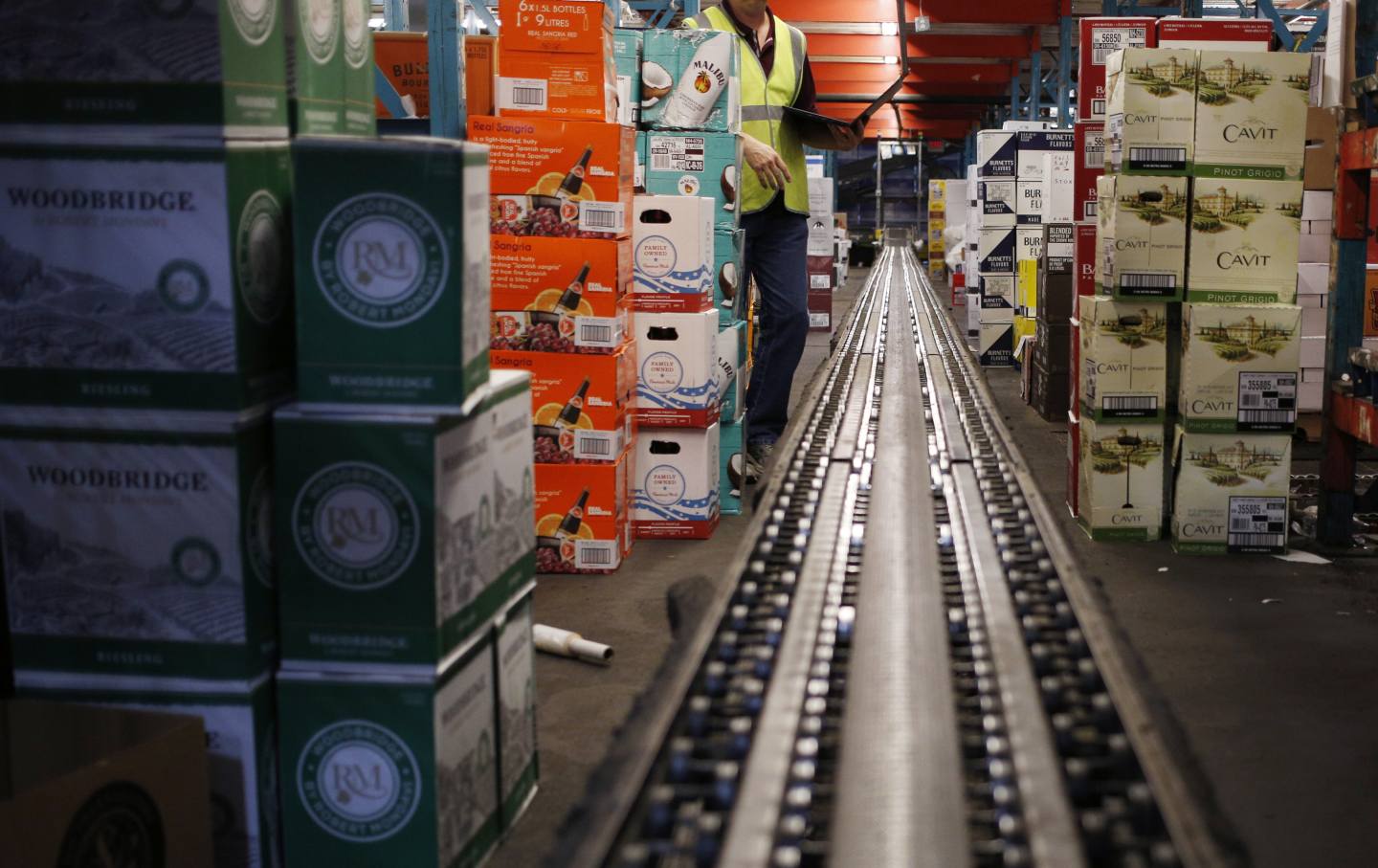
Last month, the FTC revived a long-dormant anti-monopoly law to take on the nation’s largest wine and spirits distributor. The lawsuit accuses Southern Glazer’s Wine and Spirits, a wholesale liquor giant, of cutting sweetheart deals for big chain stores while gouging small grocers, corner stores, and independent liquor shops with higher prices.
On its face, the case could restore much-needed competition to the retail liquor industry. But it’s also about something far bigger: the FTC’s attempt to restore a fundamental principle of fairness to our economy. For decades, big retailers have been allowed to dominate simply by virtue of their size, exploiting their power to strong-arm suppliers and crush smaller competitors. By reviving the Robinson-Patman Act, the FTC is signaling a bold move to undo the damage—to level the playing field, protect small businesses, and ensure that economic power isn’t concentrated in the hands of a few dominant players.
Few people have heard of the Robinson-Patman Act, a New Deal–era law that bans price discrimination, which occurs when manufacturers sell the same product to retailers at different prices—often under pressure from retail behemoths. But the FTC’s decision to stop enforcing it decades ago triggered a seismic shift in America. It gave massive chains like Walmart free rein to squeeze suppliers for unfair discounts. Walmart’s expansion went unchecked; manufacturers consolidated and shuttered factories; jobs vanished; and thousands of small businesses folded, leaving hollowed-out Main Streets and food deserts in their wake. Outside of the collapse of US manufacturing, few economic forces have done as much damage to the American landscape in the past 50 years.
Kick-starting renewed enforcement of Robinson-Patman will mean not just survival but opportunity and growth for independent stores everywhere. More competition will mean lower prices, more shelf space for cool new products, and newfound wealth in towns and cities alike. Fairness as a regulatory guiding light will mean a better deal for everyone.
The FTC’s attack on this kind of corporate unfairness seems novel because, in the frame of recent history, it is. The Robinson-Patman Act was passed in 1936—just as chain grocers Kroger and the Great Atlantic & Pacific Tea Company, known as A&P, were rapidly spreading nationwide and using their newfound size and power to bully manufacturers and farmers into selling to them at unsustainably low prices. The law, as Congress explained in passing it, would ensure economic democracy and fairness by giving small businesses the same deals and opportunities as the chains.
The FTC enforced the law intently for decades, until the Reagan administration smothered it along with most other antitrust enforcement. The law had helped to foster an open, diverse retail economy; even in the early 1980s, small, independent grocers accounted for more than half of all grocery sales, and thrived alongside big chain stores in communities around the country.
But by the dawn of the Reagan era, the law had become a punching bag for a wave of policymakers who replaced fairness with an economic philosophy that championed corporate bigness and shareholder wealth, and cast aside most attempts to set limits.
From those policy decisions rose Walmart, free to bully with impunity, setting off a chain reaction of consolidation across food retail. Walmart’s rise triggered a wave of supermarket mega-mergers; today, the industry is nearly 500 percent more concentrated than it was in 1990. Tired of getting bullied by Walmart and the mega-chains, consumer goods companies began buying one another as well. Five of the largest consumer goods companies alone—Unilever, Procter & Gamble, Nestlé, ConAgra, and PepsiCo—have bought more than 150 other branded goods companies since the 1990s, creating massive multi-product conglomerates that dominate the shelves at major retailers. Every big supplier and mega-store realized they could get away with this kind of corporate bullying, too—including, the FTC now alleges, the country’s biggest liquor supplier.
The case against Southern details what corporate unfairness looks like in practice. Southern is by far the largest wine and spirits distributor in the country. It sells liquor coast to coast, accounting for one of every three bottles of wine or spirits sold in America. In many states, It holds the exclusive rights to must-have brands—labels like Patron, Jim Beam, Jameson, Josh Cellars, and others—giving stores no choice but to deal with Southern.
Southern has struck deals nationally with some of the industry’s biggest chain retailers, from massive specialty stores like Total Wine and Binny’s to supermarket mega-chains Kroger and Albertsons, to big-box retailers Walmart and Costco. The FTC claims that Southern sells crates of wine and liquor to big chains for drastically less per bottle than it does to smaller, independent shops, putting small stores at a deep disadvantage. As the FTC says in the suit, “Southern’s pricing practices are paradigmatic violations” of the pricing fairness law.
The heavily redacted lawsuit is sparse on public details. But the experience of small liquor stores seems to back the agency’s claims against Southern.
James Dempsey spends many thousands of dollars each week keeping the shelves of Wagon Wheel Liquors in Durango, Colorado, stocked. Dempsey couldn’t stock brands like Captain Morgan, Bacardi, Josh Cellars, and other must-have brands without buying from Southern, their exclusive distributor in Colorado and most of the country.
But when he buys spirits and wine from Southern, he can’t get the same prices as the big stores around him—stores like the Kroger-owned supermarket chain City Market—no matter how much he buys. In some cases, Dempsey would have to buy dozens of cases to get the same price the bigger chains pay for just one.
All Dempsey wants is a fair shot.
“I just want it to be fair, right?” Dempsey says. “I want the same price for the same case. I shouldn’t have to buy 65 cases in order to get that same price.”
Small stores like Wagon Wheel would benefit from an enforced ban on price discrimination. Shoppers would too. In states with alcohol-specific price discrimination laws on the books, prices at both chain stores and independent shops were both low and very nearly uniform, with only a marginal difference between chains and the mom-and-pops, a recent study found. Independent stores charge folks less when they aren’t being bullied by their suppliers or forced out of business by rampant price discrimination, and prices are lower overall. Fairness, it turns out, benefits everyone.
The call for economic fairness has been growing louder, and politicians are paying attention. In early 2022, 43 members of Congress—Republican and Democrat alike—called on the FTC to revive Robinson-Patman, and made clear that the corporate bullying small retailers were facing was happening “as a result of concentration throughout the supply chain.” Then, in September of that year, FTC commissioner Alvaro Bedoya told an audience at an event in Minneapolis that enforcing Robinson-Patman was key to restoring fairness as a goal of the antitrust laws.
The benefits of antitrust enforcement guided by fairness were widespread. Enforcing those laws meant neighborhood centers were filled with shops born from, and accountable to, their communities. Farmers made decent livings and passed their businesses from one generation to the next. Workers found livable wages, and rivalry between chains and smaller stores kept prices low.
Popular
“swipe left below to view more authors”Swipe →Bedoya called on his agency to renew its pursuit of fairness everywhere. “Certain laws that were clearly passed under what you could call a fairness mandate—laws like Robinson-Patman—directly spell out specific legal prohibitions,” he said. “Congress’s intent in those laws is clear. We should enforce them.”
In suing Southern Glazer’s under Robinson-Patman, the agency has done just that. Although this case may be FTC chair Lina Khan’s closing act as head of the agency, there’s a better-than-decent chance the incoming administration won’t change course. While FTC member and soon-to-be chair Andrew Ferguson and fellow Republican Melissa Holyoak dissented against the case, incoming FTC nominee Mark Meador has long supported enforcement of the price discrimination law. His support, along with the backing of Bedoya and Democratic member Rebecca Kelly Slaughter, means that the Southern case may have the three (of five) votes needed to keep it alive and see trial.
Even Ferguson, in his pointed dissent, suggests that he’d support such cases if the company being sued were bigger and more powerful. The Walmarts and Amazons of the world should beware—the restoration of fairness to the economy may well march on.
Support independent journalism that does not fall in line
Even before February 28, the reasons for Donald Trump’s imploding approval rating were abundantly clear: untrammeled corruption and personal enrichment to the tune of billions of dollars during an affordability crisis, a foreign policy guided only by his own derelict sense of morality, and the deployment of a murderous campaign of occupation, detention, and deportation on American streets.
Now an undeclared, unauthorized, unpopular, and unconstitutional war of aggression against Iran has spread like wildfire through the region and into Europe. A new “forever war”—with an ever-increasing likelihood of American troops on the ground—may very well be upon us.
As we’ve seen over and over, this administration uses lies, misdirection, and attempts to flood the zone to justify its abuses of power at home and abroad. Just as Trump, Marco Rubio, and Pete Hegseth offer erratic and contradictory rationales for the attacks on Iran, the administration is also spreading the lie that the upcoming midterm elections are under threat from noncitizens on voter rolls. When these lies go unchecked, they become the basis for further authoritarian encroachment and war.
In these dark times, independent journalism is uniquely able to uncover the falsehoods that threaten our republic—and civilians around the world—and shine a bright light on the truth.
The Nation’s experienced team of writers, editors, and fact-checkers understands the scale of what we’re up against and the urgency with which we have to act. That’s why we’re publishing critical reporting and analysis of the war on Iran, ICE violence at home, new forms of voter suppression emerging in the courts, and much more.
But this journalism is possible only with your support.
This March, The Nation needs to raise $50,000 to ensure that we have the resources for reporting and analysis that sets the record straight and empowers people of conscience to organize. Will you donate today?
More from The Nation

Larry Summers, We Knew Ye Too Well Larry Summers, We Knew Ye Too Well
The former Harvard president and Treasury secretary has resigned over humiliating disclosures in the Epstein files. But will that be enough to keep an ardent neoliberal down?

Binance’s MAGA-Branding Strategy Binance’s MAGA-Branding Strategy
The world’s largest crypto exchange often operates beyond the reach of the law. Now it’s helping to enrich the Trump family.

How Brothel Workers in Nevada Just Made Labor History How Brothel Workers in Nevada Just Made Labor History
The courtesans at Sheri’s Ranch were staring down a horrifying new contract. So they did what workers everywhere do: They got organized.
Don’t Let Trump Fool You. The Economy Is Bad, and He Is to Blame. Don’t Let Trump Fool You. The Economy Is Bad, and He Is to Blame.
The Trump administration’s efforts to distract from the bad economy just divert attention from one dumpster fire to another.

Why Elon Musk’s Latest Mega Merger Is Little More than Vaporware Why Elon Musk’s Latest Mega Merger Is Little More than Vaporware
The tech mogul and would-be space pioneer is mashing up his properties once more in a deal that's unlikely to achieve escape velocity .
The Farmland Revolt The Farmland Revolt
America’s farmers are fuming over Trump’s tariffs. Democrats need to channel their anger.

