
Millions of Workers Are Due More Overtime Pay. Will They Get It?
New regulations are designed to expand the number of employees entitled to overtime. But the conservative courts have other ideas.
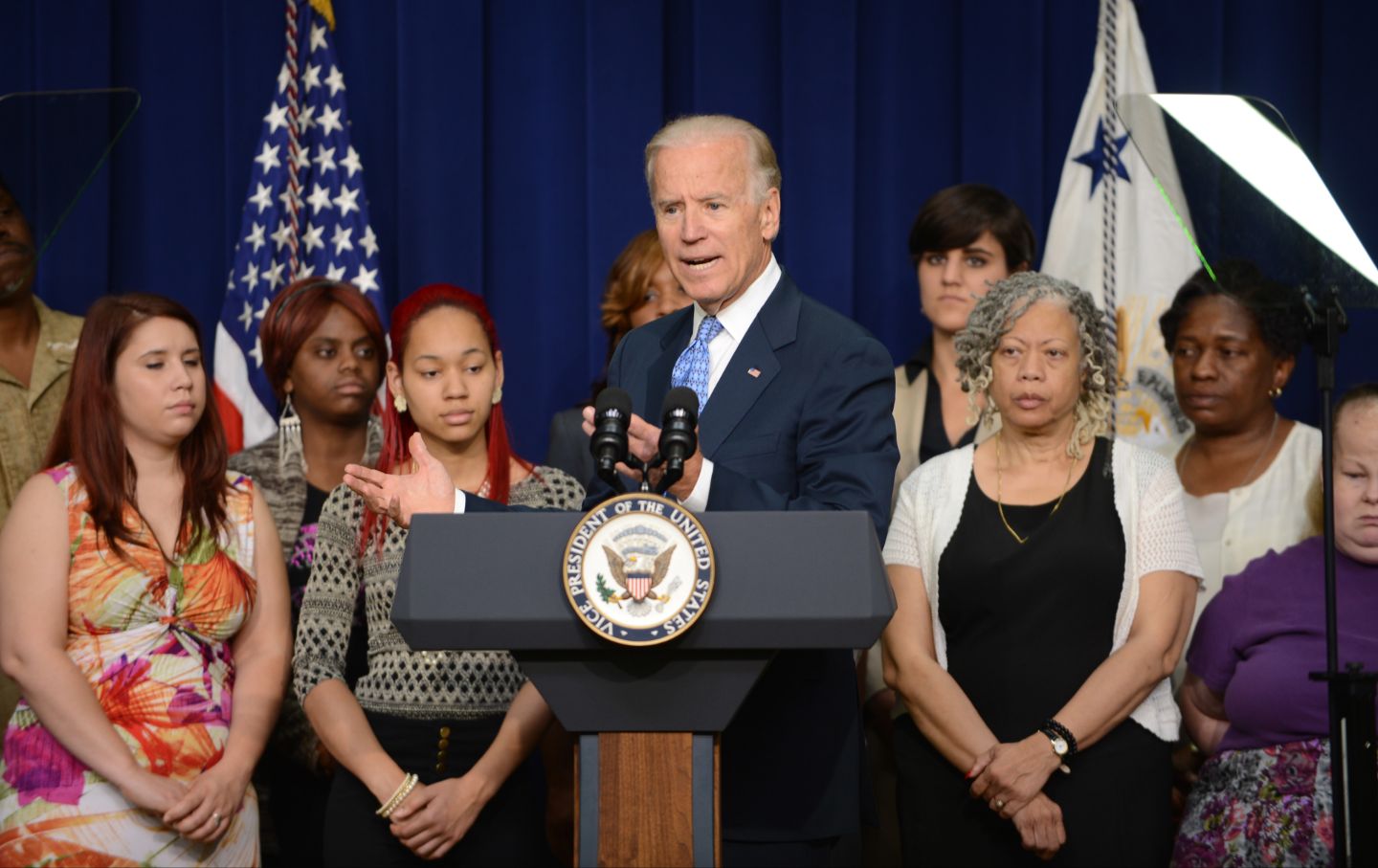
Then–Vice President Joe Biden delivers remarks at the White House on the 75th anniversary of the Fair Labor Standards Act.
(Christy Bowe / ImageCatcher News Service / Corbis via Getty Images)Zach Barber had known for years that he could easily find a better job. Despite his working full-time, money could be scarce. Once, with his bank account at zero, he was left eating nothing but canned food.
But he believed in his environmental nonprofit’s model and wanted to see it succeed, so he continued to put in long hours—sometimes over 50 a week—as an organizer. For this, he received no overtime pay at all, let alone time and a half.
That might change, though, thanks to new overtime rules from the Department of Labor. Until recently, if you were an “executive, administrative, or professional” employee making more than $35,568 per year, your employer could declare you exempt from the Fair Labor Standards Act and expect you to work extra hours for no extra money. As of July 1, 2024, that cutoff is now $43,888 per year, with plans to raise it substantially higher—to $58,656 per year—by the beginning of 2025, meaning that millions of workers should soon be newly guaranteed overtime pay. However, as Barber learned, people are still falling through the cracks.
Just days before the new regulations went into effect, Barber’s boss called him and let him know that he would be getting a raise to just over the new threshold. This should have been great news. But there was a catch: They’d be increasing his health insurance contribution by that exact sum. Barber is hoping that the January update could result in a more meaningful change to his working conditions, but at this point he knows not to take anything for granted. President Obama also attempted to boost the overtime threshold by a significant amount—an effort that stalled in court and was nixed by the incoming Trump administration. Biden’s effort faces similar threats.
Over the past 50 years, inflation has eroded the proportion of salaried workers who are guaranteed overtime pay down to nearly nothing. So few salaried workers are now protected by the FLSA’s overtime rules that many now falsely believe that if you’re paid on a salary basis at all, overtime is out of the question. The new, higher overtime thresholds could help reverse those damages—if they’re allowed to stand, and if they’re enforced.
When the FLSA debuted in 1940, it focused on the blue-collar workers who then dominated the US workforce. In order to exempt a worker from overtime, your boss would have to prove that you qualified as an executive, administrative, or professional (EAP) employee under the FLSA’s guidelines—and that you were paid a salary over its threshold. White-collar jobs sometimes fell under this exemption, but the system still wound up catching most people. Back in 1975, 63 percent of full-time salaried workers made wages low enough to automatically qualify for overtime pay.
But the salary threshold was not tied to the rate of inflation, and the government didn’t update it for nearly 30 years. By 2003, the proportion of protected workers had plummeted to 3 percent. When the Bush administration finally raised the threshold slightly the following year, it also expanded the use of a weaker “duties test,” making it easier to classify workers as EAP even when they spend most of their time doing blue-collar work. Twenty years later, the consequences would be almost comical, if they weren’t economically devastating: One study found companies liberally doling out absurd titles like “Carpet Shampoo Manager” and “Assistant Bingo Manager” to workers. Their “executive” duties exempted them from any right to overtime.
Instead of fighting to bring back a more rigorous duties test, the Department of Labor chose the “brighter line” of raising the salary threshold, said Heidi Shierholz, the Economic Policy Institute’s president. Before the July bump, only 8.5 percent of salaried workers fell under the threshold. By January, that proportion could rise to 30 percent—covering plenty of those assistant bingo managers—and the threshold will update every three years, rising in tandem with wage data.
In the short term, the benefits are clear. If your employer decides to “bump you up to the new salary threshold, then you get that wage increase,” Shierholz explained. If not—if you remain below the cutoff— “then now you’re in the world where your employer has skin in the game when they ask you to work a gajillion hours,” since that extra labor will no longer be free. “You either get more money,” she said, “or you get your time back.”
This isn’t the first time a Democratic administration has attempted to update the salary levels—or even the first time it’s happened under threat from court challenges and an impending Trump presidency. Zach Barber started his current job in the fall of 2016, shortly after an Obama-era increase to the threshold. His new employer was one of the few nonprofits who took a public stand against it. (If people can’t choose to work at a nonprofit for crappy wages, the Public Interest Network’s leaders argued, do they really even have freedom of speech?)
Then a Texas judge struck down the regulations in a ruling that implicitly questioned the Department of Labor’s authority to establish any salary threshold at all. Shierholz, who was chief economist at the time, didn’t mince words when describing the judge’s reasoning: “Absolutely bonkers.” Judy Conti, the National Employment Law Project’s government affairs director, went into slightly more detail: “It defied all of the standing law and logic.”
Even the incoming Trump administration continued to appeal the judge’s ruling, but the whole thing was rendered moot after the new Department of Labor issued its own, more miserly increase to the salary level, one that still stands today. In the years since, the legal landscape has also changed, as the Supreme Court has repeatedly undermined agencies’ ability to make regulations—particularly regulations that could have a big economic impact. Back in 2016, the EPI lobbied for a raise to the salary threshold because of its potential to improve so many American workers’ lives. Today, Shierholz said, the institute is much more cautious.
“Our public comments this time around were 10,000 very rigorous, empirical analyses about how this was a nothing-burger,” she said. “It’s gonna really matter to the people who get protections, but that’s a very small share of the workforce.” Shierholz has spotted a similar reticence from the Department of Labor itself: Any communication that inflates the economic impact of the new regulations also makes them far more vulnerable to legal attacks.
Those attacks have come anyway—in Texas, a judge has frozen implementation for state employees—but a president who really wanted to, Shierholz said, should still be able to defend the rules. Under a radicalized judiciary and in an election year, that may be little comfort.
As the federal government has floundered through legal tangles, other states have already taken it upon themselves to institute stronger overtime protections, providing a sneak peek at the potential quagmires associated with implementation. New York released higher salary thresholds at the beginning of this year: If you’re an administrative or executive worker making less than $62,400 in New York City and its environs or $58,458 in the rest of the state, you should be now paid overtime as a matter of course.
That could be great news, but few people have heard about it. A quick Google search produces a string of blogs targeting HR professionals and scant news coverage directed at a broader audience. April Glick Pulito works for the advocacy group Citizen Action of New York, but even she didn’t know about the updates until relatively recently. Since finding out that low-paid salaried workers are guaranteed overtime, though, she sees violations everywhere—on her “soapbox” so often, she said, that friends will ask her to inspect suspicious job listings.
Popular
“swipe left below to view more authors”Swipe →Those kinds of listings are far from difficult to find. A quick look through Indeed this summer found a number of organizations openly advertising overtime-exempt positions paying below the state threshold. In New York City, a career coach job paying a starting wage of $55,000 was described as “exempt” (the organization corrected the listing after The Nation asked them about it). Elsewhere in the city, a senior center was looking to pay an “exempt” director as little as $54,000 (the center did not respond to a request for comment); an after-school program planned to pay their “exempt” director $55,000 (another error, according to the program). An arts nonprofit was offering $58,500 for an “exempt” comms manager (and didn’t respond to request for comment), and the Catholic Archdiocese of New York was hiring a youth outreach leader, “not eligible for overtime” and starting at $60,000 (that salary was incorrect, the archdiocese said, and corrected it.)
A month after Biden’s new federal threshold launched, job listings on a national level were strewn with similar errors, reflecting employers’ confusion around the new regulations—or their lack of interest in paying their workers what they’re owed. In mid-July, for example, even the State of Oklahoma was looking to hire a new employee for $42,000 per year, no overtime, although the listing has since been removed. And plenty of job posts don’t mention overtime eligibility at all, making it all but impossible to determine whether they could be in violation.
The new regulations stand to have the most significant impact on industries where small budgets and long hours are the norm. Nonprofit workers can be especially vulnerable. At Citizen Action of New York, whose team recently won a union contract, Glick Pulito said she’s paid fairly and is able to take extra time off when she works more than usual. But that hasn’t always been the case. At her first campaign job, running the voter protection hotline for Biden’s Wisconsin operation, she was so thrilled to be there that she remembers putting in 90 hours a week. “The best staffers are the ones who believe,” she said. Working all those hours demonstrated her commitment, and after a decade spent waiting tables, it launched her into a field of work that changed her life.
But the culture of overwork was far from sustainable. Among her fellow workers on past campaigns, she guessed that “at least half will never work in politics again.” That first job, which paid her $4,500 a month for her frenetic efforts, would look very different if the Wisconsin Democratic Party had hired her in 2025: Thanks to Biden’s own efforts in office, she’d either be paid a higher salary or be guaranteed time-and-a-half. Or should be—assuming her employer followed the law. “Being enthusiastic, feeling the stakes of the moment, wanting to prove yourself,” she said, “all of these things make you very susceptible to being taken advantage of.”
“If you should be getting overtime, and you’re not, that is wage theft,” Judy Conti said. “But it’s hard for workers to discern when they are misclassified.” And after years of underfunding, there are only so many investigations regulators can take on. “You can’t get blood from a turnip,” Conti quipped. “And that is part of the point of people fighting to defund these agencies, right? It guts their ability to hold corporate America employers accountable for their violations.”
A low-wage worker wouldn’t generally be able to afford an attorney except on a contingency basis, Conti said. And an attorney can usually only take a case on a contingency basis if it reflects the claims, and potential winnings, of a large number of cheated workers.
Same goes for the feds: They’ll usually only take your case as part of a collective action. The best way to get the fair wage to which you’re legally entitled, Conti said, “is to be part of a union”—or, barring that, to reach out to a community organization or worker center.
Although the nonprofit where Zach Barber works unionized back in 2021, contract negotiations remained stalled for years. That doesn’t mean organizing didn’t come with benefits, such as legal protections for workers like Barber who choose to speak out about unfair labor practices.
If you find out that you’re not being paid the overtime you deserve, “the first person you should talk to should be a colleague,” Glick Pulito said. “Say, ‘Hey, they’re doing this to me. Are they doing this to you?’ And the minute that they say, ‘Oh, my God, they are doing that to me too,’ then there you go. You have something to work from.”
Support independent journalism that does not fall in line
Even before February 28, the reasons for Donald Trump’s imploding approval rating were abundantly clear: untrammeled corruption and personal enrichment to the tune of billions of dollars during an affordability crisis, a foreign policy guided only by his own derelict sense of morality, and the deployment of a murderous campaign of occupation, detention, and deportation on American streets.
Now an undeclared, unauthorized, unpopular, and unconstitutional war of aggression against Iran has spread like wildfire through the region and into Europe. A new “forever war”—with an ever-increasing likelihood of American troops on the ground—may very well be upon us.
As we’ve seen over and over, this administration uses lies, misdirection, and attempts to flood the zone to justify its abuses of power at home and abroad. Just as Trump, Marco Rubio, and Pete Hegseth offer erratic and contradictory rationales for the attacks on Iran, the administration is also spreading the lie that the upcoming midterm elections are under threat from noncitizens on voter rolls. When these lies go unchecked, they become the basis for further authoritarian encroachment and war.
In these dark times, independent journalism is uniquely able to uncover the falsehoods that threaten our republic—and civilians around the world—and shine a bright light on the truth.
The Nation’s experienced team of writers, editors, and fact-checkers understands the scale of what we’re up against and the urgency with which we have to act. That’s why we’re publishing critical reporting and analysis of the war on Iran, ICE violence at home, new forms of voter suppression emerging in the courts, and much more.
But this journalism is possible only with your support.
This March, The Nation needs to raise $50,000 to ensure that we have the resources for reporting and analysis that sets the record straight and empowers people of conscience to organize. Will you donate today?
More from The Nation
Larry Summers, We Knew Ye Too Well Larry Summers, We Knew Ye Too Well
The former Harvard president and Treasury secretary has resigned over humiliating disclosures in the Epstein files. But will that be enough to keep an ardent neoliberal down?

Binance’s MAGA-Branding Strategy Binance’s MAGA-Branding Strategy
The world’s largest crypto exchange often operates beyond the reach of the law. Now it’s helping to enrich the Trump family.

How Brothel Workers in Nevada Just Made Labor History How Brothel Workers in Nevada Just Made Labor History
The courtesans at Sheri’s Ranch were staring down a horrifying new contract. So they did what workers everywhere do: They got organized.
Don’t Let Trump Fool You. The Economy Is Bad, and He Is to Blame. Don’t Let Trump Fool You. The Economy Is Bad, and He Is to Blame.
The Trump administration’s efforts to distract from the bad economy just divert attention from one dumpster fire to another.

Why Elon Musk’s Latest Mega Merger Is Little More than Vaporware Why Elon Musk’s Latest Mega Merger Is Little More than Vaporware
The tech mogul and would-be space pioneer is mashing up his properties once more in a deal that's unlikely to achieve escape velocity .

The Farmland Revolt The Farmland Revolt
America’s farmers are fuming over Trump’s tariffs. Democrats need to channel their anger.

