
Gina Raimondo Would Be a Terrible Choice for Treasury Secretary
The commerce secretary is rumored to be the front-runner to head the Treasury Department in a Harris administration. Her coziness with corporations makes her a disastrous pick.
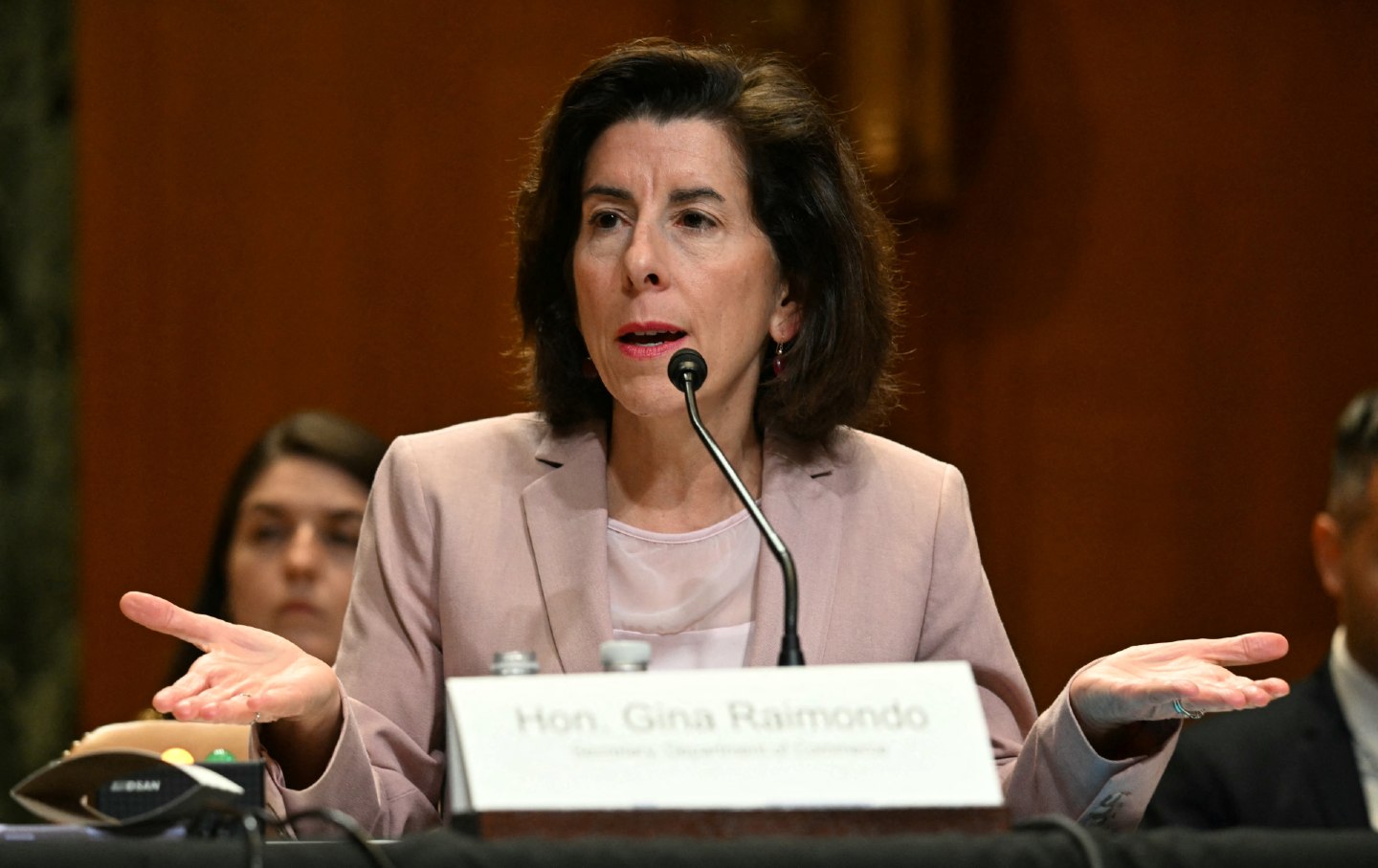
Commerce Secretary Gina Raimondo testifies during a US Senate Appropriations Subcommittee on Commerce, Justice, Science, and Related Agencies on Capitol Hill in Washington, DC, on May 15, 2024.
(Jim Watson / AFP via Getty Images)
If Kamala Harris wins the White House, she is rumored to be considering Commerce Secretary Gina Raimondo for treasury secretary should the position’s current occupant, Janet Yellen, step down. Raimondo’s name has been in the mix since at least 2022 and the persistence with which her name floats around suggests her appointment is a real possibility.
The secretary of the treasury is an immensely influential position, and with a plethora of economic challenges on the horizon—a runaway unaffordability crisis, the expiration of the US tax code, an ongoing debt crisis, a possibly looming recession—choosing who will serve in the position is no trivial matter. Broadly responsible for determining US economic and tax policy, past treasury secretaries have, for better and worse, had a direct hand in some of recent US history’s most consequential decisions, whether Hank Paulson’s role in selling Congress on the disastrous 2008 bank bailout, Steve Mnuchin’s push for successive tax cuts under Donald Trump, or Yellen’s contribution to the passage of the American Rescue Plan, which, depending on whom you believe, was to either advocate for a smaller stimulus or to back President Joe Biden’s then-controversial plan to go big.
Entrusting this job to Raimondo dramatically ups the risk that a future President Harris caters her economic policy toward those least in need, while reminding voters about everything they dislike about today’s Democratic Party. If there’s one consistent feature to Raimondo’s political career, it has been her coziness with corporate and Wall Street titans, often at the expense of the working Americans she’s meant to serve.
That’s probably because, before she was a politician, Raimondo was one of these Wall Street titans herself. After finishing law school, she founded Rhode Island’s first venture capital firm, Point Judith Capital. One of the enduring controversies of her career was the mysterious agreement, whose details were never made public, between the small and little known PJC and the Rhode Island state pension fund it was sold to in 2006. It saw the pension fund pay more than $1 million to in fees and expenses to Raimondo’s former firm—which she continued to hold a lucrative interest in even after being elected state treasurer and governor—for the paltry return of only 5.11 percent. Stranger still, both Rhode Island and its capital, Providence, continued to stay invested in the underperforming firm years after the 10-year investment was meant to have expired, with the state finally managing to wriggle out of the commitment days before she was nominated to Biden’s cabinet in 2021.
Upon transitioning to politics, first as state treasurer then as governor, arguably the defining achievement of Raimondo’s career was her 2011 overhaul of the state’s struggling pension system, against union objections. She suspended cost-of-living increases for retirees and moved them to a hybrid model—one that replaced a traditional pension that paid out a fixed benefit with 401(k)s, where employee contributions were invested and so exposed to market risk. During this time, the fund’s expenses paid to managers (and Raimondo herself) ballooned from $46 million in 2012 to nearly $188 million nine years later. The move was and remains a source of bitterness and anger in the state. It also set the standard for Raimondo’s political approach, which, after taking over as governor in 2015, would see her try to wage war on workers over what she proudly called a “brutal” austerity budget that was ultimately thwarted by progressives.
Raimondo’s time as commerce secretary has continued this throughline, with the former governor serving as, in the words of Al Thompson, Intel’s vice president of US government relations, “the Cabinet voice for the American business community” inside of what is meant to be a populist progressive administration.
Raimondo has been variously called “tech’s favorite Biden official” and “corporate America’s best friend in the White House” whom “Wall Street likes,” and who has “cultivated close ties with CEOs in New York and across the country.” That’s not an exaggeration: Upon being confirmed to the position, Raimondo stocked the agency with lobbyists and other former officials from Big Tech and Wall Street, met 230 times with top executives and industry trade groups in just her first seven months, had at least 101 meetings with Wall Street representatives in her first two years, and after only a year, had met twice as many times with Big Tech lobbyists and executives as Trump’s Commerce Secretary Wilbur Ross had in four.
Popular
“swipe left below to view more authors”Swipe →This has had a direct impact on her Commerce Department’s execution of policy. When the European Union sought to regulate tech giants by, among other things, undercutting their market domination and mandating greater privacy protections and transparency from them, Raimondo criticized the measures in a December 2021 speech. When lawmakers tried to find out if she had met with tech officials in advance of the criticism, she refused for months to release her calendar records. It was eventually clear why: The New York Times later reported that Amazon CEO Andy Jassy, who knew Raimondo from their time at Harvard, had discussed his opposition to the EU bills as well as similar US legislation. Her calendar, which was ultimately released, showed she had gotten drinks with Jassy on August 24, taken a Zoom call with him months on September 8, and took a call with him on December 16—eight days after the speech.
Raimondo has come in for similar criticism over her allocation of Biden’s 2022 CHIPS Act, the $52 billion array of subsidies and other incentives meant to reshore semiconductor chip production in the United States and lay the groundwork for the Biden administration’s revival of state industrial policy in the United States. Besides rebuilding US industrial capacity in a key sector, the legislation looked to push pro-worker policies that had failed in Congress by attaching conditions to the awarding of money to firms, money that Raimando was tasked with doling out. She did so by having former Wall Street executives make the decisions for where to allocate tens of billions of dollars.
Raimondo has been a vocal champion for some of those requirements, such as the one that firms receiving the funding set up or support childcare for their employees. That’s a policy that, incidentally, also happens to backed by tech executives as a good business policy.
But not all of them. Last month, four Democratic members of Congress, including Senator Elizabeth Warren and Congressional Progressive Caucus Chairwoman Representative Pramila Jayapal wrote to Raimondo, echoing a letter from earlier in the year, urging her to use all the power at her disposal to ensure that recipient firms didn’t engage in stock buybacks, the practice where businesses divert their profits not toward reinvesting in their workforce but toward purchasing their own stocks to push up their value for shareholders—like their executives.
Critics like Warren argue that the condition that firms don’t use the federal money to do so is currently meaningless in practice, because the fungible nature of the subsidies means firms can simply move the money around and claim to be putting other, non-taxpayer funds toward stock buybacks. They also look with suspicion at what is meant to be preference given to firms that won’t engage in the practice for five years after getting the subsidies. They point to the fact that the firms’ applications and agreements are not public and to the refusal of BAE Systems—the first of the more than 570 companies that applied for CHIPS support to get it—to commit to not pursuing future stock buybacks. Even worse, BAE was in the middle of a $2 billion stock buyback when it received the subsidy. Intel, which received the largest single CHIPS award, has likewise spent more than $30 billion on stock buybacks between 2019 and 2023, and is authorized to buy another $7.24 billion back.
Democrats in Congress have likewise urged Raimondo to do more to ensure CHIPS recipients are meeting conditions around worker protections, including wages and the right to organize. Only a small handful of chipmaking facilities are unionized in a sector historically opposed to organized labor, and workers at US chip factories have complained about a “real struggle to survive” on sub-living wages. The Taiwan-based TSMC faced no federal pushback for stubbornly resisting signing an agreement with unions or hiring union workers, and was ultimately pressured by local Arizona unions late last year to sign an agreement resolving labor disputes.
Finally, the artificial-intelligence industry views Raimondo as a major ally. In 2022, she said she didn’t believe “that we should overregulate AI and slow down the weight of innovation”—and that “we need to, if anything, step on the gas in the way we innovate.” After that, the White House put her in charge of writing the safety and security standards for the industry and the authentication guidelines for the content it produces. Given the way that AI perpetuates climate disaster, has led to hundreds of job losses and threatens many more, and is very likely in a bubble of overvaluation that may have contributed to the recent stock market tumble, this is a major red flag.
Trumpism feeds off perception that the Democratic Party has been taken over by corporate-friendly profiteers and has forgotten about the working-class people it traditionally represented. Raimondo is that belief personified. Her continued presence in a Democratic administration, let alone being potentially put in charge of the Treasury Department, would be a gift to a right wing aggressively working to win an ever-growing share of the working class.
Support independent journalism that does not fall in line
Even before February 28, the reasons for Donald Trump’s imploding approval rating were abundantly clear: untrammeled corruption and personal enrichment to the tune of billions of dollars during an affordability crisis, a foreign policy guided only by his own derelict sense of morality, and the deployment of a murderous campaign of occupation, detention, and deportation on American streets.
Now an undeclared, unauthorized, unpopular, and unconstitutional war of aggression against Iran has spread like wildfire through the region and into Europe. A new “forever war”—with an ever-increasing likelihood of American troops on the ground—may very well be upon us.
As we’ve seen over and over, this administration uses lies, misdirection, and attempts to flood the zone to justify its abuses of power at home and abroad. Just as Trump, Marco Rubio, and Pete Hegseth offer erratic and contradictory rationales for the attacks on Iran, the administration is also spreading the lie that the upcoming midterm elections are under threat from noncitizens on voter rolls. When these lies go unchecked, they become the basis for further authoritarian encroachment and war.
In these dark times, independent journalism is uniquely able to uncover the falsehoods that threaten our republic—and civilians around the world—and shine a bright light on the truth.
The Nation’s experienced team of writers, editors, and fact-checkers understands the scale of what we’re up against and the urgency with which we have to act. That’s why we’re publishing critical reporting and analysis of the war on Iran, ICE violence at home, new forms of voter suppression emerging in the courts, and much more.
But this journalism is possible only with your support.
This March, The Nation needs to raise $50,000 to ensure that we have the resources for reporting and analysis that sets the record straight and empowers people of conscience to organize. Will you donate today?
More from The Nation
Larry Summers, We Knew Ye Too Well Larry Summers, We Knew Ye Too Well
The former Harvard president and Treasury secretary has resigned over humiliating disclosures in the Epstein files. But will that be enough to keep an ardent neoliberal down?

Binance’s MAGA-Branding Strategy Binance’s MAGA-Branding Strategy
The world’s largest crypto exchange often operates beyond the reach of the law. Now it’s helping to enrich the Trump family.

How Brothel Workers in Nevada Just Made Labor History How Brothel Workers in Nevada Just Made Labor History
The courtesans at Sheri’s Ranch were staring down a horrifying new contract. So they did what workers everywhere do: They got organized.
Don’t Let Trump Fool You. The Economy Is Bad, and He Is to Blame. Don’t Let Trump Fool You. The Economy Is Bad, and He Is to Blame.
The Trump administration’s efforts to distract from the bad economy just divert attention from one dumpster fire to another.

Why Elon Musk’s Latest Mega Merger Is Little More than Vaporware Why Elon Musk’s Latest Mega Merger Is Little More than Vaporware
The tech mogul and would-be space pioneer is mashing up his properties once more in a deal that's unlikely to achieve escape velocity .

The Farmland Revolt The Farmland Revolt
America’s farmers are fuming over Trump’s tariffs. Democrats need to channel their anger.

