Why Elon Musk’s Latest Mega Merger Is Little More than Vaporware
The tech mogul and would-be space pioneer is mashing up his properties once more in a deal that’s unlikely to achieve escape velocity .
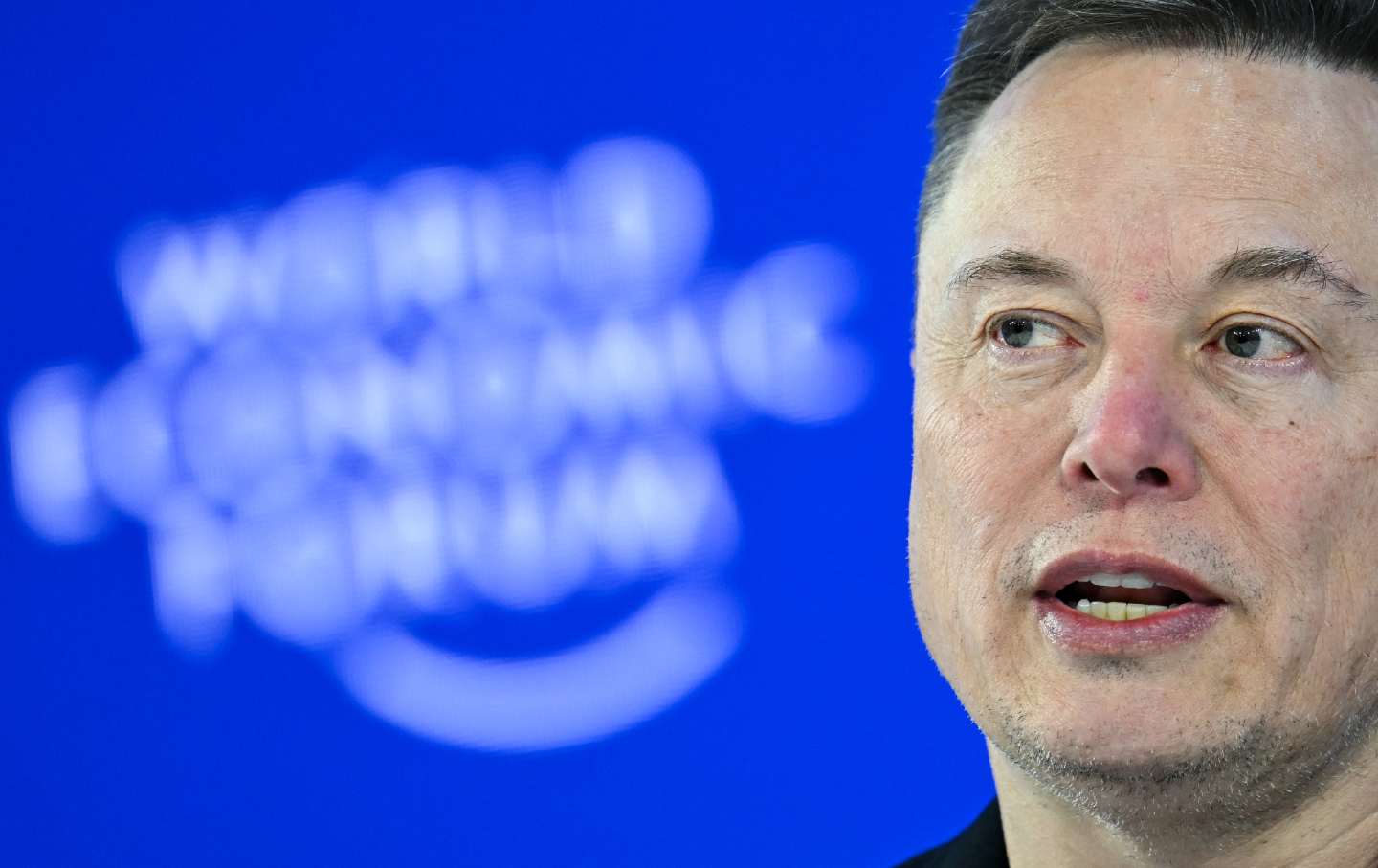
Elon Musk peddles his vision of cosmic colonization at the World Economic Forum in Davos, Switzerland.
(Fabrice Coffrini / AFP via Getty Images)After what were surely some very intense negotiations with himself, Elon Musk has decided to merge his rocket company SpaceX with his AI and social-media company xAI in what amounts to a $1.25 trillion tie-up. Combining two of his companies into a new mega-corp supposedly worth more than the sum of its overvalued parts is a classic Musk move. His last self-merging coup came last year when he combined X and xAI. Along with frequent capital raises, Musk’s vertically integrated takeovers of his own properties allow him to continue to pump up the values of his start-ups. In December, SpaceX was valued at $800 billion. Less than two months later, for the purposes of this deal, it was valued at $1 trillion, with xAI considered to be worth $250 billion.
SpaceX sealed the deal by issuing $250 billion in new shares that it handed to xAI’s shareholders. The move effectively diluted the holdings of existing SpaceX shareholders. The New York Times summed up the parlous bargain: “SpaceX’s longtime backers were forced to shrink their ownership in the company drastically, as a percentage, to pay for the acquisition.”
That would infuriate most investors, but thanks to the circular nature of Musk’s corporate economy—otherwise known as the Muskonomy—and his frequent reliance on the same group of financiers, some of SpaceX’s investors were already xAI investors. (SpaceX is also expected to raise at least $50 billion in a public offering this summer.) Minting new SpaceX shares is supposed to buoy the entire enterprise while saving Musk the trouble of pursuing more conventional ownership models that involve real dollars.
Tesla is Musk’s only publicly traded company, but all of his firms do business with one another, share personnel and investors, and are otherwise increasingly intertwined. Just a few months ago, Musk was putting forward initiatives to have Tesla and SpaceX invest billions in xAI. Some have suggested that his many ventures will one day be amalgamated under a single Musk Corp, which Musk can oversee with the imperiousness, resource shuffling, and ad hoc financial engineering that can be generously termed his management style.
Musk’s periodic mergers and self-dealing can seem like attempts to force synergies that aren’t there while masking the massive costs around data-center construction and SpaceX’s failed Starship tests, among other boondoggles. Musk says that his imagined future depends on a vertically integrated firm managing rockets, space exploration, a free speech platform, data centers, and artificial intelligence. But his alchemical approach to mergers exposes the overall fragility of his corporate empire, which is increasingly leveraged to support a few big bets—AI, robotics, self-driving vehicles, space exploration—that may never yield major returns. The overlapping missions of the companies anchoring the Muskonomy also create extremely harmful fallout, such as the transformation of the X platform’s highly touted AI function, Grok, into the world’s most popular chatbot for pedophilic and nonconsensual sexual imagery. Earlier this week, French prosecutors conducted a raid on X’s Paris headquarters targeting this ugly feature, while a UK investigation into Grok’s predatory imaging is ongoing.
In a memo to employees posted on SpaceX’s website, Musk described his new company’s mission as “scaling to make a sentient sun to understand the Universe and extend the light of consciousness to the stars!” To that end, he wants to begin putting data centers in space, where they can supposedly operate with fewer restrictions than their terrestrial counterparts. More important, in Musk’s space-lord vision of the future, they would have unfettered access to the bounteous rays of the sun.
It’s an idea that has gained adherents among a number of tech leaders in the last year, including Jeff Bezos, who has long talked about putting infrastructure in Earth’s orbit. SpaceX claims that it now plans to launch 1 million satellites as part of an enormous “constellation” of AI data centers featuring massive solar arrays. Deploying one of his typically improbable timelines, Musk has said that he thinks he’ll be able to start launching data centers into space within two or three years.
For Musk, building this fantastically large collection of space-based data centers is an essential step to allow humanity to “meaningfully ascend the Kardashev scale and harness a non-trivial percentage of the Sun’s power.” After spending the last few decades floating improbable plans to colonize Mars, Musk has lately taken to hymning the rapid conquest of the Kardashev scale—an esoteric system to measure a civilization’s technological advancement that was devised by a Soviet scientist in the 1960s. In recent years, Silicon Valley figures have embraced the Kardashev scale as the measure of their cosmos-spanning ambitions. Per the Kardashev scale, a civilization advances according to the amount of energy it consumes, with a Type II civilization—Musk’s stated goal—being capable of harnessing all of the energy emitted by a nearby star.
The sci-fi retro futurism at work here is mostly a smokescreen that rationalizes the tech billionaires’ ongoing plunder of the finite resources of planet Earth. The hardware required—which has yet to be created—would have to be replaced or augmented every five years. The potential waste is as obscene as the trillions of dollars in capital currently being lavished on terrestrial data-center constructions. The ability to launch data centers into space depends on a massive drop in the cost of rocket launches, well beyond the scale that SpaceX or any of its competitors has managed to achieve. None of this is really financially feasible.
As Musk inflates his technological predictions, his big bets are converging because his costs are ballooning. Last month, xAI announced that it had raised $20 billion. As of last year, xAI was reportedly churning through $1 billion per month. The AI boom is sustained by ever greater infusions of capital supporting ever greater promises of technological innovation. From super intelligence to universal wealth to space data centers, the industry’s plans are fantastically expensive and always well beyond the next horizon.
Musk’s main talent in recent years has been to keep the whirligig moving while periodically tapping the same close circle of venture capitalists, Middle Eastern sovereign wealth funds, and political patrons who help subsidize his torrid entrepreneurialism. One day that machine—and whatever bargain Musk has made with his financial backers—will fall apart. But Musk’s latest corporate contortion will likely work, as intended, to further postpone that day of reckoning.
Your support makes stories like this possible
From Minneapolis to Venezuela, from Gaza to Washington, DC, this is a time of staggering chaos, cruelty, and violence.
Unlike other publications that parrot the views of authoritarians, billionaires, and corporations, The Nation publishes stories that hold the powerful to account and center the communities too often denied a voice in the national media—stories like the one you’ve just read.
Each day, our journalism cuts through lies and distortions, contextualizes the developments reshaping politics around the globe, and advances progressive ideas that oxygenate our movements and instigate change in the halls of power.
This independent journalism is only possible with the support of our readers. If you want to see more urgent coverage like this, please donate to The Nation today.
More from The Nation

The Farmland Revolt The Farmland Revolt
America’s farmers are fuming over Trump’s tariffs. Democrats need to channel their anger.

We Need Radical Abundance We Need Radical Abundance
If we want abundance we have to ask, an abundance of what exactly, and produced under what economic logic?

Zohran Mamdani Takes on the Gig Economy’s Wage Thieves Zohran Mamdani Takes on the Gig Economy’s Wage Thieves
New York City is suing a delivery app for stealing workers’ pay—signaling that under Mamdani, gig companies can no longer break the law with impunity.
How Trump’s Immigration Crackdown Chills Organizing and Erodes Conditions for All Workers How Trump’s Immigration Crackdown Chills Organizing and Erodes Conditions for All Workers
When one group of workers is terrorized or disappeared, it threatens all workers’ ability to fight for their labor rights.

Ro Khanna Has a New Tech Social Contract for California’s Oligarchs Ro Khanna Has a New Tech Social Contract for California’s Oligarchs
As Peter Thiel and other fat cats threaten to flee California over a billionaire tax, Khanna is calling their bluff.