
Why The Voice of Hind Rajab Will Break Your Heart
Why “The Voice of Hind Rajab” Will Break Your Heart
A film dramatizing a rescue crew’s attempts to save the 5-year-old Gazan girl might be one of the most affecting movies of the year.
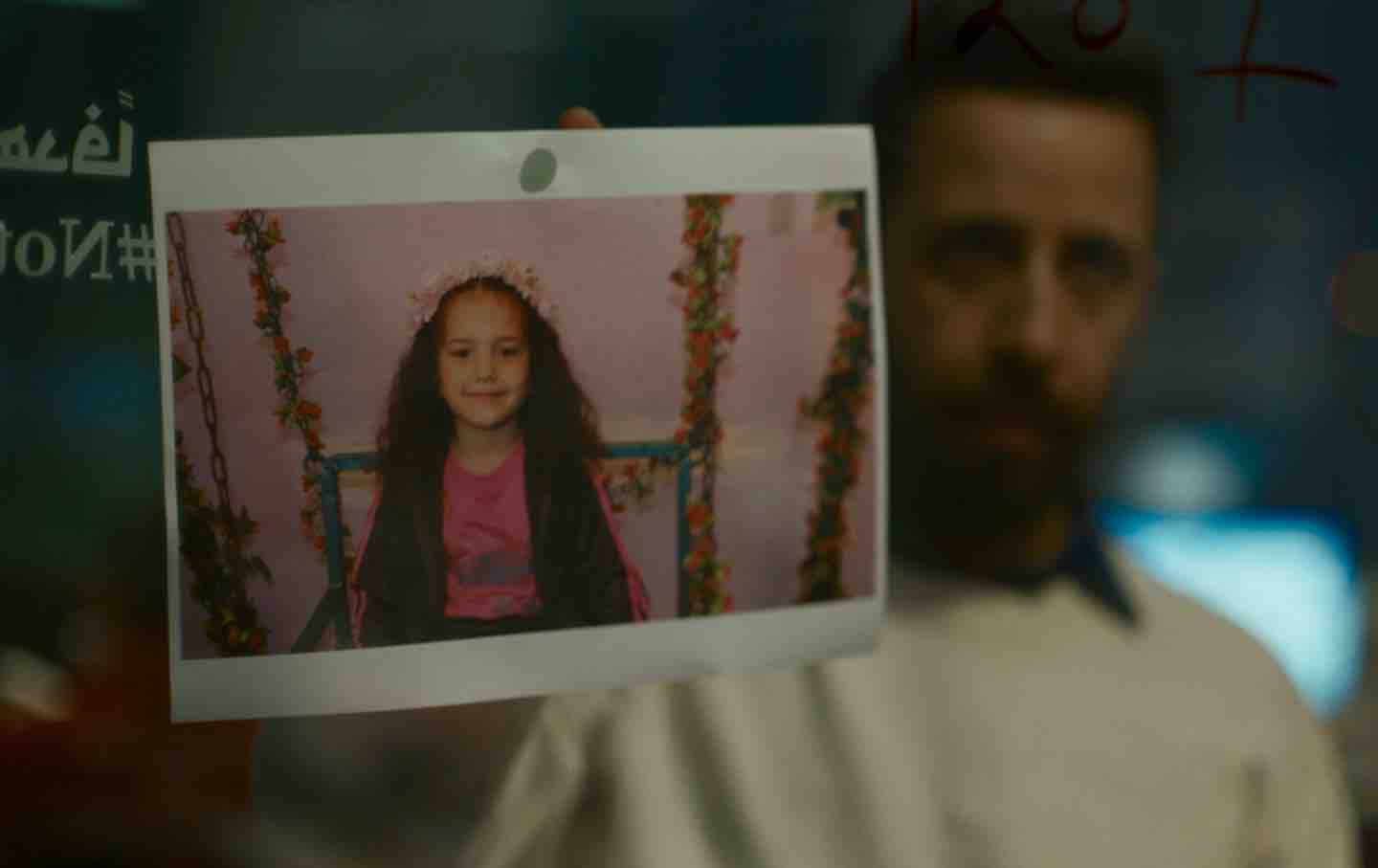
Bad things happen in the shadows. Not only the actual shadows, but in the places unplumbed by certainty. The kind of atmosphere evoked by “the fog of war” or “the heat of battle” in places where all the journalists have been murdered—or rather, have died, because who can really know? Perhaps because of circumstances, despite our best efforts…
Hind Rajab, a beautiful 5-year-old girl from northern Gaza, was first terrorized and then murdered alongside six members of her family by Israeli soldiers on January 29, 2024. I can say so with certainty because I’ve listened to the voice recording she left behind—the last vestige of the little girl’s ever having existed. Her remains, a little body, a small skeleton, may now be scattered in the loose earth of northern Gaza. Perhaps there is nothing left—it has been nearly two years, after all. And our cemeteries have not warranted special consideration from the forward troops of the Israeli genocide.
I remember first seeing the posts on Twitter. A little girl in Gaza was trapped in a car. The audio recordings of her cries and pleas, posted for all the world to listen to: This couldn’t be real, could it? The shock of listening to a child explain that her family was dead and she was scared. Night was falling.
It was too much.
As it turned out, the reality was worse than I could imagine it would be.
People around the world reacted to Hind’s murder in different ways. Students at Columbia University occupied Hamilton Hall on April 30, 2024, renaming it Hind’s Hall. The musician Macklemore released a song honoring the child. And the Tunisian writer and director Kaouther Ben Hania made a film, The Voice of Hind Rajab, the subject of this review. The movie is a work of art—and of humanity. A spare examination of the hours, the eternity, spent by Hind’s would-be rescuers as they speak with the girl and try in vain, hopefully and then hopelessly, to save her life.
When the film premiered at the Venice Film Festival, it earned a 23-minute standing ovation. The film’s producers—Joaquin Phoenix, Brad Pitt, Jonathan Glazer, Alfonso Cuarón, and Rooney Mara, among others—deserve special thanks for lending their credibility and celebrity to a film that honors the life of a little girl and the lives of those who were murdered alongside her. Already, Hind’s story has attained symbolic proportions. But here, in this film, she is a child, a human being. A person whose life carried meaning, who deserved a warm bed and a childhood. I am so sorry for her, and for the more than 20,000 children—and the more than 100,000 Palestinians in Gaza—who were murdered by the Israeli state.
The film begins with the view of a terrace at the Palestine Red Crescent Society’s offices in Ramallah; the staff are on a cigarette break. The PRCS’s premises in Gaza, we learn, have been destroyed, so all calls are routed through Ramallah. The subtext is important: At a time when the Israelis and their American supporters seek to claim a cleavage—Gaza apart from the rest of Palestine—the effort is undermined by the fact of where the PCRS team is located. Palestine exists, whole and continuous, if only because the people there believe it does, and behave as though it does.
The Palestine Red Crescent Society is supposed to operate, more or less, the same way emergency dispatch works around the world: Incoming calls are taken and routed to an ambulance by people in an office. The dispatchers describe the circumstances and locations, and, in the best case, a rescue is made. But in Palestine, under occupation, the dispatchers are required to submit ambulance routes for clearance by the Israeli army. The coordination chain follows the tortuous logic of apartheid in that country, particularly when the victim requiring help has been injured by the Israelis. First, the call goes to the PCRS staff, who coordinate with the Red Cross, which then conducts outreach to COGAT—the occupation army administrator. And then information, or permissions, flows back up the chain. Often the victims bleed out and die while awaiting rescue—one more genus of crime in that forsaken place.
Soon after the film starts, a call comes into the dispatch office. It’s from Layan Hamada, Hind’s 15-year-old cousin. Her family had sought to comply with the evacuation orders issued by the Israeli army, leaving their home in Tel Al Hawa, in northern Gaza. They had come under fire from a tank, and Layan was wounded. She calls the PCRS to request aid, and while she is on the line, she is murdered. The recording is unadorned, and the sounds of shooting and Layan’s screams are painful, excruciating, to listen to.
So, too, is what follows: Hind’s tormented entreaties—plea after plea for rescue. Her voice, plaintive and small, captures through a vertiginous inversion the enormity of what’s happening: the violence she is subjected to, and the inhumanity of her tormentors, her murderers.
All of the recordings are real—there is no actor playing Hind or Layan. Instead, the actors portray the staff in the PCRS office, their efforts and reactions in real time as they converse with ghosts. Documentary evidence—a video recording of a staffer on that awful day, for example—is used at times to enhance the viewer’s identification with these real people.
The acting is superb. But is it acting? What human can listen to Hind’s call and not be deeply affected, pained and anguished? Clara Khoury, Motaz Malhees, Saja Kilani, and Amer Hlehel showcase their humanity for the camera. Their anxiety, their tears and lamentations—their trauma—is real.
At times, my mind turned to the Israeli soldiers who waited that day, watching Hind’s family’s car, 20 meters away. I thought of their sadism—they used the deconfliction process to lure a PCRS ambulance to their vicinity, Hind’s vicinity, before summarily executing the ambulance drivers, Yousef Zeino and Ahmed al-Madhoun. I tried to imagine their inner lives. How would I behave in the commission of a crime like this one, whose viciousness only attains its full horror in contemplation of the ennui, the boredom of sitting in a tank, awaiting an ambulance for three hours or more?
My imagination fails. These Israeli soldiers sit outside the envelope of my personal understanding of what shared humanity means. If there are crimes that cause the criminal to forfeit his humanity, surely these murders rise to cross that threshold. Better to consider Zeino and al-Madhoun’s heroic final deed. Or the singsong cadence of a little girl’s whisper into the void.
Popular
“swipe left below to view more authors”Swipe →And here, I am grateful for small things. I learned through the film that Hind was able to speak briefly with her mother, Wesam Hamada before her murder. I imagine speaking with my children in similar circumstances… and it is too much. I stand in awe of Hamada, her strength and her will to survive in the face of the darkest knowledge any parent can possess: the pain and fear that attend their small child’s last hours on earth.
I left the theater with swollen eyes and a thickness in my head. I took the train home from New York, and when I walked into my kitchen that evening, my wife was on the phone while my youngest child, a 4-year-old, chatted happily at her, having somehow resisted bedtime. I led my daughter upstairs to bed and held her for a moment, trying to imbibe her living, her beating heart.
More from The Nation

The Melania in “Melania” Likes Her Gilded Cage Just Fine The Melania in “Melania” Likes Her Gilded Cage Just Fine
The $45 million advertorial abounds in unintended ironies.
Nobody Knows “The Bluest Eye” Nobody Knows “The Bluest Eye”
Toni Morrison’s debut novel might be her most misunderstood.

Melania at the Multiplex Melania at the Multiplex
Packaging a $75 million bribe from Jeff Bezos as a vapid, content-challenged biopic.
Ishmael Reed on His Diverse Inspirations Ishmael Reed on His Diverse Inspirations
The origins of the Before Columbus Foundation.
How Was Sociology Invented? How Was Sociology Invented?
A conversation with Kwame Anthony Appiah about the religious origins of social theory and his recent book Captive Gods.

How Immigration Transformed Europe’s Most Conservative Capital How Immigration Transformed Europe’s Most Conservative Capital
Madrid has changed greatly since 1975, at once opening itself to immigrants from Latin America while also doubling down on conservative politics.

