Why Terry Southern Was “the Most Useful Writer” in America
The satirist, Nation critic, Dr. Strangelove cowriter, and “eggheaded prankster” was born exactly 100 years ago, and his work remains as relevant as ever.
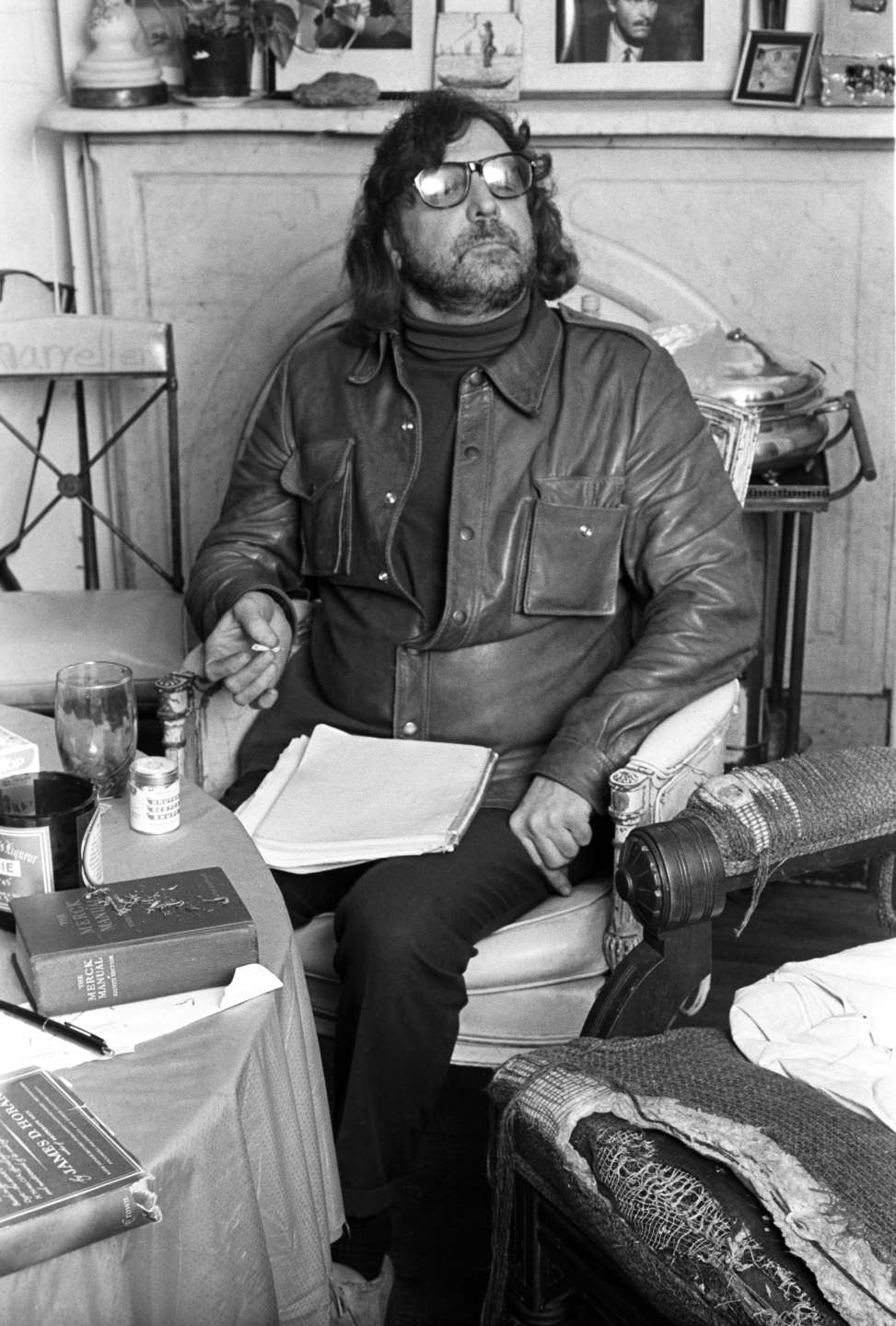
The madcap satires of Terry Southern, who would have turned 100 today, remain urgently relevant, from the piercing send-up of our national obsession with money in The Magic Christian (1960) to the unforgiving account of American militarism in Dr. Strangelove (1964), the film he cowrote with Stanley Kubrick. The “most profoundly witty writer of our generation,” as Gore Vidal called him, anticipated—and then participated in—many of the countercultural currents of the 1960s. He’s even on the cover of Sgt. Pepper’s Lonely Hearts Club Band, two heads up from a young Paul McCartney. Southern died in 1995, but the best of his work, marked by what The New York Times called his “eggheaded pranksterism,” lives on.
That would not surprise Nelson Algren, who wrote in his Nation review (February 27, 1960) that The Magic Christian “is at once the most profoundly satiric and wildly comic account of our life and times in years.”
In 1960, just months after The Magic Christian was published, Southern began writing for The Nation—noteworthy in itself, given that the magazine wasn’t exactly at the forefront of cultural happenings. (We dismissed the Beatles as “derivative…manna for dull minds.”) Southern scholar David Tully writes that the magazine “offered him the greatest freedom and the greatest field for creative growth” as a journalist. While the reviews he contributed to The New York Times and elsewhere were mere summaries, Tully notes that his Nation pieces “were often extended, meditative essays.” He specialized in roundups of a whole season’s crop of new fiction. One piece from 1962 has Southern wrestling with no fewer than 16 new novels, including works by some of the biggest authors of the period: James Baldwin, William Golding, Vladimir Nabokov, Ignazio Silone. Though his tenure as a contributor was brief—by 1964, he had largely left journalism behind for Hollywood—Southern’s sojourn in the Nation orbit left behind some impressively astute, and characteristically witty, pieces of criticism.
One of his first pieces was an essay on the role of humor in existentialist fiction from Franz Kafka and William Faulker to Albert Camus and William S. Burroughs. “The future of this literature,” Southern pronounced, “rests with writers who retain the ability of realistic surprise, and with readers who are loose enough to unbridle their response regardless of how ‘unprecedented’ it may seem to them at the time.”
In the Fall Books issue of 1960, Southern looked at a collection recent fiction, including books by John Barth, William Styron, and John Updike. Here we have Southern turn his merciless mode of critique on literary culture itself:
The cult of bigness, in its various attitudes, is by now a well-annotated American disease of which most symptoms and many causes appear to be fully understood. This sickness, however, as it applies to that brief lamplight called “contemporary literature,” does not derive, as is generally supposed, from the great Victorian plague. It stems from aborted notions of Joyce and Moby Dick—sources of influence to be celebrated solely (should one judge by the content of our current fat serious novels) for their use of prefatory quotes and their bulk…. The bloated format of our novels is most usually a panicked attempt to bolster the otherwise rather shaky impression that anything worth saying is being said; like the meandering speech of a lying man who must talk about anything under the sun except the crime itself.
Southern found Updike’s Rabbit, Run to be a yawnfest, damning it with the praise that it was “carefully written.”
In his 1962 Nation essay, “When Film Gets Good…,” Southern assessed the state of American fiction at the dawn of the new Hollywood, to which Southern himself would contribute. Suddenly, influenced by foreign films, American producers had realized it was possible to make good movies instead of bad ones. “Now, when Film gets good, Book is in trouble,” Southern wrote. “Theoretically, it is not possible for a book to compete, aesthetically, psychologically, or in any other way, with a film…. It has become evident that it is wasteful, pointless, and in terms of art, inexcusable, to write a novel which could, or in fact should, have been a film.” The article went to print the same month Southern started work with Stanley Kubrick on what became Dr. Strangelove. (He would also go on to have a hand in 1969’s Easy Rider.)
Southern returned to The Nation’s pages near the end of his life with a few satirical pieces about Iran-Contra, the first Gulf War, and Mother Teresa. Indeed, a year before Christopher Hitchens published The Missionary Position, his excoriation of the Albanian fundamentalist. Southern ridiculed her criticism of abortion and contraception at the National Prayer Breakfast, aired on C-Span. Southern rejoiced at Hillary Clinton’s apparent discomfort, calling the episode “a fitting comeuppance for public persons who fail to distance themselves from such arcane sky-god antics and adulations.”
Nearly 30 years after his death, Southern’s voice is deeply missed—though a forthcoming documentary produced by the writer’s son, Nile Southern, promises to bring it to new audiences. “Southern’s stance toward the contemporary American scene,” Algren wrote in The Nation in 1964, “seems to be one of ironic affiliation rather than hysterical alienation.” He was, Algren added, “the most useful writer in this country.”
Support independent journalism that does not fall in line
Even before February 28, the reasons for Donald Trump’s imploding approval rating were abundantly clear: untrammeled corruption and personal enrichment to the tune of billions of dollars during an affordability crisis, a foreign policy guided only by his own derelict sense of morality, and the deployment of a murderous campaign of occupation, detention, and deportation on American streets.
Now an undeclared, unauthorized, unpopular, and unconstitutional war of aggression against Iran has spread like wildfire through the region and into Europe. A new “forever war”—with an ever-increasing likelihood of American troops on the ground—may very well be upon us.
As we’ve seen over and over, this administration uses lies, misdirection, and attempts to flood the zone to justify its abuses of power at home and abroad. Just as Trump, Marco Rubio, and Pete Hegseth offer erratic and contradictory rationales for the attacks on Iran, the administration is also spreading the lie that the upcoming midterm elections are under threat from noncitizens on voter rolls. When these lies go unchecked, they become the basis for further authoritarian encroachment and war.
In these dark times, independent journalism is uniquely able to uncover the falsehoods that threaten our republic—and civilians around the world—and shine a bright light on the truth.
The Nation’s experienced team of writers, editors, and fact-checkers understands the scale of what we’re up against and the urgency with which we have to act. That’s why we’re publishing critical reporting and analysis of the war on Iran, ICE violence at home, new forms of voter suppression emerging in the courts, and much more.
But this journalism is possible only with your support.
This March, The Nation needs to raise $50,000 to ensure that we have the resources for reporting and analysis that sets the record straight and empowers people of conscience to organize. Will you donate today?