
The Pending Disaster of a Skydance-Warners Merger
The Ellison family’s aggressive pursuit of the WBD empire would shred news values and further pillage movie and TV production.
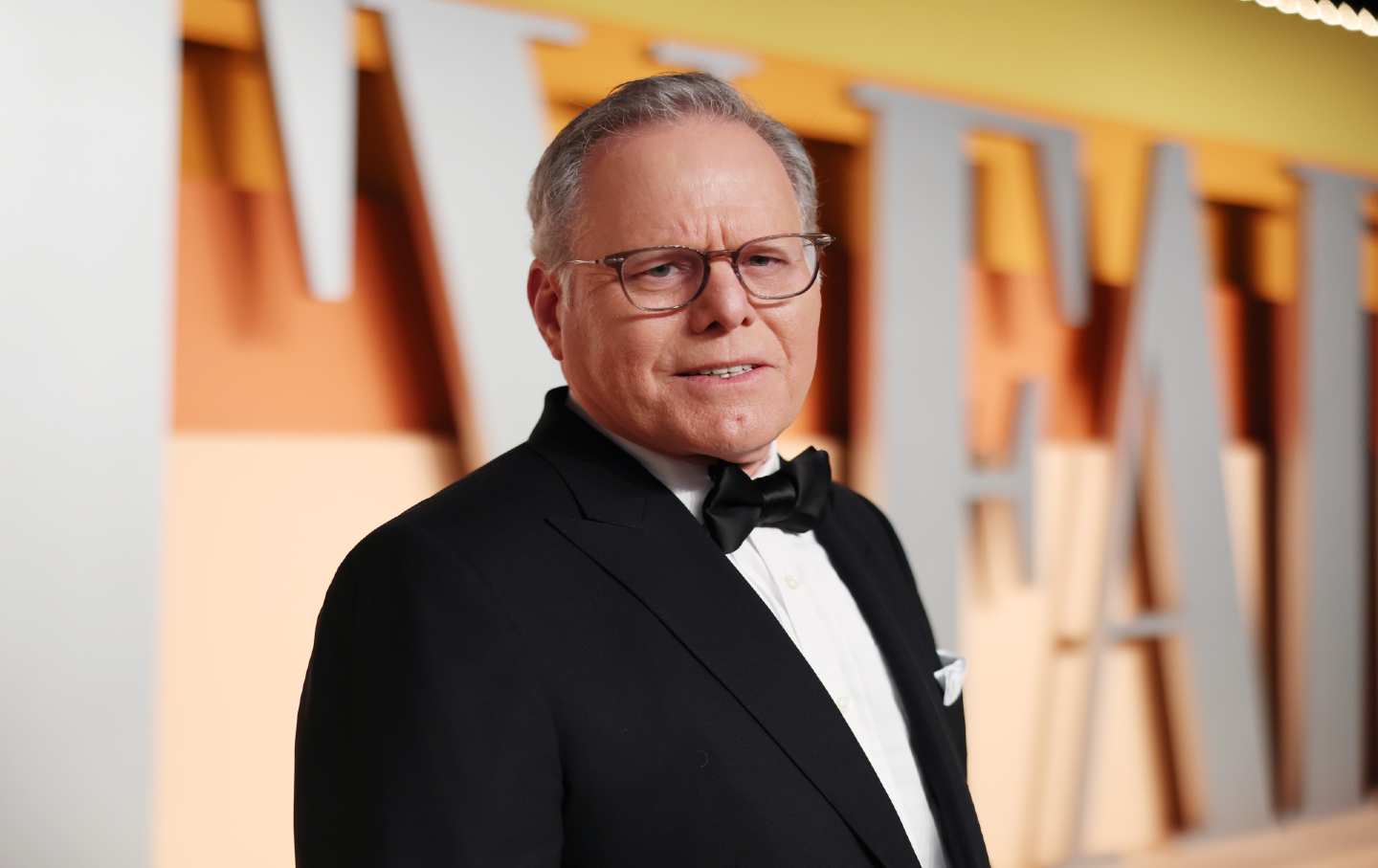
WBD CEO David Zaslav at this year’s Vanity Fair Oscars Party
(Phillip Faraone/ VF25 / Getty Images for Vanity Fair)This fall, the would-be movie mogul career of Warner Bros. Discovery (WBD) CEO David Zaslav took one step forward, and it now threatens to take one large, disastrous step backward, off a cliff. For movie fans, that step forward meant WBD releasing Paul Thomas Anderson’s One Battle After Another, a delirious political fever dream combining modern-day immigration and MAGA politics with bravura filmmaking. That step off the cliff? In late October, Zaslav announced that, after three increasingly aggressive offers from David Ellison’s Skydance, WBD is up for sale. Skydance, which recently acquired CBS via its merger with Viacom, made its mark there by canceling arch–Trump critic Stephen Colbert and hiring anti-woke crusader Bari Weiss to oversee CBS News. Paul Thomas Anderson or Bari Weiss—you don’t get choices much starker than that.
Zaslav oversees a massive conglomerate that came together in 2022 when Warner Media (the offspring of the unwieldy 2018 merger between AT&T and Time Warner) merged with Discovery Inc. to become WBD. The fact that a “W” for Warner always figures prominently in any incarnation of these properties gives you a sense of the history of the Warner Bros. brand and what’s it’s meant to the American public since 1923. It’s the studio that made a host of landmark films, from Casablanca and Pee Wee’s Big Adventure to this year’s Sinners. The current WBD banner combines CNN, HBO, Turner Classic Movies, DC Studios, TNT Sports, Animal Planet, and dozens of other media companies. Zaslav’s sale announcement seems calculated to touch off a bidding war to reach an asking price of more than $70 billion. If that doesn’t materialize, WBD could also get broken up from within and sold in parts.
Given this summer’s Skydance buyout of Viacom, which included Paramount and CBS News, it’s hard to see how a parallel deal to scoop up WBD is good for anyone: employees, news, or our pop culture. To allow the Skydance-Viacom deal to go through, the Trump administration demanded and received a $16 million cash payout from CBS News to resolve its meritless lawsuit over the editing of an interview with Kamala Harris. CBS proceeded to suspiciously cancel Colbert’s The Late Show just as Trump’s FCC chairman Brendan Carr finalized the deal. Then, in an effort to appease the unappeasable MAGA base, the new CBS invented a job for Bari Weiss as the editor in chief of CBS News. The Ellison family, lest we forget, also invested $1 billion dollars in Elon Musk’s buyout of X.com when it was Twitter, which has become a miserable repository for Musk’s campaign to troll humanity at large into submission to his edgelord will.
After Zaslav’s announcement, the Trump administration immediately signaled its enthusiasm for a Skydance-WBD deal. It’s not hard to see why: The last deal put cash in Trump’s hand, turned CBS News over to MAGA, and exacted petty revenge on Colbert. Critics who just as quickly lambasted the idea of this merger include Senators Elizabeth Warren of Massachusetts and Bernie Sanders of Vermont, as well as the Writers Guild of America (WGA). Warren voiced a central argument against the deal’s antitrust implications, noting that one entity’s controlling that many movies, in theaters and on TV, television programming, news media, and sports gives instant leverage to Skydance to raise prices for consumers. That’s an all-too-common industry practice that the WGA documented in its 2021 study of a decade’s worth of failed mergers, “Broken Promises.”
Then there’s the rampant downsizing that a merger of this scale would produce. Paramount and CBS are getting their first taste of this harsh shareholder-enriching mandate, with an estimated 2,000 employees receiving beautifully crafted farewells explaining that a “a strong, future-focused company would require significant change.” That’s on top of an industry-wide labor contraction, in the aftermath of several disastrous streaming platform ventures that cost Hollywood billions.
A Skydance-WBD alliance would also continue wreaking harm to the basic canons of newsgathering. If Skydance takes over CNN, it would likely visit the same makeover it’s imposed on CBS News at a network that sits high on the list of President Trump’s most-hated news organizations. As Bernie Sanders posted on X.com, “Trump’s billionaire friend Larry Ellison bought CBS. Now he’s after CNN. Next up: TikTok. All with Trump’s backing. This is how media works in authoritarian societies—a very dangerous trend.”
The merger would also bode ill for Warner Bros.’ mainstay products—film and television. Since the 2022 WB-Discovery merger, Zaslav has been an occasional hero in the battle for non-pandering entertainment, but more often a villain. In his mission to shrink the $43 billion in debt he took on from the organization’s Time Warner era, Zaslav has shelved completed films, decimated the staff at Turner Classic Movies, and shrunk the libraries of WBD’s streaming platform considerably—but not your subscription fees. At the same time, Zaslav has signaled that films are the one domain in the WBD empire he cares most about; when he took over, he made a show of getting original WB founder Jack Warner’s old desk out of storage for his own office. He also bought the house of Paramount producer and New Hollywood 1970s legend Robert Evans, the studio head who greenlighted Rosemary’s Baby, Chinatown, Harold and Maude, and The Godfather, among others.
After three years of hacking away at WBD, Zaslav put his global-size debt where his mouth is by backing Mike DeLuca and Pam Abdy, the studio’s lead executives, as they greenlighted risk-taking projects in the old Warners mold like Mickey 17 (Bong Joon Ho), One Battle After Another, and Sinners (Ryan Coogler). Even the studio’s Superman reboot from James Gunn drew fire from MAGA as too woke.
The future was finally looking bright for Warner Bros. Zaslav announced that he would split WBD in half by April 2026. The half he would oversee included the newly named Warner Bros., made up of Warner Bros. Television, Warner Bros. Motion Picture Group, DC Studios, HBO and HBO Max, as well as the studio’s vast film and television libraries. The other half included CNN and WBD’s massively debt-ridden collection of atrophied and dying cable channels, spun off into its own company, Global Discovery. Zaslav planned to oversee a stand-alone entertainment company—a decidedly endangered business model in an age when TV and film increasingly act as “content” for phone and streaming companies. At long last, Zaslav would get to live out his Jack Warner–Robert Evans dream of being a genuine movie mogul.
Then Skydance made its offers. For Hollywood, what seemed like light at the end of the tunnel turned out to be a train emblazoned with the Skydance logo. That rarest of undertakings in the movie business, a stand-alone studio, now appeared to be headed for something far worse than the usual corporate ownership. Of course, many Hollywood studios have fallen under the sway of big corporations. Oil companies, soda companies, liquor companies, electronics conglomerates, telecommunication giants, cell phone companies, and streaming platforms have all bought and sold them. But those businesses were still competitors. Filmmakers, consumers, and the overall entertainment market fared better when studios had a range of buyers to set up and distribute their movies. Competition worked for everyone.
Skydance’s entertainment plans look to be of a piece with Disney’s 2019 buyout of Fox Films from Rupert Murdoch’s News Corp. In that deal, Disney absorbed Fox, as it had Lucasfilm and the Marvel Cinematic Universe, reducing a once important cultural force in the film and television world to another franchise-focused Disney subsidiary. When Fox Films and Disney stopped being rival studios in a competitive market, Fox stopped doing much to supply innovative entertainment aimed at adult interests outside of Disney. It’s one giant corporation now, serving the uninspiring mandate of brand and franchise management.
We already see signs of this at Viacom-Paramount. The entertainment arm of that merged behemoth just lost marquee showrunner Taylor Sheridan. One would expect that Sheridan, whose breakout series Yellowstone has made him a conservative culture hero, would be a Hollywood figure appealing to MAGA fans ready to review-bomb and boycott anything with a whiff of wokenesss about it. But Sheridan’s politics aren’t so simple and he’s expensive and argumentative talent—which is to say, an irascible auteur in the mold of the old Hollywood studios.
The good news, so far, is that a Paramount-WBD deal is a long way from complete. The WBD board has to approve it, as would federal regulators. There’s also the attorney general of California, the state that would take the hardest hit in job losses, who could sue to block it. The deal would also face much stiffer resistance overseas from regulators in the European Union, the United Kingdom’s Competition and Markets Authority, as well as from Canada’s Radio-Television and Telecommunications Commission. There’s also Trump to consider, who could easily change his mind and blow it all up over a South Park joke.
Popular
“swipe left below to view more authors”Swipe →If Zaslav and the board don’t sell to Skydance, there’s no reason not to be optimistic about his prospects for reviving Warner Bros. as the kind of film studio it was during its heyday. If he wants to sit at Jack Warner’s desk, he would do well to pay heed to what Warner said when he cashed out and left that desk in order to retire to Palm Springs: “You’re nothing if you don’t have a studio. Now I’m just another millionaire.”
Become a Sustaining Donor This September
Between the reemergence of right-wing red-baiting and Donald Trump’s use of the chilling National Security Presidential Memorandum–7 to criminalize left political organizing, we’re seeing McCarthyism reborn before our eyes.
This assault on democracy cannot be ignored or wished away. Resisting it requires bravery in the face of threats and repression, a steadfast commitment to the truth, and the unwavering belief that we can—and will—overcome this darkness.
We must have an independent media that sets the record straight, unearths corruption and abuses of power, and advances a politics of justice and dignity for all if we’re to win this fight.
That’s why I’m writing to you today. This September, The Nation needs to add 100 monthly donors to sustain our progressive journalism. Your contribution makes the next investigative report, the next truth-speaking column, and the next pathbreaking essay all possible.
I hope you’ll support our work with a recurring donation today. If you donate $10 or more a month, we’ll send you a brand new “Hands Off the Free Press!” sticker to recognise your commitment to our cause. Please, donate today.
Onward,
Katrina vanden Heuvel
Editor and Publisher, The Nation
More from The Nation
America Without the NFL America Without the NFL
Chuck Klosterman’s Football is a eulogy for the sport on the eve of its decline.
Edward Said: Between Worlds Edward Said: Between Worlds
A new film biography depicts the Palestinian writer as still out of place—and ahead of his time.
Imani Thompson’s Grad-School Thriller Imani Thompson’s Grad-School Thriller
In Honey, the novelist offers a different take on the campus satire.
Love and Literature in Leslie Fiedler’s America Love and Literature in Leslie Fiedler’s America
When will the American novel grow up?

