
The Hidden Crisis of Addiction Treatment
In Rehab, Shoshana Walter investigates the corruption and abuse rife in the business of drug rehabilitation.
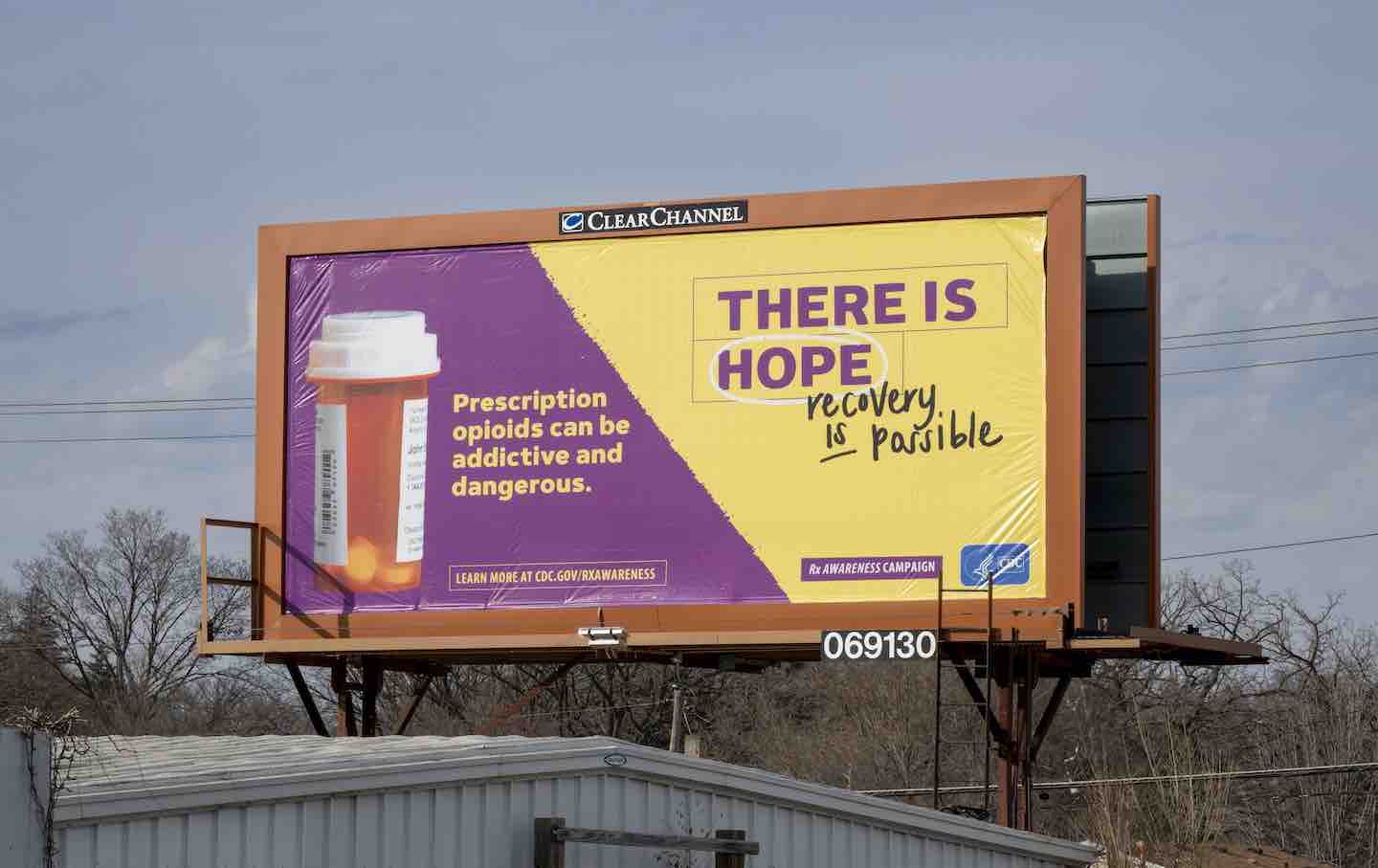
A billboard in St. Paul, Minnesota, 2025.
(Photo by Michael Siluk/UCG/Universal Images Group via Getty Images)
Shoshana Walter’s Rehab: An American Scandal opens with the search for a body. But there are no homicide detectives on the scene. In the spring of 2014, family members, local volunteers, and a retired crime-scene investigator set out to find the remains of 21-year-old Donovan Doyle, a former patient at the Above It All Treatment Center in Skyforest, California. Doyle had disappeared eight months earlier and was presumed dead. When he initially went missing, the police did not try to find him. One law-enforcement official told a local newspaper that he was considered a “voluntary missing adult” and thus “did not meet the criteria to send our search and rescue and put them in danger.” No foul play was suspected, and the police closed the case.
Books in review
Rehab: An American Crisis
Buy this bookThe night before Doyle disappeared, he had threatened to kill himself. Upon hearing this news, the rehab’s supervisor, Kory Avarell—a Mormon businessman with no training in addiction treatment—ordered a concerned employee not to call 911; he said Doyle was merely courting attention. This went against Above It All’s policy—employees were supposed to contact authorities if a patient might be in danger. When Doyle refused to go to a counseling session the next morning, Avarell immediately kicked him out of the program, which meant that he had to leave the facility. Avarell did not notify Doyle’s family or arrange a way for him to reach the nearest bus station (it had begun to snow heavily). Doyle left the facility angry—he threw his belongings into a trash bag and attempted to punch his counselor on the way out. He then walked off into the San Bernardino National Forest. That’s where a search-party member found his wallet, his tattered sweats, and then his skull.
Doyle’s death at Above It All is one of several preventable deaths that Walter investigates in Rehab. In opening her book with Doyle’s story, Walter, a staff writer for the Marshall Project, signals to readers that the stakes go beyond arguments over what constitutes effective addiction treatment in America. Rehab is fundamentally concerned with life and death, revealing how the places we might send our loved ones for help when they are at their most in need are not just ineffective, but rife with exploitation, fraud, abuse, and mortal danger.
Walter characterizes the rehab industry as “America’s other drug crisis,” one in which residential treatment—which abruptly ends after 30, 90, or 365 days—often leaves patients worse off than they were before. Walter holds rehabs to account in the way that Patrick Raden Keefe exposes the malfeasance of the Sackler family and Purdue Pharma in Empire of Pain. But Walter is also more exacting: She calls Purdue Pharma an “easy villain to blame for the opioid epidemic,” implying that the pharmaceutical dynasty’s outsize profile conveniently obscures other forces that have contributed to the public-health crisis.
Unlike the Sacklers, rehabs are faceless; these extra-medical facilities hide behind names that signal moral uplift: Above It All, Future Promises, Harmony Place. We use rehab as shorthand for addiction treatment, but this implies a degree of standardization. One rehab may offer medications for addiction, counseling, and access to licensed health professionals; another might put you to work for no pay, overmedicate you, or discharge you for using your cell phone. As Walter writes, “unlike other forms of medical treatment, there [are] no real standards or even a proven addiction cure.” And what’s worse, these centers are intertwined with the legal system. Legal entities known as drug courts often send people arrested for drug-related crimes and who want to avoid prison sentences to punitive rehabs for months. (The judges presiding over these courts, who have no training or experience in addiction medicine, are allowed to dictate treatment plans without any input from medical professionals.)
So what happens when the treatment itself is rotten—when it exploits the most vulnerable for profit and manages to evade accountability? And how have these facilities continued to operate for decades without oversight? In unearthing the stories of the people who have suffered inside addiction treatment centers, Walter shines a harsh light on an epidemic of apathy toward people who use drugs.
Rehab revolves around four characters, each of whom introduces readers to a disturbing, little-known facet of addiction treatment in America. Chris Koon was at Cenikor, a nonprofit rehab with locations across Texas and Louisiana that forced its participants to perform labor for no pay. Rehabs like Cenikor say that the act of work—specifically physical labor—can help cure addiction. Cenikor patients were ordered to work at industrial laundromats, Exxon, Shell, and Walmart, among other for-profit companies. Laying steel in more than 100-degree heat and moving boxes in a warehouse were considered core tenets of therapy. (Robert F. Kennedy Jr., the current secretary of the Department of Health and Human Services, is a fan of work camps for addiction treatment, which he calls “healing farms.”) Cenikor then pocketed the wages that patients earned at these offsite locations, claiming that it went toward the cost of their treatment. Walter devotes a large part of her book to Cenikor—she has been covering the company since 2017, and she was also the lead reporter for a podcast series for Reveal that focused on Cenikor and other rehabs that use “work therapy” to treat patients.
Walter’s reporting is damning: Cenikor is perhaps the most egregious example of a rehab where work seemed to “usurp any other feature of the program,” including counseling or the use of evidence-based medications. Koon’s story is emblematic of how rehabs like Cenikor—where cigarettes were used as compensation for 80- hour workweeks—can make patients feel even more disempowered and isolated. Koon told Walter that his bosses would “talk about you like you were just inventory, like you weren’t even a person. I’ve heard bosses talking, being like, ‘Yeah, we need to order like five more Cenikors for tomorrow’…people just disregard you like that. No one should have to feel that.”
Koon, a young, middle-class white man, was raised in Pinesville, Louisiana, and developed an addiction to pain pills in the wake of the 2008 financial crisis. He was unemployed and socially anxious; drugs made him feel less alone. Koon quickly transitioned from taking OxyContin to injecting heroin, because it was cheaper and stronger—his whole life began to revolve around avoiding withdrawal. In 2015, he was arrested for drug possession and agreed to appear before a drug court, where the judge decided to send him to Cenikor. When Koon asked people in jail whether they’d heard of Cenikor, a fellow inmate said, “Man, you might just want to go to prison.”
President Ronald Reagan visited Cenikor in 1983 and found its philosophy to be in perfect alignment with his politics, proclaiming to the participants: “This center is self-sufficient, just like all of you will soon be.” Addiction wasn’t considered a medical issue; it was a problem that could be solved by pulling yourself up by your bootstraps. Cenikor barely offered therapy to its patients: One counselor had over 70 patients in her caseload, more than three times what was allowed by state law in Louisiana. Most Cenikor counselors were also trainees without formal degrees—unable to deal with such large, complicated caseloads. In 2019, regulators in Texas found Cenikor guilty of a litany of violations: the exploitation of patients for financial gain, sexual harassment and assault, overdoses, and unsafe facilities. Cenikor was fined over $1 million, but the case ended in a settlement, with the company paying just $125,000. Cenikor continues to operate to this day.
After enduring nearly two years at Cenikor, Koon was expelled from the program. In a letter to his drug-court judge, Cenikor’s program manager stated that Koon was “unresponsive to treatment.” The program manager cited the messiness of his room, Koon’s “reading a book while in behavior management,” and two relapses as evidence to support this claim. (Relapses, in fact, are a normal part of recovery and should not necessarily be met with punishment.) Because he “failed” the program, Koon had to go before the judge and face sentencing—potentially up to five years in prison. Koon caught the judge on a good day: He was offered three years of supervised probation in lieu of prison time. Although Koon had dreamed of going to law school and holding Cenikor to account for its civil-rights violations, his life began to move forward in a more basic way: He began taking buprenorphine to address his opioid cravings, proposed to a woman he used to date in high school, and got a job as a welder in Austin, Texas.
Koon’s story dovetails with that of Wendy McEntyre, a mom from the suburbs of Los Angeles whose son had died of an overdose in a “sober living home” called Safe House. Sober living homes are places where many people go after stints in inpatient rehab. Sober living homes are even less regulated than rehabs because they do not offer treatment, just a place to sleep. McEntyre’s increasingly extreme fight to hold rehabs and sober living homes to account—advocating for her deceased son and hundreds like him when no one else would—ultimately led to her arrest for felony kidnapping. (McEntyre had helped a teenager escape from a juvenile mental-health facility.)
Popular
“swipe left below to view more authors”Swipe →McEntyre’s activism veered into the illegal—she routinely surveilled rehab facilities and harassed their leadership—but she adopted these tactics because no one would listen. She gave a voice to people like Koon, who suffered inside these facilities with no resources to speak up for themselves. McEntyre became a lifeline for families, helping Donovan Doyle’s parents search for their son’s body in the San Bernardino Forest. She then launched a statewide investigation into Above It All after yet another patient died at the facility from an overdose under circumstances in which a nurse had ordered medications using a doctor’s prescription pad. Other than the passage of a law that now requires detox facilities in California to employ medical staff, most of McEntyre’s efforts did not result in legislative wins. Despite the criminal charges she has faced, McEntyre continues to pressure state agencies to uncover abuse at rehabs nationally.
Walter’s reporting on Cenikor and Above It All raises the question of how all these rehabs came into existence in the first place. The Bush and Obama administrations responded to the first wave of the opioid-overdose crisis—which began in the 1990s after a dramatic rise in the use of prescription drugs like OxyContin—with an expansion of addiction treatment, mandating that insurance companies cover addiction like any other medical condition. Both nonprofit and for-profit rehabs proliferated, especially after the passage of the Affordable Care Act in 2010, turning addiction treatment into a $53-billion-per-year industry. But there were too many rehabs and not enough state and federal regulators, leaving conditions at these rehabs to continue unchecked.
Despite their religious overtones and little to no data proving their efficacy, 12-step programs reign supreme at rehabs across the country. And while 12-step programs may be helpful for some patients, they tend to abjure medication, which flies in the face of proven opioid-addiction treatment. Few rehabs offer what works: A 2020 survey of residential treatment programs across the US revealed that only 29 percent of these facilities offered medications like methadone and buprenorphine. These two medications are the only treatment interventions proven to significantly reduce overdose rates and opioid use. Addiction treatment is also most effective, with medication or not, when a patient is housed, has childcare, and can tap into a social-support network. Some rehabs fall short on this front to an egregious degree, financially exploiting patients and discharging them to the street, where many people relapse, as a recent Wall Street Journal investigation revealed.
It’s through the story of April Lee that Walter explores the “post-rehab trap”—where patients who lack a social-safety net drift in and out of rehab facilities for months, even years. Lee, a Black woman from Philadelphia, struggled with addiction from an early age and spent much of her adult life cycling through rehabs and sober living houses. Lee often did not have a home to return to after she left these programs, prompting her to relapse, get arrested, and inevitably end up back in rehab. Lee’s story reveals how treatment systems fall especially short for poor women and people of color. She was already a mom and pregnant with her second child when she was looking to enroll in treatment for her heroin addiction. But only 2 percent of rehab facilities nationwide allow women to bring their children, making rehab for mothers without social support virtually impossible.
Lee’s experience navigating the treatment system also invites us to consider whether rehabs are actually therapeutic or simply places that provide temporary housing and minimal support. Was Lee “getting better” at each rehab she entered, or did these facilities just provide a bed for her to sleep in at night? After Lee finished a 28-day program, she would be “expected to walk out the door a new woman,” Walter writes. A “new woman” in just one short month?
Walter doesn’t only cover rehabs and sober living homes, the physical spaces that house patients with addictions; she also critiques the rollout of buprenorphine, a highly effective and safe medication to treat opioid addiction. Buprenorphine, colloquially known by its most common brand name, Suboxone, became available to patients in 2003, a time when a treatment for opioid addiction was urgently needed. Reckitt Benckiser Pharmaceuticals, the company behind Suboxone, stalled its public release by applying for orphan-drug status through the Food and Drug Administration, thereby prohibiting generic competition and maximizing profits, all while keeping the medication out of the hands of the people who needed it most.
Not only did Reckitt Benckiser make Suboxone difficult to access; the Drug Enforcement Administration also became obsessed with regulating it, unleashing droves of “diversion investigators” to surveil the physicians and clinics that prescribed the medication. That’s how we meet Walter’s last subject, Dr. Larry Ley, an addiction doctor who opened a buprenorphine clinic in rural Indiana in 2004. Ley was one of the few buprenorphine prescribers in the state, and patients often drove upwards of four hours to get to his clinic.
The DEA regarded buprenorphine as “just another drug, like another form of heroin,” Walter writes, and DEA officials seemed to struggle with the concept that buprenorphine was in fact quite different from heroin or OxyContin. Buprenorphine was an FDA-approved treatment that curbed cravings and prevented overdose, not a “drug of abuse.” When some patients began to sell buprenorphine on the street, however, the DEA ramped up its crackdown. Diversion investigators began surveilling clinics, leading doctors to panic. A buprenorphine clinic owner in Ohio closed his facility after the DEA dropped by, posting the following note on his clinic’s door:
Heroin is killing people every day, and physicians are being scared out of the ability to help. This is an EPIDEMIC! Addicts need physicians, clinics, and pharmacies, and everybody helping them fight to stay alive.
The DEA began targeting Ley in a similar fashion, but he was steadfast in the face of threats for nearly a decade. In 2014, DEA agents raided his clinic and arrested him and his entire staff. (Ley was eventually acquitted.) The officer who arrested Ley told local reporters during a press conference that “this type of ruse of a clinic perpetuates the problem because people are still addicted to a drug.” This is a tragic misunderstanding: Buprenorphine reduces the mortality rate from opioid-related overdoses by more than 50 percent and significantly decreases non-prescribed opioid use. Fearful of the DEA and of people who use drugs, physicians today still hesitate to prescribe it, even though buprenorphine is easier than ever to prescribe.
As an early-career doctor, I’ve chosen to specialize in addiction medicine, a subspecialty that has existed for only about a decade. I see patients in diverse clinical-practice settings—from methadone clinics and street-outreach vans to hospitals and jails—but I have never stepped inside a rehab. Clinical rotations at the kinds of rehabs that Walter profiles in her book are not part of my curriculum, because few doctors work in any. These rehabs lie so far outside my scope of practice that they are not even considered to be a site for reform. And that’s a problem: Why don’t I know what goes on in rehabs, the primary site of addiction treatment in the United States? And is this perhaps intentional?
Walter doesn’t go that far in her analysis, but I’d like to interrogate the idea that people with addiction need to be put away in the first place. To achieve “recovery”—a term that inaccurately implies finality—must people be separated from their families and subjected to infantilizing, often humiliating rules? Given the scale of our overdose crisis, shouldn’t rehab facilities be on the cutting edge of addiction treatment? The rehab facilities of today feel closer to 19th-century sanatoriums—where seclusion was considered the key to recovery—rather than an extension of medical care.
I recently saw a patient in the hospital who had relapsed on methamphetamine. The patient had been sober for many years prior to this relapse, had a strong support network, and was financially stable. But she wanted to go to rehab and found a place near LA. It looked nice from the website—palm trees, reading nooks, the ocean. Another doctor even joked that he’d want to go on a vacation there. When I asked what kind of addiction treatment was offered at this facility, no one on our team knew. We ultimately supported the patient’s decision to go. But as I scrolled through the photos on the rehab’s website, I began to worry: Why were we so quick to rubber-stamp a treatment plan we knew so little about? Is medical treatment in an idyllic setting just a mirage? I’ll never know, and I can only hope that she is OK.
More from The Nation
Rock and Roll’s Dutch Old Master Rock and Roll’s Dutch Old Master
How Anton Corbijn’s photographs shaped the history of rock music.

The Enigma of Gertrude Stein The Enigma of Gertrude Stein
Why do we misunderstand one of modernism’s great writers?

What Its Like to Serve the Chinese Elite What Its Like to Serve the Chinese Elite
Zhang Yueran’s novel Women, Seated—a take on the upstairs, downstairs drama—examines class conflict among the Chinese upper crust and the people who wait on them.
In “Bomarzo,” the Renaissance Man is a Monster In “Bomarzo,” the Renaissance Man is a Monster
Manuel Mujica Lainez’s historical novel, a strange biography of a 16th-century duke, leaves the reader wondering if human nature can ever change.

When Did the Natural World Stop Feeling Sublime? When Did the Natural World Stop Feeling Sublime?
In Is a River Alive?, Robert Macfarlane challenges himself, and others, to find a new way to write about nature.

The Trouble With Adapting “Wuthering Heights” The Trouble With Adapting “Wuthering Heights”
Why adaptations of Emily Brontë’s novel, across generations, have misunderstood the work and its world.

