The Immortal Poetry of Ron Padgett
Pink Dust, a collection about aging and death, offers an optimistic vision of life as a continual act of reading.

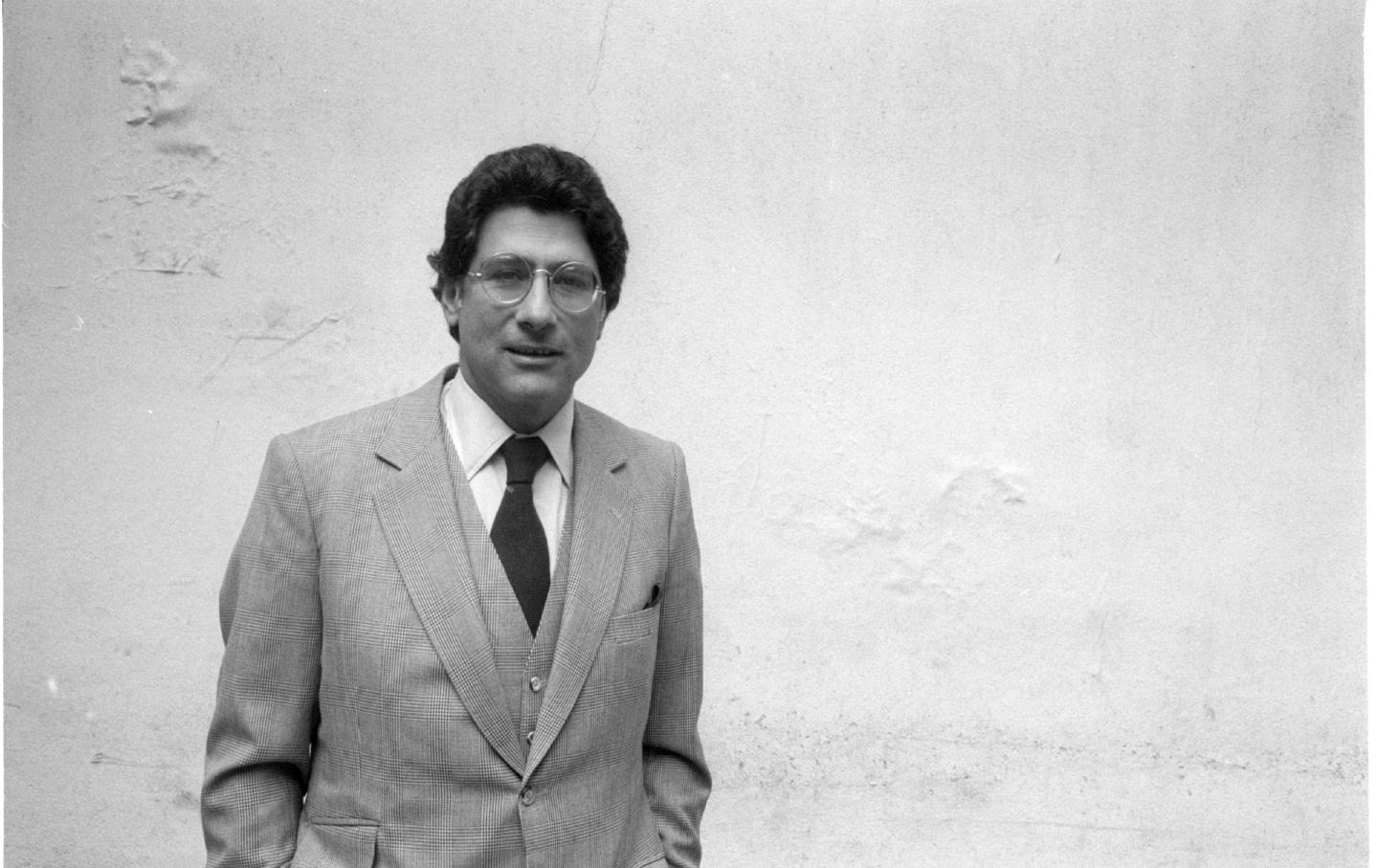
Ron Padgett, 1995.
(Jack Mitchell / Getty Images)
Death is unavoidable, a fact of life. What shifts over time is our attitude toward it, how we approach the subject of our own death and that of others. For Ron Padgett, as the 82-year-old poet confronts mortality in his latest collection, Pink Dust, death and art are impossibly intertwined. The result is a book that, as it infuses each of its lines with a wry memento mori sensibility, reminds the reader that death—be it the death of the analogue or our own—is coming for us, too.
Books in review
Pink Dust
Buy this bookThe book is divided into three sections—“Residue,” “Geezer,” and “Lockdown”—and an air of finality hangs over each. Implicit in “Residue” is the idea of remnants, leftovers, discarded memories, fingerprint smudges on glass; we are looking at fragments of the past. A 15-line poem about erasers begins this section, serving as a statement of purpose for the rest of the collection: “I’d like to replay / all those moments in my life,” Padgett writes of what has disappeared beneath the eraser’s touch,
one after the other,
in a film to be called
A History of Pink Dust.
Dust, that most fundamental component of what makes up life in so many cosmologies—“From dust you came, and to dust you shall return” goes the line from Genesis—is here imagined via the ordinary pink rubber of a pencil eraser. It is an image that, in its meaning, contradicts its placement at the beginning of the book, where nothing much has happened yet—where nothing yet seems to be needing correction. Few words have appeared, though another brief, untitled poem opens the book before “Residue” begins. A tension lurks: creation, paired with erasure. Is life itself, in this context, a first draft?
It is the first poem in the collection, though—the one that appears right before the eraser poem in “Residue”—that initially casts this need to create in gently humorous tones, a register that will characterize many of the poems in the book. “Every time I approach a blank page / the poems in it shout, ‘Oh no! / Here he comes again! Run!’” The poem may read like a joke, but its punch line approaches an interesting question about the creative process: When we write, are we creating something out of thin air, or simply holding up a kind of tuning fork and recording what it is that we hear? In other words, do we adhere to a Platonic idea of perfect forms or not? In just a few lines, Padgett has subtly introduced one of Western thinking’s most fundamental debates about the nature of mimesis, reality, and art-versus-life, couching it and hiding it within a brief slip of a joke. This kind of droll, subtle humor is typical Padgett: Clever without being mean-spirited or inaccessible, it welcomes the reader, encouraging them to explore the hidden depths in the relationship between art and life, and points to the fundamental humor found in our day-to-day existence.
“Geezer” follows this first section of poems, and “Lockdown” follows after that, the latter taking place during the 2020 Covid pandemic. As in the poems of “Residue,” the present in “Lockdown” slides frequently into the past, the two intermingling within poems, within stanzas, and even within lines. The writers and books that influenced a young Padgett are frequently invoked; in one particularly clever poem, “A Brief Guide to Twentieth-Century American Poetry,” the ghosts of early 20th-century Modernism make an appearance. “Pound was a verb, Eliot a noun,” Padgett writes, punning in the next line, “They sentenced us to Modernity.” (Another wink to this era follows: The poem that comes next is titled “Four Quartets,” a callback to T.S. Eliot’s famous cycle by that name.) From the same era, Gertrude Stein and William Carlos Williams are also named.
Literature and books appear frequently in the youthful memories that Padgett summons. A book called An Anthology of French Poets From Nerval to Valéry in English Translation, from 1958, appears in an early poem. “Imagine you are a young poet / who bought it a few years later / for $1.45,” Padgett writes. The exhortations to “imagine that you are” spin out from there, leaping from reality and memory to something more fanciful:
Imagine that you are the mouse
who nibbled a lacemark
along the edge of the cover.
Imagine that you are the book itself,
standing on a shelf for forty years,
and then someone takes you down,
holds you, opens you,
and falls in love with you again.
To be a book, and to be read by another—to be interpreted and analyzed and, finally, remembered—is understood as a human action in this rendering. The act of love is born directly from the act of reading. It is a tender understanding of how the books we read when we are young follow and affect us throughout our lives and shape the life narrative that is to come.
Viewing one’s life as a book, and the pleasures of life as tied in this way to the pleasures of reading, is one way of approaching the eternal question of reality versus art. The act of living fills this book’s pages, contrasted with the act of aging. Sex in old age is discussed (“like being / covered with warm snow / by an angel / who pretends to be blushing”), as is the contradiction between one’s outward appearance and one’s more youthful interior (“my dark green flannel shirt…its sleeves cover the arms of my grandfather”). “I’m trying to remember / what it feels like to be young,” Padgett observes in an untitled poem in the second section of the book. “Do you need more proof / of how ridiculous I am?… There is nothing more ridiculous / than a human being.”
The names of the dead fill these pages, too. George Schneeman is quoted, a reading with Robert Creeley is remembered. A “Joe” is referred to—is it Joe Brainard, the poet and artist and a childhood friend of Padgett’s? An “Uncle James” appears. The poet Dick Gallup is memorialized. Alongside the recently deceased and Padgett’s modernist forebears are invocations of long-dead artists from other genres who have inspired the poet along the way, such as the composer Franz Joseph Haydn, as though to imply that a human life is made out of a pile of references, the influences that shape our tastes. They haunt the book, phantoms that cannot be expunged. And this, in a way, is what reading is: a haunting. When we read, we conjure up the names and ideas of the past, reanimating them for as long as we continue to turn the page.
What happens after we die—is there a soul that seeks resolution elsewhere, even as our bodies decompose? This is a question that science cannot answer, and so some turn to religion. But isn’t art a kind of faith, a system that believes in the beauty that humans can accomplish? Mortality, by the collection’s end, has become something to be explicitly referenced: “There can’t be many more years in my life,” Padgett quietly observes.
I’ll go on to a new notebook,
hopefully one without metaphors.Don’t get me wrong.
I like metaphors,quite a lot.
In fact I live in one.
A book.
We sculpt our lives from metaphors, from language. Figures of speech. The same dust that is pressed into paper and printed into books is akin to the dust from which we are composed. The dust that marks out the fact of our existence, evidence that—yes—even in the face of death’s erasure, we did, indeed, endure. In Ron Padgett’s Pink Dust, this dust is more than just the residue of living. It is a reminder of the ways in which our lives intersect, however briefly, with something sublime—art itself. The second draft beckons.
Become a Sustaining Donor This September
Between the reemergence of right-wing red-baiting and Donald Trump’s use of the chilling National Security Presidential Memorandum–7 to criminalize left political organizing, we’re seeing McCarthyism reborn before our eyes.
This assault on democracy cannot be ignored or wished away. Resisting it requires bravery in the face of threats and repression, a steadfast commitment to the truth, and the unwavering belief that we can—and will—overcome this darkness.
We must have an independent media that sets the record straight, unearths corruption and abuses of power, and advances a politics of justice and dignity for all if we’re to win this fight.
That’s why I’m writing to you today. This September, The Nation needs to add 100 monthly donors to sustain our progressive journalism. Your contribution makes the next investigative report, the next truth-speaking column, and the next pathbreaking essay all possible.
I hope you’ll support our work with a recurring donation today. If you donate $10 or more a month, we’ll send you a brand new “Hands Off the Free Press!” sticker to recognise your commitment to our cause. Please, donate today.
Onward,
Katrina vanden Heuvel
Editor and Publisher, The Nation