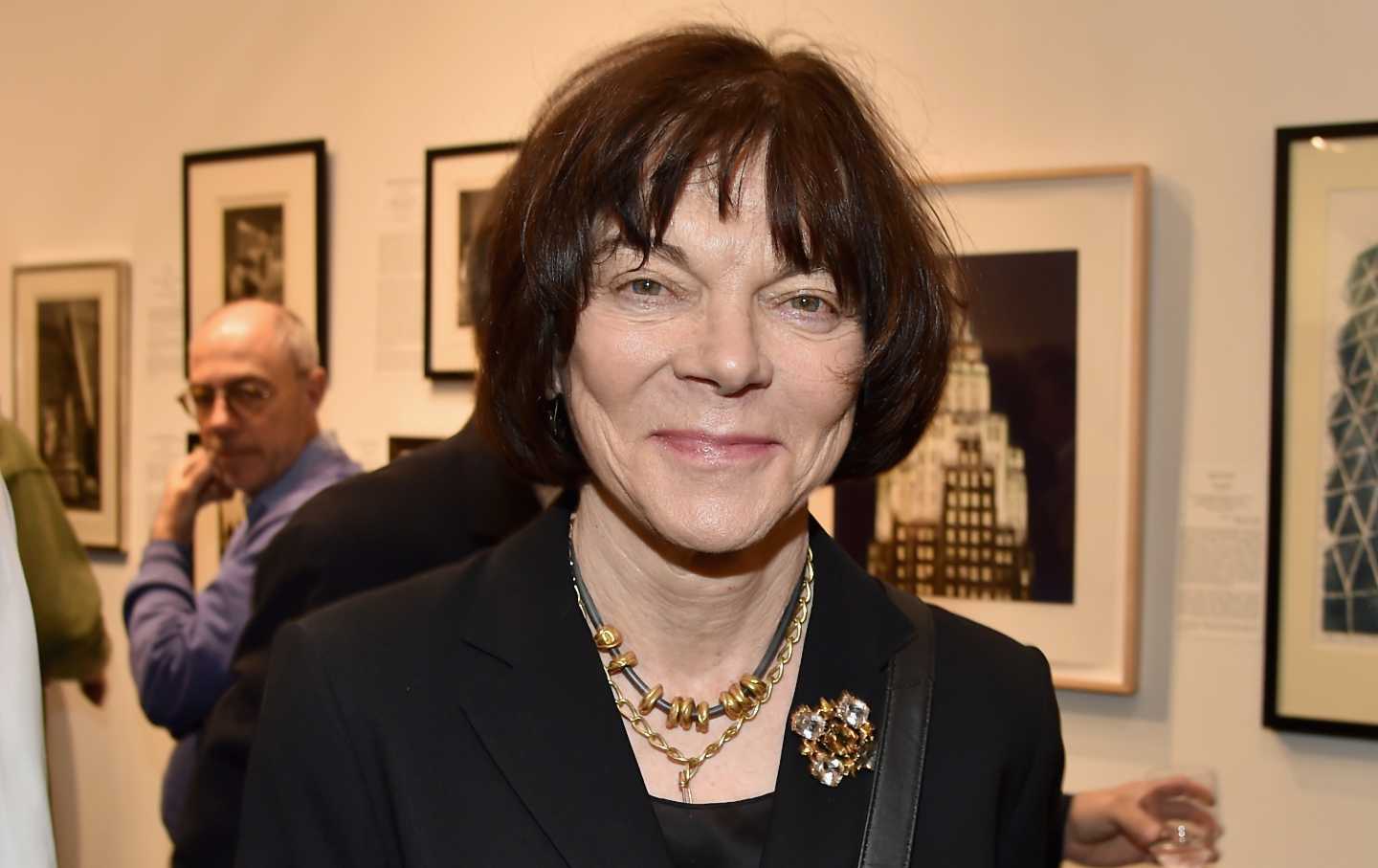
Elizabeth Pochoda at the IFPDA Fine Art Print Fair preview, 2017.
(Patrick McMullan / Getty)I couldn’t have been the only person who feared Betsy Pochoda at first sight. She was one of those illuminated beings whose eyes entered a room—or your senses—before the rest of her did. Those wide pale orbs announced a hot-wired intensity that was at a higher, deeper level than most people were accustomed to casually encounter. To varying degrees, it was unsettling at first when Betsy aimed this intensity on you. Until you found out (and it usually didn’t take very long) that her focus was a gift, an acknowledgment that she’d seen something in you that aligned with her own formidable intellect and comprehensive passions. Such a meeting of minds promised fruitful and gratifying outcomes, especially if you were a writer and were lucky enough to have her as your editor.
Betsy died May 8 at her Brooklyn home at 83. Her loss has been acutely felt by those of us who worked with her at practically every level of New York print media, including The Nation, where she was literary editor from 1976 to 1982 and from 1986 to 1989, and served on the magazine’s editorial board until her death. After leaving The Nation, Betsy became a kind of editorial ronin, taking her scholar’s rigor, eclectic’s curiosity, and sensualist’s delight with novelty, humor, and diversity to a truly eclectic range of publications. Whether it was helping with the 1980s relaunch of Vanity Fair or with the launch of Entertainment Weekly a decade later, Betsy’s range of interests and her unerring instinct for matching writers with subjects broadened her reputation as a versatile, incisive editor and solidified the devotion of writers who followed her wherever she went, benefiting from her solicitousness and enthusiasm toward their individual voices as well as her insights into how to amplify and enhance their work. Her small-c-catholic curriculum vitae evoked a small-d democratic sensibility, encompassing the New York Daily News, Mirabella, the New York Post, Vogue, House & Garden, Grand Street (the groundbreaking literary journal she helped establish) and The Magazine Antiques, among others.
Though some of these publications catered to elitist tastes, Betsy was impervious to exclusivity, snobbery, or dogma. She wanted the copy she edited to read well and to be free of jargon, platitudes, and (above all) lethargy. If some of the people she edited were more dogmatic than she, that was fine as long as their engagement was sound and deeply felt. Still, she could be exasperated at times when a contributor was overly inflexible in their point of view. “Let many flowers bloom!” I heard her once admonish an especially stubborn writer, who wasn’t persuaded, but whom she allowed to carry his biases into print anyway. Her own writing was, as you might expect, witty, wise, whip-smart, and humming with vitality.
As steely and implacable as she could sometimes be, even to longtime friends and colleagues, her enthusiasm and inquisitiveness were contagious. She encouraged me, two years ago, to write a piece for The Nation about the Woody Guthrie exhibit at the Morgan Library. There was little to nothing in my own professional background, besides my music writing, that seemed to make me an obvious choice for such a piece. But for her, Guthrie embodied possibilities of an American culture where artificial boundaries separating class, race, religion, and ideology were leveled by compulsive creativity and freewheeling ecumenism. Such were the spaces she created for those who wrote for her—or for that matter, hung out with her. For the record, she was enjoyable and knowledgeable company when she tagged along with me on jazz gigs. And, as much as anything, I shall miss our online exchanges whenever the University of Connecticut’s women’s basketball team—a shared passion—was playing. Our last digital confab took place little more than a month ago, despite her illness, as the big three of Paige Bueckers, Azzi Fudd, and Sarah Strong were leading the Huskies to another NCAA title.
Happy trails, boss. Hope this will meet your standards.
Support independent journalism that does not fall in line
Even before February 28, the reasons for Donald Trump’s imploding approval rating were abundantly clear: untrammeled corruption and personal enrichment to the tune of billions of dollars during an affordability crisis, a foreign policy guided only by his own derelict sense of morality, and the deployment of a murderous campaign of occupation, detention, and deportation on American streets.
Now an undeclared, unauthorized, unpopular, and unconstitutional war of aggression against Iran has spread like wildfire through the region and into Europe. A new “forever war”—with an ever-increasing likelihood of American troops on the ground—may very well be upon us.
As we’ve seen over and over, this administration uses lies, misdirection, and attempts to flood the zone to justify its abuses of power at home and abroad. Just as Trump, Marco Rubio, and Pete Hegseth offer erratic and contradictory rationales for the attacks on Iran, the administration is also spreading the lie that the upcoming midterm elections are under threat from noncitizens on voter rolls. When these lies go unchecked, they become the basis for further authoritarian encroachment and war.
In these dark times, independent journalism is uniquely able to uncover the falsehoods that threaten our republic—and civilians around the world—and shine a bright light on the truth.
The Nation’s experienced team of writers, editors, and fact-checkers understands the scale of what we’re up against and the urgency with which we have to act. That’s why we’re publishing critical reporting and analysis of the war on Iran, ICE violence at home, new forms of voter suppression emerging in the courts, and much more.
But this journalism is possible only with your support.
This March, The Nation needs to raise $50,000 to ensure that we have the resources for reporting and analysis that sets the record straight and empowers people of conscience to organize. Will you donate today?