David Fincher’s Man Without Qualities
His grim action movie satire The Killer pokes fun at the blandness of modern life and modern moviemaking.
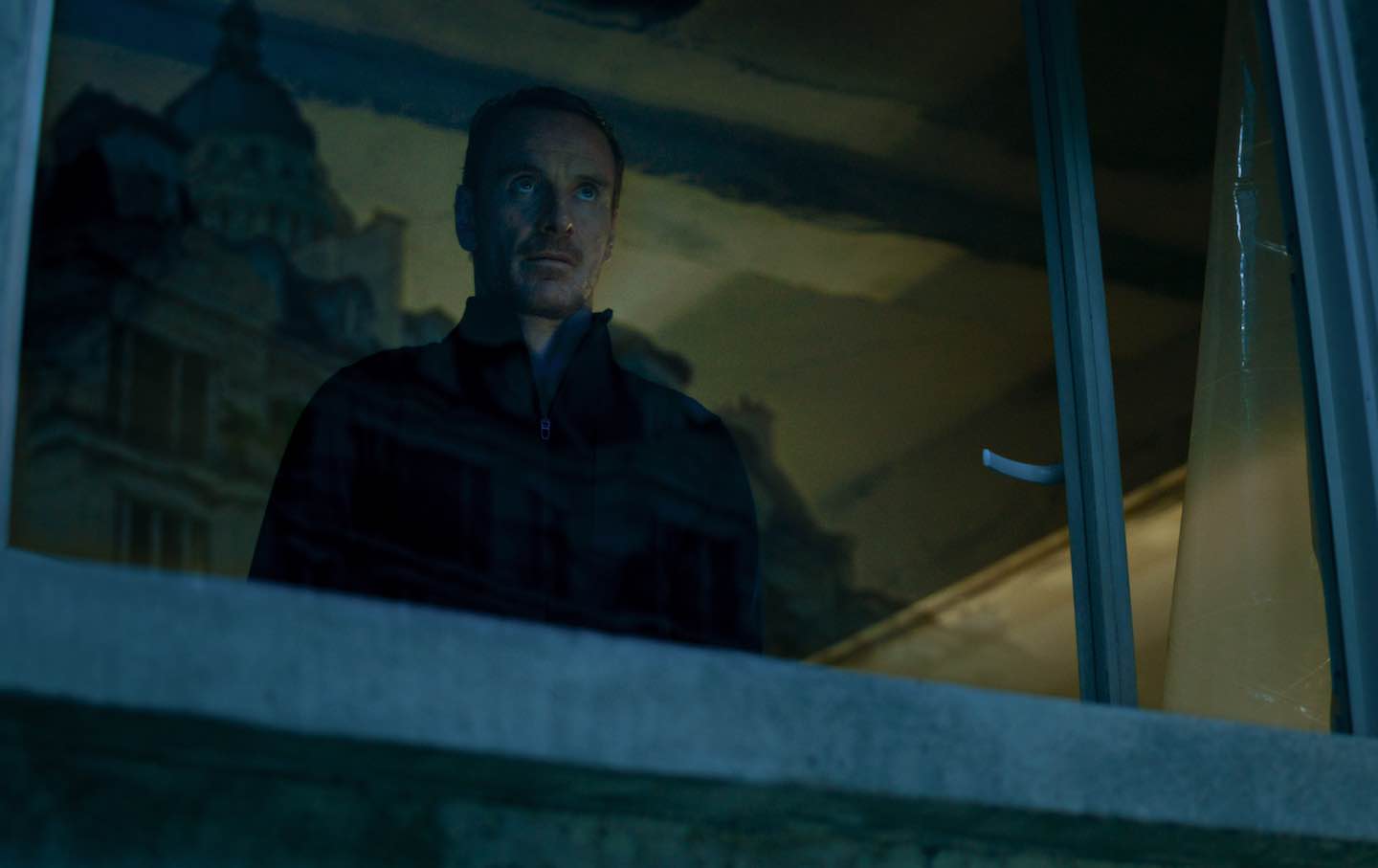
The pivot point of David Fincher’s tragicomedy The Killer resembles the crucial moment that triggers a housewife’s unraveling in Chantal Akerman’s Jeanne Dielman, 23 quai du Commerce, 1080 Bruxelles. When Jeanne overcooks the potatoes, her error creates a hairline crack in her highly regimented existence, throwing her off the obsessive patterns that ensure her psychic self-preservation. Likewise, in The Killer, the nameless hit man played by Michael Fassbender loses control: Perched in an abandoned WeWork office in Paris, he waits for his heart rate to fall below 60, the threshold of calm and steadiness he needs to reach before he can fire a bullet with precision. His target is some zillionaire staying in a swanky hotel opposite his hideout. But right when he shoots, the sex worker hired by his target moves into the line of fire. The target flees the scene with his bodyguards, and the sex worker—she’s likely dead. For the remainder of the film, the killer deals with the fact of having missed, never mind the innocent casualty. The irritation caused by that failed shot is persistent. It gives The Killer its edge as well as its grim, self-deprecating sense of humor.
“If you’re unable to endure boredom, then this work is not for you,” Fassbender says. That applies to peeling potatoes as much as to waiting, as he does, for his target to enter the frame of his rifle’s scope. During the intervals between the multiple gunshots and one particularly bloody brawl, The Killer might seem willfully mundane, a feeling enhanced by its neutral tones and generic settings: airports, hotels, storage units, and customer service desks, the stomping grounds of our nondescript killer, who thrives in the folds of structured anonymity. Fincher portrays these transient spaces as devoid of personality. But rather than eliciting a sense of estrangement, these realms appear distressingly familiar, drawing as they do on the lifeless minimalism of modern interior design, which seems to have invaded every commercial hub in the world.
In Akerman’s films, boredom and banality is a base ingredient; the mundane calls attention to the possibility of something more beneath its surface. Similarly, The Killer works because there’s more than mere automaton stylings. There’s a tension, heightened by each tight frame and scrupulous composition, between the killer’s rote professionalism and the spiritual turmoil such professionalism keeps subdued. In Fassbender’s character, Fincher gives us a man whose success is premised on his ordinariness, which allows him to easily go unnoticed. If Jeanne Dielman forces us to pay attention to and thus dignify a woman we might easily disregard, Fincher’s hero presents a different generic contradiction—a purveyor of action-movie thrills in the body of a mindless and competent Everyman. He wants only to be an efficient “part” (read cog) in the machine that is contract killing. Yet, in the privacy of his own thoughts, he laments the way his profession privileges monotony: “When was my last nice, quiet drowning?”
Unlike the trim suits and trench coats of the French hit men in Le Samouraï, or the rugged urbanity of Matt Damon’s bomber jackets and tight T-shirts in The Bourne Identity, Fincher’s hit man wears khaki utility pants and weatherproof outerwear; a puffer vest and sweat-wicking zip-ups. He sustains himself on a high-protein diet: hard-boiled eggs, McMuffins without the buns. Like the arenas of transit he traverses, he is built for maximized productivity; his blank, symmetrical visage, the appropriate cover for a near-vacant interiority.
After his missed shot, he returns to his hideout in the Dominican Republic. His girlfriend (Sophie Charlotte) has been severely battered by assassins hired by his own dissatisfied client to kill him. The client’s reasons for such vengeance aren’t personal, though. The trail must simply stay clean. Fassbender’s killer responds accordingly. First taking out the middlemen—an attorney and his secretary—then seeking out the two hired guns who stepped on his turf. The first is a brute living in Florida (Sala Baker); the second, a femme fatale (Tilda Swinton), hiding in the affluent suburbs of upstate New York. They’re actual characters, whereas the titular killer is no one worth remembering, like the white-bread sitcom characters whose names (Sam Malone from Cheers, Robert Hartley from The Bob Newhart Show) he uses as aliases; or like the strolling German tourist he poses as while waiting for the arrival of his mark.
In other words, he’s like any other middlebrow white dude: sightseeing in Paris, doing yoga, listening to the Smiths. He’s fast and strong—but not too strong like the roided-out Floridian. Nor is he like Swinton’s androgynous dandy, who indulges in the bourgeois comforts of whisky tastings, fine dining, and idle chatter. In other words, the killer is the ideal worker, conforming to the demands of his employer by stripping himself of all superfluous qualities. He doesn’t “give a fuck,” and (as the film’s tagline reads) “execution is everything.”
The Killer is not the story of an antihero playing executioner to save his girlfriend’s honor. “This will never happen again,” says the killer to the brother of his hospitalized beau, which, in Fassbender’s hands, doesn’t sound like the words of a valiant protector. Rather, the brother is like another client—and Fassbender wants to instill confidence in his new boss. The Killer, as is made clear in moments like these, plays like a lonely and disgruntled worker’s tale of retribution. But it’s more than that: Amid all the gray spaces and dead-eyed flaneuring, a consumer-culture satire unfolds, rendering the most quotidian lifestyle “hacks” into tools of cold-blooded murder. It’s no wonder our protagonist listens to the Smiths—the British indie-rock band encases agony and self-loathing in a hard shell of cheeky wit.
The comforts of late capitalism—globe-trotting fueled by the swipe of a credit card, GPS functions that pinpoint whatever destination we want—are presented ambivalently. An air of menace is conjured by the droning palpitations of the score by Trent Reznor and Atticus Ross. Today’s ubiquitous technologies of convenience, from Google Maps to Postmates, create the illusion of mastery over life’s ambiguities. Fincher, always one to anchor his thrills to an everyday realism, relies on these amenities, which are so unremarkable next to the sophisticated gadgets that populate Hollywood’s action-thriller spectacles (think Mission Impossible). For the average person, Amazon Prime saves you the time and effort of fetching the cat kibble; for the killer, the service delivers a key fob copier that he’ll use to invade his final target’s penthouse apartment.
What Fincher brings out is the efficiency mindset’s latent anxiety, cursed as the killer is with consciousness. This element is underscored by the running voice-over narration—a Fincher signature employed prominently in previous works like Fight Club and Gone Girl, both times as tools of self-deception. Over and over again, the killer utters the same verses: “Stick to your plan. Anticipate, don’t improvise. Trust no one. Never yield an advantage. Fight only the battle you’re paid to fight.” These rules are spoken with increasing fervor, like an ex-addict’s inner dialogue in the face of temptation. If the killer’s code-bound actions never convince us of his humanity, Fassbender’s controlled performance subtly communicates the mental processes flickering behind the front of his robotic gaze. We scroll past atrocities; work through natural disasters, give off a shiver of unease and move on with our routines, as expected.
For Fincher fanboys, the film also offers a juicy meta-commentary on the director himself, known for his painstakingly methodical approach on set. The killer’s fight with the meathead, for instance, appears to be shot with a handheld camera, but the effect was achieved in postproduction—a testament to Fincher’s disciplined designs. Maybe The Killer represents Fincher’s time as a hired gun for commercials and MTV music videos in the 1980s and ’90s; or perhaps it speaks to his four-year Netflix contract, and the fallout from Mank, his divisive classic-Hollywood-set talkie from 2020.
Either way, Fincher must see some of the killer in himself and his work—both are sought-after commodities, reliable suppliers of high-quality services, be they flawless executions or stylish, cerebral entertainment. Over the years, Fincher has passed from one era of commercial filmmaking to the next, performing within the parameters of the ever-evolving film industry and creating art out of the process if not the actual task. The Killer stands as his critique of this seemingly inescapable dynamic. Close to home as it may be for the director himself, it’s not specific to the rarefied conditions of working in Hollywood, or any one factory of ideas and mass culture, for that matter. That The Killer has it both ways—it’s an anti-action movie in the sheep’s clothing of a standard Netflix thriller—comes off like an act of trolling, yet the bottom line is as callous as the film’s systematic killings: To work is to compromise, to “not give a fuck” even when we do.
Support independent journalism that does not fall in line
Even before February 28, the reasons for Donald Trump’s imploding approval rating were abundantly clear: untrammeled corruption and personal enrichment to the tune of billions of dollars during an affordability crisis, a foreign policy guided only by his own derelict sense of morality, and the deployment of a murderous campaign of occupation, detention, and deportation on American streets.
Now an undeclared, unauthorized, unpopular, and unconstitutional war of aggression against Iran has spread like wildfire through the region and into Europe. A new “forever war”—with an ever-increasing likelihood of American troops on the ground—may very well be upon us.
As we’ve seen over and over, this administration uses lies, misdirection, and attempts to flood the zone to justify its abuses of power at home and abroad. Just as Trump, Marco Rubio, and Pete Hegseth offer erratic and contradictory rationales for the attacks on Iran, the administration is also spreading the lie that the upcoming midterm elections are under threat from noncitizens on voter rolls. When these lies go unchecked, they become the basis for further authoritarian encroachment and war.
In these dark times, independent journalism is uniquely able to uncover the falsehoods that threaten our republic—and civilians around the world—and shine a bright light on the truth.
The Nation’s experienced team of writers, editors, and fact-checkers understands the scale of what we’re up against and the urgency with which we have to act. That’s why we’re publishing critical reporting and analysis of the war on Iran, ICE violence at home, new forms of voter suppression emerging in the courts, and much more.
But this journalism is possible only with your support.
This March, The Nation needs to raise $50,000 to ensure that we have the resources for reporting and analysis that sets the record straight and empowers people of conscience to organize. Will you donate today?