
Missed Connections
The labyrinthine fiction of Catherine Lacey.
Catherine Lacey’s Missed Connections
In her most personal work, The Möbius Book, Lacey uses a devastating moment of heartbreak to ruminate on the messy intersections between life and writing.
The characters in Catherine Lacey’s fiction are always running away from themselves. In her first novel, Nobody Is Ever Missing, we meet a woman named Elyria as she’s about to leave for New Zealand with few plans other than abandoning her husband in Manhattan. In Pew, a genderless, ageless, and nameless person quite literally appears one day out of the blue, having spent the night sleeping in a church in a small Southern town, mystifying its members. In The Answers, we follow a woman by the name of Mary Parsons, who in a desperate search for a cure to her mysterious ailments, enrolls in expensive “neuro-physio-chi bodywork” sessions called Pneuma Adaptive Kinesthesia and then takes part in a 24/7 “income-generating experience” in order to pay for them. As we get to know her, we discover that she is not even Mary Parsons but a woman named Junia Stone, who grew up in a religious household in the South from which she’s now estranged.
Books in review
The Möbius Book
Buy this bookBiography of X, Lacey’s most recent work of pure fiction, also revolves around a mercurial figure, or really two, on the run from themselves as much as from others. Upon entering the novel, we learn that we are reading a biography by a writer named C.M. Lucca, who has set out to uncover the details of her mysterious, recently deceased ex-wife’s past and to correct the record left by a competing biography writer. Aptly inscrutable, Lucca’s Tár-esque ex-wife is best known as the famous visual artist “X.” Who is this elusive woman? By the book’s end, her mask has been torn off: We learn that she had up to 18 different names in her various incarnations, each attached to a distinct career and place of residence. These places, too, are not so familiar: In the novel’s alternative history, the Southern states seceded from the nation in 1945. X was born in Mississippi as Caroline Luanna Walker and lived the rest of her life as a fleeing “refugee.”
Is escaping danger any different from escaping ourselves? And if we manage to do either, do we know where we are going? These are the kinds of questions that animate almost all of Lacey’s fiction, including her newest genre-bending work, The Möbius Book. Billed as a “memoir-cum-novel,” it is Lacey’s first explicitly personal book, though it is a work of universal exposition as much as biographical recollection. Meditating on her life after a divorce, recalling her fraught religious childhood, and sorting through the reasons that she writes fiction in the first place, Lacey offers us an experiment in form but also in ideas. As the first half of The Möbius Book tells a fictional story about a friendship in which not all secrets are revealed, and the second half serves as a vehicle to reflect on the dissolution of a romantic relationship, Lacey presents us with a work that functions like a maze: Where exactly the exit is, and how we might navigate the abrupt, unexpected turns, will always remain a mystery.
If we can compare writing books to painting, then Lacey has always viewed the practice as something akin to performance art. The Answers switches tenses halfway through the novel, and Biography of X uses real people’s photographs as well as names and places. Meanwhile, Pew is told via a strange, ambiguous, mute narrator, so seemingly inanimate that many critics have called the book a fable.
Like Lacey’s earlier work, The Möbius Book breaks many of the rules of contemporary fiction. The first half is a work of fiction, the second half a memoir; and by including both but keeping them separate, the book belongs to neither genre. Each half has its own set of identical opening pages featuring a list of previous works and publisher information, and yet the two cannot really be read as separate entities: Each is one-half of the same whole.
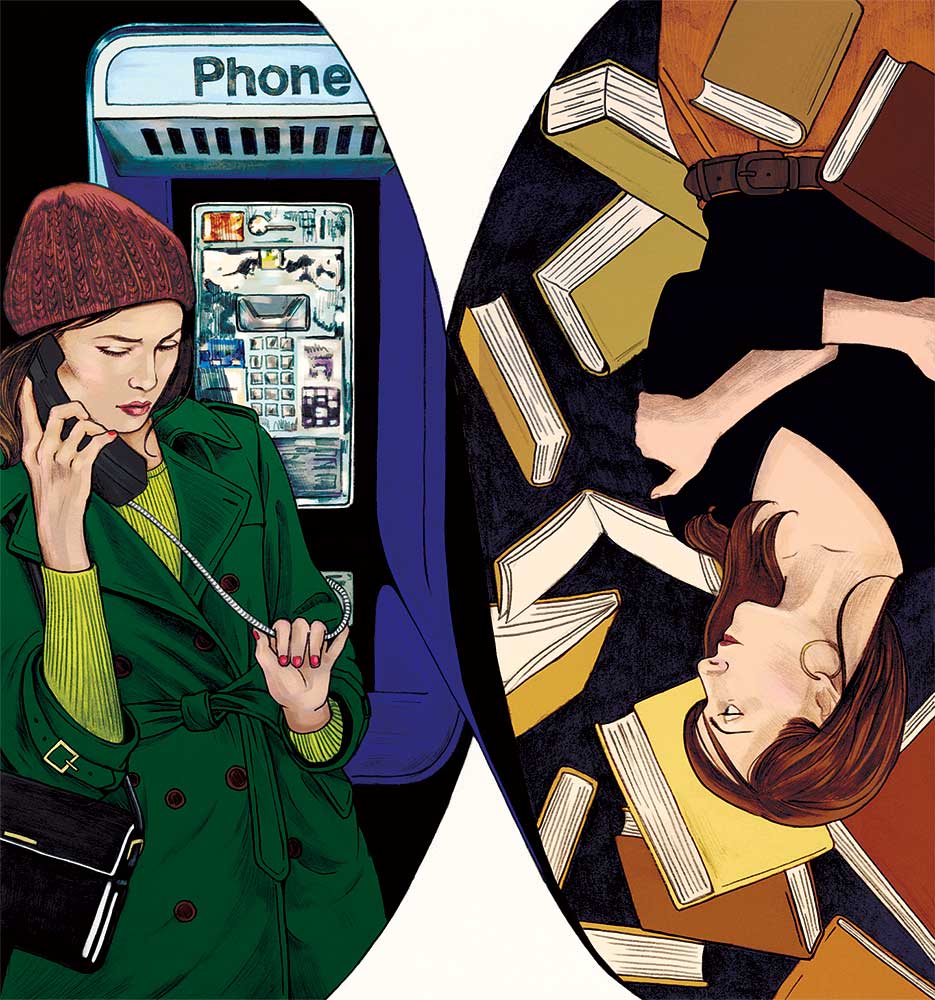
The Möbius Book begins by introducing us to Marie. The resident of an unnamed city and a woman of an unspecified age, Marie gets a call from her friend Edie, who is coming over for a surprise visit on Christmas evening. Though the book otherwise has all the markers of a story set in the present day, Marie communicates exclusively on a landline and a payphone—the proximity to the latter in fact was a reason she chose her apartment: She wanted to be close to “something so irrevocably stuck in the past.”
But things only get stranger after this disclosure: On her way back to her apartment, Marie passes a neighbor’s door and sees a pool of blood. Most people might stop to find out what’s going on, but Marie walks right past; nor does she mention it to Edie when she arrives. The two of them, after all, have plenty of things to discuss. Marie, we learn, has recently gotten a divorce from her wife, whom she cheated on and with whom she has twin children that she no longer sees. Edie, meanwhile, has been through a rough break-up with a manipulative man so domineering that “around him she felt like a child.”
While the two women compare and contrast their relationships, their conversation, almost script-like, is occasionally punctuated by philosophical musings about how things that break can sometimes be repaired; the ambiguity of attraction; and the fleeting, specific nature of memory. But Marie still can’t shake what she saw and has brief moments of private panic: What happened to the couple who lives next door? Did a murder transpire right under her nose?
What actually happens is more bizarre. Toward the end of Marie and Edie’s story, the police appear at Marie’s door and ask her to go down to the station with them. “The story about her weird affair hadn’t made it seem like Marie was truly guilty of anything,” Edie tells the reader as she watches her friend skulk out of the building with her hands behind her back. “But the sight of her getting into a police car does.”
But why is Marie being questioned at all? And how does this relate to her and Edie’s romantic failings? These are questions that we don’t ever get the answers to, even if the analogous stories offer fodder for guesses. Yet when this story “ends,” and after we peruse the acknowledgments and the “works consulted” page—the latter featuring everything from Maggie Nelson’s Bluets to the musician Bad Bunny’s reggaeton album Un Verano Sin Ti—we have no choice but to flip The Möbius Book on its head, open the back cover, and begin again.
In the second half of The Möbius Book, a new character appears: Catherine Lacey herself. We learn about how her relationship with her partner of six years ended suddenly; how she was forced to sell her house and split the mortgage; and, ultimately, how she lost herself along the way. “What do you call it when a man emails you from the other room to explain that he met another woman last week and now it’s over?” Lacey asks the reader.
She begins this story by telling us how her marriage came undone: One day, we learn, Lacey’s husband, a writer and professor with a proclivity for anger, ends their relationship in a flash. “The Reason,” as Lacey refers to her ex-husband throughout the story, tells her that she has clearly “stopped loving him” and that the reason they weren’t having “as much sex as he would have liked” is because she was, “most likely, just a lesbian.” Lacey is surprised by these declarations, but she also feels as if she has no agency to argue against them, for “later it became clear—The Reason had the right to explain my feelings to me because he’d spent six years telling me who I was, and what I should want or do.”
For the remainder of this second book, we follow Lacey’s thinking as she becomes unmoored, starves herself thin, and jolts herself into quick-and-hot rebound relationships that leave her feeling “emotionally shrink-wrapped.” That Lacey refers to her estranged partner only as The Reason, while most other figures receive real names or at least monikers, is germane here: It is one signal among others that this book isn’t so much a personal history of a relationship as it is about how a relationship can change one’s sense of reality.
How else should we interpret a book that moves not chronologically or even logically, but betwixt itself? Part of the magic of The Möbius Book is that new metaphors and meanings emerge and come into focus as one reads its two different parts. As one reads book two after completing book one, for example, it becomes clear that Lacey shares much with Edie in the earlier tale.
Once that association has been made, the reader can connect the dots to form a clearer picture of Lacey, how she was raised, and what misdeeds have followed her from one relationship to another. In book one, we learn about a betraying parent who closely resembles Lacey’s father. It is him that she thinks of when she recalls The Reason, who, during their marriage, punches walls so hard he breaks his hand. An enraged father followed by an even angrier husband—such are the patterns of life and fiction.
The Möbius Book, as its title might suggest, is full of these associations: clues from real life that shed light on its metaphors and hints in the fiction that elucidate Lacey’s own past. There is also a lot of talk about feeling guilt even though you haven’t committed a crime; about finding and losing faith; about hearing messages from species who can’t speak any human tongue; and even, at one point, about an exorcism that a friend performs on her in Oaxaca.
None of these supernatural references will surprise her longtime readers: In addition to formal invention, Lacey’s earlier novels abound with allegory, religious trauma, and spirituality. Yet one mystery remains unsolved in The Möbius Book: Amid its shocking, beguiling tales is that pool of blood. While we do eventually learn its likely cause, the explanation is so strange as to muddle our understanding of interpretation itself. But that, too, seems to be intentional. For if most of Lacey’s fiction is about running away from something or someone, in The Möbius Book we also get a study of how ignoring the past nearly always results in loss: not only of one’s tangible identity, but also of one’s coherence, orientation, and sense of meaning.
Popular
“swipe left below to view more authors”Swipe →In this way, The Möbius Book is reminiscent of work by writers like Sheila Heti, Leslie Jamison, and Maggie Nelson. But in another way, the book is also something novel: While Lacey sets out to write both fiction and memoir tinged with universalisms, she resists combining the two genres explicitly; each has its own separate place in the work. As one of Lacey’s many lovely poetic bromides reads (in this case, taken from a jar of peanut butter): “Separation is natural.”
Separation is natural, but when a heartbroken person searches for connection, she is struggling to fill a void. In the book’s memoiristic section, Lacey tells us about her escapades with various people in various locales. She goes hiking with strangers, considers energy healing, and does “anything I had previously believed myself not to be the type of person to do.” She moves from Chicago to Los Angeles, from Los Angeles to a hotel room in Manhattan, from a beach in Mexico to a cabin in Switzerland, each time not quite finding what she is after.
At one point while she’s in New York City, Lacey takes a trip to the Museum of Modern Art with her friend Avery. Admiring Matisse’s Red Studio, the two women commiserate over how neither of their writing projects is going very well. “Our trouble was a shared one,” Lacey observes. “We were looking for endings, but all we could find was more middle. It was hard, we agreed, to find satisfying conclusions to stories that weren’t exactly stories but rather a set of prompts that resisted completion, a Möbius strip of narrative.”
Most of the author’s platonic and romantic relationships after The Reason amount to nothing permanent, while most of her attempts at closure come to even less. But eventually—or perhaps inevitably—she does find something meaningful. In Mexico, Lacey meets a man named Daniel, with whom she splits a tab of acid. They go to a mutual friend’s house for food, where they are offered a jar of artichokes. Connections compound; separation is not the only natural experience. That summer evening with Daniel turns into months, then seasons, until Lacey finds herself in love with him. On the story’s final page, she asks Daniel a question about their future while they sit in a library. Outside, she sees tourists taking pictures with “out-of-commission payphones.” She is bringing us back to Marie and Edie and some of the unsolved mysteries that opened the book.
Catherine Lacey is much more interested in the questions than the answers, and so the circular nature of The Möbius Book seems fitting: It turns out that the maze she sends us into has no exit and no end. Just like a Möbius strip, we might be sliced down our middles, even split in half. But the bind that holds us together will always stay intact.
Support independent journalism that does not fall in line
Even before February 28, the reasons for Donald Trump’s imploding approval rating were abundantly clear: untrammeled corruption and personal enrichment to the tune of billions of dollars during an affordability crisis, a foreign policy guided only by his own derelict sense of morality, and the deployment of a murderous campaign of occupation, detention, and deportation on American streets.
Now an undeclared, unauthorized, unpopular, and unconstitutional war of aggression against Iran has spread like wildfire through the region and into Europe. A new “forever war”—with an ever-increasing likelihood of American troops on the ground—may very well be upon us.
As we’ve seen over and over, this administration uses lies, misdirection, and attempts to flood the zone to justify its abuses of power at home and abroad. Just as Trump, Marco Rubio, and Pete Hegseth offer erratic and contradictory rationales for the attacks on Iran, the administration is also spreading the lie that the upcoming midterm elections are under threat from noncitizens on voter rolls. When these lies go unchecked, they become the basis for further authoritarian encroachment and war.
In these dark times, independent journalism is uniquely able to uncover the falsehoods that threaten our republic—and civilians around the world—and shine a bright light on the truth.
The Nation’s experienced team of writers, editors, and fact-checkers understands the scale of what we’re up against and the urgency with which we have to act. That’s why we’re publishing critical reporting and analysis of the war on Iran, ICE violence at home, new forms of voter suppression emerging in the courts, and much more.
But this journalism is possible only with your support.
This March, The Nation needs to raise $50,000 to ensure that we have the resources for reporting and analysis that sets the record straight and empowers people of conscience to organize. Will you donate today?
More from The Nation

The Cinema of Societal Collapse The Cinema of Societal Collapse
This year’s Oscar-nominated international feature films—especially The Secret Agent and Sirāt—tackle what it means to live and die under tyranny.
Can the Dictionary Keep Up? Can the Dictionary Keep Up?
In Stefan Fatsis’s capacious, and at times score-settling, personal history of the reference book, he reveals what the dictionary can still tell us about language in modern life

Why We Misunderstand the Chinese Internet Why We Misunderstand the Chinese Internet
Journalist Yi-Ling Liu’s The Wall Dancers traces how the Internet affected daily life in China, showing how similar this corner of the Web is to the one experienced in the West.
The Bad Vibes of “Wuthering Heights” The Bad Vibes of “Wuthering Heights”
Keeping its distance from the novel, Emerald Fennell’s film ends up offering us a mirror of our own times.

Has Contemporary Fiction Ignored the Working Class? Has Contemporary Fiction Ignored the Working Class?
Claire Baglin’s bracing On the Clock gives its readers a close look at work behind the fry station, and in the process asks what experiences are missing from mainstream letters.

Werner Herzog Between Fact and Fiction Werner Herzog Between Fact and Fiction
The German auteur’s recent book presents a strange, idiosyncratic vision of the concept of “truth,” one that defines how he sees the world and his art.

