
Double Vision
Art and politics in Ben Lerner’s fiction
Ben Lerner’s Novel of Fathers and Sons
His most experimental and unsettling book, Transcription is about a set of writers who are tormented by the question of whether art is futile or the most important weapon we have.
Ben Lerner writes about the hardships and humiliations of modern masculinity. His first two novels followed listless young men in their 20s worrying their way through the literary and dating scenes of Madrid and New York. In his more recent fiction, his protagonists have matured into responsible adults with families. Yet no matter their age or obligations, the men are not OK. They are anxious and insecure. They are anxious about being insecure. Preoccupied with themselves, these men are obsessed with how they are perceived by others. The Lerner man frets constantly and about everything: his sex life, his romantic life, his friendships, his family, his failing body.
Take, for example, the beginning of Lerner’s short story “Café Loup”:
When I became a father, I began to worry not only that I would die and not be able to care for my daughter but that I would die in an embarrassing way, that my death would be an abiding embarrassment for Astra—that in some future world, assuming there is a future, she will be on a date with someone, hard as that is for me to imagine, and her date will ask, “What does your father do?,” and she will say, “He died when I was little,” and her date will respond, “I’m sorry,” hesitate, and then ask, in a bid for intimacy, how I died, and Astra will feel ashamed, will look down into her blue wine, there will be blue wine in the future, and say, “He had an aneurysm on the toilet,” which is one of the ways I often fear I might die.
And that’s just the first sentence. In a single syntactic unit, Lerner reveals the full catalog of his protagonist’s concerns: the travails of dating, health, death, the uncertain future, and, as ever, the possibility of being embarrassed. But now this poor man also has to worry about his daughter, her dating life, and the possibility of her being embarrassed because of him. Becoming a parent hasn’t grounded him; it has multiplied his anxieties.
Lerner’s latest novel, Transcription, is also about the dad life. The first-person narrator resembles his predecessors: He is keyed-up, introspective, clever. Whether he is in Providence, or Madrid, or Los Angeles, this man too is resolutely self-absorbed. Fatherhood has only deepened the solipsism of Lerner’s protagonists: If the only others that occupy your consciousness are your progeny, you still haven’t really stopped thinking about yourself.
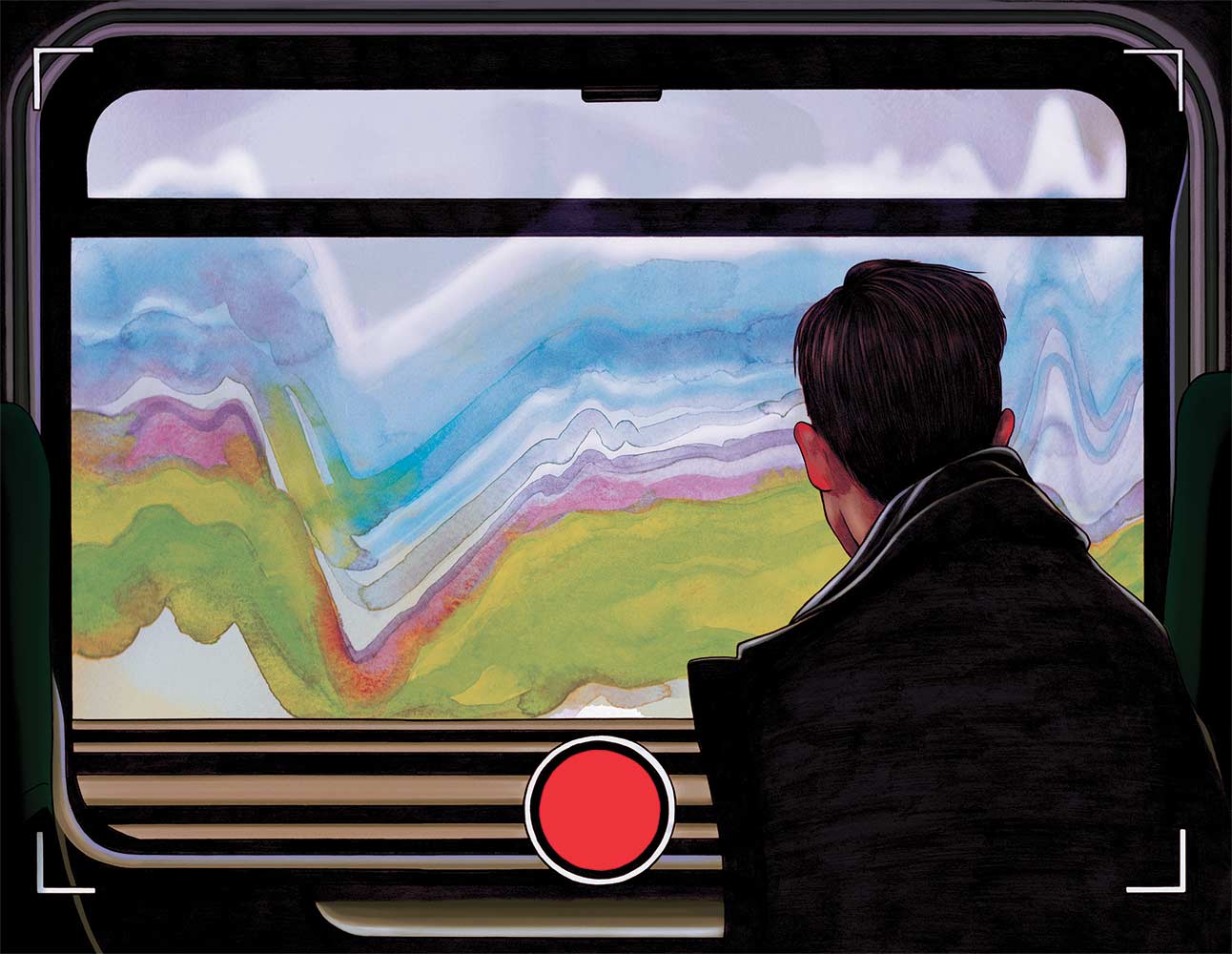
Transcription opens with the unnamed narrator texting his wife to check in on their daughter. Naturally, he is anxious about her anxiety. The narrator is texting rather than talking to his wife, we learn, because he is on an Amtrak train to Providence to interview the 90-year-old Thomas, one of “the world’s most renowned thinkers about art and technology,” who is also the narrator’s mentor and the father of his old college friend Max. Before he checks into a four-star hotel, paid for by the magazine in which the interview will appear, the narrator notices two people sleeping on the sidewalk—or, as he puts it, the “bare life on the street.” The throwaway phrase kills two birds for Lerner: It establishes his protagonist’s credentials as a progressive sickened by the inequality of contemporary life and as an intellectual who knows his Agamben.
Like his predecessors, the narrator of Transcription is a highly educated and very guilty liberal. He knows that we inhabit a depraved and dying world—war, wildfires, terrorism, and poverty abound—that allows people like him to have money and houses. He lives in comfort, complicit. When he meets an old acquaintance on the street, they ritualistically express their guilt—“We exchanged some familiar language about the disaster of the world”—before catching up on what’s happening with their shared acquaintances.
Appropriately, the instigating event in this novel is not a geopolitical catastrophe but a domestic mishap: After washing his face in the hotel bathroom, the narrator drops his phone into the clogged sink and breaks it. This occasions panic—he now has no way to record his interview with Thomas—but before he is forced to confront this “crisis,” he must endure the immediate difficulties of being unexpectedly offline. He can’t find the hours of the local Apple Store, he doesn’t remember Thomas’s phone number, and he can’t look it up. He has been locked out of an entire universe. After some initial frustration, though, his newly offline state induces a sort of euphoria, “a withdrawal indistinguishable from mild intoxication.” Now that he can’t take photographs or read the news, he is able to pay attention to the world again.
But when he reaches Thomas’s home, he has to figure out how to handle the interview sans device. Immediately, it becomes apparent that this will not be a straightforward endeavor. First, the narrator inexplicably refuses to tell his mentor about the broken phone—“to tell him the truth seemed impossible”—so he lies and pretends he is recording their conversation. Then, from the opening question on, it is clear that Thomas is no normal interviewee: He is a force of personality, a man for whom “to listen to a story was to become involved in its composition.” When the narrator shares an anxious dream about his daughter, Thomas tells him that it might actually be his—that is, Thomas’s—dream. Once the conversation gets going, the narrator has trouble staying in control. But as the evening progresses, it also becomes clear that this great intellectual has started to lose some of his faculties. His memory is faulty: “I lose the numbers and the names,” Thomas explains. The narrator notices that his mentor’s kitchen is in a state of neglect and that he repeats himself without realizing it. Most troubling of all, Thomas starts to confuse the narrator with his son Max. He levels accusations at Max, and the narrator tries unsuccessfully to correct him: I am not Max; I am me.
After the fraught interview ends, the narration jumps in place and time. We are now in Madrid, at least several months later, and the narrator has just finished giving one of several talks at a gathering to honor Thomas. The old man, we are given reason to believe, recently ended his life at an assisted-suicide clinic in Switzerland. Like Adam in Lerner’s debut novel, Leaving the Atocha Station, the unnamed narrator of Transcription wanders through the streets of Madrid and begrudges the stylish ease of Europeans. But now the married father’s envy is directed elsewhere: to the children running loose on the streets and the carefree style of European parenting.
Our narrator is no longer sans phone. He’s already back under its thumb: e-mailing, Googling, texting. Before dinner with the other speakers, he calls his wife, Mia, to check in on her and their daughter Eva:
Then I FaceTimed Mia, who was having lunch in Washington Square Park; she held up her phone so I could see the gathering of the Neturei Karta men beside the fountain, their free Palestine signs. The sky behind her—or, depending on the position of her phone, above her—looked blue and cloudless, identical to the sky in Madrid. There was drumming somewhere nearby. I told her the talk went well. It must have been hard, she said. Not really. I don’t know. Maybe. I asked about her day, after Eva, who was fine, more than fine, Mia said, a lot of laughter in the morning and at bedtime, although Eva had recently told us to stop saying bedtime.
A hallmark of Lerner’s fiction is the very particular way that politics encroaches, or rather doesn’t, on the life of the protagonist and his milieu: It is there as a backdrop, a marker of time and place but not much else. As in Leaving the Atocha Station, where Adam arrives in Spain shortly after American troops have invaded Iraq, and in 10:04, which opens with Hurricane Irene, closes in the aftermath of Hurricane Sandy, and includes a cameo by an Occupy protester, significant political events in Transcription, such as the wars in Gaza and Ukraine, are alluded to throughout the narrative. The events of Transcription unfold while Israel and Russia are murdering civilians without consequence, but the novel doesn’t dwell on it. Instead, we move swiftly from the horrors of the present political moment to aesthetic observations about cloudless blue skies and the personal and familial.
Politics is mere background texture because Lerner’s novels are primarily tales of personal misadventure. In this section, the focus is the talk that the narrator just gave and how it was received. Over the course of a conversation between him and the female art curator who had organized the gathering, we discover that the talk that the narrator gave, in which he recounts not recording Thomas during their interview, angered many in attendance, including his old friend (and Thomas’s son) Max. “Trust me,” the curator assures him, “Max is furious.”
Popular
“swipe left below to view more authors”Swipe →The curator asks what many readers are surely thinking: Why did you go ahead with the interview if you couldn’t record it? Why didn’t you just tell him that your phone was broken? She offers the narrator her theory: You are a coward, desperate to impress your mentor and still afraid of disappointing him. Bewildered at first, the narrator eventually recognizes that she has a point: “I had the sense that the text was, at that instant, rearranging itself—that what had been some personal introductory remarks about my foolishness, my always acting like a clumsy student around Thomas, was recomposing itself into a startling confession I’d have to confront when I went upstairs.”
Here, the novel rearranges itself. Until this point, a reader may have assumed they were reading autofiction—a fair assumption, especially since, alongside Sheila Heti and Karl Ove Knausgård, Lerner is frequently hailed as one of the leading modern practitioners of the genre. But this has always been an inaccurate, or at least incomplete, description of his fiction. Lerner’s novels also belong to various other literary traditions: conceptual novels, introspective novels of ideas, novels of futurity, novels about masculinity, the anti-hero novel, to name a few. Transcription has elements of each of these genres, but it is perhaps primarily a metafictional experiment—a meditation on fiction itself.
Each of Lerner’s four novels is haunted by a different literary giant: John Ashbery in Leaving the Atocha Station, Walt Whitman in 10:04, Hermann Hesse in The Topeka School, and Franz Kafka in Transcription. As Kafka does, Lerner calls attention to the construction, status, and effects of fiction in his latest novel, asking us to contemplate the procedure of fiction through a discussion of Leopold and Rudolf Blaschka’s otherworldly collection of glass models known as the Glass Flowers.
Early in Transcription, the narrator explains how he was able, on a visit to the Harvard Museum of Natural History as an undergraduate, to switch at will between seeing the glass models of rotting fruit as both real (that is, as the fruit itself) and artificial (as representations of the fruit). Lerner invites us to do the same as we read Transcription and, more broadly, to recognize that this is how fiction works. To read fiction, he suggests, is to move fluidly between the two modes of seeing—it is fake; it is real. This is what makes fiction magical: It bestows on us a double vision and the ability to contemplate paradox.
Lerner’s debt to Kafka is most apparent in the third and final section of the novel, which is told entirely in direct speech. The narrator, relegated to the role of listener, here yields the mic to his friend Max. The scene has shifted once again: We are now at Max’s house in Los Angeles, and his monologue again remakes how we understand what has come before. Like all of Kafka’s fiction, Lerner’s Transcription is seductively frustrating.
Much like his friend the narrator, Max is very concerned about his young daughter Emmie, who has an eating problem. Doctors have offered acronyms for her condition—FTT (Failure to Thrive), ARFID (Avoidant/Restrictive Food Intake Disorder)—but no explanations or solutions. Max and his wife are locked in a nightmare. They plead, they shout, they take their daughter to therapy, they consult the ARFID oracle of LA. Nothing helps. It is a tremendously sensitive portrait of an excruciating experience. There is something hypnotic about Max’s detailed account of Emmie’s struggles and his increasingly desperate attempts to coax her to eat something, anything.
Max confesses that at times Emmie’s refusal of food appears even to him to be “some kind of horrible performance art.” It was as if “she was a patiently suffering messenger,” he tells his old friend, “like her suffering had some obscure meaning that had not been revealed.” But even though Max entertains doubts about his daughter’s behavior, he cannot tolerate anybody else suggesting that she is anything except sick. When his father, Thomas, on a trip to LA to receive a big prize, draws the obvious literary parallel to Kafka’s story “The Hunger Artist,” Max reacts with fury: “Before the word ‘Hungerkünstler’ was fully out of his mouth, before he could quote his beloved Kafka at me…I snapped at him in German: This is not fucking theater, Dad, this isn’t art or literature, Emmie isn’t a character in a fiction, she’s my fucking daughter.”
Max harbors unresolved anger and resentment toward his father, but he is also devoted to him. As he switches from telling the narrator about Emmie to talking about his father, Transcription reveals yet another layer of complexity: It is also a Covid novel. Through Max’s voice, Lerner registers different phases of the pandemic, from the early lockdown rituals of disinfecting vegetables (“Now the extremity of our caution embarrasses me”) to mid-pandemic decisions like adopting rescue puppies to the period of optional masking and a return to eating at restaurants. In the most moving scene of the novel, Max recounts a virtual visit in April 2020 with his hospitalized father, conducted first on Zoom and then on a kind nurse’s personal phone. It is a powerful and devastating account of what so many people across the world had to endure not very long ago.
Formally, Max is a character distinct from the narrator, but he also functions as a double for the narrator. The similarities between the two are almost too many to name: Both men are worried about their children and anxious that they may not be good enough as fathers. Both men are concerned that the “disasters of the world” may be affecting their daughters’ mental and physical health. Both men are, to use Max’s phrase, “self-loathing elites”: They are hyperaware of their positions of privilege and suitably ashamed. But like all of Lerner’s men, their guilt doesn’t stop them from thinking and talking about themselves. When Thomas mixes up the two in the first part of the novel, his confusion appears solely as evidence of his mental deterioration, but the more Max speaks, the more it seems that these two men are interchangeable. The narrator is Max; Max is him.
Max recognizes this mutual imbrication, and it manifests itself in their every interaction. Almost every time the narrator interjects, Max doesn’t let him finish his sentence. When the narrator mentions that he once ate sauerbraten at Thomas’s house, Max insists that this is impossible; his father never cooked that. His verbal aggression—the interruptions, corrections, and refusal to yield back the mic—is indicative of Max’s desire to establish that he is Thomas’s real son and that the narrator is an interloper. When he recounts a promise that he made to his father on that awful Zoom call—“I will manage it all, your things and your work and your stories and your voice”—we understand exactly why he might be so angry at the narrator. Soon, he makes his insecurity explicit: On his next trip home, Max confesses, “I felt perhaps as intensely as ever—the unheimlich. Maybe the real son would just come downstairs, maybe you were the real son, maybe I was the clone or robot or doppelgänger.”
If Kafka’s “The Hunger Artist” is one touchstone in Transcription, then “The Judgment” is the other: Like that story, Transcription offers a study of the complex dynamics between a father and a son, and between a father and the son’s friend. (Like the father in “The Judgment,” Thomas is both frail and preternaturally robust.) But the story I thought of most often when reading Transcription is one of Kafka’s shortest, “The Trees.” Here it is in full: “For we are like tree trunks in the snow. In appearance they lie sleekly and a little push should be enough to set them rolling. No, it can’t be done, for they are firmly wedded to the ground. But see, even that is only appearance.”
If you read the first line in isolation, the trees seem vertical, but then the second line turns them horizontal and the third stands them back up again. The fourth leaves you questioning the third—a literary duck-rabbit. As with the glass flowers, we can see two things at once. Most readers of Kafka’s story want to know: Which one is it? In a way, it’s an odd impulse—there are no trees; it’s all made up!—but it is also unavoidable. This is how we all read stories: We want to know which of the fictional facts are true.
All of Lerner’s novels provoke the desire to discover the truth of the fiction, but perhaps none more so than Transcription, his most experimental and unsettling book yet. Each of the novel’s three sections is named after a real hotel: the Hotel Providence in Providence, the Hotel Villa Real in Madrid, and the Hotel Arbez, which is located on the border between France and Switzerland. Although the final section of Transcription takes place in Los Angeles, the Hotel Arbez gets naming rights because it is a site of contested memory between father and son and the narrator. The reader gets conflicting versions of a story about a long-ago trip to the hotel. We want to know which of the fictional facts are true.
All of this makes for delicious reading, but is that enough? Critics often start their ecstatic reviews of Lerner’s fiction by confessing that they expected to hate his novels—that, in fact, they wanted to hate them because they typically don’t like autofiction, particularly not autofiction by straight white American men, and certainly not autofiction by straight white American men who live in Brooklyn and write about the large advances handed out by New York publishers. But, they insist, despite all this, Lerner is simply too good to dislike his work. He is a brilliant stylist; he understands the power of language as only a poet can; by wielding language the way he does, he makes us reconsider not just what fiction is but also what it can be. As a result, all narcissism is forgiven.
In many ways, these critics are right: Lerner’s prose is terrific. He writes with unrivaled elegance about the rhythms and textures of modern bourgeois life. Here, for instance, is his description of the moments after the narrator drops his phone in the clogged sink:
I tried to dry it with a towel but my screen was cracked in places and the liquid had seeped in; I watched it spread, like the solution across a rapid antigen test. The screen wouldn’t respond to my touch except to blur a little where I pressed it. The home-screen image of Eva and Mia and Luna was growing abstract around the edges.
I rushed out of the bathroom and did a terrible thing: I plugged it in, perhaps with the childlike instinct that power would help it dry. An error message—I could make out a yellow triangle in a gray box—appeared on the screen when I inserted the cable, and then the phone went black mirror. I carried it in my palm like a small, wounded animal back into the bathroom and removed the wall-mounted hair dryer from its charger.
There is a lot to admire here: Lerner’s ingenious use of a Covid test to capture the interaction between water and the diodes of the display, the subtle deployment of the adjective terrible to capture the narrator’s hysteria, the explanation that the panic has caused the narrator to momentarily revert to childhood. But “like a small, wounded animal” is stunning. In just five words, Lerner captures the irrational tenderness with which we sometimes treat inanimate objects in moments like these, as if maybe being gentle might nurture the phone back to life. In “A Defence of Poetry,” Percy Bysshe Shelley wrote, “Poetry lifts the veil from the hidden beauty of the world, and makes familiar objects be as if they were not familiar.” Lerner might write novels now, but in this sense, he remains one of our great poets.
And yet even this doesn’t feel like enough. In a rare critical review (published in these pages), Jon Baskin asked why it is that Lerner’s fiction appeals so universally. Or rather, why do the type of people who write reviews for literary magazines love Lerner so unequivocally? Baskin makes a powerful argument: that Lerner is the “leading practitioner of the novel of detachment.” His protagonists embody a certain kind of detachment pervasive among liberal elites. For them, caring about politics is vaguely embarrassing. Baskin is careful not to argue that Lerner’s novels are pro-detachment or pro-indecision; in fact, he notes that they are critical of both. But ultimately, Baskin says (stealing a phrase from Lerner), this is just art as stylized despair.
I agree. But I also want to suggest an alternative hypothesis, or at least a supplementary one, about Lerner’s widespread appeal. The attraction is not—or not only—because his protagonists are models of detachment, but rather because they are motivated by the specter of shame. They are constantly embarrassed or worried that they will be embarrassed soon. They know they should be ashamed—of their lavish bourgeois lives, their insecurities, their desires, their failures, their successes—just as we know we should be. And their shame appeals to us because we have entered an era when the men and women running things are not just shameless but seemingly shame-proof. It makes sense, then, that liberals want a protagonist who is still capable of feeling remorse. But on its own, shame isn’t political. After all, Lerner’s protagonists are ashamed mostly of their petty desires. Worse, their shame is what prevents them from participating in political life. They are so worried about being embarrassed, so terrified that commitment is cringe, that they do nothing but notice that the world is fucked.
The final scene of The Topeka School, in which Adam and his family attend a protest against ICE, suggested that the Lerner protagonist was starting to find a way out of his immobilizing sense of embarrassment. Adam finds the chanting a little mortifying, but (progress!) he still soldiers on. Yet today, even this feels too little and too late. In our age of political shamelessness and state violence, is polite singing really enough?
Last June, the landing page of The New York Times had two articles side by side. On the left, the headline read “The Lethal Risk of Seeking Food in Gaza”; on the right, “The 21 Best Croissants in New York Right Now.” Lerner’s protagonists are likely to be found making small talk about the depravity of war as they park their strollers outside the bakery ranked second on the list.
It might be possible to read Lerner’s fiction as an indictment of these guilty liberals, but I don’t buy it. Surely it is possible to act on rather than become mired in one’s guilt? And are you really feeling guilty if all you do is think about yourself? This might seem unfair. But Lerner’s fiction invites this judgment, for his artist-protagonists are tormented by the power of art. They can’t decide if it is futile (what could it possibly do?) or if it is the most important weapon we have. If there is even the slightest chance that it is the latter, perhaps one of the most talented novelists working today could write fiction that does more than just contemplate itself.
More from The Nation
The Worlds of Jamaica Kincaid The Worlds of Jamaica Kincaid
Memory pervades a new collection of nonfiction, and so do the ghosts of empire.
Jay McInerney’s Yuppie New York Jay McInerney’s Yuppie New York
The novelist has spent a career mocking and romanticizing the lifestyle of New York's bourgeoisie. Now, in his latest, he examines them as they come to the end of their lives.

Fact-Checkers Anonymous Fact-Checkers Anonymous
Getting a job at The New Yorker felt like an arbitrary stroke of luck. Getting fired was quite the opposite.
Alejandro Cartagena’s Mexico in Flux Alejandro Cartagena’s Mexico in Flux
Reminiscent of the New Topographics, the photographs of Cartagena and others captures a country in the midst of a geographic transformation.

The Hidden Crisis of Addiction Treatment The Hidden Crisis of Addiction Treatment
In Rehab, Shoshana Walter investigates the corruption and abuse rife in the business of drug rehabilitation.
Rock and Roll’s Dutch Old Master Rock and Roll’s Dutch Old Master
How Anton Corbijn’s photographs shaped the history of rock music.

