All Dirt Roads Taste of Salt: A Masterpiece of American Southern Filmmaking
“All Dirt Roads Taste of Salt”: A Masterpiece of American Southern Filmmaking
Raven Jackson’s remarkable debut is a poetic look into Black family life in the South.
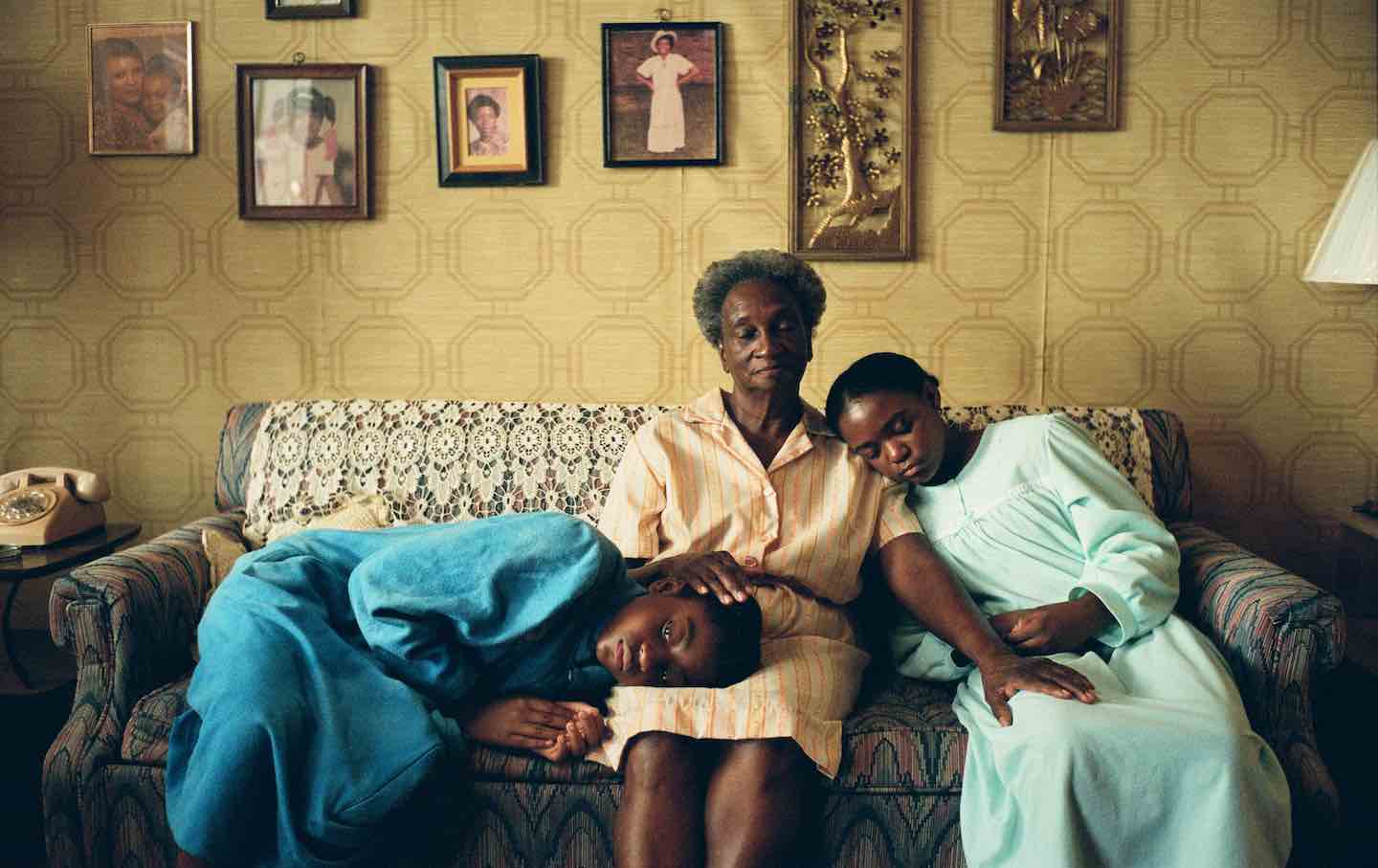
Kaylee Nicole Johnson, Jannie Hampton, Jayah Henry in All Dirt Roads Taste of Salt.
(Photo by Jaclyn Martinez / A24)A pastoral scene opens Raven Jackson’s debut feature, All Dirt Roads Taste of Salt: We find Mack (played as a child by Kaylee Nicole Johnson), a pensive little girl in pigtails, crouching by the riverside as her father, Isaiah (Chris Chalk), gives her a fishing lesson. An otherwise quotidian episode comes alive in the details. To her father’s chagrin, Mack slides a curious finger over the slick, wet scales of a gasping fish, freshly plucked from the water. A layered soundscape maps the bucolic environs—the Mississippi countryside, it turns out—and sparse dialogue gives way to an indigenous orchestra: a cacophony of cicadas, the chimes of slow-moving water, chirping crickets.
A deceptive minimalism scaffolds Jackson’s sprawling profile of Mack from her childhood (sometime in the 1970s) to middle age. The writer-director does not generally trouble herself with the granular demands of what might ordinarily pass for plot, and her characters do not squander words where sensoria would so obviously prevail. The film traces Mack’s life in oblique portraiture: lilting, observational vignettes, ornately composed of lush, slow-moving shots attuned to the minutiae of living. Jackson largely dispenses with a straightforward timeline and sketches the years with exquisite bursts of feeling: a toddler pressed warmly to her mother’s chest; a smattering of raindrops upon outstretched arms; the tightness of more than one lingering embrace.
For all its experiments in form and structure, the film does have a shape: memory. We float from one sequence to the next, as if to conjure the way remembrances invariably fall out of context, until the past eases into something more like reverie. It’s a fitting method, one less concerned with chronology than with preservation, a mosaic of Southern Black domesticity and, therefore, an archive of survival.
The whole of the South is a living (haunted) museum that boasts, among its many feverishly hoarded artifacts, ancient architecture, vernacular, and traditions. For better or worse, preservation has always been a virtue. And for Black families in particular—cleaved from their origins, systematically dispossessed—every exercise in memory-keeping becomes sustained defiance. In another scene, Mack and her mother, Evelyn (Sheila Atim), take to the roadside, where they excavate clay pebbles from deposits beneath the surface soil. Clay-eating, a broadly (though not exclusively) Southern phenomenon among whites as well as Blacks, has been a practice for generations (you can still find parcels of kaolin for eating sold at certain stores and markets throughout the region). There is some contention among anthropologists and scholars as to why or what function dirt-eating serves, but none can deny that by its very pattern it announces hermetic bonds shaped by ancestral arcana, whether they descend from Africa or South America. And is there a better way to anchor yourself to home than with the taste of the very soil beneath your feet?
Much of the film is devoted to private moments of pedagogy—how to fish, how to prepare the fish, how to eat dirt—an informal kind of knowledge that relies on community and is therefore fundamentally alive. Memory moves from the private to the collective here, at once intimate and tribal. This was, for centuries, the only way to record history: not with the pen, but with the body. Mack and her sister, Josie (Jayah Henry), kneel at their grandmother’s feet as she tells them, “My ma used to put a little bit of dirt in my hand. ‘This you,’ she said. Dirt and water. Her mama had said the same to her.” Heritage and personal history, in action, are often an ongoing ritual that continually restages the past, transforming habit into ceremony, something sacred and precious. Remembering, then, becomes not merely the film’s rhythm but its core project. Later, a grown-up Mack (now played by Charleen McClure) welcomes her own newborn with hushed reverence: “You’re made of dirt, you know that? And water.”
It would be impossible to deliver dirt and water entirely from the confines of symbolism: the not insignificant gestures to Communion, for example, and agriculture (and all that, regionally and racially, that entails). The film certainly lends itself to these poetics. Jackson, a poet and photographer, no doubt operates with these modes in mind. In her poetry (including the poem from which the film takes its name), she frequently returns to the dense romance of nature: for example, “Plants Mama should have swallowed as seeds swelled from mud like legs…” in her poem “After Fire,” or “but all you see are cornfields and the triangle of light you had your first kiss under” in “axe #6.” All Dirt Roads Taste of Salt , then, promises something compelling in its wedding of poetics and photography: We come to understand the history of Black people in this country—the story of their displacement and the miracle of their survival—at a visceral level, as a tale of water and earth.
Few filmmakers have really managed to capture the peculiar temporal condition of existing in the South, everywhere surrounded by hauntings and mired in its rambling malaise. The languorous cadence that Jackson’s film adopts appears to have vexed some critics, but such a rhythm is characteristic of Southern living: that is to say, shrinking from time (among its foremost regional enchantments), unhurried in pace. In any case, All Dirt Roads Taste of Salt can count certain notable forebears. Its most vividly discernible influence, Julie Dash’s Daughters of the Dust (1991), is narrated by an unborn child as her pregnant mother and her women kin retell their individual and shared histories. Past and future spill into the present; time becomes cyclical and synchronous rather than linear. Jackson’s film also contains echoes of Terrence Malick, that other famous master of time-bending, who has faced many of the same critiques (opacity, an elliptical form known to exasperate his viewers). There is, too, a thematic and—if not quite stylistic—certainly a formal kinship with the work of Louisiana-based filmmaker Garrett Bradley, whose films America (2019) and Time (2020) similarly concern the project of archiving (fundamentally disrupting conventional structures of time) and Black domesticity.
In a testament to the sophistication of her perspective, Jackson distinguishes her debut feature by sculpting a sumptuous vision of arcadia with the aid of cinematographer Jomo Fray, who worked with the director on her short film Nettles (2019), and editor Lee Chatametikool (Apichatpong Weerasethakul’s longtime collaborator), who lends his dreamy contours to the film. Far from an ecological project, All Dirt Roads Taste of Salt revels in the cavernous realms of human intimacy. Mack watches her parents embrace as they dance, their arms intertwined, each one’s hands stacked atop the other’s, transported in a crowd. She also watches rapt as her mother applies bright red lipstick in the bathroom, another moment of archival reproduction or ritual of identity-building. Half-veiled by arching stalks of grass, Mack lies back-to-back with her childhood sweetheart, Wood (played as a boy by Preston McDowell), their ears pressed keenly to the ground. In another scene, as her distracted mother gazes at the ongoing party, Mack’s finger grazes Evelyn’s polished toenail. When Mack, a grown woman again, reunites with Wood (now played by Reginald Helms Jr.), their eyes weighted with all the unknowable years in between, it is their hands that embody the film’s overarching premise. After a prolonged, aching embrace, the camera hones in on their interlaced fingers—and when Wood finally departs, one last shot sinks to capture the somber emptiness of Mack’s hands, dangling at her side. By now we know her journey includes—as all lives must—triumph and loss; great tragedy, but also indescribable joy.
Support independent journalism that does not fall in line
Even before February 28, the reasons for Donald Trump’s imploding approval rating were abundantly clear: untrammeled corruption and personal enrichment to the tune of billions of dollars during an affordability crisis, a foreign policy guided only by his own derelict sense of morality, and the deployment of a murderous campaign of occupation, detention, and deportation on American streets.
Now an undeclared, unauthorized, unpopular, and unconstitutional war of aggression against Iran has spread like wildfire through the region and into Europe. A new “forever war”—with an ever-increasing likelihood of American troops on the ground—may very well be upon us.
As we’ve seen over and over, this administration uses lies, misdirection, and attempts to flood the zone to justify its abuses of power at home and abroad. Just as Trump, Marco Rubio, and Pete Hegseth offer erratic and contradictory rationales for the attacks on Iran, the administration is also spreading the lie that the upcoming midterm elections are under threat from noncitizens on voter rolls. When these lies go unchecked, they become the basis for further authoritarian encroachment and war.
In these dark times, independent journalism is uniquely able to uncover the falsehoods that threaten our republic—and civilians around the world—and shine a bright light on the truth.
The Nation’s experienced team of writers, editors, and fact-checkers understands the scale of what we’re up against and the urgency with which we have to act. That’s why we’re publishing critical reporting and analysis of the war on Iran, ICE violence at home, new forms of voter suppression emerging in the courts, and much more.
But this journalism is possible only with your support.
This March, The Nation needs to raise $50,000 to ensure that we have the resources for reporting and analysis that sets the record straight and empowers people of conscience to organize. Will you donate today?