
Elevators and Escalades
The rise of New York’s super-tall luxury buildings.
What’s the Deal With Manhattan’s Pencil-Thin High Rises?
A walk along 57th Street.
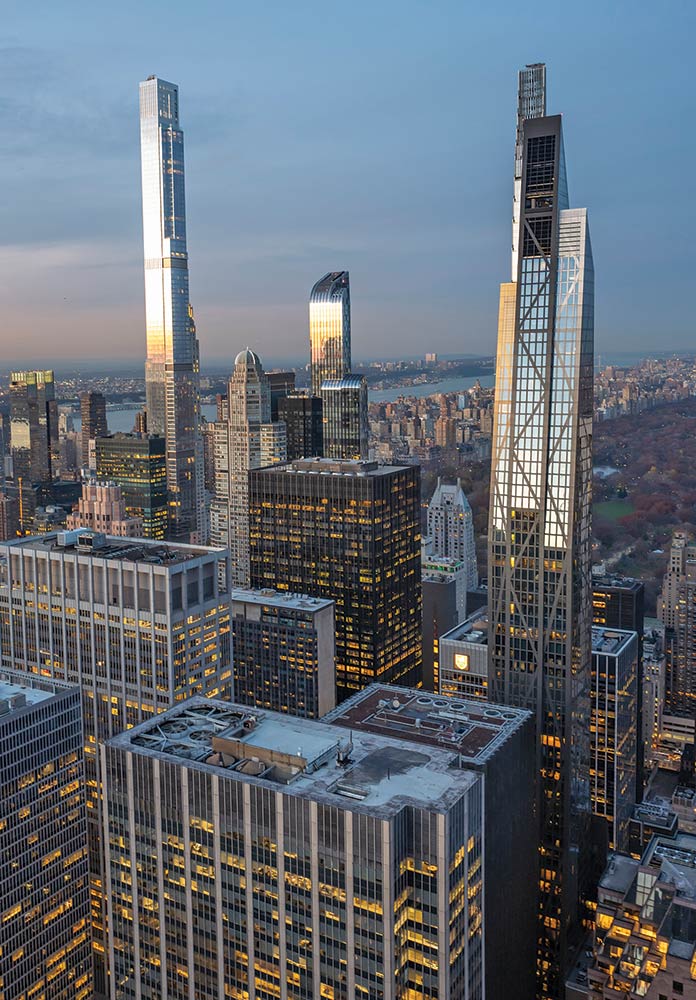
In Billionaires’ Row, a book by the Wall Street Journal reporter Katherine Clarke, we are presented with a riveting narrative in which the heroes of her account, the developers Harry Macklowe and Gary Barnett, race to build the city’s first very tall and exceptionally skinny condo towers. And when I say “very tall and exceptionally skinny,” I mean it: Macklowe’s project, at 432 Park Avenue, was planned to be a soaring 1,397 feet in height, while Barnett’s project (known as One57), at 157 West 57th Street, was just over 1,000 feet tall. And because these buildings are so much taller than they are wide, some unorthodox engineering was needed just to keep them standing upright: 432 Park, for example, has five double-height floors open to the elements to allow the wind to pass right through.
To those who follow New York City’s real-estate high jinks, Macklowe and Barnett were already well-known. Back in 1985, Macklowe achieved tabloid infamy by bulldozing a string of Times Square single-room-occupancy hotels to make room for a 38-story luxury hotel, just days ahead of a city moratorium on the demolition of this much-derided (but inarguably necessary) form of low-cost housing. Barnett, the chairman of a company called Extell, is no slouch either: He achieved his notoriety during Superstorm Sandy, when a damaged crane dangled from the roof of One57 and took a solid week to be properly secured.
Yet, as Clarke documents, the greatest challenge the two men faced in their race to finish the city’s first super-tall condo tower was money: It was very complicated to assemble the financing and, not incidentally, to buy the air rights from surrounding properties, which, under New York City’s zoning rules, would allow them to build taller than the floor-area ratio (or FAR) would otherwise permit.
One problem for both developers was that they were cobbling together financing in the wake of the 2008 mortgage meltdown, which meant that banks were not eager to lend—especially for speculative projects like outrageously slender towers for the superrich. Macklowe, at a certain point, tried to partner with an entity called CMZ Ventures. The “M” stood for Paul Manafort, Donald Trump’s future campaign manager, who brought in a potential backer for the project, Dmytro Firtash, a Ukrainian oligarch with alleged connections to the Russian mob. Firtash said he would provide $112 million in equity to help Macklowe, but the funds never arrived. A 2011 civil suit alleged that Firtash and his cronies were using supposed real-estate deals to cover up a money-laundering scheme; while the suit was ultimately thrown out, the gambit found its way into special counsel Robert Mueller’s investigation. Eventually, Macklowe’s financing would come from a Los Angeles–based private-equity fund called CIM. Barnett’s search for a backer, meanwhile, led him abroad, to an investment fund based in Abu Dhabi.
Clarke’s chronicle of these high-profile developers doing backflips to attract investors reminds me of a similar story I once wrote—except mine wasn’t about funding luxury condos but about the labyrinthine process of funding affordable housing. The obstacle in this case wasn’t the refusal of banks to lend, but rather that we no longer build new public housing in the United States, so low-cost homes can be built only via a labor-intensive process of securing tax breaks and vouchers. As the noted for-profit affordable-housing developer Jonathan F.P. Rose told me, a typical project requires six to 12 funding sources. An affordable-housing developer in New York often gets funding in the form of the low-income housing tax credits created under an arcane system in which major corporations can reduce their tax bills by funding low-cost housing.
All I could think while reading about the genesis of Billionaires’ Row in midtown Manhattan is that, in a sane world, corporations (and billionaire condo owners) would simply pay taxes and the government would directly fund low-cost housing. And guys like Macklowe and Barnett might even be killing themselves to build housing for people who want a decent place to live rather than a safe place to park their money.
Ours, however, is not a sane world. So the competition between these two developers to build the city’s first super-tall luxury apartment tower didn’t do anything to alleviate the shortage of housing for actual New Yorkers. Instead, it spawned more such towers and kicked off an aggressive reinvention of West 57th Street, a crosstown thoroughfare that has never been exactly one thing or another. In the past, it was known primarily for a motley assortment of high culture (Carnegie Hall, art galleries, the Art Students League), low culture (remember Planet Hollywood?), and eateries that—with the possible exception of the Russian Tea Room—were not generally regarded as destinations.
Many people I know, or that I encounter on social media, are outraged by how the towers of Billionaires’ Row distort the city’s skyline. The buildings are so tall that they’re hard to miss, but so skinny that they look more like a row of smokestacks. They possess a dystopian weirdness that suggests to me they were designed more by software than by human architects—and that the software might have made a miscalculation or two.
Admittedly, I have a genuine affection for the late Rafael Viñoly’s 432 Park: It’s the one skinny tower that, from the outside at least, has some aesthetic coherence. (Its inner workings, as reported by Stefanos Chen of The New York Times, are another matter altogether: The building has been plagued by flooding, elevator problems, and weird noises. Also, the ultrarich, it seems, don’t like each other any more than they like the rest of us: “Everybody hates each other here,” one condo owner told Chen.)
But what offends me about these towers is not the skyline they’ve created, but how they behave at street level. Specifically, I’ve thought a lot about what happens to a midtown Manhattan street when it’s remade for people who don’t live or work there and who come and go intermittently via the massive black Suburbans and Escalades that are perpetually idling near the front doors.
A couple of years ago, I took my School of Visual Arts grad students for a walk that began at Columbus Circle, then followed 57th Street to Park Avenue and headed south to Grand Central. Along the way, we looked carefully at each of the new condo towers, paying attention to how they were designed and how they functioned at street level. Then, on Park Avenue, we looked at the mid-century modernist icons built as corporate headquarters—Lever House, the Seagram Building, Pepsi-Cola—that were at one time as controversial as the super-talls that line Billionaires’ Row.
The thing we realized as we walked around is that West 57th is something of a ghost town. Of course, there are people on the street, because it’s still Manhattan. But those who shelled out tens of millions for their apartments (the top asking price was $250 million for the Central Park Tower penthouse, later reduced) are not exactly promenading types.
Then, as we strolled down Park Avenue, stopping to discuss each significant building, it became apparent that the corporations that built them had deployed their wealth in a way that was more inclusive. Or, at least, those buildings came with generous plazas that were available to anyone who wanted to linger. The emaciated towers of 57th Street, on the other hand, are only for those who have bought into them. The emphasis of the marketing websites for these buildings is, of course, on the gloriousness of the interiors: luxe finishes, stupendous views, and amenities like “the highest private ballroom on the planet.” But the main selling point—the asset that developers, according to Clarke, have sued each other over—is the view of Central Park. This public place, the amenity that none of these developers with all their machinations can offer exclusively, is precisely what they’re selling. What the oligarchs are spending tens of millions to purchase is something that, in truth, belongs to you and me. So it seems reasonable to wonder about the impact that these very private towers will have on the public realm that makes them so valuable.
There are some good things that have come from the construction of the super-talls. For example, the Central Park Tower has New York’s first Nordstrom’s at its base. And it’s a nice enough department store. But mostly, the real-estate deals that were necessary to build these towers erased many of the businesses and shops that were the lifeblood of the street. The landmark Steinway Hall, formerly home to a famed piano showroom, is now the entryway to 111 West 57th and houses a health club for the billionaires upstairs. Signs in the window advertise unleased retail space.
On the next block east, there are four tremendous vacant lots, an unusual circumstance in midtown. One of them, on the north side of the street, is slated to become a 1,100-foot-tall condo tower—renderings show an elongated wishbone—with a hotel on the lower floors, developed by Sedesco and designed by the Dutch architecture firm OMA. Another vacant lot, next door to the Solow Building, a 1970s office tower with a sloping façade, is jointly owned by the developers LeFrak and Vornado. About a decade ago, they demolished three older buildings, including the beloved 109-year-old home of Rizzoli Books. At the time, it was assumed that the site was being cleared for another addition to Billionaires’ Row. But sales on the extravagant condos have slowed considerably; one recent report said that 23 percent of the sponsor units in the towers remain unsold, and if you count the owners trying to resell their apartments, that means something like 50 percent of the units are currently on the market.
Popular
“swipe left below to view more authors”Swipe →As it turns out, 432 Park—my favorite on the skyline—is the one that works best at street level. Yes, the building is a fortress, with a forbidding garage entrance and black SUVs parked on the marble slabs out front. As Clarke notes in her book, the “builders installed sliding wooden pocket doors separating the front desk area, which was visible to outsiders, from the elevator banks,” allowing residents to wait for an elevator hidden from the prying eyes of the public. But 432 Park, like Seagram or the Lever House, at least has a privately owned public space (or POPS, as they’re known), which is usually the result of a deal made between the developers and the city that allows for things like more building height in exchange for a parklet. It’s an attractive one, too, with Bertoia chairs and little round tables, and paved with the same slabs of marble that surround the tower’s entrance.
However, even this unusually generous (by Billionaires’ Row standards) handout to the plebs betrays a degree of antipathy. The plaza out front comes with the longest list of restrictions I’ve ever encountered in a nominally public place. The sign begins with a warning: “Disregard of the rules may subject you to removal.” The forbidden activities include almost anything you could possibly do other than sit very, very quietly: tree climbing, relocating furniture, distribution or posting of any literature, sound amplification, bird feeding… “All packages,” the sign notes, “are subject to screening or removal at owner’s expense.” The list is so draconian that it is unintentionally revealing, exposing the chasm between those who see this city as something that belongs to all of us, and those who have never learned to share.
Support independent journalism that does not fall in line
Even before February 28, the reasons for Donald Trump’s imploding approval rating were abundantly clear: untrammeled corruption and personal enrichment to the tune of billions of dollars during an affordability crisis, a foreign policy guided only by his own derelict sense of morality, and the deployment of a murderous campaign of occupation, detention, and deportation on American streets.
Now an undeclared, unauthorized, unpopular, and unconstitutional war of aggression against Iran has spread like wildfire through the region and into Europe. A new “forever war”—with an ever-increasing likelihood of American troops on the ground—may very well be upon us.
As we’ve seen over and over, this administration uses lies, misdirection, and attempts to flood the zone to justify its abuses of power at home and abroad. Just as Trump, Marco Rubio, and Pete Hegseth offer erratic and contradictory rationales for the attacks on Iran, the administration is also spreading the lie that the upcoming midterm elections are under threat from noncitizens on voter rolls. When these lies go unchecked, they become the basis for further authoritarian encroachment and war.
In these dark times, independent journalism is uniquely able to uncover the falsehoods that threaten our republic—and civilians around the world—and shine a bright light on the truth.
The Nation’s experienced team of writers, editors, and fact-checkers understands the scale of what we’re up against and the urgency with which we have to act. That’s why we’re publishing critical reporting and analysis of the war on Iran, ICE violence at home, new forms of voter suppression emerging in the courts, and much more.
But this journalism is possible only with your support.
This March, The Nation needs to raise $50,000 to ensure that we have the resources for reporting and analysis that sets the record straight and empowers people of conscience to organize. Will you donate today?
More from The Nation

The Cinema of Societal Collapse The Cinema of Societal Collapse
This year’s Oscar-nominated international feature films—especially The Secret Agent and Sirāt—tackle what it means to live and die under tyranny.
Can the Dictionary Keep Up? Can the Dictionary Keep Up?
In Stefan Fatsis’s capacious, and at times score-settling, personal history of the reference book, he reveals what the dictionary can still tell us about language in modern life

Why We Misunderstand the Chinese Internet Why We Misunderstand the Chinese Internet
Journalist Yi-Ling Liu’s The Wall Dancers traces how the Internet affected daily life in China, showing how similar this corner of the Web is to the one experienced in the West.
The Bad Vibes of “Wuthering Heights” The Bad Vibes of “Wuthering Heights”
Keeping its distance from the novel, Emerald Fennell’s film ends up offering us a mirror of our own times.

Has Contemporary Fiction Ignored the Working Class? Has Contemporary Fiction Ignored the Working Class?
Claire Baglin’s bracing On the Clock gives its readers a close look at work behind the fry station, and in the process asks what experiences are missing from mainstream letters.
Werner Herzog Between Fact and Fiction Werner Herzog Between Fact and Fiction
The German auteur’s recent book presents a strange, idiosyncratic vision of the concept of “truth,” one that defines how he sees the world and his art.

