
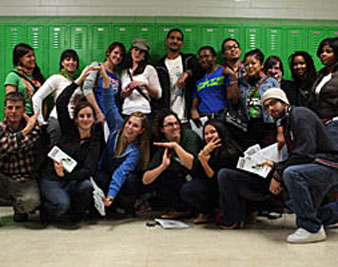
 Photography by Rebecca ‘B FRESH’ McDonald.
On November 4, 23 million young people came out to vote–the largest number since 1972 and 3.4 million larger than in 2004. But more significant, this year’s election became about much more than just voting. Volunteering in record numbers, young people became the superforce of the Obama camp, sustaining and energizing what became one of the biggest grassroots movements for a presidential campaign ever seen. Young people gave up higher-paying jobs for less money to knock on doors, organize block parties, foment online campaigns, make T-shirts and music, and drive voters to the polls. From college campuses to working-class communities, young people realized that, as a group, they have the power to change things in their own country.
Many progressives hope that the elation and idealism that Barack Obama’s campaign helped inspire will turn into a lifetime of community service. There is hope that something can be done about the ever-increasing income gap and poverty, growing unemployment, porous healthcare, environmental degradation and broken schools in low-income communities. And while the president and Congress deliberate policy and allocate funding, the direction of their work will depend, in part, on the continued grassroots activism of young people.
That’s why TheNation.com and WireTap magazine partnered to kick off “You Voted. Now What?”–a series of stories highlighting some of our nation’s most inspiring and successful young activists, coast to coast, working on building new opportunities for the previously dispossessed. Through these stories we hope to highlight a broad range of potential paths for channeling some of the prodigious energy unleashed during the Obama campaign. We begin with an overview of the political landscape in which young people can continue their activism, from part-time volunteering to lifetime careers in public service.
BE LIKE OBAMA–BECOME A COMMUNITY ORGANIZER
After graduating from Columbia College and a brief stint in business consulting, Obama became a community organizer in the far South Side of Chicago. He worked with churches and blue-collar communities to hold local officials accountable, and he helped open college preparatory and job-training programs, playgrounds and after-school programs.
Popular
"swipe left below to view more authors"Swipe →
As Obama went on to Harvard Law School and later the US Senate, he credited his years as a community organizer as the time when he learned to listen, bridge different communities and turn complex issues into winnable solutions. Most important, as he organized community meetings and actions, he discovered the importance of “change from below”–an idea that truly lasting change happens only when ordinary citizens define their own needs, work on solutions together and push their government to respond.
Today there are more than 600 youth-led community organizations working on creating green jobs, removing toxic waste facilities, combating corporate pollution, working toward prison reform, assisting at-risk youth, making college more affordable and organizing for immigrants’ rights, among many other issues.
Future5000.com, the first comprehensive database of youth activism, offers an easy way to search, by region, for activist campaigns under way nationwide. The range of organizing and volunteering opportunities is vast. (A recent Future5000.com search in the state of New York pulled up 103 organizations alone.)
If you’re looking to go beyond volunteering, and commit to community organizing as a career, there are several programs that provide paid fellowships in some of the most effective progressive organizations nationwide. The Center for Community Change, Young People For, the Center for Progressive Leadership, the Drum Major Institute and PolitiCorps all offer paid fellowships filled with practical-skills training, one-on-one coaching and assistance with job hunting.
JOIN THE NATIONAL SERVICE: THE PEACE CORPS, AMERICORPS, YOUTHBUILD OR TEACH FOR AMERICA
In a recent speech at the University of Colorado, President-elect Obama declared, “When you choose to serve–whether it’s your nation, your community or simply your neighbor–you are connected to that fundamental American ideal that we want: life, liberty and the pursuit of happiness, not just for ourselves but for all Americans. That is why this is a great nation.” Obama went on to affirm that he will ask all young people to serve their communities and the world, and provide funding to help make that a sustainable commitment.
What would this service look like? AmeriCorps partners with nonprofit organizations and faith-based organizations to work on issues ranging from public education to environmental cleanup. The Peace Corps, established by John F. Kennedy in his first months in office, sends volunteers around the globe to work with governments, schools, nonprofits and entrepreneurs. Teach for America recruits recent college graduates to teach for two years in schools in low-income communities throughout the United States. And YouthBuild provides education, counseling and job skills to unemployed young American adults.
BECOME A POLITICIAN
At 27, Tony Payton is the youngest member of the Pennsylvania House of Representatives. At 23, Andrew Gillum was elected to serve in the Tallahassee, Florida, City Commission. Both Payton and Gillum represent the growing number of young elected leaders in congressional, state and city seats who want to speak for underrepresented communities. While working in Washington is often more coveted, municipal and state officials frequently have a far greater impact and far wider political parameters in which to operate. That’s why they sometimes enact far more progressive legislation than their federal counterparts–like in Massachusetts, which recently decriminalized small possessions of drugs, or San Francisco, which now guarantees healthcare for all city residents.
Since 18- to 29-year-olds represent over 20 percent of the population but only 4.8 percent of all government seats nationwide, the field of youth organizing has established several programs to help young idealists become politicians. The Center for Progressive Leadership recruits progressive leaders from communities with the least access to political power and connects them with trainers and organizations through paid internships and fellowships. The Young Elected Officials Network provides ongoing personal development and professional support for young elected officials.
Young people helped elect our country’s first African-American president. Record numbers of volunteers chose working for their ideals over high-paying jobs. But the work isn’t over. Not by a long shot. Barack Obama may be able to seize the moment and push a new kind of politics, but not unless he is pushed to do so. He can only realize what he was elected to achieve with the continued energy of a new generation intent on real change. Here’s to anticipation for what a new generation of first-time voters can do to change their communities and the world.
Visit StudentNation in two weeks for our first profile.

