
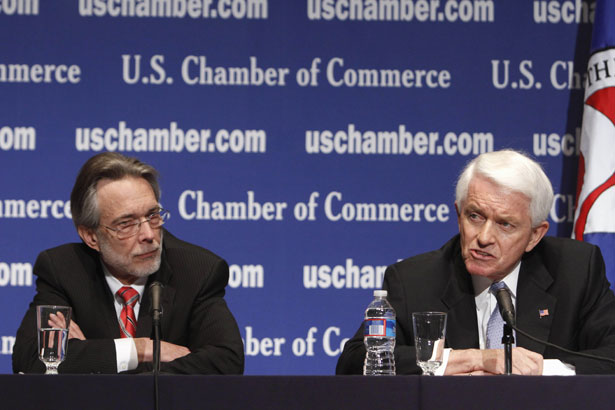
Chamber of Commerce President Thomas Donohue at a press conference. Major health insurers have given the chamber millions of dollars to campaign against healthcare reform but reported almost none of the transactions. (AP Photo/Jacquelyn Martin.)
The Securities and Exchange Commission took a bold step in considering new rules that would require publicly traded companies to disclose political donations. This is a good idea, because since the Citizens United decision, corporate entities have moved away from disclosed campaign committees, and instead have begun funneling cash into secret campaign funds, mostly 501c nonprofits.
Last year, The Nation published an investigation that debunked the idea that corporate money has flowed mostly to so-called SuperPACs in the wake of Citizens United. Rather, big business has embraced nonprofit trade associations and issue advocacy groups to pour hundreds of millions into direct campaign advocacy. The distinction is important because SuperPACs, for all their problems, at least disclose their donors and spending records; trade associations and issue advocacy groups do not.
To the credit of reformers, particularly the Center for Political Accountability and several investor groups, many large corporations have voluntarily adopted transparency measures. While we should applaud corporations that go beyond the letter of the law in disclosing these funds, a system based on voluntary participation does not come close to solving the problem of secret political slush funds. In some cases, voluntary disclosure actually obscures the truth.
Take health insurance companies. Aetna, Aflac and WellPoint are among several that have adopted voluntary disclose rules to provide the public and shareholders with a window into their giving patterns. There’s one problem: they aren’t truthful.
In 2009, the major health insurers, including the aforementioned companies, secretly funneled over $86.2 million to the US Chamber of Commerce, a trade association, using another trade association as a proxy to move the money, to run television and radio advertisements against health reform. Aetna’s disclosures that year only revealed $100,000 to the Chamber. WellPoint and Aflac failed to report those donations, as well. The following year, during the midterm elections, Aetna again secretly provided $7 million to “American Action Network,” a social welfare nonprofit used to run partisan attack ads against Democrats, along with the Chamber, which spent over $50 million on a partisan campaign to elect mostly Republicans that year. Again, Aetna’s voluntary disclosure report made no mention of the money, which became public through an inadvertent regulatory filing.
Popular
"swipe left below to view more authors"Swipe →
Similarly, several major oil companies have adopted voluntary disclosure guidelines that are fairly useless. ExxonMobil and Valero Energy are two examples: Both firms proudly produce annual reports on which candidates and political parties they fund. The problem? That data can be found already on the Federal Elections Commission website and related state-level disclosure websites, so there’s nothing new. As The Nation has reported, oil companies often work through secretive trade associations like the American Petroleum Institute, which has become more active in financing campaign-related advertisements and grants to other dark-money groups.
As Senator John McCain and others have noted, the hundreds of millions slushing in secret money is bound to lead to another major scandal. And that scandal will likely to produce a lot of liability for the corporations involved. Moreover, as attorney Jerry Goldfeder noted in a letter to The New York Times this week, the IRS has sent a questionnaire to 1,300 nonprofit groups questioning their tax exempt status. The increased scrutiny could lead to new questions that could increase liability for corporations: Are these groups being used to violate the Foreign Corrupt Practices Act, by funneling cash to foreign governments? Are consumer brands secretly funding ads that could harm the perception of their product (as was the case with Target and their donations to an anti-gay politician in Minnesota)?
Under the current system, only corporate executives, their lobbyists, and certain politicians really understand where the money is flowing. Shareholders, the public, and reporters have a right to know, too.
Read Lee Fang on Microsoft, which even as it runs an ad featuring same-sex marriage has supported the anti-gay CPAC.

