
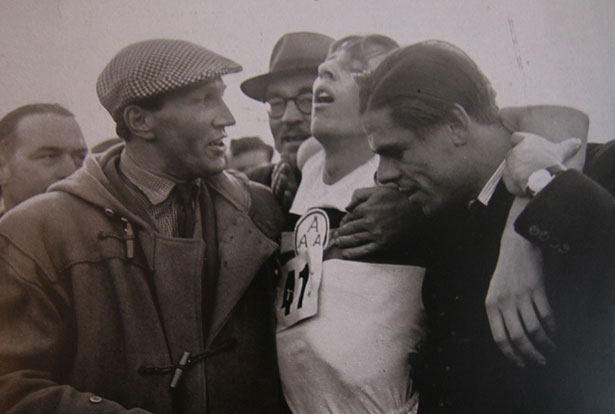
Roger Bannister, after running the first sub–4:00 mile. (Flickr/CC, 2.0)
I discovered a new unity with nature. I had found a new source of power and beauty, a source I never dreamt existed. —Roger Bannister
It was once believed that a human being couldn’t run a mile in under four minutes. Physicians wrote academic articles that the human anatomy wouldn’t allow for such exertions. Four minutes, we were told, was the Maginot Line of our physical capacity. Then in 1954, a medical student named Roger Bannister ran the race in 3:59 and it was like the running community awoke from a collective hypnosis. Mass psychology had shifted in decisive fashion. Within a week, Australian runner John Landy ran it in 3:57 and sub-four minute miles became the world-class average instead of the unapproachable standard. People’s minds had to dramatically adjust to a new reality as the inconceivable became the new normal.
There are many calling Jason Collins’s decision to be the first active male athlete to come out of the closet a “Jackie Robinson Moment,” after the man who smashed baseball’s color line in 1947. But I consider this to be more of a Roger Bannister Moment. For years, people have been waiting to see whether an active male athlete would come out of the closet. For years, people of all political stripes said it would be a long time coming. For decades, media and management has policed the sexuality of players to make sure the closet door was welded shut. Even those most supportive, until recently, were pessimistic. Just in 2011, Will Leitch of New York magazine wrote, “You probably don’t know the most likely first openly gay pro athlete, because he’s not a pro yet. He might be 12.” Leitch then quoted Jim Buzinski who co-founded the LGBT-focused website Outsports who said, “It’ll be someone who has identified as gay through high school and just doesn’t think anything about it. They’ll just be so talented that no one would even think to deny them.” But we didn’t have to wait ten years and we didn’t have to wait for that irresistibly talented superstar. Instead we have Jason Collins, 34-year-old journeyman center: right here, right now, in 2013.
As Collins explained why he did it to The New York Times, “There are so many people who have come before me both as a black male and then as a gay male, who have sort of paved the road for me…. Now it’s time for me to pave the road for somebody else, to be a great teammate, society being the team. It’s my responsibility to acknowledge those who came before me, give credit to them, and then there are those who are going to come after me, and it’s my responsibility to lift them up.”
Popular
"swipe left below to view more authors"Swipe →
Now that he’s come out, more players will feel liberated and lifted, unburdened by the pressure to be first. More people will explore the parameters of the possible because Jason Collins chose to be a pioneer.
It’s certainly tempting to think of this as a Jackie Robinson Moment as well. In this case there are also very strong, if inexact, parallels. Like Robinson, Collins, through his very existence, forces teammates, fans and the dominant culture to confront their own prejudice. Like Robinson, Collins has to face ignorance cloaked in religion that claims his very existence in the locker room is an abomination. Like Robinson, Collins has sparked discussions among the panicked about how his teammates could possibly shower in peace. The differences between Jackie Robinson and Jason Collins also matter. Robinson broke into Major League Baseball in 1947 eight years before the formal start of the civil rights movement. He was, as Dr. King put it, “A sit-inner before sit-ins.” Jason Collins, as he readily says, felt confidence to come out because of the social movements that have been taking place off the field and because more straight players across the Sports World have started to speak out for LGBT equality. This doesn’t in any way diminish what Collins did. It just should remind us that the dynamic interaction between sports and social movements flows in both directions. It’s also worth noting that Jackie Robinson didn’t have to deal with a twenty-f0ur-hour sports media machine willing to give a platform to people telling him he was going to hell. The two stories lined up side-by-side remind one of Mark Twain’s famous dictum that “history does not repeat itself, but it does rhyme.”
That’s why I see this as more of a Roger Bannister Moment. Thanks to Jason Collins, our parameters of the possible have shifted and now our collective thinking will have to change. That’s the power of just being brave enough to dare see what isn’t there. When Roger Bannister was asked how it was possible he achieved his record-breaking feat, he replied, “It’s the ability to take more out of yourself than you’ve got.” That’s what Jason Collins did as well, and we are all the better for it.
What’s it like to cross the border without papers? Read Aura Bogado’s review of the interactive La Ruta.

