
“Where have all the workers gone?” David Wessel of the Wall Street Journal wondered about the labor force this week:
In the past two years, the number of people in the U.S. who are older than 16 (and not in the military or prison) has grown by 5.4 million. The number of people working or looking for work hasn’t grown at all.
So, where have all the workers gone? Have they retired, suspended their labors temporarily or are they languishing on public assistance? asks Wessel.
There are some other possibilities. Since the crash of 2008, there’s no question that millions of Americans have indeed stopped looking for a job. But that doesn’t necessarily mean they’re not working. Look around, it’s much more likely that the officially “unemployed” are busy, doing their best to make ends meet in whatever ways they can. Sex work, drugs and crime spring to mind, but the underground or “shadow” economy includes all sorts of off-the-books toil. From baby-sitting, bartering, mending, kitchen-garden farming and selling goods in a yard sale, all sorts of people—from the tamale seller on your corner, to the dancer who teachers yoga—are all contributing to the underground economy along with the “employed” who pay them for their wares.
The “underground” is always with us. For better and often for worse, it’s how marginalized populations tend to survive—often not very well. (Think of the old, the young, the formerly incarcerated or foreign.) In recessions—surprise, surprise—“irregular” employment grows. Consider recent stories from Greece about wageless public “workers” swapping skills and trading food for teaching. Austrian economist, Friedrich Schneider, an expert in underground economies, has documented a surge in shadow economy activity in 2009 and 2010 in Europe. University of Wisconsin–Madison economist Edgar Feige has been doing his best to follow what’s happened here.
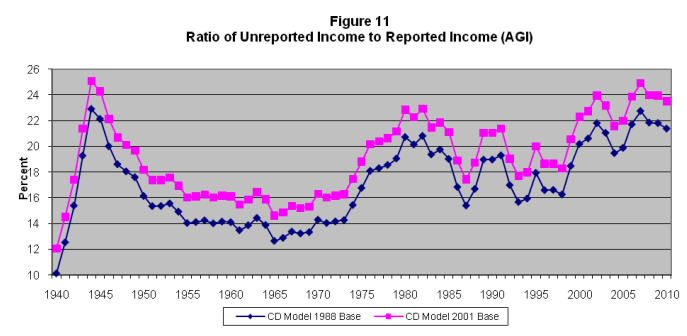
Tracking the gap between reported and unreported income in the United States since 1940, Feige finds:
Popular
"swipe left below to view more authors"Swipe →
Measuring unreported data is not easy, but from Feige’s graph one thing is clear: there’s as much unreported income swirling around the United States today as there was in WWII under rationing, and that number’s not going down with any speed.
Unreported income matters to the IRS because those “unreported” dollars are lost revenue for the taxman. (In 2001, the Internal Revenue Service estimates it was losing $345 billion in tax revenue. In 2009, according to Feige, that estimate could be approaching $600 billion.)
A shrinking workforce matters to policy makers too, as Wessel explains:
“Figuring out how many of those now on the job-market sidelines are likely to come back onto the field matters to gauging the current state of the economy, to fashioning the right remedy for the sluggish recovery and to evaluating prospects for economic growth, which hinge, in part, on an expanding labor force.”
Getting a more accurate picture of our economy matters for another reason too. For one thing, ever since Adam Smith, we (at least we in the West) have been taught there is one set of rules, and one viable economy: the “end of history” economy of jobs and wages, profits and losses, and round the world trading on the stock market. The reality is, as farmer/science writer Sharon Astyk put it recently, what “the economy” is is not the only economy.
“Let us remind ourselves that the informal economy is, in fact, the larger part of the world’s total economy. When you add in the domestic and household economy of the world’s households, the subsistence economy, the barter economy, the volunteer economy, the ‘under the table’ economy, the criminal economy and a few other smaller players, you get something that adds up to 3/4 of the world’s total economic activity. The formal economy—the territory of professional and paid work, of tax statements and GDP—is only 1/4 of the world’s total economic activity.”
Looking ahead at our employment and energy future, it’s not at all clear what the economy will look like in years to come. With fewer dirty Satanic mills to labor in, regular Joe and Jane workers are going to have find income that doesn’t depend on them transmuting into celebrities or high-rolling mobsters of high finance. What are they going to do? For those who believe that stocks and bonds and 9–5 jobs are the only economy there is, the picture is dire.
For others, there’s a world of possibility ahead. Gar Alperovitz and his colleagues at the Democracy Collaborative are about to launch a series on the upsurge of thinking that’s currently happening about different ways in which people might support themselves and restructure the political and economy. They point to the exploding interest in “new economy” conferences and the array of real-world experiments, from solar-powered businesses to worker-owned cooperatives and state-owned banks.
“History dramatizes the implacable power of the existing institutions—until, somehow, that power gives way to the force of social movements. Most of those in the ‘New Economy’ movement understand the challenge as both immediate and long term: how to put an end to the most egregious social and economically destructive practices in the near term; how to lay foundations for a possible transformation in the longer term,” writes Alperovitz in the first of five articles.
Could it be that the old economy is losing its grip, not only on our lives, but also on our ideas? There is much—much—more to come.

