
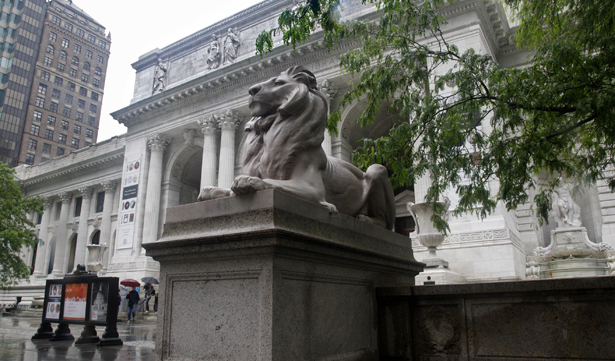
The main entrance to the New York Public Library in New York. (AP Photo/Bebeto Matthews)
“There is no more important landmark building in New York than the New York Public Library…. Yet it is about to undertake its own destruction.” So wrote architecture critic Ada Louise Huxtable in her final essay before she died (at the age of 91) on January 7. That essay, which appeared in The Wall Street Journal, was one of two luminous pieces of criticism published in the winter concerning the NYPL’s Central Library Plan. Huxtable decried the library’s lack of transparency: three phone calls she made to the institution this past August were not returned until a powerful city official intervened on her behalf. As for the CLP, Huxtable arrived at a stark conclusion: “After extensive study of the library’s conception and construction I have become convinced that irreversible changes of this magnitude should not be made in this landmark building…. You don’t ‘update’ a masterpiece.”
Eight weeks later Michael Kimmelman, architecture critic for The New York Times, took a sledgehammer to the CLP, reminding the NYPL’s leaders that “the last thing they’d want to be remembered for is trashing their landmark building and digging a money pit,” and urging them to unleash their architect, Norman Foster, on the tumbledown building across the street, the Mid-Manhattan Library, which the NYPL is determined to sell for approximately $100 million [see Sherman, “Upheaval at the New York Public Library,” December 19, 2011].
Those impassioned arguments were not enough to derail the CLP, the cost of which could reach as high as $350 million. But those funds would be more wisely spent on the NYPL’s eighty-seven branch libraries in Manhattan, the Bronx and Staten Island, which need approximately $800 million in renovations, including elevator rehabilitation; new roofs, boilers and windows; and fire alarms. At a recent City Council hearing, NYPL president Anthony Marx declared that some of those branch libraries are “shocking…an insult to the citizens of New York.” A few hours after Kimmelman’s article appeared in print, Marx championed the CLP in an interview with WNYC radio, during which he reiterated the very claims the two critics had already demolished.
In its quest to alter the Forty-second Street library and sell off real estate assets, the NYPL in January moved two steps closer to its goal. On January 17, the local community board, CB5, passed a pro-CLP resolution, the wording of which bore a suspicious likeness to the NYPL’s press information and talking points. On January 22, the Landmarks Preservation Commission, by a vote of 6 to 2, gave the NYPL a green light for a handful of exterior alterations the library had requested for Forty-second Street. The hearing had a scripted quality: the small changes approved by the commission enable and set in motion colossal changes to the interior, including the demolition of seven levels of stacks beneath the Rose Reading Room, which were designed by Carrère and Hastings. Alas, the stacks are not landmarked, and their fate did not stir the six commissioners. In February, the NYPL’s chief operating officer, David Offensend, told the trustees, “We are still on track to begin construction this summer.”
Popular
"swipe left below to view more authors"Swipe →
The NYPL is not the only New York City library under criticism. In January, the Brooklyn Public Library (which is separate from the NYPL) revealed that in the wake of diminishing financial support from the city, it intends to sell two branch libraries to real estate developers: a 1962 building in upscale Brooklyn Heights (for which the BPL could get up to $100 million) and a sturdy Beaux-Arts building in a gentrifying section of downtown Brooklyn, constructed in 1904. A SignOn.org petition—directed at the BPL and the NYPL and lamenting the “shrinking [of] our library system to create real estate deals for the wealthy”—has been signed by more than 9,000 people.
The NYPL’s lack of transparency is just one worrisome aspect of the current controversy. Another is the willingness of its president, Marx, to put forth dubious assertions—that millions of books are “rotting” in the Forty-second Street stacks, where there are “almost no preservation values”; that the stacks are a fire hazard; that the CLP will generate “about $15 million a year”; that the plan “has been the subject of public discussion for five years.” In his Timesessay, Kimmelman urged the NYPL to provide, before any contracts are signed, a “clear and open accounting of both its plan and some alternatives,” as well as a “detailed cost analysis by at least one independent party.” We are still waiting for all those things; the fact that much of the CLP ($150 million) will be paid for by taxpayers adds urgency to Kimmelman’s demand. Public libraries are not oil companies or banks; they exist to disseminate information, and it’s disheartening to see the world-class NYPL hoarding data that belong in public hands.
But Marx wants to rush to the finish line: he admitted in a 2012 letter to scholars that the next mayor and City Council may not embrace the CLP, and that demolition at Forty-second Street must therefore commence while Michael Bloomberg is still mayor. Huxtable and Kimmelman, as well as the writer Caleb Crain, have put a less expensive compromise solution on the table—allow Foster to renovate the Mid-Manhattan Library (“the results will be spectacular,” Huxtable wrote) and let a landmark remain a landmark. In an April 11 letter to Marx, Charles Warren, co-author of a book on Carrère and Hastings, wrote: “I urge you to open this process to wider debate. Alternatives must be examined by independent experts and all options considered publicly before one of our greatest buildings is incapacitated and the books are sent away forever. If instead, you keep to a closed, narrowly determined course, we will all soon regret the result.”
View Scott Sherman’s previous articles on the NYPL here and here.

