The Return of Noname
In her new album, Sundial, the rapper melds her activism and artistry seamlessly.
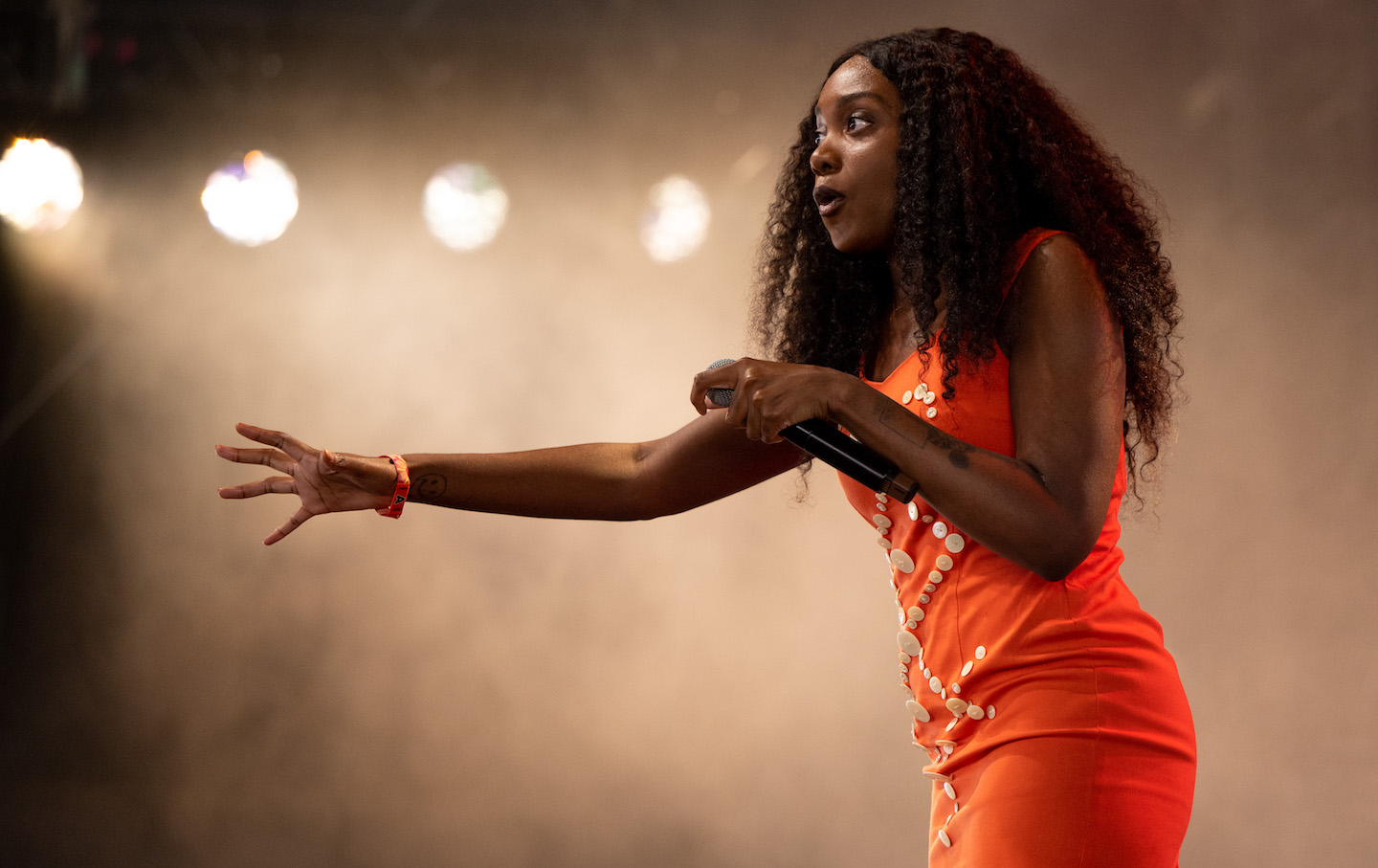
Can a celebrity truly practice socialism? For the past five years, that question seemed to stump the Los Angeles–based rapper and prison abolitionist Noname. Following her 2018 album Room 25, a dazzling mosaic of artistic and sexual awakening, Noname’s already meager output became glacial, slowing to a half-dozen guest verses and singles. The source of the downturn, she said, was her radical book club, which was founded in 2019 and blossomed into chapters in cities across the US, even making inroads into prisons. As she explained to Rolling Stone in 2021, “The more I’m feeding into political education and organizing and the mutual-aid work that we’re doing…I’m starting to be a little less interested in making music.” As Noname’s sabbatical extended, her solution to reconciling the collectivity of her politics and the individualism of her art appeared to be to give up on creating the latter. But on her new album Sundial, Noname turns her internal tightrope act into public soul-searching.
Her second album reintroduces Noname as an agitator and stylist committed to interrogating her beliefs as intensely as she espouses them. As if making up for lost time, the record’s mood is urgent and confrontational. Soulful arrangements of keys, high-stepping basslines, and triumphant horns swing and snap like a bullwhip. The percussion tumbles and coils, at times bringing to mind the polyrhythms of dancehall or jungle. Noname retains the playful, free-associative lyricism of her past work, but her delivery is nimbler and more direct: “I don’t wanna see death no more / Let’s fight,” she urges on “namesake.”
Sundial gushes with affirmations of life and multiplicity that convey Noname’s individuality and her belonging to a larger movement. “She’s a shadow walker, moon stalker, Black author / Librarian, contrarian,” Noname says on the opener, “black mirror,” owning her many mantles and her evolution as a public figure. She’s not just an activist, she insists as she sways through moods and identities. On the saucy “boomboom,” she beckons a lover to kiss her “pum pum” over breezy Latin jazz. For the pensive “balloons,” she takes on the role of cultural critic, rebuking the voyeurism of white audiences and the tendency of certain rappers to turn Black death into entertainment. The shape-shifting presents her activism as playful and curious as well as militant. For Noname, there’s no changing the world without expanding the self.
Noname doesn’t just contain multitudes; she explores them. She dissects her attraction to Eurocentric standards on “beauty supply,” checks her outsized anger at a cheating ex on “toxic,” and turns apathy into bluster on “oblivion.” Her critiques avoid the defensiveness that has characterized pop culture’s faux adoption of vulnerability in recent years. Noname seeks to be accountable rather than relatable, examining her flaws and insecurities and not merely declaring her imperfection. On the gospel-influenced “hold me down,” she compels Black people to look beyond popular culture for affirmation and to embrace a more nuanced, reparative vision of Blackness. To the fantasies of “We good! We is Wakanda!,” she offers a tender but fierce rejoinder: “We better when we admit we too can cause harm.” The arch line serves as both reprimand and invitation.
Noname ended Room 25 with an ode to anonymity, casting her stage name as a refuge from expectations and idolatry: “No name for people to call small or colonize optimism / No name for inmate registries that they put me in prison.” But throughout Sundial, Noname foregrounds herself, declining to downplay her pride in her skills or her anger at the state of the world. Although she drifts “in and out of consciousness like the rappers do”—a clever triple entendre that alludes to the druggy sounds and tales of modern rap, the long history of so-called “conscious rappers” not always turning out to be progressive thinkers, and her own wavering—the deviance is productive. Her wayward path affirms that struggle is normal.
Noname doesn’t walk alone. Nearly every track features layers of warm vocal coos and background harmonies that subtly highlight the communal nature of making music. The contributions from fellow rap mavericks Jay Electronica, billy woods, and $ilkMoney and soul singers Ayoni, STOUT, and Eryn Allen Kane turn Sundial into a gathering space for a wide range of notions of Black freedom. The album’s verses span ecstasy and irritation, divine rapture and petty rage, citing everything from Zimbabwean independence to doomed relationships to the biblical figure Lazarus.
Noname’s style has evolved as much as her ideas. She’s long been a dexterous rapper capable of bobbing in and out of pockets, but here her flair is more pronounced. She frequently punctuates her winding lines with punchy (and often funny) declarations that leap to the fore like sneezes. A selection: “eat me out sweetie”; “yo dick is mid”; “I ain’t fucking with the NFL or Jay-Z”; “I’m that bitch! I told you that!” The chest-puffing often feeds into the philosophizing, as on “potentially the interlude,” where she rebuffs loaded calls for her to make music more like Kendrick Lamar’s—which is to say, music that’s more palatable. “People say they love you, but they really love potential,” she chants with annoyance. Being told to replicate someone else, especially an artist whose music has wildly different goals and ideas, is anathema to Noname’s projects of autonomy and self-expression.
Noname mentions Lamar again on “namesake,” a song that takes her radical ideas directly to the doorstep of representational politics. Shuffling over breakneck drums, Noname skewers Black capitalism and notes that the same military industry that supports the NFL supplies the guns used by cops on the West Coast and IDF soldiers in the West Bank. The song’s mentions of Lamar, Rihanna, and Beyoncé (all former Super Bowl performers) will certainly be received as attention-grabbing disses. But the name-checks—which include Noname scolding herself—raise an important question: If even the most influential and wealthy Black people enable systems of oppression, what do they really stand for?
Across Sundial, Noname broaches questions like that with humility and openness, declining to give in to easy answers or empty optics. Her anti-escapist rap insists that the pleasures of facing our contradictory world head-on outweigh those of fleeing into comfort and complacency. The album’s smooth sound somewhat diminishes the vitriol that courses through it; more abrasive and unnerving production, or even poppier compositions, could have upped the anger and sarcasm of Noname’s writing. The lack of an anthem also feels like an oversight given the album’s emphasis on rousing the listener. Sundial works despite these faults, though. Noname is ultimately less interested in whether celebrity and radical politics are compatible, and more drawn to the sparks that fly when belief clashes with complicity.
Support independent journalism that does not fall in line
Even before February 28, the reasons for Donald Trump’s imploding approval rating were abundantly clear: untrammeled corruption and personal enrichment to the tune of billions of dollars during an affordability crisis, a foreign policy guided only by his own derelict sense of morality, and the deployment of a murderous campaign of occupation, detention, and deportation on American streets.
Now an undeclared, unauthorized, unpopular, and unconstitutional war of aggression against Iran has spread like wildfire through the region and into Europe. A new “forever war”—with an ever-increasing likelihood of American troops on the ground—may very well be upon us.
As we’ve seen over and over, this administration uses lies, misdirection, and attempts to flood the zone to justify its abuses of power at home and abroad. Just as Trump, Marco Rubio, and Pete Hegseth offer erratic and contradictory rationales for the attacks on Iran, the administration is also spreading the lie that the upcoming midterm elections are under threat from noncitizens on voter rolls. When these lies go unchecked, they become the basis for further authoritarian encroachment and war.
In these dark times, independent journalism is uniquely able to uncover the falsehoods that threaten our republic—and civilians around the world—and shine a bright light on the truth.
The Nation’s experienced team of writers, editors, and fact-checkers understands the scale of what we’re up against and the urgency with which we have to act. That’s why we’re publishing critical reporting and analysis of the war on Iran, ICE violence at home, new forms of voter suppression emerging in the courts, and much more.
But this journalism is possible only with your support.
This March, The Nation needs to raise $50,000 to ensure that we have the resources for reporting and analysis that sets the record straight and empowers people of conscience to organize. Will you donate today?