
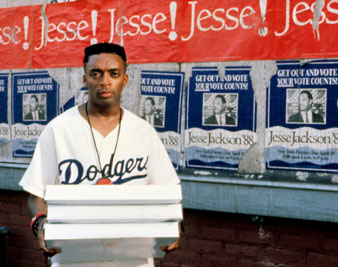
 Everett CollectionSpike Lee in Do the Right Thing, 1989.
New York City’s second most-famous Mookie delivers pizza and fights the power in Spike Lee’s breakthrough film. Some critics predicted its provocative portrayal of race tensions would cause riots. Instead, the film started a dialogue.
In the days of the Harlem Renaissance, when Langston Hughes was being attacked in some quarters for writing about black America’s lower classes, Carl Van Vechten remarked jestingly to the poet, “You and I are the only colored people who really love niggers.”
As it was with Hughes, so it has been with Spike Lee. He began his career only half a dozen years ago with the remarkably accomplished student film Joe’s BedStuy Barbershop: We Cut Heads. No one who saw it could ignore either Lee’s talent or his love for the common citizens of the Brooklyn ghetto—not just the upward-striving, the politically involved, the gifted, but the whole range of street-corner society. In She’s Gotta Have It, Lee himself portrays the fast-talking Mars Blackmon, who won’t let anything so small as sexual jealousy come between him and a fellow African-American. In School Daze, the entire film depends on the conflict between black people who are plainly, emphatically black and those who are wannabees -that is, who want to be white. Now, in Do the Right Thing, you can still hear the echoes of Mars Blackmon’s sentiment in the catch-phrase of Buggin Out (Giancarlo Esposito), whose standard parting line is, “Stay black.”
A love like that separates loyalists from sellouts. It also animates certain troubled characters with a talent for making themselves unpopular. Jesters mock and receive favors in return; satirists love, and that seems to be Spike Lee’s hard fate.
Do the Right Thing is Lee’s most complex, heartfelt and disturbing film to date, a drama about racism that is more shockingly outspoken than any I’ve seen since David Mamet’s great, and neglected, Edmond. Needless to say, the film depicts white bigotry with all due contempt. The best of the white character who seems a very good man indeed—is still ready to scream “nigger” when all else fails; the worst are willing to kill. The melanin-impaired will therefore feel uncomfortable with this film, and with good reason. But so, too, might the black community. Lee loves his fellow African-Americans, but he also portrays them as political good-for-nothings, long on talk and short on action, except when their actions are misguided. In Do the Right Thing, nobody does.
Popular
"swipe left below to view more authors"Swipe →
Set on a single block in Bedford-Stuyvesant, Do the Right Thing follows about two dozen characters through a very hot summer’s day, from a morning when interracial civility is already strained to a night when all hell breaks loose. The structure is episodic; brief, seemingly self-enclosed dramas follow one another rapidly, with two characters helping to frame and judge the action. The first of these is Mister Señor Love Daddy (Sam Jackson), disc jockey of an extremely local radio station, who observes the neighborhood through his livingroom window and broadcasts what he sees, along with the finest in black music. The second framing character is Da Mayor (Ossie Davis), an old gentleman who rambles up and down the block all day. Da Mayor is courtly and kindhearted; he’s also a drunk. To some of the younger people, he is a figure of fun. To Mother Sister (Ruby Dee), the block’s reigning older woman, he is a contemptible bum. It is Ida Mayor who enunciates the sentiment of the title, “Always do the right thing,” in addressing his neighbor Mookie (Spike Lee). And in fact, Mookie tries hard to follow that advice. The effort he makes, and the degree to which he fails, will be the subject of debate for everyone who sees the film.
When we first see him, Mookie is at home with his sister Jade (Joie Lee), who is running out of patience with him as an unpaying roommate. As far as she is concerned, Mookie should get an apartment of his own, preferably with his girlfriend, Tina (Rosie Perez), and his infant son. Apparently, Mookie lays eyes on Tina only when he wants to do the nasty. Then, pleading the need to work, he disappears again from her life, proceeding in the general direction of his place of employment, Sal’s Famous Pizzeria.
The whole neighborhood seems to meet at Sal’s, and has done so for twenty-five years. In the words of Sal himself (Danny Aiello), “These people grew up on my food. And I’m very proud of that.” Bear-like and bluff, Sal enjoys his business, enjoys his customers (most of them) and treats Mookic with the same combination of amused tolerance and restrained sarcasm that Mookie uses with him. There’s even a grudging respect between Sal and his deliveryman and that is a problem for Mookie. He can deal with Sal’s son Pino (John Turturro), an outspoken bigot who spends the day urging honest labor on Mookie while avoiding his own work. Since Pino has declared himself an enemy of all black people, Mookie can respond in kind, with a clear conscience. But Sal is not simply the enemy. He’s humane enough to command some loyalty from Mookie, who then is caught between his white boss and his black friends and neighbors.
Mookie’s conflict begins with a visit from Buggin Out, owner of the fastest mouth and strangest hairstyle on the block. In search of a fresh shot of adrenaline, Buggin Out picks a fight with Sal over the pizzeria’s Wall of Fame: a display of photographs of celebrated Italian-Americans. Where are the photos of black people? Has Sal never heard of Malcolm X and Michael Jordan? Buggin Out blusters; Sal boils over; Mookie gets the unhappy task of escorting his friend outside. Mookie tries to keep the incident on a personal level, complaining that Buggin Out is giving him trouble at his job. Buggin Out absolves Mookie but says goodbye with a meaningful “Stay black.”
The conflict worsens with the appearance in the pizzeria of Radio Raheem (Bill Nunn). Powerfully built, inarticulate, able to peel the paint off walls with a single glare, Raheem takes his nickname from his constant companion, the biggest boom-box in Brooklyn. He stalks the neighborhood on a single-minded mission: making sure that every resident of Bed-Stuy hears the soothing tones of “Fight the Power” by Public Enemy. This is the only song he will play—in fact, the only one he will allow anyone to hear. With a heart-stopping glower and the push of a lever on his mighty box, Raheem drowns out all other music in the neighborhood. Sal threatens to throw him out of the pizzeria.
Now there are two people on the block with a grudge against Sal. A third joins their ranks when Pino gratuitously insults Smiley, the neighborhood idiot (Roger Guenveur Smith). Ordinarily, Smiley goes about preaching love and selling hand-decorated photographs of Martin Luther King Jr. and Malcolm X. Once he’s been chased down the block, though, Smiley, too, is ready to take action against Sal’s Famous.
Consider Mookie’s dilemma. On one side, there are the protesters—his own people, even though they can’t agree on what they’re protesting, even though Mookie actually likes only one of the three. On the other side, there is Sal. Though Mookie almost likes him, he is white, he’s the boss, and he is backed by a police force that’s willing to kill black people. As the long, hot day comes to a boil, Mookie is given one moment to decide how to do the right thing. And that’s the moment when Sal announces his own, antithetical philosophy: “You do what you gotta.”
So Do the Right Thing comes down to an argument between morality and necessity—or rather, alleged necessity. It is a film about conflicting loyalties and evaded responsibilities; about the way our society values a white man’s property over a black man’s life; about the terrible gap between a community’s need to mobilize itself and an individual’s political acumen. To call these themes and their treatment inflammatory would be no more than the literal truth. More to the point, Spike Lee makes them lively and vivid, funny and exasperating as well.
His style is deliberately juiced-up. The editing is fast, with dialogue sometimes crosscut on each line; the acting is often more stylized than natural. When Sal and his family first appear, for example, they seem to use three hand gestures for each spoken word. As in the past, Lee often points his camera head-on to the actors and has them talk straight into the lens. When even that method seems too oblique, he begins the shot with a fast dolly, as if the camera were a speeding Pontiac, jolting to a stop before somebody who refuses to get out of the way. Add to all this the episodic structure and the tendency of some of the characters to act out, and the film at times takes on an almost cartoonlike quality.
In other words, the style closely matches the characters’ thoughts, which tend toward big, simplified outlines—the contours of a Hanna-Barbera cartoon, rather than a Disney animation. Do the Right Thing is very smart about portraying politics at this very dumb level. On the street, as Lee knows, there is little reasoned argument but a lot of totemism. Everything depends on which song is coming out of your radio, which photo is on the wall of your shop, which brand of sneaker you’re wearing. The mere presence of a Boston Celtics jersey on a Bed-Stuy street is an insult to the residents—and if you don’t know that, you obviously don’t belong on the street in the first place. This, may heaven help us, is real American politics—which explains the inclusion of simple-minded Smiley in the plot and his ghastly moment of triumph at the climax.
Many of the reactions to the film, I imagine, will be on Smiley’s level. Already Lee has had to explain that Do the Right Thing is not based on the Howard Beach case—that is, on white vigilantism—but is instead about the background to police violence. In some quarters, official murder is always alleged, never real. In those same quarters editorialists will probably call Lee’s film an incitement to riot. (Sure—and racism, as Reagan informed us, is caused by civil rights leaders.) Among more open-minded viewers, though, Do the Right Thing will be seen as an incitement to thought. I hope the sidewalks outside the movie theaters this summer will be filled with people arguing over the rights and wrongs of Mookie’s actions and the meanings of the two texts—one by Dr. King, the other by Malcolm X—-that close the film.
N.B.: The opening credits feature a couple of women doing the bump-and-grind, which is hardly a tribute to Lee’s taste or to the sophistication of his audience. I beg your patience with that sequence and with a later interlude of tits and ass. Maybe the heat got to Spike.

