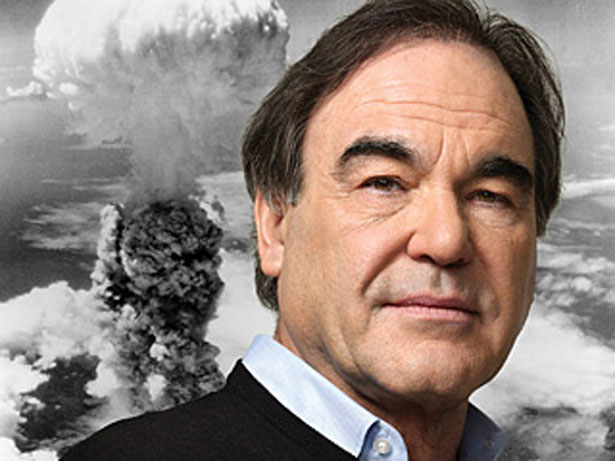
Oliver Stone. (Courtesy of Showtime)
Editor’s Note: Each week we cross-post an excerpt from Katrina vanden Heuvel’s column at the WashingtonPost.com. Read the full text of Katrina’s column here.
Oliver Stone’s 10-hour documentary series, The Untold History of The United States, which first appeared on Showtime in 2012, is about to be rereleased this month on DVD with three new episodes and a post-series conversation between Stone and his frequent collaborator, author and activist Tariq Ali.
The series, which is remarkably free of talking heads and offers a treasure trove of historical footage, kicks off with an alternative narrative of the Cold War. Like many historians, Stone believes that, had Franklin Roosevelt lived, he might have avoided the Cold War. If the Democrats had not dumped Vice President Henry Wallace in favor of Harry Truman in 1944, Stone contends, Wallace would have carried on FDR’s policies and “there might have been no atomic bombings, no nuclear arms race and no cold war.
Untold History is full of such tantalizing what-ifs. What if Kennedy had lived? Would there have been a Vietnam War? What if George W. Bush had taken the advice of US intelligence operatives more seriously before the 9/11 attacks? Could the disasters in Afghanistan and Iraq have been avoided?
Most historians tend to avoid this “counterfactual” or “what if” history, but these alternative scenarios provide thought exercises that help us consider what might have happened if history had taken a radically different course. They make us more aware of the missed opportunities, the roads not taken. They challenge the prevailing orthodoxy and narrow consensus of our contemporary political debate. And they teach us about the past so that we can learn from it.
Stone has said that in high school and college he was taught a “Disneyfied” version of American history. He resolved to use his talents as a filmmaker to challenge that version. This he has done through popular fictionalized history and political films such as Salvador, Platoon, Born on the Fourth of July, Wall Street and its sequel, Wall Street: Money Never Sleeps.
As he and his collaborator Peter Kuznick wrote, “Historically-challenged students turn into historically-challenged adults who make for unqualified citizens. Our republican system requires a literate, educated, and knowledgeable public.” Unfortunately, today’s students “know very little history. Second, much of what they do learn is extremely partial or flat out wrong.”
Editor’s Note: Each week we cross-post an excerpt from Katrina vanden Heuvel’s column at the WashingtonPost.com. Read the full text of Katrina’s column here.

