
“No Kings” Has to Become “No More Wars”
Donald Trump killed the anti-war right—but offers a chance to revive the anti-war left.
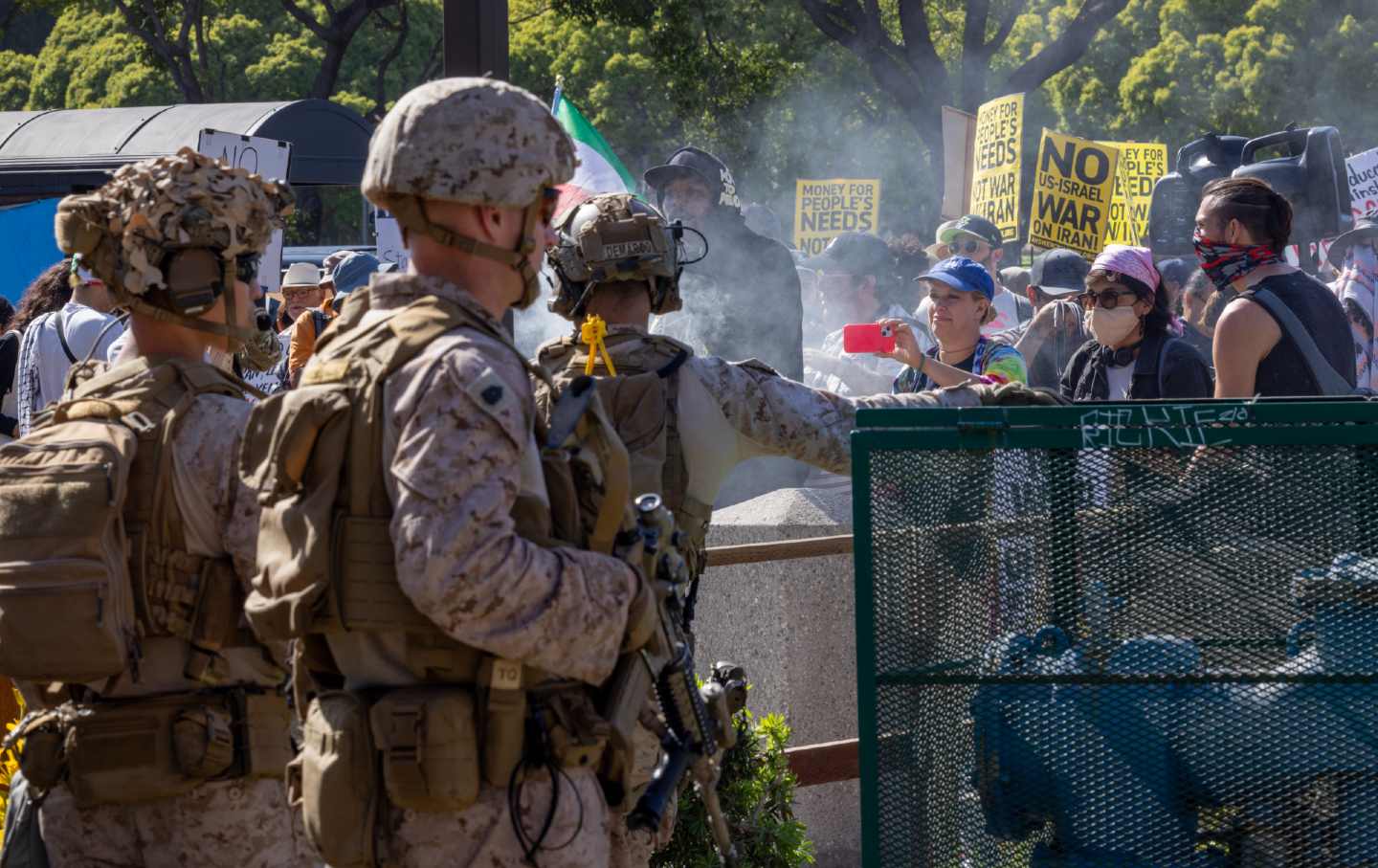
On Friday night, Senator Bernie Sanders took his populist message of fighting oligarchy to Tulsa, Oklahoma, drawing a crowd of nearly 6,000. During his speech a woman from the audience yelled out, “We just bombed Iran!” Gasps of horror could be heard as both the senator and the audience tried to process the news, many in the audience muttering, “Oh dear God.” A Sanders staffer rushed to the stage and handed the senator a paper, containing a print of Donald Trump’s tweet announcing America’s newest war. Sanders, visibly disgusted, read from the tweet while a chant started rising from the audience of “No more war!” In videos from the event, you can see the rage spread through the crowd like a prairie fire as the cry grows louder and louder, “No more war, no more war, no more war!”
Sanders was well prepared for the passions that had overtaken the audience. Unlike almost all of his colleagues in Congress, he had been at the forefront of trying to rein in Trump’s foreign policy, having introduced the No War Against Iran Act on Monday, repeatedly emphasizing that any unilateral attack on Iran without congressional approval would be unconstitutional. But Sanders is the exception. Among both Republicans and Democrats, Trump’s war will present a challenge, since both parties are in truth divided on the subject.
The anger at the Sanders rally is an early premonition of how Trump’s decision to openly join Israel in its war against Iran has upended American politics. There was already a large and growing opposition to Trump’s presidency. Last weekend’s “No Kings” rally drew between 4 and 6 million people in hundreds of cities and towns, which means it might have been the biggest one-day protest in American history. The slogan “No Kings” succinctly encapsulates the dangers of Trump as an autocrat, a threat made clear in his immigration crackdown, his war against academia, his shunting aside of Congress, his frequent expressions of contempt for the courts, and his attempt to transform the military into a private security force at his beck and call. All of these are urgent issues—but the dangers they pose to democracy will only be intensified if the United States enters a prolonged war, which will not just strengthen Trump’s autocratic tendencies but give him even more opportunities to exploit the terrifying power of the American national security state against enemies both at home and abroad.
With this new war, the slogan “No More War” has become as urgent as “No Kings.” The merit of “No more war!” as a rallying cry is that it both highlights Trump’s betrayal of his party and can help Democrats overcome one of their biggest problems—the dominance of an establishment that is wildly out of touch with the American public.
Donald Trump’s decision to become a war president rests on a paradox: He rose to power in no small part because he was able to harness the anger many Americans felt at the bipartisan foreign policy establishment that supported George W. Bush’s failed wars in Afghanistan and Iraq. One of the believers in Trump as an agent of a new foreign policy was Vice President JD Vance. In 2016, Vance, then a Trump critic, wrote in The New York Times that Trump’s willingness to attack Bush’s foreign policy “reflects what people like most about him: his complete break with the party elite.” Revisiting this topic in The Wall Street Journal in 2024, Vance argued that “Trump’s best foreign policy” was “not starting any wars.”
But Trump has ended up destroying the right-wing anti-war position that he helped popularize. As I’ve noted in earlier columns, Trump’s administration has always been deeply divided between a faction of “American First” right-wingers (who want to withdraw from the Middle East and Europe to concentrate on China) and more mainstream neoconservatives (who are hawkish on every front). With the attack on Iran, it is clear which side has won the factional battle. The neoconservatives are in charge, and Trump’s promise of ending the age of the forever wars has turned out to be a lie.
The triumph of militarism has left the anti-war Republicans scrambling. Representative Thomas Massie remains a principled critic of militarism and is sponsoring with Democratic Representative Ro Khanna a War Powers Resolution. But Trump is targeting Massie by supporting an effort to defeat him in next year’s primary. Appearing on Face the Nation, Massie offered this forlorn hope: “There are still voices in this administration—you’ve still got JD Vance, Tulsi Gabbard, RFK Jr—you’ve still got calmer heads that could prevail.” In truth, none of those names inspire confidence. They are all opportunists who will shift in whatever direction Trump directs them to turn.
Appearing on Meet the Press on Sunday, Vance said:
I certainly empathize with Americans who are exhausted after 25 years of foreign entanglements in the Middle East. I understand the concern, but the difference is that back then, we had dumb presidents, and now we have a president who actually knows how to accomplish America’s national security objectives.
This is not a statement of America First or principled non-interventionism. Rather it is the loyalty oath of a personality cult. Because Trump can do no wrong, we should support him in this war even if the lessons of the past have taught that these wars will end badly. Vance has proven to be a loyal soldier but in doing so he has shown there is no future in America First non-interventionism.
Vance also offered the false promise that the attack on Iran would be a one-and-done affair, which can be followed by a return to negotiations. He told Meet the Press, that this “is not going to be some long, drawn-out thing.”
After Vance’s TV appearance, Trump posted on Truth Social that he might be open to regime change:
It’s not politically correct to use the term, “Regime Change,” but if the current Iranian Regime is unable to MAKE IRAN GREAT AGAIN, why wouldn’t there be a Regime change??? MIGA!!!
This typically vile post gives the lie to Vance’s hope that the Iran attack was a quick and easy victory. Further, evidence suggests that Iran was in fact able to preserve much of its enriched uranium stockpile. In other words, the core issues of the conflict remain.
Popular
“swipe left below to view more authors”Swipe →The war in Iran is not likely to end quickly. Wars are easier to start than to finish and almost always have unpleasant surprises.
On the Democratic side, there is also a divide. While the war is unpopular among Democrats and the population at large, many party leaders—notably Senator Chuck Schumer and Representative Hakeem Jeffries—remain in thrall to hawkish politics. Schumer and Jeffries have been slow-walking their opposition to the war and casting it as merely a procedural matter of Trump needing congressional approval. For the Democrats, a fight to end the war will have to include a fight to change the decrepit party leadership that is reluctant to take up the anti-war cause.
All of these factors make “No More Wars” the urgent cry of the moment. If Democrats fail to take it up, they will doom themselves to even greater irrelevance.
More from
Jeet Heer 
Even Republicans Are Waking Up to Trump’s Corruption Even Republicans Are Waking Up to Trump’s Corruption
And, somewhat shockingly, so are Democratic elites.
Where Is the Outrage Over Trump’s Racist Targeting of Ilhan Omar? Where Is the Outrage Over Trump’s Racist Targeting of Ilhan Omar?
The establishment press and some Democrats are strangely mute over the president’s flagrant abuse of the legal system.
The Real AI Threat Is Already Here The Real AI Threat Is Already Here
Never mind some future apocalypse—AI is being used right now to cause enormous suffering.
Elon Musk’s James Talarico Smear Blew Up In His Face Elon Musk’s James Talarico Smear Blew Up In His Face
But that doesn’t mean the danger from Musk’s lies is over.
Does America First Really Mean Israel First? Does America First Really Mean Israel First?
Mike Huckabee’s aide shows how an extremist agenda dominates Trump’s Middle East policy.

The Death Penalty Has Become a Torture Machine The Death Penalty Has Become a Torture Machine
Christa Pike's botched lethal injection proves there is no humane form of execution.

