If We Want to Save Public Health, We Need to Get Out of Our Bubble
The struggle to save public health and biomedical research in the US must be seen as part of a global battle against antidemocratic forces.
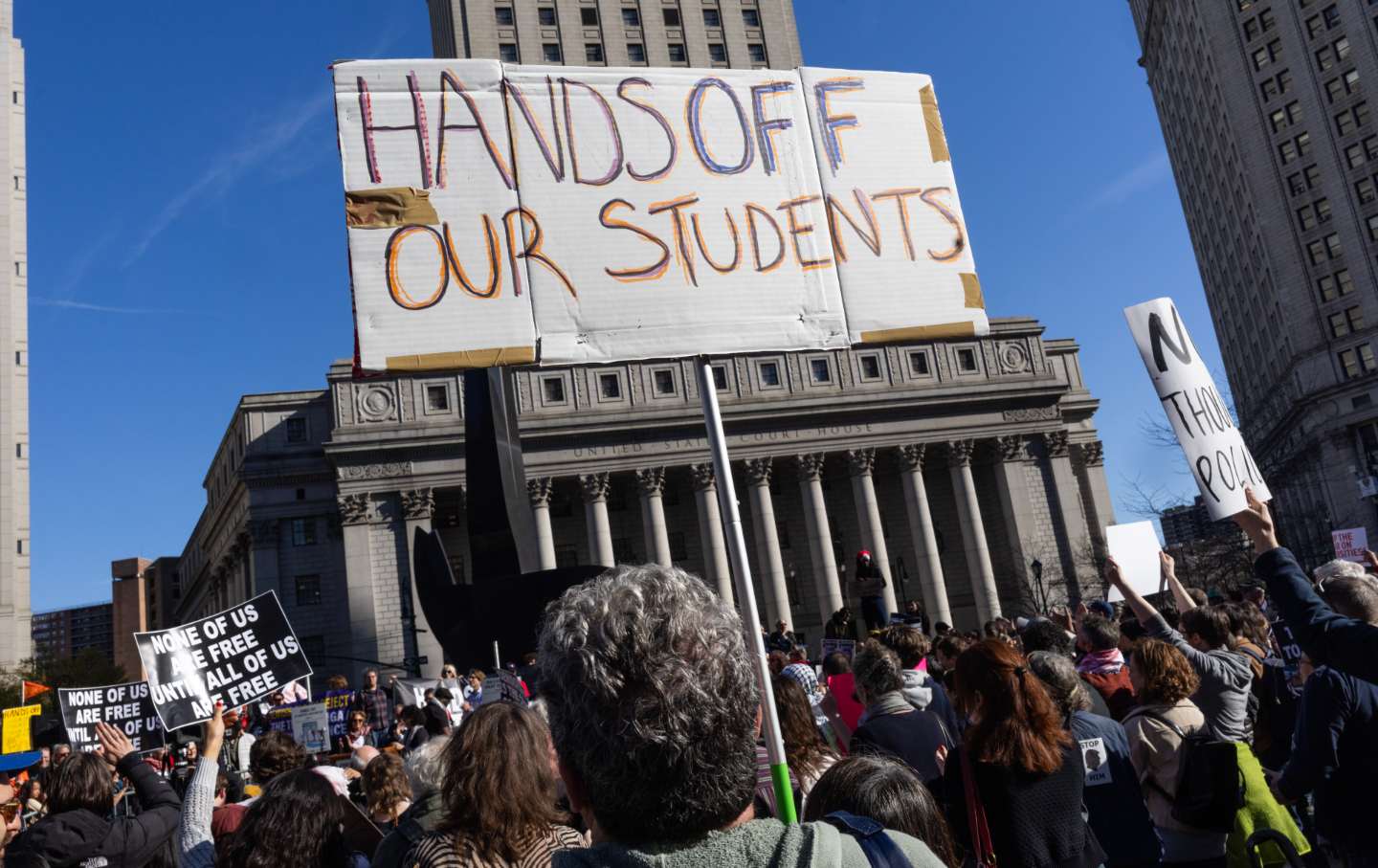
University faculty and students protest the detention and deportation of students under the Trump administration with a march and rally on April 17, 2025, in New York City.
(Andrew Lichtenstein / Corbis via Getty Images)This week, I attended a meeting on democracy and higher education at the University of Notre Dame. The meeting was largely composed of political scientists with direct expertise on the topics under discussion, along with leaders in higher education from around the country. As a public health scholar, I was a bit of a fish out of water. But understanding the attacks on public health and biomedical research in America is impossible without the context that the experts assembled in South Bend, Indiana, provided this week.
While much of the media is obsessed with the art of the deal—the terms of surrender to Donald Trump being offered up or considered by major universities around the country—this transactional lens obscures the fact that, as Ryan Enos and Steve Levitsky from Harvard have said, “this isn’t negotiation. It’s authoritarian extortion.” Talking about how, or whether, universities should make a deal with the White House also accepts the framing of the administration that this is about a settlement of contested claims or policy disputes. My late Sicilian grandfather would recognize what’s going on immediately. When two gentlemen from the Cosa Nostra came into his bakery in Brooklyn in the 1920s, he, perhaps unwisely, chased them down the street with a handgun. But he knew that this was a Mafia-style shakedown. He was not having it, and neither should any of us.
But the lessons I learned this week at Notre Dame were instructive. These attacks on higher education are not uncommon, and we do not have to reach back to distant history to see how they are rooted in the desire to dominate, destroy, and crush political and civic opposition.
Less than a decade ago, for instance, the Law and Justice (PiS) government in Poland sought to exert control over university governance, targeting certain areas of study, including gender studies, sociology, philosophy, and history, as “anti-Polish.” PiS used lawsuits and financial pressure on universities and even individual researchers to enforce its conservative vision for higher education. In Turkey—again, only a few years ago—President Recep Tayyip Erdoğan forced over 1,500 university deans to resign and changed laws to curtail the fiscal and academic autonomy of universities, while harassing faculty and students for dissenting views. The former Mexican President Andrés Manuel López Obrador froze or reduced funding for universities that he saw as out of step with his political vision, restructured leadership bodies such as the National Council of Science and Technology to suit his whims, and targeted individual researchers with charges of misuse of funds in order to intimidate them. Lastly, Viktor Orbán, the darling of the American right, has had a long-standing campaign to bring universities to heel, by taking over their leadership, shuttering degree programs in social sciences and humanities (e.g., in sociology, anthropology, history, and philosophy), and even forcing the Central European University to relocate its degree-granting programs from Budapest to Vienna.
In the light of this historical context, the struggle to save public health and biomedical research in the US cannot be seen as a single-issue fight. It’s part of a global battle against the anti-democratic forces that have been at play around the world and are now thriving here at home.
Getting the NIH to relent on terminated grants, or the Administration to restore impounded funds stripped from public health agencies or institutions of higher education are important, but that’s not enough. The Trump regime will always find a way to inflict pain on its perceived opponents, and pursuing individual fights as if they’re unconnected to a broader crisis will ultimately be a frustrating game of whack-a-mole. It is also true that the question of whether Columbia gave up “too much,” whether Harvard should “settle,” or what UCLA should offer up to appease the Trump administration are absolute and sorry distractions by commentators too afraid to speak the truth aloud.
Where does it leave us? I think it means that those of us in public health and biomedicine are going to have to ally with the pro-democracy movement writ large. And again, history provides some lessons. The Sanitary Reform Movement (Movimento da Reforma Sanitária) in Brazil, which pushed for healthcare reforms and the creation of a national healthcare system in the country, was also deeply tied to the struggle against Brazil’s military dictatorship in the 1970s and ’80s. The struggle for antiretroviral therapy in South Africa in the 2000s was part of a broad-based political campaign to get what was essentially a recalcitrant one-party state to address the desperate needs of its citizens for lifesaving medicines.
To save public health and biomedical research, we’re going to have to be part of a united democratic front with other groups working to oppose and fight democratic backsliding in the United States. We have to link arms with people working on immigration, the environment, and civil rights, to name a few. We are all under siege together and we must all fight as one. Many already understand this simple fact—we hang together or hang separately—but it is difficult for some in public health and biomedicine, particularly in academia, to grasp these political realities. We were trained as technicians of patient and population health, and not necessarily how to deal with the body politic. But we need to learn the lessons of history now—to understand our predicament—how others have faced what we are facing now and how we might fight to win.
Become a Sustaining Donor This September
Between the reemergence of right-wing red-baiting and Donald Trump’s use of the chilling National Security Presidential Memorandum–7 to criminalize left political organizing, we’re seeing McCarthyism reborn before our eyes.
This assault on democracy cannot be ignored or wished away. Resisting it requires bravery in the face of threats and repression, a steadfast commitment to the truth, and the unwavering belief that we can—and will—overcome this darkness.
We must have an independent media that sets the record straight, unearths corruption and abuses of power, and advances a politics of justice and dignity for all if we’re to win this fight.
That’s why I’m writing to you today. This September, The Nation needs to add 100 monthly donors to sustain our progressive journalism. Your contribution makes the next investigative report, the next truth-speaking column, and the next pathbreaking essay all possible.
I hope you’ll support our work with a recurring donation today. If you donate $10 or more a month, we’ll send you a brand new “Hands Off the Free Press!” sticker to recognise your commitment to our cause. Please, donate today.
Onward,
Katrina vanden Heuvel
Editor and Publisher, The Nation