Palestine Reveals the Empty Promises of US Democracy
Kei Pritsker, a codirector of The Encampments, a documentary film that follows the pro-Palestine movement at Columbia, says the student protesters will be remembered as heroes.
Palestine Reveals the Empty Promises of US Democracy
Kei Pritsker, a codirector of “The Encampments,” a documentary film that follows the pro-Palestine movement at Columbia, says the student protesters will be remembered as heroes.
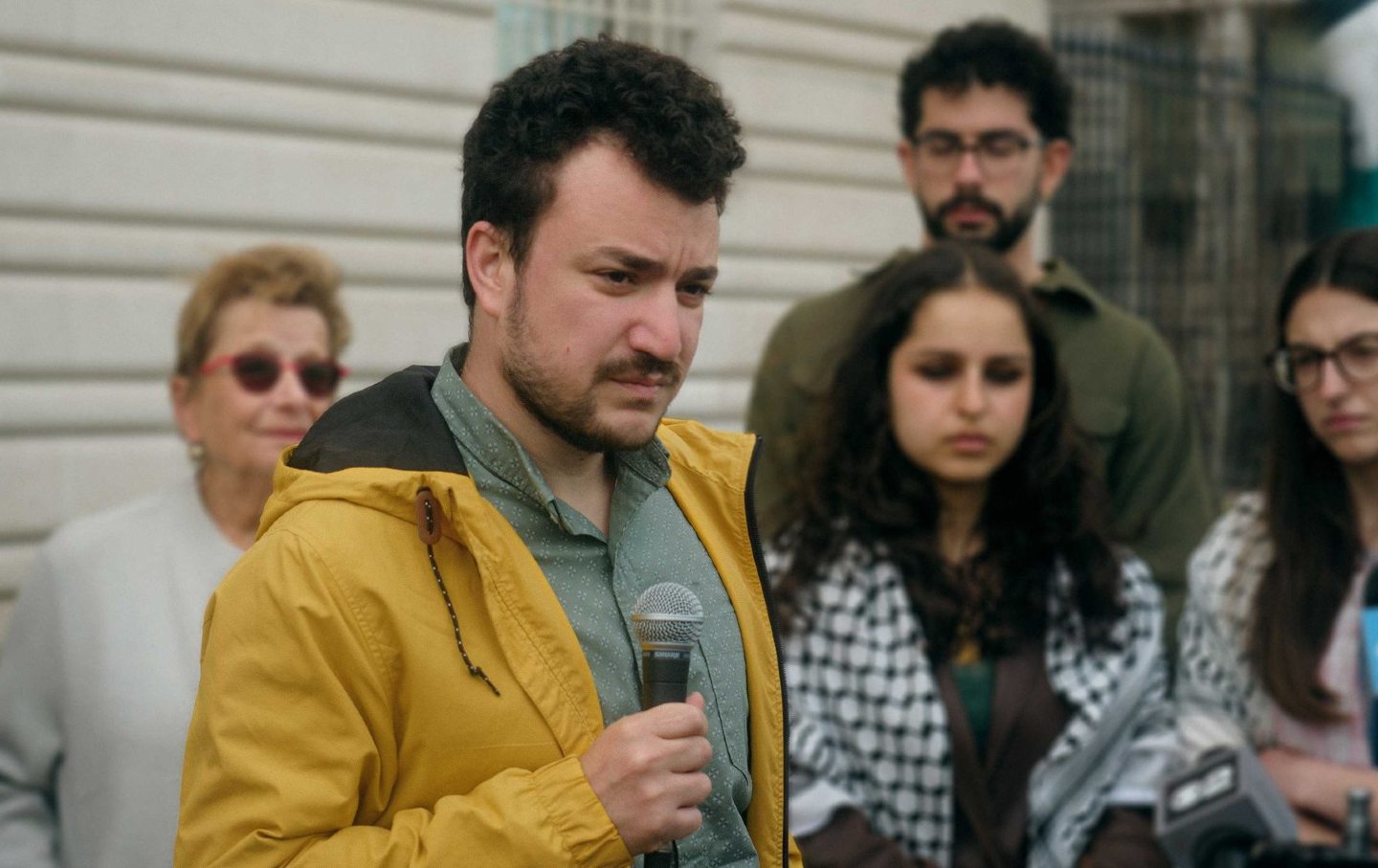
A film still of Mahmoud Khalil from the documentary The Encampments, directed by Michael T. Workman and Kei Pritsker.
(The Encampments)
When students at Columbia University occupied Hamilton Hall last spring, they renamed it Hind’s Hall in honor of Hind Rajab, a young Palestinian girl killed by Israel last January. Rajab’s final pleas were recorded by the Palestine Red Crescent Society and are included in The Encampments, a documentary film from Watermelon Pictures that offers an intimate look at the organizing efforts of Columbia students, including Mahmoud Khalil, who was arrested and sent to an ICE facility in Louisiana last month.
Initially, The Encampments—which aims to counter claims that the student resistance at Columbia was antisemitic and violent—was going to be released in the fall, to coincide with the start of the school year. “With the abduction of Mahmoud…they were taking all the lies about the encampments and using it as the foundation for this deportation campaign against students who participated,” Kei Pritsker, a journalist with Breakthrough News and one of the film’s directors, said. So the film was released early.
After a record-setting opening weekend in New York City, The Encampments is now playing at select theaters nationwide. I spoke with Pritsker, who lived at the Columbia encampment while filming, about what the student resistance can teach us about the state of American democracy.
—Alyssa Oursler
Alyssa Oursler: Why do you think the encampments, and the encampment at Columbia specifically, are important for understanding the current political moment, from Trump’s reelection to the detention and possible deportation of graduate students by ICE?
Kei Pritsker: This moment reflects a much deeper trend that was expressed through Palestine, which is that we don’t really have much of a say in this so-called democracy. What are we always told? That this is the most democratic, the freest country in the world. This is a country where the people are in power through their elected representation. I think over the course of the last few years and the last decade, there’s been a slow realization among vast sectors of society that the people, the majority, the working class, the ones who do everything, get none of the say in society. The issue of Palestine is one of the greatest expressions of that. What kind of democracy do you live in if you can’t even tell your politicians that you don’t want to participate in a genocide?
People are afraid of Trump, but this happened under Biden. It was under Biden that every campus in America was turned into a police state. We start the film off with a question. We ask: What was it about a bunch of students camping out on lawns that made all the most powerful institutions and powerful people in the country freak out? It’s the fact that they realized they’re losing the narrative. I see what’s happening under Trump, this attempt to deport the students, as first and foremost an admission that they’ve lost the narrative are resorting to what authoritarian regimes use as tool of last resort: repression, censorship, and violence.
AO: It’s a good point that this issue predates Trump and has been years, if not decades, in the making. The documentary, for instance, cites the historical precedence of campus occupation going back to the ’60s. What has changed since then—and what hasn’t?
KP: What hasn’t changed is that students have always been on the right side of history. We look back on the actions of students and think: “Wow, they were ahead of their time.” Back in those days, the universities fought the students as well—especially Columbia. Columbia, as you see in the film, sent in cops to beat the students who occupied Hamilton Hall in the ’60s during protests against segregation. The students were also disciplined and chastised for protesting South African apartheid. But Columbia looks back on those protests and celebrates them. They talk about the 1968 protests, the 1985 protests, and they say: “Look at Columbia, look at our students, look at how forward-thinking they are, look at how they’re agents of history, agents of change. Come to Columbia, and you can be like them!” But they don’t realize that Palestine is this 21st-century human rights peace movement, and they’re repeating the same mistakes they made during South African apartheid and during Jim Crow.
What has changed is that this new generation is saying something much more fundamental about the society and the system we live in—that it’s fundamentally rigged against the vast majority of people and that the only way to change this is through a complete overhaul of the system. They want to see the whole system changed from bottom to top.
AO: What does institutional complicity at elite institutions like Columbia tell us about the depth and pervasiveness of Israeli influence in the United States and the state of the country more broadly?
KP: The influence of the Israel lobby is really unmatched by any other foreign lobby. You think about the Trump presidency; his campaign was so heavily financed by Israel, receiving $100 million from Miriam Adelson, Steve Witkoff, all these people. The fact that the US government would sooner arrest and tear-gas and handcuff its own students and turn every campus in this country into a police state rather than divest money from companies that are complicit in war crimes tells you everything about who the US ruling elite is loyal to.
AIPAC brags on their website about how they win 95 percent of the elections they intervene in. We saw that on display with the defeats of Jamaal Bowman and Cori Bush. They spent the most they’ve ever spent in any congressional campaign cycle on these races, and they claimed responsibility. And now there are all these pro-Israel groups calling for the deportation of students whose only crime is criticizing a country that is committing a genocide.
People have to ask real questions: What does it mean that Israel is our greatest ally? Greatest ally to whom? I would say the answer is that Israel is the greatest ally to the military-industrial complex, to weapons manufacturers, but it’s not an ally to anyone else in the United States. [But also,] the US-Israel relationship and the power of the Israel lobby is symptomatic of something far more fundamental, which is that in the capitalist system the government itself is for sale to the highest bidder.
AO: There is a really powerful scene in the film where Mahmoud Khalil is asked what would happen if he were deported. How pervasive was fear of this type of repression while the encampment was happening a year ago?
KP: There was definitely fear, especially among Palestinian students. But anyone who’s been in the Palestinian movement for a while knows that Palestinian students have been relentlessly targeted for doxing. This is especially problematic because the border controls in occupied Palestine are controlled by Israel. If they’re doxed, they could be prevented from entering their own country. So we knew in the abstract that these images, the footage could be weaponized against them. Did we know it would be like this? Did we know that it would be using AI to comb through and target anyone on student visa who’s here? No. We definitely did not know that. We always knew it was in theory a possibility, but we never anticipated anything like this.
AO: Do you fear retribution from the Trump administration because of the film?
KP: I’m not afraid, no. I understand a lot of people are afraid, and that’s completely understandable. What’s happening now [with deportations] is a new development. But I don’t think anyone ever got involved in the Palestine movement because they thought they’d be more safe or more comfortable. Everyone that got involved, especially these students, did so knowing it would make them less safe, that they might get doxed, they might get harassed, they might face real violence. But they do it anyway because they understand this is a necessity for humanity. What ramifications does this have for the collective soul of this planet if we just watch a genocide happen in front of our eyes?
I would also say: What is history besides a series of tremendous risks and sacrifices? That’s the essence of history: sacrifice. Giving a part of yourself and risking everything to build a better world. Where would we be had people not taken risks, whether Martin Luther King Jr. or Frederick Douglass or any person of consequence? I believe we will look back at this one day—on this moment, on the Palestinian movement—and think: How could we have ever let this go on for so long? How could people have stayed silent for so long? People will look back on the students, on the movement, and think: Those were the real heroes. History will absolve us.
AO: That makes me think of the book titled One Day, Everyone Will Have Always Been Against This. The phrase is stuck in my head all the time. Which brings me to my next question. What do you think is the role of art and archival in this struggle?
KP: I think it plays a huge role. The thing we have to understand about war, warmongering, imperialism, and capitalism is that truth is always the first casualty. People know you cannot sell a war, sell a genocide, without a distortion. I’m 28. I’m part of the 9/11 generation. The United States has been at war every year of my life. You think about all these wars—all of them were based on total propaganda. You can’t go to the people with the truth and win them over. They couldn’t say: We want to invade Iraq, destroy its infrastructure, and clear the way for oil companies, energy companies, construction companies, and weapons companies to do whatever they want, to turn Iraq into a playground. We’re going to send a bunch of your kids over there to kill people and die so our people can make money. You can’t go to the American people and say that. You have to say we’re doing this for democracy, for freedom.
Similarly, there are billions and billions of dollars going into propaganda to justify the continued unconditional support of Israel. We don’t have billions of dollars, but we have some cameras. Art is so important because we are constantly fed images and artistic depictions that what the US and Israel are doing over there is heroic and good, when it’s actually imperial plunder. It’s the Palestinians who are marching for peace and protesting to uphold the UN Charter, the South African lawyers going into the ICJ, the students, they’re the heroes.
They’ve been trying to tell us for the last 20-something years that the politicians, the media, the think tanks, these are the people we can trust. A white guy in a suit and tie. What a lot of people are realizing now is that those people are actually the enemy. It’s the suits who are the ones selling us on a total lie—the ones not only selling us on these wars but also blocking social progress here. Part of the artistic undercurrent of the film is to make people evaluate who it is that we should really consider authorities in our society.
AO: Do you think another big wave of activism is brewing?
KP: Yes, absolutely. What the encampments and this latest deportation crackdown have shown is that we have absolutely no say in this system. Even when something is deeply, deeply popular—like a ceasefire in Gaza—even that, to this day, is being ignored. We’ve done peaceful protests, we’ve done civil disobedience, we’ve done social media campaigns, we’ve called our senators, which is what they always say to do. We did that every day, every week, every month, and nothing happened. It’s exposed how fundamentally undemocratic our system is, which is why protest is inevitable. The issue hasn’t been solved at all. This status quo is unsustainable. It’s unconscionable to live in a society where people can just be abducted in broad daylight for protesting a genocide. It’s not a way we can continue to live. It’s a pot that is boiling and is going to blow.
Become a Sustaining Donor This September
Between the reemergence of right-wing red-baiting and Donald Trump’s use of the chilling National Security Presidential Memorandum–7 to criminalize left political organizing, we’re seeing McCarthyism reborn before our eyes.
This assault on democracy cannot be ignored or wished away. Resisting it requires bravery in the face of threats and repression, a steadfast commitment to the truth, and the unwavering belief that we can—and will—overcome this darkness.
We must have an independent media that sets the record straight, unearths corruption and abuses of power, and advances a politics of justice and dignity for all if we’re to win this fight.
That’s why I’m writing to you today. This September, The Nation needs to add 100 monthly donors to sustain our progressive journalism. Your contribution makes the next investigative report, the next truth-speaking column, and the next pathbreaking essay all possible.
I hope you’ll support our work with a recurring donation today. If you donate $10 or more a month, we’ll send you a brand new “Hands Off the Free Press!” sticker to recognise your commitment to our cause. Please, donate today.
Onward,
Katrina vanden Heuvel
Editor and Publisher, The Nation