To Win Big, Progressives Need to Up Their Strategy Game
Practical radicals offer strategies that play to our strengths.
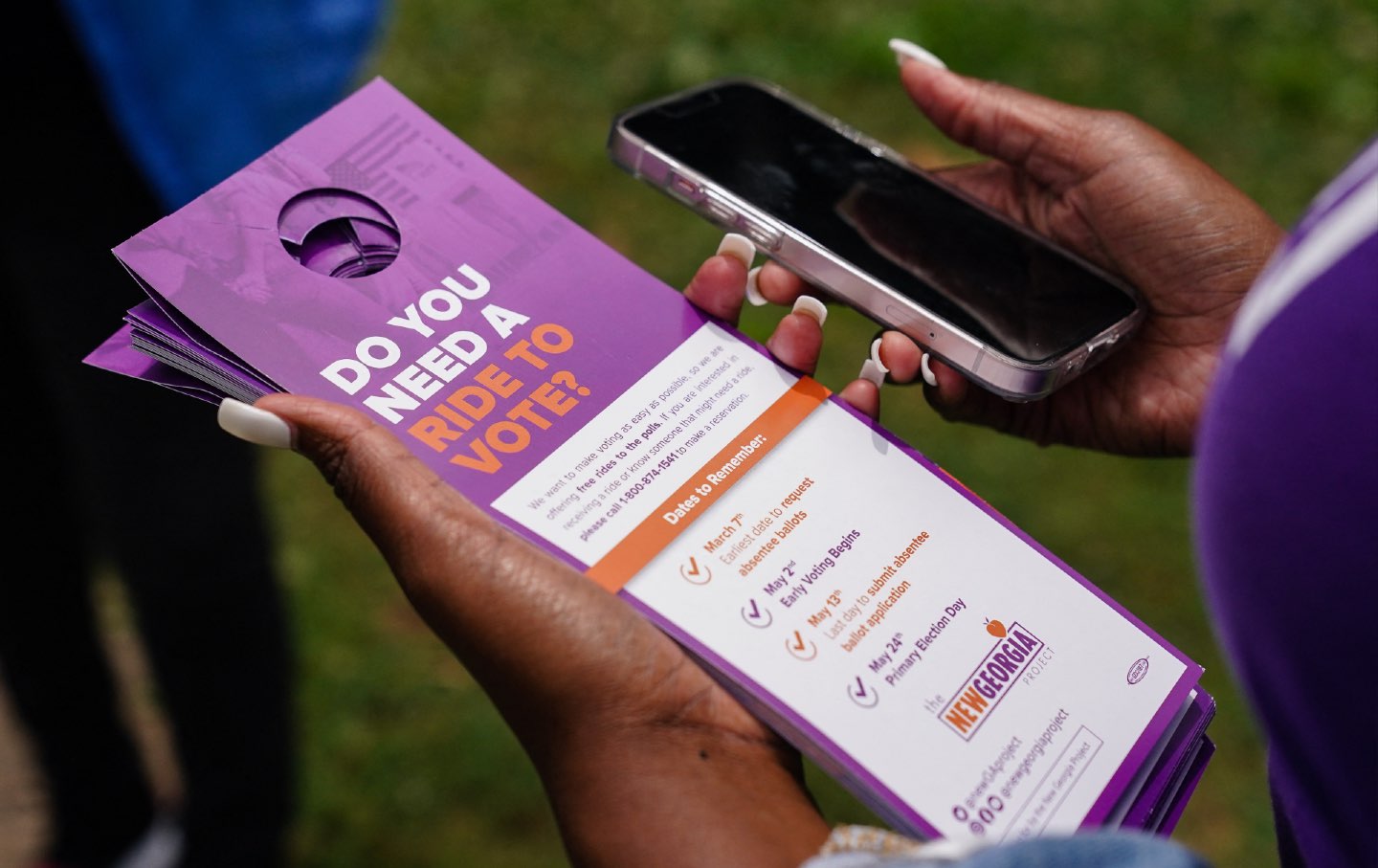
New Georgia Project canvasser Kayla McCall holds informational door hangers about the upcoming primary election on May 23, 2022, in East Point, Ga.
(Elijah Nouvelle / Getty)We teach a course on organizing, and every year students ask the same question: Why does the right wing keep winning? Given how unpopular their policies are, they should be relegated to a small fringe (as they once were). So why are we losing—not just people on the left, but almost everyone—the underdogs? One reason is because the rules of our system give minorities outsize power in the Senate and the electoral college; another is the ever-growing effect of money in politics. But another, often overlooked reason is that progressives—the people who should be presenting a clear alternative to the right—have gotten worse at strategy even as the challenges, from soaring wealth inequality to climate change, have gotten bigger.
By contrast, the right has long recognized that strategists are made, not born, and has nurtured, cultivated, and networked their up-and-coming activists. The conservative Leadership Institute alone has trained over 200,000 activists, linking big vision with a ruthless orientation to taking power. The credo of the Leadership Institute says it all: “you owe it to your philosophy to learn how to win.” (In fact, winning is the philosophy—it’s been a long time since the right has held to any higher principle than taking and holding power.) We see the impact of these decades-long investments in our courts, the media, and politics.
We’re not arguing that progressives should mimic these efforts. For one thing, the right (unsurprisingly) appeals to the authoritarian personality—their activists follow marching orders to an extent that progressives couldn’t match even if we wanted to.
That, however, doesn’t mean that progressives can’t, or shouldn’t, use strategy at all. There are strategies that play to our strengths as well. We’ve studied some of the biggest victories for social change—from the abolition of slavery to the New Deal to the civil rights movement—and we’ve found seven strategies that today’s underdogs—which is to say, almost all of us—can use to win. All are relevant, but four especially so at this moment.
First, our main source of power is our numbers, but that only matters if we stick together. To win anything, we need to organize people, often one to one. This is base-building. Progressives need a culture of recruitment, knowing that nobody will agree about everything, but welcoming them anyway without demanding purity, and making sure they have a real voice. It’s been too easy to try to substitute social media or glossy ads for the work of building real connection. This work is hard, but the rewards can be great. For instance, undocumented immigrants in New York State, facing great odds, won pandemic relief funds with Make the Road NY by building their base until politicians had to pay attention.
Underdogs can also win through disruption, actually stopping an oppressive system from functioning so that the people who benefit from it have to make concessions. Even the threat of disrupting production and profit is powerful. This is one of the truly hopeful developments of our time: workers, from autoworkers to UPS drivers to TV writers, are rediscovering their power. But these actions must truly disrupt; symbolic protest isn’t enough in an era where one side seems to no longer feel shame and a host of news sources will never even report on it. The autoworkers embraced disruption and they won big. They went on strike at strategic locations, including the most profitable plants of each of the Big Three automakers, and won tentative agreements that would provide 25 percent wage increases at Ford and Stellantis.
While there is widespread, and understandable, disillusionment with electoral politics, the stakes of electoral change have never been higher. We can’t deal with the growing threats to our climate, our economy, and democracy itself without governing power. Conservatives have fought hard to capture courts, legislatures, and the voting process because they know their importance. (Nobody’s coming for your guns. They are coming for your votes.) But progressives have done electoral work poorly, focusing on individual candidates who, win or lose, leave no infrastructure behind. Instead, we must connect electoral work to ongoing organizing. The New Georgia Project, California Calls, and the Working Families Party are some of the groups working to organize year-round, bringing in members who have a say in setting priorities.
As we saw in the pandemic, and as we’re seeing with climate disasters, collective care is necessary for survival. But movements have also used it strategically; taking care of each other enables us to take risks, pool resources, and fight for change more effectively. For instance, the Gay Men’s Health Crisis provided collective care that was critical in supporting activists who fought the AIDS epidemic.
Progressives CAN win the future, and we found many inspiring cases from Minnesota to California to Georgia where they are doing that. But we’ll need to get much more serious about strategy. In addition to the four strategies discussed above, change also occurs by capturing the hearts and minds and support for your vision. We’ve seen progressives use narrative shift strategies as key components to win gains like marriage equality. The momentum model combines mass protest with narrative change, looking to expand what’s possible to win by changing the common sense, as 350.org did through its campaign to divest from fossil fuels. And, without governing power, we can still use inside-outside policy campaign strategy to connect movements and legislators to win real gains, like the Fight for $15 and a Union did in city councils around the country.
Some of the avenues we’ve long counted on, such as the courts, are blocked or nearly so. We can—and must—rediscover the timeless strategies used by previous generations to change history.
Become a Sustaining Donor This September
Between the reemergence of right-wing red-baiting and Donald Trump’s use of the chilling National Security Presidential Memorandum–7 to criminalize left political organizing, we’re seeing McCarthyism reborn before our eyes.
This assault on democracy cannot be ignored or wished away. Resisting it requires bravery in the face of threats and repression, a steadfast commitment to the truth, and the unwavering belief that we can—and will—overcome this darkness.
We must have an independent media that sets the record straight, unearths corruption and abuses of power, and advances a politics of justice and dignity for all if we’re to win this fight.
That’s why I’m writing to you today. This September, The Nation needs to add 100 monthly donors to sustain our progressive journalism. Your contribution makes the next investigative report, the next truth-speaking column, and the next pathbreaking essay all possible.
I hope you’ll support our work with a recurring donation today. If you donate $10 or more a month, we’ll send you a brand new “Hands Off the Free Press!” sticker to recognise your commitment to our cause. Please, donate today.
Onward,
Katrina vanden Heuvel
Editor and Publisher, The Nation