
 Everett Collection
The horror film that unfairly tarnished the reputation of good gorillas everywhere.
At least one of our national characteristics is illustrated in the RKO-Radio production of King Kong which loomed over the audiences of both Radio City moviehouses last week. It is a characteristic hard to define except that it is related to that sometimes childish, sometimes magnificent passion for scale that foreigners have remarked in our building of hundred-story skyscrapers, our fondness for hyperbole in myth and popular speech, and our habit of applying superlatives to all our accomplishments. Efforts to explain it have not been very satisfactory; the result is usually a contradiction in which we are represented as a race that is at once too civilized and not civilized enough. If Herr Spengler interprets the extreme gigantism of the American mind and imagination as the sign of an inflated decadence resembling that of Alexandria and the later Roman Empire, others discover in it the simpler expression of a race still unawakened from childhood. At Radio City last week one was able to see the contradiction pretty dramatically borne out; an audience enjoying all the sensations of primitive terror and fascination within the scientifically air-cooled temple of baroque modernism that is Mr. Rockefeller’s contribution to contemporary culture.
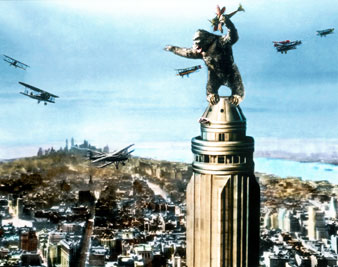
What is to be seen at work in King Kong is the American imagination faithfully adhering to its characteristic process of multiplication. We have had plays and pictures about monsters before, but never one in which the desired effect depended as completely on the increased dimensions of the monster. Kong is a veritable skyscraper among the apes. In his own jungle haunts he rules like a king over the rest of the animal world; and when he is taken to New York to be exhibited before a light-minded human audience he breaks through his chromium steel handcuffs, hurls down two or three elevated trains that get in his way, and scales the topmost heights of the Empire State building with the fragile Miss Fay Wray squirming in his hairy paw. The photographic ingenuity that was necessary to make all this seem plausible was considerable, and in places so remarkable as to advance the possibility of a filming of certain other stories depending largely on effects of scale—Gulliver’s Travels, for example, and possibly even the Odyssey. But unfortunately, it was thought necessary to mitigate some of the predominant horror by introducing a human, all-too-human theme. “It was not the guns that got him,” says one of the characters at the end, after Kong has been brought to ground by a whole squadron of battle planes. “It was Beauty killed the Beast,” By having Beauty, in the person of Miss Wray, lure the great monster to his destruction, the scenario writers sought to unite two rather widely separated traditions of the popular cinema—that of the “thriller” and that of the sentimental romance. The only difficulty was that they failed to realize that such a union was possible only by straining out powers of credulity and perhaps also one or two fundamental laws of nature. For if the love that Kong felt for the heroine was sacred, it suggests a weakness that hardly fits in with his other actions; and if it was, after all, merely profane, it proposes problems to the imagination that are not the less real for being crude.
The technical difficulties, both of acting and photography inherent in any treatment of the Dr. Jekyll-Mr. Hyde theme were pretty consistently ignored by those responsible for L’Autre at the Fifth Avenue Playhouse. Nothing in its direction reminded one that it was the work of Robert Wiene whose Cabinet of Dr. Caligari was so important in the development of still photography in the silent film. The German operetta Friederike at the Europa is worth seeing principally for the charming reconstruction of eighteenth-century Germany which is its background, and worth hearing for those of the Franz Lehar songs which are sung by Mady Christians.

