
 RYAN INZANA
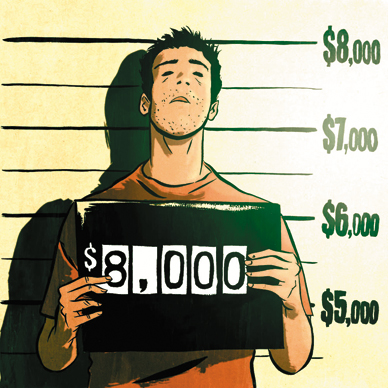
Paying a debt to society now means more than doing time. In addition to prison sentences or alternatives to incarceration such as drug programs, fees and surcharges are being imposed on criminal offenders throughout the country. In some states, offender-based revenues start to accumulate upon arrest, without a wait for conviction. These charges are in addition to any fines and restitution they may be required to pay.
Surcharges and fees are mandatory in all New York criminal cases. A felony conviction for drugs, larceny or burglary, for example, costs the defendant a statutory $300 fee plus $25 to a victims' fund. Judges have no discretion to waive them despite the defendant's likely indigence. As New York State Supreme Court Justice Gustin Reichbach says, "The imposition of mandatory surcharges, like mandatory sentencing, erodes judicial independence by tying the judges' hands even when they think that justice requires a different result."
"It is fiscal gimmickry used to close budget gaps," says Brooklyn Assembly member Hakeem Jeffries. "No one thinks it's anything but a barrier to successful re-entry into society, because people with low or no income will owe significant amounts of money." Alan Rosenthal, director of justice strategies for the Center for Community Alternatives, adds, "It is not a public safety issue, and there are almost no proponents of these financial consequences for any reason other than the revenue streams."
Bobby, 26, who admits to having "a bad record," recently served eighteen and a half months in Virginia. He's out now and working part time but says he owes more than $9,000 in court fees and another $10,000 in accrued interest and penalties. His prison balance sheet had hourly wages of 42 cents, from which he paid a dollar a day for his lodging and medical attention. Bobby, who is on "intensified parole," says, "I can never get out of it, and once you get into that Catch-22, you might as well live it up until you get locked up again."
But "recidivism is what nobody talks about," according to David Udell, director of the Justice Program at the Brennan Center for Justice at New York University School of Law. The biggest problem, he explains, is that there is no meaningful thought or dialogue on the implications of the entire surcharge/fee phenomenon. "You are loading debt onto people who are in the system in the first place due to lack of financial resources," Udell says. In fact, 80 percent of people facing felony prosecutions are indigent, and 60 percent of men and women released from prison are still unemployed a year later.
Whether there's an arrest on new charges, and a whole new case with new surcharges and fees, or violations of parole and probation for nonpayment, "the ability to stay out of prison depends on making payments," Udell explains. At the same time, civil judgments are routinely entered against the debtors. On top of a criminal record, this results in bad credit, garnishment of salaries and inability to gain employment, housing or education. In Washington, as well as other states, unpaid court debt can end voting rights. Private collection agencies are widely used, but the surest collections are from inmates because their prison earnings as well as commissary money sent by families, while usually insufficient to cover the debt, are seized by the state.
In the meantime, there are arrest fees (Texas), booking fees (Colorado) and DNA bank fees (New York). Michigan bills for the services of court-appointed lawyers, creating an incentive to waive counsel or to plead guilty at an early stage before legal costs escalate. Eighteen percent of Rhode Island inmates are in custody in connection with court-imposed financial obligations. An open court debt in Florida leads to a suspended driver's license, which in turn can lead to loss of job or re-arrest for driving with a suspended license. Alabama judges can increase fees from $600 to $10,000. There are special fees for particular offenses such as sex crimes, abuse of children or the elderly and, especially, driving while intoxicated.
Staten Island District Attorney Dan Donovan, who does not believe that surcharges and fees deter crime, says, "The true benefit of court-mandated fees is that they require criminals to financially support the operation of the criminal justice system they have violated as well as to benefit programs targeting violence and substance abuse." Yet the surcharges and fees are not earmarked for criminal justice, the courts or victims but go instead to the state treasury. David Bookstaver, communications director for the New York State Unified Court System, says he does not know how much revenue the courts generate or where the money goes. However, he does know, "We do not keep the money here."
The spokesperson for another prosecutor sums it up: "I always found it kind of strange to sentence a guy to ten years, and then say, Oh, by the way, you also owe $1,000."

