
Elon Musk’s Mortal Threat to Democracy
The world’s richest man—saying he’s “wised up” to the fiction of self-government—is leveraging his wealth to sway elections, threaten Congress, and alter the global balance of power.
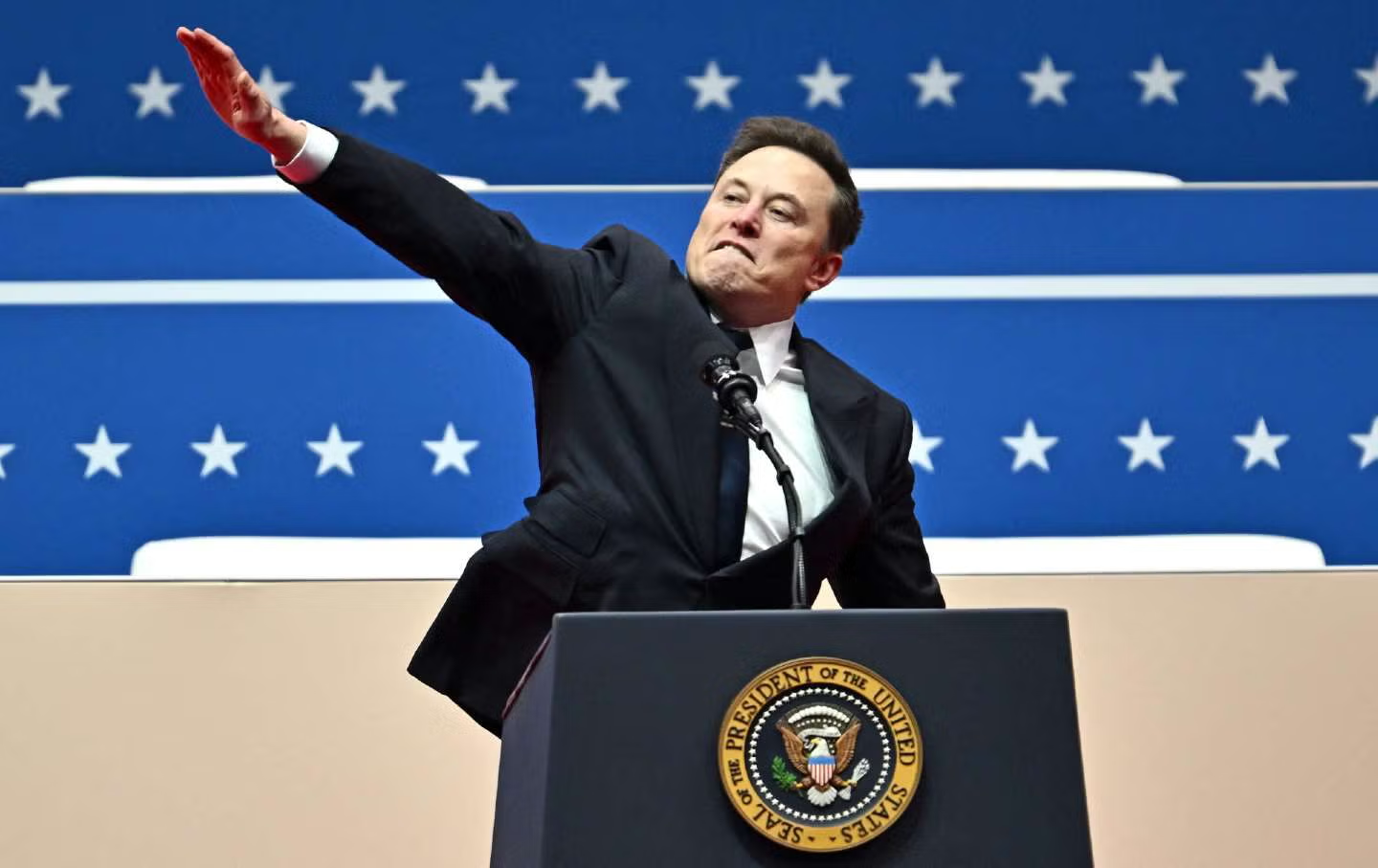
Elon Musk delivers a Sieg Heil–style salute during Donald Trump’s inauguration celebration last year.
(Angela Weiss / AFP via Getty Images)Should we worry that the world’s richest man, a self-appointed arbiter of all things cool or not, seems to have decided that democracy is deeply cringe? On the Fourth of July, while millions of Americans enjoyed fireworks displays and their dogs and cats cowered under beds in auditory terror, Elon Musk was having a conversation about the relative merits of “makers” and “takers” with a self-published science fiction author on X, the socia-media platform he happens to own.
“Elon, this is the moment where you’re supposed to wise up and abandon classical liberalism,” Devon Eriksen wrote. “If you let takers vote, they will not only take more and more, they will make it more and more rewarding to be a taker.… Universal suffrage leads to universal suffering.”
Musk’s reply? “I have wised up.”
As an alarmed David French noted in The New York Times, Musk’s response recalled weirdo techbro investor Peter Thiel’s infamous 2009 declaration that he “no longer believe[d] that freedom and democracy are compatible.”
Thiel may have been an early recruit to Big Tech democracy-bashing, but many others have followed his example. Elites in and around Silicon Valley, perennially angry about wealth taxes and government regulation of people like them, have become increasingly hostile to democracy itself. Egg-headed venture capitalist Marc Andreessen has declared that “democracy is fake” and holds up F.T. Marinetti, the Futurist who co-authored the 1919 Fascist Manifesto, as a personal hero. Tech entrepreneur and author Balaji Srinivasan, a former partner at Andreessen Horowitz, has become the Valley’s loudest proponent of what he calls the “network state”—a scheme to supplant boring old democracies with high-tech city-states lorded over by kinglike CEOs. Meanwhile, neo-reactionary monarchist Curtis Yarvin, formerly known as the alt-right blogger Mencius Moldbug, has become what Thiel biographer Max Chafkin calls the “house political philosopher” of the tech world’s fraternity of democracy haters; Thiel has funded his ventures and Vice President JD Vance, another Thiel protégé, considers him a friend.
It’s more than a little alarming that Musk has decided to join this motley crew. He’s obviously a powerfully situated foe of self-government, just because he’s got so much damn money, with his net worth hovering around a cool trillion. Beyond that, though, he now wields unprecedented geopolitical clout thanks to his ownership of more than 80 percent of the voting shares of SpaceX—a stake that gives him control over Starlink, the leading satellite Internet service. This Musk property is now a vital part of the tech infrastructure in 160 countries around the world—and not just for those living in rural or remote areas who would otherwise be without Internet service. Notably, Ukraine depends on the civilian version of Starlink for general communications and control in its war against the Russian invaders, while also relying on Starshield, its military-grade application, to control fleets of drones, which can be used to defend against Russian drones and to strike well behind enemy lines.
It can, that is, when Ukraine’s use of both Starlink and Starshield is unrestricted. On October 10, after Ukrainian attacks on Russian oil refineries, an irritated Musk posted that “Zelinsky has gone too far.” President Donald Trump, also angry over the refinery strikes, said it was “time for Ukraine to get a new president.” Four days later, Ukraine found itself facing extreme restrictions on its Starshield use that made it nearly impossible to successfully use its drone interceptors. Musk said it wasn’t he who had effectively pulled the plug, but Trump. Trump, for his part, said that “it wasn’t me and I don’t think it was Elon”—apparently pointing his finger at the infamous invisible gremlin Not Me, or perhaps his colleague Ida Know, from the cartoon Family Circus.
After more than a week of denials all around, Musk muddied the waters further with a post on X Saturday in which he acknowledged throttling Starlink, but not Starshield, because, he said, the Ukrainians had violated its terms of services by “us[ing] it for offensive drone strikes to kill people.” Ukrainian officials replied that they not only hadn’t but couldn’t have committed such a violation, because Starlink does not, by design, work in Russian territories, with one adviser to Zelinsky remarking that it was “very strange” that Musk didn’t seem to know about the restrictions on his own technology.
Musk went on in his post to insist that the US government, not him, controls the military-grade Starshield, but then added rather ominously, “Were Starlink to be turned off, the Ukrainian front line would collapse immediately. This is NOT a threat, it is simply a statement of fact.” He ended by declaring that he had “nothing but UTTER CONTEMPT for the virtue-signaling evil warmongers who push for endless slaughter and offer no realistic solution to the conflict”—presumably a swipe at anyone who thinks the Ukrainians shouldn’t immediately cede land for “peace.” Whichever version of l’affaire Starlink turns out to be true, it should now be abundantly clear that the mercurial, not-to-mention unelected, Musk has no business conducting foreign policy for us, and that his ability to do so is a threat not only to Ukraine but also to democracy in America.
Meanwhile, Musk can conduct the equivalent of a coordinated political drone assault on the American political system via his vast hoard of cash. According to Bloomberg, Musk has dumped more than $445 million into assorted Republican-aligned dark-money PACs in an attempt to put his big fat thumb on the scale in the November midterms. At least $158 million of that total has gone to the odious Ken Paxton, running for the Senate in Texas, Musk’s current home state; Musk is basically bankrolling his campaign.
Putting this much money into a political race is essentially a vote against democracy itself, an attempt to nudge results your way by overwhelming uninformed and uncommitted voters with a flood of paid propaganda—like the mailers sent out en masse by Musk’s own America PAC declaring, “THE SOCIALIST LEFT is DESTROYING AMERICA.” Notably, America PAC has spent four times as much on attacks against Paxton’s Democratic rival, James Talarico, than it has supporting the Republican. Musk has supplemented his PACs’ propaganda with even less subtle jabs at the “creepy” Talarico on X, where the tech mogul has 241 million followers. “There is something deeply wrong with Talarico,” Musk wrote in one post last week, adding in another that “Talarico would vote to take away your kids and transition them, not just in Texas, but nationwide. Pure evil.” Needless to say, Talarico would do no such thing. Musk—deeply estranged from his trans daughter, model Vivian Jenna Wilson—evidently takes this issue too personally to tell the truth about it.
The most unnerving thing about Musk’s political outlays isn’t that he’s spending so much; it’s that, in proportion to what he has, he’s spending so little. In politics, a half-billion dollars is a ton of money. In Muskworld, it’s a rounding error, representing only a fraction of a fraction of his total net worth. In 2022, he spent $44 billion buying what was then called Twitter and turning it into the fascist-infested hellhole it is today; that’s 99 times what he’s put into Republican races this fall. Hell, according to Forbes’s wealth tracker, Musk’s net worth rose by more than $10 billion during the time it took me to write this piece, because investors were feeling more charitable toward him on Friday than I was. He could easily dump a great deal more money into the midterms and somehow I suspect he will.
One reason for this suspicion is that Musk is clearly feeling antsy about what might happen to him if the midterms don’t go his way. Once regarded as a sort of quirky tech wunderkind, Musk has recently seen his popularity sink toward Trumpian levels in recent days; an Economist/YouGov poll from earlier this month puts it at 34 percent. So it’s hardly surprising that some Democrats have begun to talk about hauling him before Congress to answer questions about, among other things, the skulduggery of DOGE and its enormous human cost; even a few Republicans want to ask him about just what happened with Starlink.
Popular
“swipe left below to view more authors”Swipe →On a Bulwark podcast last week, tech journalist Kara Swisher remarked that if the Republicans lose the House and the Senate the Democrats are “gonna start investigating again. You think he’s not on the list? He’s at the top of that list.” She went on to speculate that if Kamala Harris had won in 2024, Musk might already be in jail, not because Harris would have been “some avenging fury” but because there are “a lot of questions around different companies of his.”
Musk reacted with, well, fury. “Live by the sword, die by the sword,” he wrote ominously. “Sounds like Swisher really wants to go to prison.” For what exactly he didn’t say. A cat may look at a king, but apparently a journalist looking too critically at Musk has committed a jailable offense.
“Those who pick fights with me should understand that I will find out who is really pulling the strings and come for them, not just their puppets,” Musk added in another post, sounding like a B-list Marvel supervillain.
If Musk were just some crank on X, none of this would matter. It matters because this particular crank is, well, Elon Musk—a capricious, emotionally stunted man-baby mogul with incomprehensibly more power and money than he deserves, and who’s decidedly prone to basing most of his decisions on a mixture of strange whims and dark impulses. It is practically our small-d democratic duty to tax the shit out of billionaires like him. Yes, we could certainly use his money—but we’ve also long eclipsed the point at which his fortune has given him powers that are fundamentally incompatible with democracy. Elon Musk is a policy failure.
More from The Nation
Michigan Students Are All In for Abdul El-Sayed Michigan Students Are All In for Abdul El-Sayed
The progressive Senate candidate has won over students with his politics—and, in at least one case, his protein intake.
What Are Democrats Prepared to Do if Trump Rigs the Election? What Are Democrats Prepared to Do if Trump Rigs the Election?
In this week’s Elie v. U.S, our justice correspondent challenges Democrats' lack of a plan if Trump steals the midterms. Plus: the most racist, and honest, AI add ever.
Ramaswamy’s Guide to a Better Vocabulary Ramaswamy’s Guide to a Better Vocabulary
Quotes of the Week.
Why Trump Is Embracing Vivek Ramaswamy’s Vile Ad Why Trump Is Embracing Vivek Ramaswamy’s Vile Ad
The president is leaning into the politics of toxic parenting.

The Shadow Knows The Shadow Knows
High-tech weapons, low-tech intelligence.

Tom Hayden’s Legacy and the New American Left Tom Hayden’s Legacy and the New American Left
It’s been 10 years since he passed away.

