
A Reckoning Comes for Nepal
A year after its Gen Z uprising, Nepal faces a struggle not only for democracy and human rights but for climate survival.
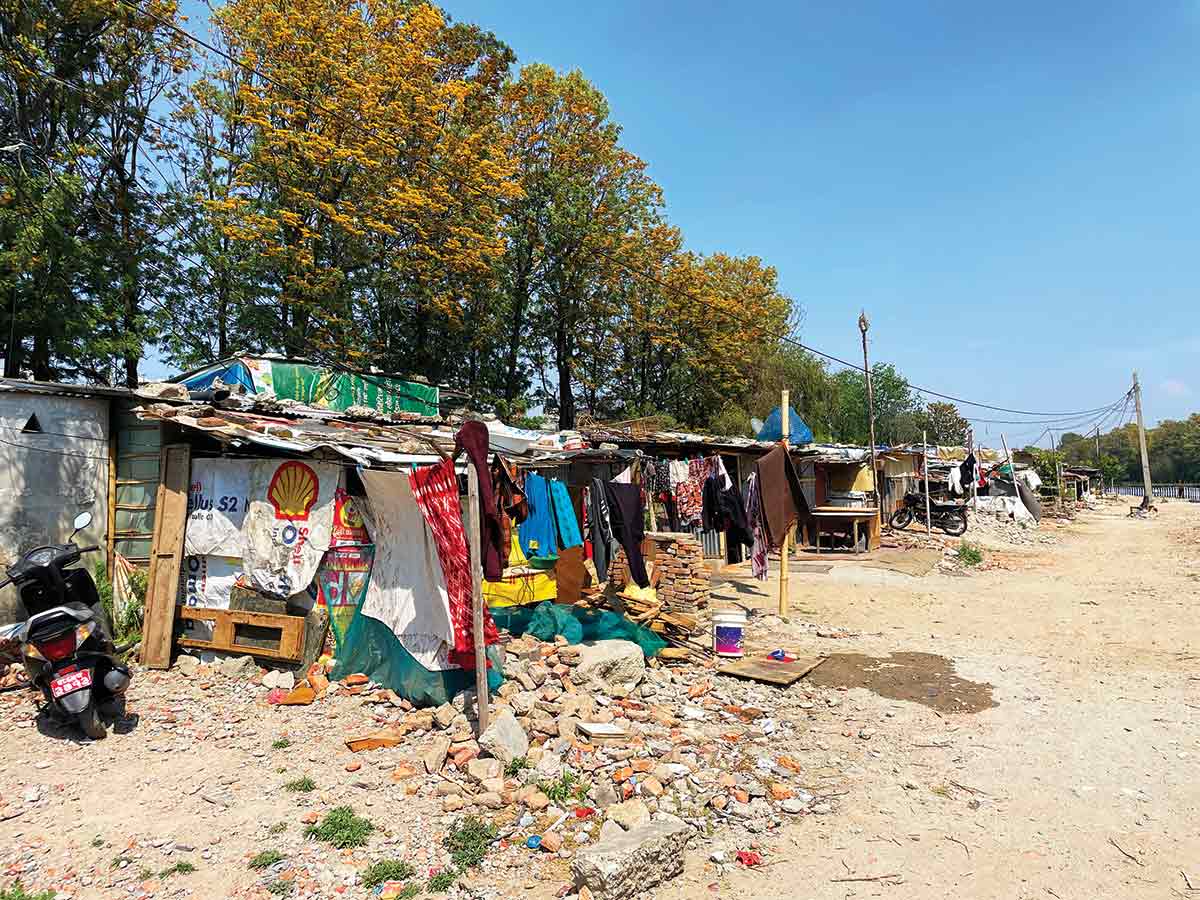
On a Monday in mid-April, I walked through the informal settlement in the Thapathali neighborhood of Kathmandu, situated on the banks of the sacred, flood-prone, and sewage-filled Bagmati River. The sights were familiar. I’d visited the decades-old community of about 150 poor and landless families two years earlier while reporting on riverside slums that were facing threats of forced eviction and increasingly frequent and ferocious floods.
This time I was just passing through, retracing a route through the Bagmati’s dense urban corridor, its riverfront alternating between informal settlements, high-end apartments, shiny office complexes, and sleekly designed parks with pedestrian paths beside the fouled river. The pricey new buildings often loom over the slum dwellings like a taunt.
There are many such informal settlements across the Kathmandu Valley’s chaotic urban sprawl, and they’re home to tens of thousands of people. Across the country, there are at least a million informal settlers. Many are internal migrants to the cities from rapidly depopulating rural districts, fleeing droughts, floods, landslides, and poverty. (Roughly one in five Nepalis live below the official poverty line of less than $1.50 a day.) Because these families occupy public property, the government and many Nepalis call them “squatters.”
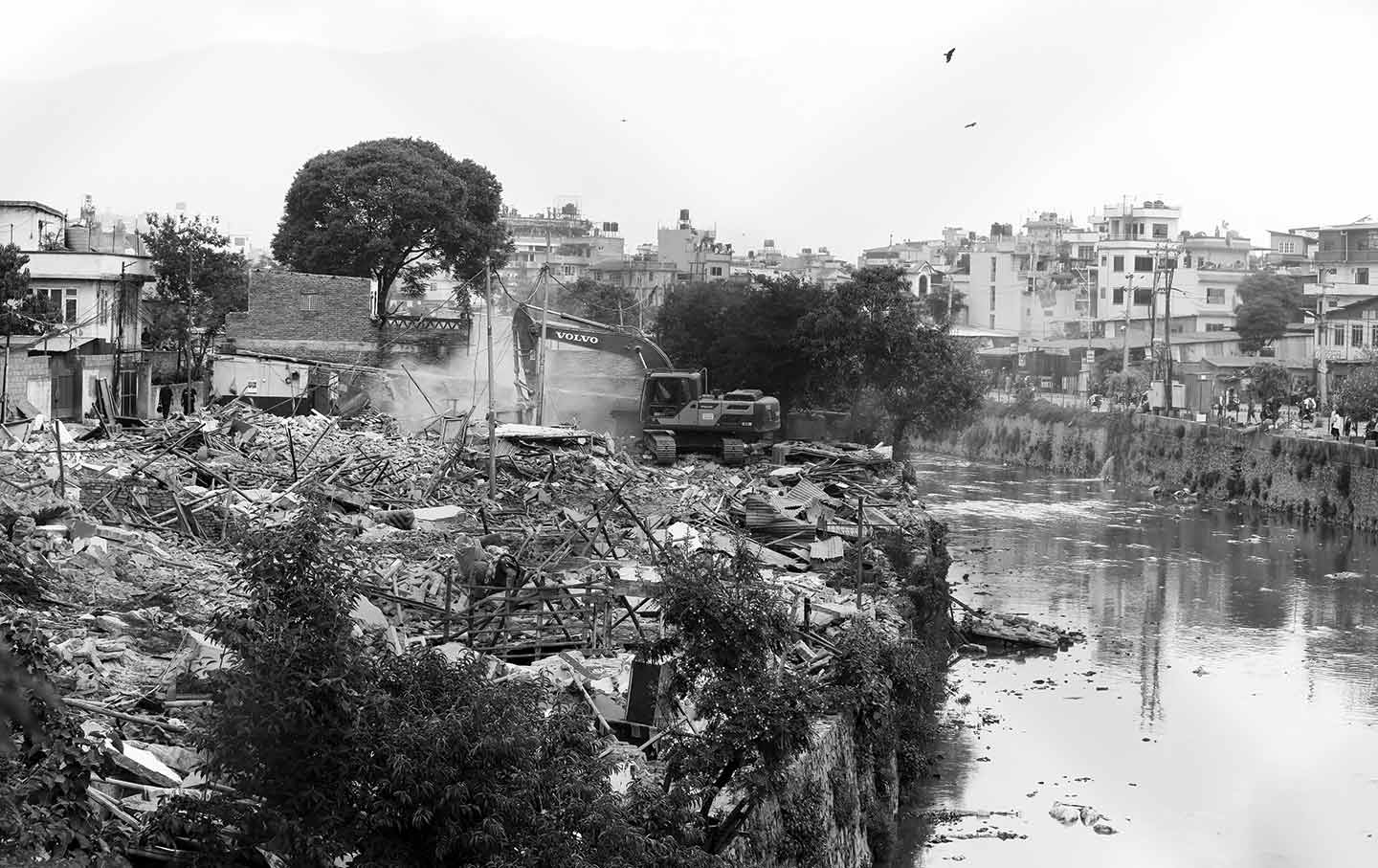
That day in Thapathali, I paused to chat with a young father who stood in the doorway of his improvised home. Five days later, by the evening of April 25, that home and the entire Thapathali settlement—along with other settlements in Kathmandu Valley—were gone. On the orders of the recently elected prime minister, Balendra “Balen” Shah, bulldozers leveled the community, with thousands of armed security personnel, including national police and the Nepali Army, enforcing the evictions. The government gave the residents 24 hours’ notice—at most. Households scrambled to save what belongings they could. Thousands of people were moved to hastily prepared and ill-equipped temporary holding centers, where they waited for a promised resettlement plan. Many more simply fled, fearful of the authorities. In all, according to advocates for the landless, more than 2,800 households and close to 17,000 people were displaced. At least five people have died because of the evictions.
The razing of the riverside settlements was one of the first initiatives of Shah’s premiership. In March, he had swept into office on a wave of hope and change after last September’s Gen Z uprising and the ensuing violence. His Rastriya Swatantra Party (RSP) had won almost two-thirds of the vote in the snap elections—unprecedented in Nepal’s 30-year history of unstable parliamentary democracy—and then, in April, Shah exploited widespread anti-squatter (and anti-poor) sentiment for populist effect. As the mayor of Kathmandu from 2022 until this past winter, he had tried and failed to demolish the Thapathali settlement without regard for due process, but he was met with fierce resistance on the streets and, ultimately, was stopped by the High Court pending a government resettlement plan. This time, as prime minister, he moved with overwhelming force—and without any such plan.
The evictions dominated headlines and social media for weeks in April and May and were cheered by Shah’s middle-class fan base. But prominent members of Nepali civil society decried the campaign, calling out Shah’s “authoritarian” disregard for the rule of law and “grave violation of basic human rights.”
What I saw from my vantage point was all of that and more. One of the justifications for the mass evictions, offered by Shah in a social-media post (his preferred means of communication), was to rescue the riverside residents from the deadly floods, as if he had only their welfare in mind—and not the real-estate developers eyeing the city’s riverfront. What I saw, in other words, was the fraught intersection of climate change, social justice, and human rights. To be sure, the people of these riverside communities should be moved out of harm’s way and provided safe and secure housing—but only through a legal process, established under Nepali and international law, of consultation and mutually agreed-upon resettlement options, with plenty of notice before eviction. Not bulldozers at dawn and decades-old neighborhoods reduced to rubble and the debris of precarious lives.
There is a tendency among advocates, especially in the Global North, to talk about global climate justice in terms that are abstract and idealized, disconnected from the social and political realities within specific countries. In Nepal, efforts to implement meaningful climate-adaptation policies at scale have long been stymied not only by a lack of money and institutional capacity but by the political instability and endemic corruption of the revolving coalition governments ruled by the three major legacy parties for the past three decades. The political earthquake in September, combined with the RSP’s election sweep in March, seemed to offer the possibility of a new era—a new generation of leaders who might transform Nepal’s governance and make real progress. But the reality is far more complicated.
If “climate justice” is to mean anything in places like Nepal, where catastrophe is already unfolding, it will depend as much on conditions on the ground as on the amount of funding for adaptation and climate-related “loss and damage” that may or may not materialize through the United Nations and other geopolitical processes. Climate justice will have to be fought for—and equality and human rights will have to be won—not only among countries but within them.
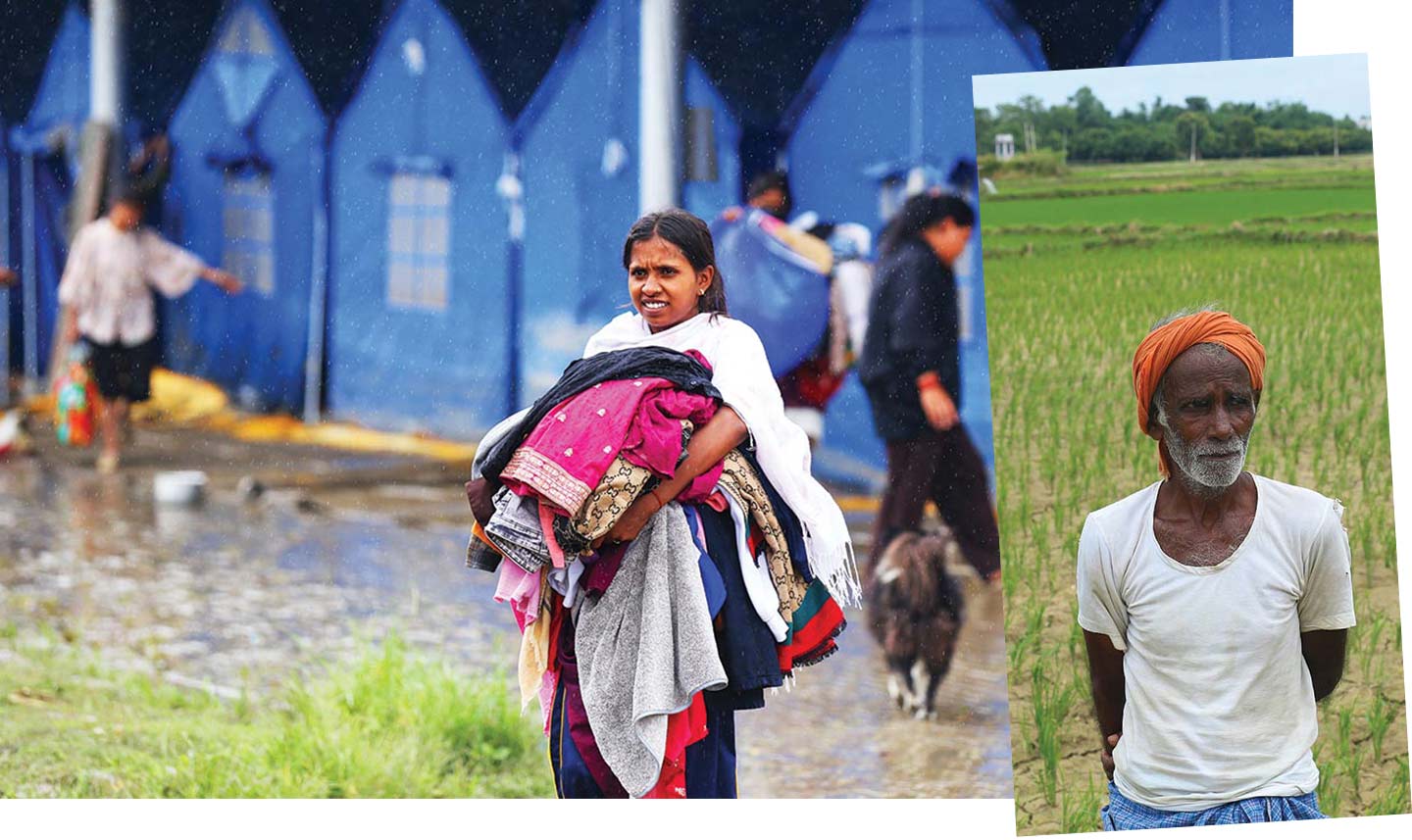
The week before Shah’s bulldozers rolled into the riverside settlements, I sat with two landless women in the informal settlement on the Manohara River, near Kathmandu’s Tribhuvan International Airport. The women, members of Nepal’s Dalit community (that is, “untouchables”), told me about their struggles, not least with water—both flooding and scarcity.
The elder of the two, 67-year-old Shanti Devi, migrated from western Nepal and had lived in the community for more than 20 years. She spoke about purchasing drinking water in large jugs, while those who can’t afford them queue up at 4 am at the free public water tap 45 minutes away. “You have to wait for three to four hours,” she said. “There used to be a large amount of water; now it is only a small amount.” The younger woman, Karun, a 31-year-old mother of two, told me about a flood three years ago that inundated her home: “Everything was lost—the children’s books, clothes, food—because of the huge mud inside the house.” It took 15 days to clean out the house with the help of neighbors, while family members fell ill with fevers and skin ailments. “I was only able to save my life and my children’s lives,” she said.
When I asked Karun what she thought of Shah and the new government, she was surprisingly sanguine. “We are hopeful that he is not going to evict us,” she said, unaware of what was to come. “If the government evicts us, where will we go? How will we survive?”
Nepal is among the foremost places on earth where some of humanity’s poorest and most marginalized are living on a knife-edge of climate breakdown and sociopolitical polycrisis. That describes much of the Global South, of course, but Nepal is uniquely situated not only geopolitically, between India and China, but geographically, as the central and iconic Himalayan nation, where the Indo-Gangetic Plain transitions into the Himalayan foothills. Indeed, the plains and hills make up most of Nepal’s territory and are home to the vast majority of its roughly 30 million people (a population about the size of Texas’s or Venezuela’s).
The Nepali people now face an accelerating climate emergency on multiple fronts. Disastrous river flooding is just one facet of it. With climate change, it’s always too much water or too little—and the latter is fast becoming Nepal’s new reality. From villages in the high Himalayas to urban and rural districts in the hills and plains, the country’s extreme vulnerability may soon reach an inflection point in the alarming water-scarcity crisis affecting much of the population.
Madhukar Upadhya is one of Nepal’s leading water and environmental experts. Writing in The Kathmandu Post, Nepal’s most widely read English-language daily, in the weeks leading up to the March election, he warned of “ever-escalating climate impacts” amplifying the daunting economic and social challenges at the root of the country’s political instability. “The earlier the aspiring leaders acknowledge that we are fast descending into this abyss of intersecting polycrisis—worsened by decades of performative politics—the greater our capacity to mobilize the much-needed collective action would be,” he writes.
I’ve met and spoken at length with Upadhya, who has worked on water and climate issues in the government and academia for three decades. When I reached out to him last winter about Nepal’s growing water crisis, he suggested that I visit the Panchkhal Valley, a major agricultural area amid the hills east of Kathmandu that has suffered severe water scarcity over the past decade or more.
The day I took a car out to Panchkhal in mid-April was warm and sunless, the air thick with the Kathmandu Valley’s notorious pollution. The smog combined with a dense soup of wildfire smoke from the west, and I could barely see the other side of the steep, narrow valleys as we ascended into the hills. Once in Panchkhal—the skies clearer but still hazy—we stopped at the small bridge over the Jhiku Khola, its principal river, now down to a trickle, its sandy bed mostly weeds and scattered pools of water.
Following a footpath between the fields beside the river, I saw that most were green with crops and new plantings, fed by irrigation water carried down ditches and pumped through long hoses. In recent years, farmers have resorted to digging deep pits in the dry riverbed from which to pump water into the parched nearby fields, but a farmer we met by the road told us that they were now using water stored on the low hill across the river. When I visited the municipality office down the road, a spokesman for the mayor’s office told me they had recently created rainwater-harvesting ponds on the hill. But I could see that many fields farther from the river lay fallow and dry, and on the steep slopes at the valley’s edges, most of the terraced fields, dependent entirely on rain and spring water, had been abandoned.
Upadhya, who has studied the Panchkhal Valley for decades, told me how he swam in the Jhiku Khola 20 years ago, when it was already in decline but still flowing. Here was a proud agricultural community that had once supplied the largest share of Kathmandu’s vegetables, Upadhya said, its future now uncertain. Food production, the valley’s primary source of income, has declined over the years, and according to the municipal spokesman, a proposed irrigation pipeline has yet to win government support.
In a remarkable series of articles over the past several years for The Kathmandu Post, Upadhya has tried to raise the alarm on the depth and scale of the water crisis—and of the climate crisis more broadly—and to rouse the country’s political class into action. Pointing to a recent UN report on the imminent threat of global “water bankruptcy” and its growing evidence in Nepal, Upadhya issued a grave warning: “What was thought of as a crisis—large-scale but manageable—has turned into a paradigm-shattering realization of irreversible bankruptcy on a planetary scale…a state where local hydrological systems have been pushed to the point of collapse.”
In Nepal, as in many other places, warming temperatures and shifting rainfall patterns have led not only to drier winters in large swaths of the country and increasing pre-monsoon droughts, but also to extreme downpours. “Instead of jhari,” Upadhya writes, using the Nepali term for low-intensity continuous rain, “monsoons are dominated by short-duration, high-intensity localized rain,” which increases flooding while at the same time reducing the recharge of groundwater, even as its depletion surges. A 2022 government survey of 6,500 households in every region of the country found that an eye-popping 43 percent of Nepalis have seen their local streams and rivulets dry up over the past 25 years. And when it comes to springs, 38 percent of Nepalis have seen them dry up completely, with 58 percent overall in the hills and more than 75 percent in the hardest-hit areas. That 38 percent “is more than a third of the population,” Upadhya told me. “So 10 million people have lost water sources already. That is serious.”
Last year, the monsoon arrived six weeks late in the plains, leading the government to declare a drought disaster in Madhesh, an ethnically and politically marginalized province (and Nepal’s second-most-populous) on the border with India, where the shallow hand-pumped wells ubiquitous among Madheshi households had already mostly dried up. By way of response, the government sent water tankers and proposed to drill more deep-boring wells, tapping into aquifers that have already been dangerously depleted. Food production took a major hit, with approximately 10 percent of Nepal’s rice-growing capacity in peril.
Upadhya questions the new government’s grasp of the situation and whether it “possesses the resolve to address it effectively. The hard truth,” he writes, “is that one cannot build a secure and prosperous future on an empty aquifer.”
Upadhya and other experts offer a familiar list of measures to address the crisis. Writing in the Nepali Times in May, Ngamindra Dahal, a hydrometeorologist at the Nepal Water Conservation Foundation, argues that water security is central to the country’s future. Protecting water sources, he writes, “calls for sustained investment in watershed conservation, recharge ponds, soil moisture retention and community-led spring management.” Even more so, the government “must stop treating water as a sector isolated from everything else.” Nepal cannot stop climate change—after all, it contributes just 0.1 percent of global greenhouse emissions—but responding to it, Dahal writes, means “treating springs, watersheds and local water systems not as peripheral environmental concerns, but as the foundation of national resilience.”
Over a long lunch in Kathmandu’s Gyaneshwor neighborhood, I asked Upadhya—who is now in his 70s and a gregarious talker with decades of stories from the field—what he sees as the most important things to be done at this point. “There are two things you have to understand,” he said. “Even if you can only stop groundwater from depleting further, that is an achievement.” Second, “water is a local thing, right? Very, very local. When it rains, it’s in a decentralized way, so you have to manage in a decentralized way. And only through community is it possible.”
As an example, Upadhya proposes mobilizing a nationwide grassroots effort, organized through high schools, to create tens of thousands of water-harvesting ponds throughout Nepal—and educate a new generation about water. “We need to create an army of people to understand water and then act accordingly,” he said. “Harvesting the rain, they’ll have practical, hands-on understanding of the hydrology at the ground level. When these students become leaders, you won’t have to tell them the problem of water.”
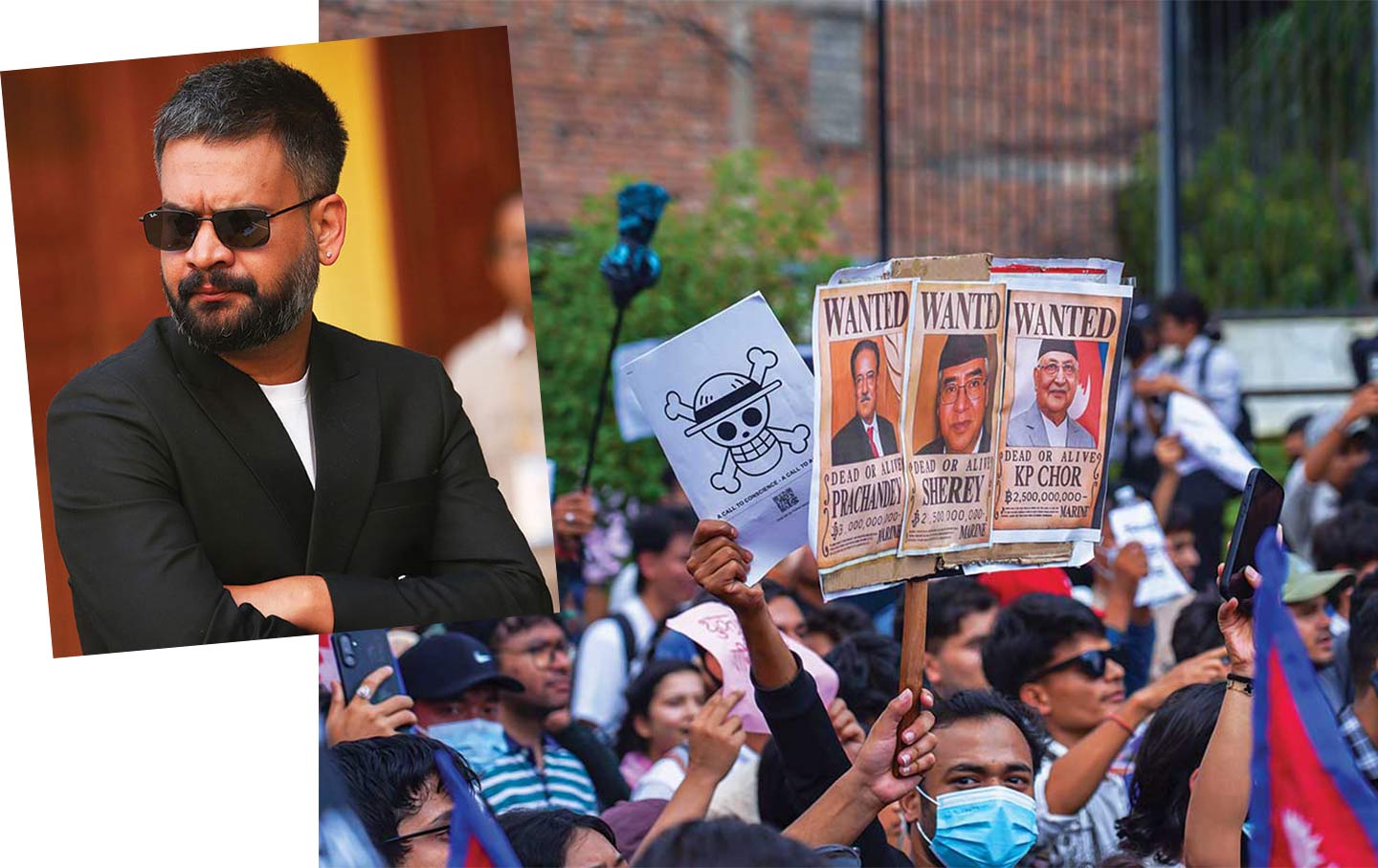
There is scant evidence that Shah’s administration and the RSP will prioritize the water crisis or Nepal’s advancing climate emergency—and on this issue, they are not much better than previous governments. In fact, the national budget presented by Finance Minister Swarnim Waglé in May deprioritizes climate action, as critics in the press have pointed out.
One of those critics is Sonia Awale, the editor of the Nepali Times and an accomplished climate reporter. When we met in Kathmandu, I asked her where climate fits into the new political landscape. One might think, given the way corruption and political instability were obstacles to climate policy under the old regime, that the RSP’s nearly two-thirds majority, its centrist technocratic reputation, and its promise of effective governance could translate into much-needed action.
“It’s a little too early,” Awale said, “but for the first time in I don’t know how many years, people in Nepal are generally hopeful about everything. So I am optimistic.” On climate specifically, “a lot of people [within the RSP] who have advocated along these lines are now policymakers themselves. But it has to be a priority of the leadership.” And at that level, she added, “I’m not seeing a lot of focus. The RSP’s 100-point agenda does not reflect environmental issues.” The government’s immediate priorities are the issues that swept it into office: ending corruption, reforming the bureaucracy, jump-starting the economy, and creating jobs to address Nepal’s massive out-migration of workers.
Even in the best case, I asked, if the RSP and the prime minister were to focus their minds on the urgency of, say, the water crisis—using it as a broad, unifying issue that touches the lives of nearly all Nepalis—and were able to implement smart policy, does the country have the resources and the capacity to address climate change at scale without the long-promised international assistance for adaptation and climate-related loss and damage?
“That process is very slow,” Awale replied. “We simply don’t have time to wait for that money. And, honestly, it is not money enough. Even if it does come through, are the people who actually need it going to get that money?”
In other words, Awale was telling me, Nepal must assume that, as a country on the front lines of climate catastrophe, it is on its own. “Each country will need to prepare in their own way,” she said. There are things that Nepal won’t be able to do without assistance—large infrastructure projects to protect highways, for example, or regional early-warning systems for catastrophic floods. But what can be done, especially at the local level, must be done, she added. “I’ve seen local communities do their own thing, something as simple as rainwater harvesting or planting sugarcane—which is a cash crop—on the banks of the river as a natural buffer [against floods]. Those local solutions become so important—and local government’s role becomes so important, working directly with people.”
Abhishek Jha is a 30-year-old political and policy analyst at the International Institute for Democracy and Electoral Assistance in Kathmandu, where he does research and advocacy on climate, governance, and other issues. Of the many Nepali experts and activists that I’ve interviewed, Jha offered one of the clearest answers to the puzzling question of why the climate emergency is not a government priority, especially given Nepal’s vulnerability.
“Climate is not political yet in Nepal,” Jha told me. “The fulcrum of Nepali politics is socio-ethnic. If a politician or party campaigns on climate, they won’t gain any traction. It has to be approached as a social issue. The social becomes the political in Nepal.”
Jha spent a year and a half working on water scarcity and conservation in the plains of Madhesh Province, where his own family is from. “If you go and tell people in Madhesh that it is drying up—heading toward large-scale desertification—and if you say that the Himalayas are melting and that’s why there is water scarcity, they won’t understand,” he said. “We have to make people aware that ‘this is your issue’—this is a social-justice issue, a livelihood issue, an existence issue.”
“Working with local government,” Jha continued, “I see some organization comes and says that you should make this policy, and they make it. But people don’t relate to it. The state doesn’t own it. And these organizations, their work is done. But change at the ground level does not materialize in the way it should. It has to start from the community.”
In Nepal, climate advocacy comes across as “an academic-activist adventure,” Jha told me, with conferences and dialogues held in air-conditioned hotel banquet halls. “There is a barrier that advocates have to cross. It has to be a bottom-up approach, people-driven, community-driven,” so that the government cannot ignore it.
Gen Z can also play a pivotal role in forcing the government to pay attention, particularly by prioritizing climate as a grassroots, social-justice issue. “The Gen Zs aren’t thinking from that perspective,” Jha noted. “But there is an opportunity.”
While Nepal lacks a strong climate-justice movement, a few Gen Z activists have been trying to elevate the issue, with mixed results. Monisha Choudhary, a 24-year-old law-school graduate from a Madheshi family who’s been deeply involved with the Gen Z Movement Alliance, said they see a difficult road ahead.
I caught up with Choudhary in early May, after they had just come from court, where they and other Gen Z lawyers were supporting landless-rights advocates in the legal challenges to Shah’s demolition of the informal settlements. As soon as word got out in late April that the evictions were imminent, Gen Z activists sprang into action, both on the streets—where they joined protests attempting to stop the destruction in Thapathali—and in the courtroom.
I asked Choudhary whether they and other Gen Z climate activists see the plight of the riverside settlements in the context of climate justice, and their response was direct. The week before, they told me, they had spoken at a conference of young climate activists in Pokhara. “I was really, really shocked to find that the young people there did not connect human rights or climate justice with this issue. The language they used was ‘[If you don’t evict the informal settlements,] then how do you develop the country?’ This is something climate activists in Nepal come up against, that you are anti-development.”
“It feels like we’ve hit some sort of moral collapse,” Choudhary said, “this excessive atomization where people are unable to sympathize with the poor.”
Nirajan Thapaliya is the director of Amnesty International Nepal and a veteran human-rights campaigner. When I met him at his office in Kathmandu, I asked whether he sees any movement emerging that prioritizes human rights around the issue of climate adaptation and resilience to safeguard the poorest and most marginalized in Nepali society. “There is no political movement,” Thapaliya told me. There is a growing awareness, he added, and climate has recently entered mainstream human-rights discussions. But the idea “that the climate crisis is fundamentally a human-rights crisis is a late realization.”
It is legitimate to ask what sort of climate justice may still be possible on a burning planet without a coordinated and equitable global response from the world’s wealthy nations. And it may well be that the only answers will be found on the ground, one country and one people’s struggle at a time.
Now, with a super El Niño on the way riding on top of some of the highest global temperatures in recorded history, Nepal may soon face a genuine reckoning. The hope that current approaches will be enough to address the impacts, Upadhya argued in The Kathmandu Post in June, is a “dangerous illusion.” Though some “remain naively optimistic” about the prospect of international aid that isn’t coming, he writes, Nepal “cannot afford to wait as climate shocks intensify. We must embrace self-reliance…using what we have, where we are.”
“The whole geopolitics has changed,” Upadhya told me in Kathmandu. “You’ll have less money coming from NGOs or governments. USAID is closed. And funders are reducing [grants] and putting money in their own security now.” As a result, “community resilience is more important now than anytime in the past.”
I asked Upadhya whether Nepal can really do this on its own. His answer, in essence: What choice do Nepalis have?
More from The Nation
Abby Martin on the Climate Cost of US Empire Abby Martin on the Climate Cost of US Empire
The filmmaker discusses military pollution, her reporting in Hawai’i, and why the climate and antiwar movements belong together.
Trump Is Making Deals With Big Oil Trump Is Making Deals With Big Oil
Democrats and the press should be paying attention to how this pay-to-play behavior relates to the midterms
This Lawsuit Could Make Big Oil Pay for the Harm It’s Caused This Lawsuit Could Make Big Oil Pay for the Harm It’s Caused
The question is whether the Supreme Court will let it.
Germany and California Make Up an Environmental Superpower Germany and California Make Up an Environmental Superpower
The world’s third- and fourth-largest economies have pledged to environmental protections. Will others follow suit?

Gavin Newsom Comments on Climate Gavin Newsom Comments on Climate
On the sidelines of the UN General Assembly meeting and New York Climate Week, the California governor called AOC “the real damn deal.”

Cities as Climate Labs: Inside the U20 Summit Cities as Climate Labs: Inside the U20 Summit
Mayors at the Urban 20 Summit worked across borders to confront the climate crisis at the local level.

