
A Second Year of Central Texas Floods Reopened Old Wounds. Communities Are Still Healing.
In July 2025, the Guadalupe River surged in a storm that killed more than 130 people. Only a year later, the waters rose again.
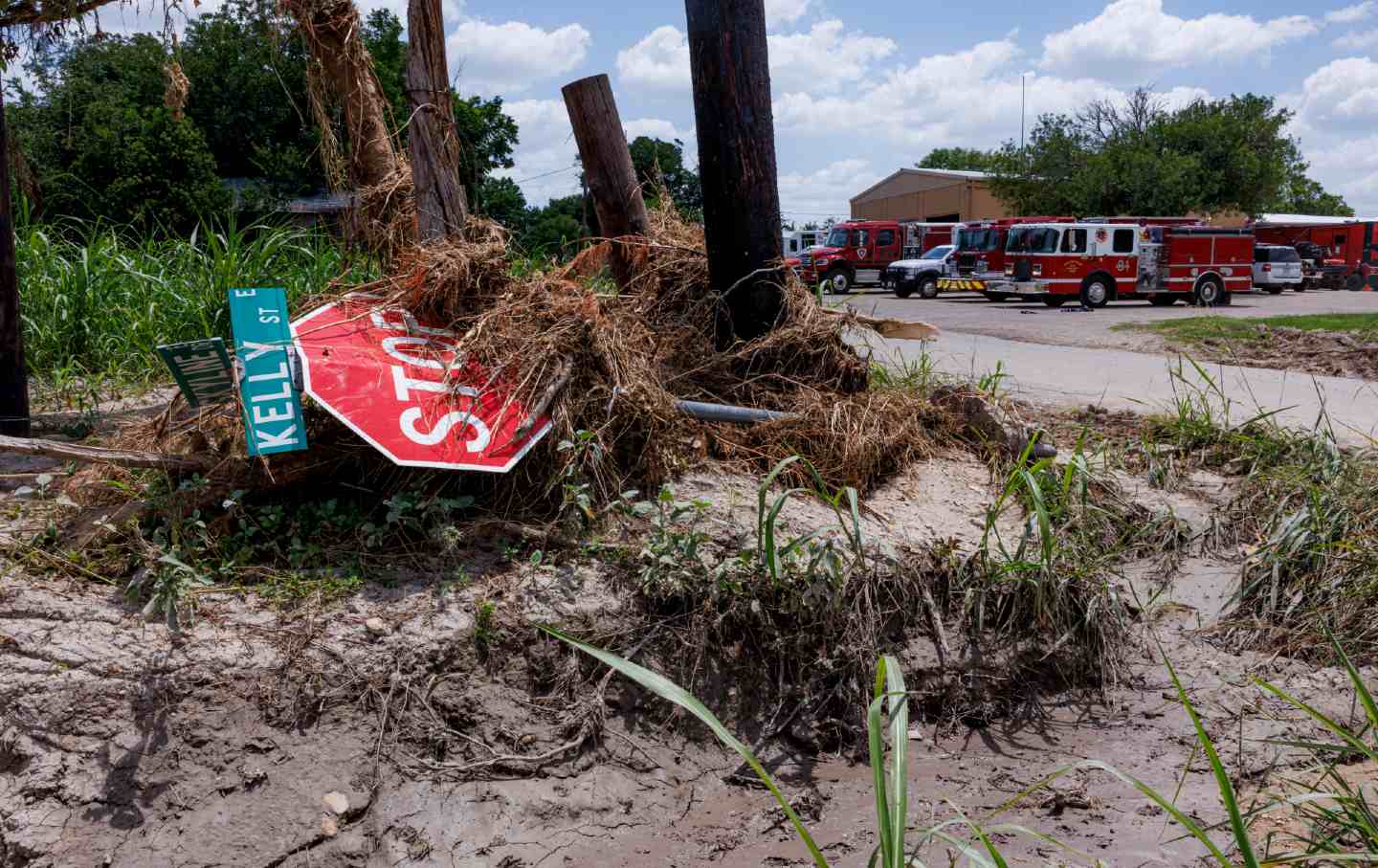
A downed street sign and stop sign are tangled in debris outside the Center Point Volunteer Fire Department after flooding.
(Sam Owens / San Antonio Express-News via Getty Images)Razor Dobbs looked out at River Road. The rural stretch that hugs the winding banks of the upper Guadalupe River in Center Point, Texas, was being inundated with rain.
It was past two in the morning on July 16 and the Guadalupe was rising fast. Within seconds, Dobbs said, it was coming up onto the road.
“It hit me: This is bad,” Dobbs said. “This is like last year.”
Soon, Dobbs, a firefighter with the Center Point Volunteer Fire Department, was called to begin evacuations across town. He spent the next 22 hours working—responding to dozens of distress calls, rescuing residents from attics, and wading through water to pull people from floating cars.
“It wasn’t like, ‘Oh, we just had a flood,’” Dobbs said. “No, we had a biblical flood.”
Multiple rounds of storms hit Texas between July 13 and17, resulting in what the National Weather Service described as “catastrophic flooding,” that led to the death of two people. More than a dozen locations in the counties hardest hit received more than two feet of rain in just a few days. Rivers surged causing widespread property damage and road closures in counties as far as Southwest and West Texas.
Strikingly for communities in the heart of the Hill Country, like Center Point in Kerr County, the floods were strikingly familiar.
For, in those communities, it had only been a year since the Guadalupe River rose almost 30 feet in under an hour after being pummeled by an intense burst of late-night rain. The surge created a wall of water that tore through the Hill Country. More than 130 people died, including 25 young girls at Camp Mystic. Most of the deaths occurred in Kerr County.
Key differences helped spare lives when the river rose again this year. The storm played out over multiple days and multiple river basins, allowing people more time to evacuate and prepare. There were fewer visitors camping and staying along the Guadalupe (last year’s floods occurred during the early morning of the Fourth of July). Responders and residents alike reported swifter reactions to warning signs due to anxiety and experience related to last year’s tragedy and, in some cases, more available response tools.
But Dobbs said a lower death toll should not undercut the severity of this year’s floods. In Center Point, the Guadalupe rose 32 feet in four hours, as high as last year. In Comfort, a town nine miles away, the river rose higher than it did in 2025, cresting at 37 feet. The river in that area had measured only around three feet in the weeks leading up to the flood.
Rebecca Loebe, a Center Point resident, was asleep in her home when the rain began to fall in the early morning of July 16. Her husband woke up around 5:30 am to a missed call and a text from their neighbor. “Go check on the river,” the text said. “It’s flooding.”
Loebe’s husband woke her after reading the text and the two jumped out of bed to examine the state of the Guadalupe.
Loebe knew the river had been high after days of rainfall. But her property is 40 feet up, so when the river rises under typical circumstances, “it goes from being 40 feet away to being 36 feet away.” Only a tiny portion of her backyard lies in the 500-year floodplain, she said.
“I found that out when we were getting home insurance,” Loebe said. “And I said, if the water ever gets up here, then I think the whole world is underwater.”
But when she went outside her house, down to the sidewalk and toward a cliff that overlooks the Guadalupe, Loebe knew something was wrong. The water was all the way up the cliff, coming up into the yard—and it was moving fast.
Loebe spotted the pair of inner tubes that she and her husband have used to float on the river during different times. They were already in the water and Loebe resigned herself to losing them. When she looked back only seconds later, the tubes were already 100 yards away.
“I didn’t stick around,” Loebe said.
She raced back to her house to gather the few important items she could think of: their passports, birth certificates, her father’s guitar—and their dog. Then, Loebe and her husband made their way to higher ground on their property, the mother-in-law house built at the end of their driveway.
From there, they noticed that the creek that runs behind houses across the street from their property was also flooding. Water was coming towards them in both directions.
As morning pressed on, the sun began to rise, and the river appeared to slowly recede. But around 9 am, Loebe and her husband evacuated to the lone school in Center Point after being informed that another wall of water was coming down the river. She and her husband didn’t return home for hours.
Loebe’s property survived relatively unscathed, but the day’s events stayed with her. She’d been out of town when the Guadalupe flooded last year, and water made its way into her backyard—an image that at the time felt impossible to visualize.
However, she did see the aftermath—the debris, the destruction. Like along the stretch of river that runs behind her house, where a nearly 70-foot cypress tree had fallen. During the flood, the tree had raced down the middle of the river, running parallel to the banks. She observed that the nearly 12-foot root structure shooting off of the giant tree had become fully perpendicular to the banks.
Now Loebe had seen the flooding river with her own eyes, watched it rise, waited, and wondered if it would reach her. When she next observed that stretch of river behind her house, the giant cypress was gone. It had been washed away.
“So many of us had this story that what happened last year was like a once in a lifetime event,” Loebe said. “As the water peaked at almost the exact same spot, it conflicted with that narrative. To see something very similar so soon was unnerving.”
Indeed, residents across the Hill Country are grappling with the improbability that two floods that reached similar extremes could happen in back-to-back years.
Alix Seyfarth, the director of strategy at All Hands & Hearts, said the disaster relief nonprofit is seeing damage in many of the same areas as last year. After the July 2025 floods, AH&H deployed tens of thousands of volunteers to the Hill Country to assist with immediate recovery.
Over the year that followed, their efforts shifted to repairing homes. Seyfarth said AH&H had completed 11 homes and had nine in progress when floods hit this July. Four of these homes were re-impacted after this year’s floods, three of which were structurally damaged.
“We’re going back to homes that we’ve already supported, where people have to do everything all over again,” Seyfarth said.
Dondi Persyn, a Boerne, Texas, native who’s been organizing in the Hill Country since the 2025 floods said she’s been assisting many of the same locals she met while doing relief work over the past year.
Last year, Persyn initially began her recovery efforts by searching for flood victims. But after noticing how many personal items were strewn about the area, she launched the Facebook page Found on the Guadalupe River, with the intention of reconnecting victims with belongings lost in the flood. The effort expanded quickly, with Persyn running a warehouse until March of this year where personal effects found along the river were collected, cleaned and organized for victims to parse through.
As demand slowed, Persyn moved remaining items into a storage unit, though she continues to collect belongings weekly and makes frequent visits to Kerr County. When rain began to pour in mid-July, Persyn prepared herself for the possibility of another flood. After the storm, she assumed that people would begin reaching out again, asking about lost items and notifying her of belongings discovered. But instead, there was a different need.
“It’s been a different kind of damage,” Persyn said. “Not one where people were losing as much of their personal property that were just like flooded way down the river. More like it ended up in their yard.”
And so, Persyn alongside other volunteers from Found on the Guadalupe, returned to the homes of the same residents they’d gotten to know over the past year—residents whose belongings they’d washed, whose items they’d returned, whose stories they’d heard.
“Since we’ve been in the community over the last year, we’ve grown these really deep bonds with the people that live there,” Persyn said. “When you’re washing their things and returning their loved ones’ items, you become bonded. You get to know them on a different level. All the people that have survived, we know their stories.”
Persyn said her team initially worked on mucking out homes. Then, they set up a distribution center at a local business where she’s spent weeks handing out storage bins, boots, and squeegees. On one such day, she spent around seven hours giving out dehumidifiers. On another weekend, she distributed more than 1,000 bins for storing clean items that can’t be mixed up with the mud and muck inside flooded houses.
Popular
“swipe left below to view more authors”Swipe →Though this process of recovery is different, particularly because it does not stem from extreme loss of life, pain, uncertainty, and confusion lie in the fact that another extreme flood happened so soon. For Dobbs, last year’s flood was difficult. He and the fire department spent nearly a month after the flood working 12-hour days in search of missing victims. He also found flood victims on his property. He used his wife’s UTV as a recovery vehicle to carry the bodies out.
“It just brought back so much,” Dobbs said.
And while residents grapple with the question of how such a similar flood could have occurred so soon after last year, some—Loebe included—are beginning to ponder another increasingly obvious question. Will this happen again?
The way that University of South Carolina professor and climate scientist Claudia Benitez-Nelson sees it, extreme flooding will likely continue to occur in the Hill Country.
“These types of events used to happen once every 100 years, once every 1,000 years,” she said. “But now they’re happening over and over again as the temperature gets hotter.”
Benitez-Nelson said climate change is making extreme weather events more likely. This is particularly true, she said, for extreme rain events. As the planet warms, there’s more heat in the atmosphere, which allows for more evaporation. These heavy downpours are becoming more frequent because warmer air can hold more moisture.
“Heat is energy,” Benitez-Nelson said. “That energy has to go somewhere, and that energy is what we’re seeing in these massive thunderstorms.”
Rice University professor and flood prediction expert Phillip Bedient agrees that extreme flooding will become more frequent. Moving forward in this landscape, he said, means investing in technology that can warn residents of a disaster quickly and accurately.
Currently, Bedient is working with researchers at the University of Texas at Arlington to develop an early flood warning system that links radar-based computerized predictions with siren and river gauges. This technology and swift emergency response like what occurred this year will be a key element in ensuring safety during future floods, he said.
“It’s unfortunate, but that’s what it’s going to take to make it a viable area,” Bedient said. “They’ve got to have this kind of system because they’re not going to all leave. They’re going to stick it out because for many of them, it’s their land.”
And so, these communities will continue to recover—to pick up the pieces, neighbors helping neighbors, preparing to start anew.
Dobbs has already returned to his work with the Center Point Volunteer Fire Department, even though the station is damaged from flooding for the second year in a row. For there will be more calls, more neighbors in need of assistance, more accidents. Someone will need to be there.
More from The Nation
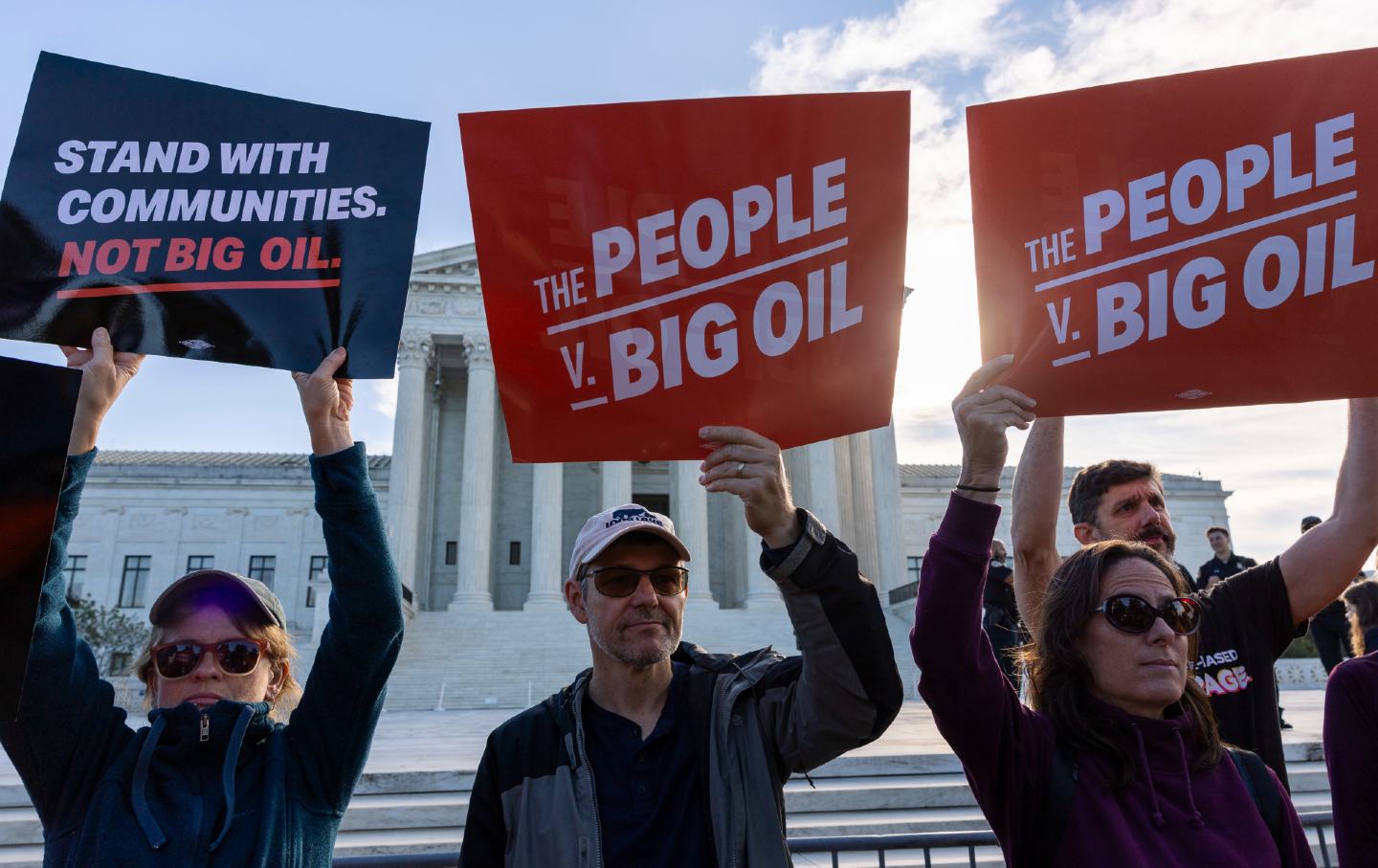
This Lawsuit Could Make Big Oil Pay for the Harm It’s Caused This Lawsuit Could Make Big Oil Pay for the Harm It’s Caused
The question is whether the Supreme Court will let it.
Germany and California Make Up an Environmental Superpower Germany and California Make Up an Environmental Superpower
The world’s third- and fourth-largest economies have pledged to environmental protections. Will others follow suit?

Gavin Newsom Comments on Climate Gavin Newsom Comments on Climate
On the sidelines of the UN General Assembly meeting and New York Climate Week, the California governor called AOC “the real damn deal.”

Cities as Climate Labs: Inside the U20 Summit Cities as Climate Labs: Inside the U20 Summit
Mayors at the Urban 20 Summit worked across borders to confront the climate crisis at the local level.
Big Oil’s Origin Story Big Oil’s Origin Story
Amy Westervelt’s new book, Brought to You By, exposes the deep history of today’s “information pollution.”
Two Years After Helene, North Carolina’s Unsettled Recovery Two Years After Helene, North Carolina’s Unsettled Recovery
The state has become a testing ground under an eviscerated FEMA and a missing-in-action “recovery czar,” Michael Whatley, with big political ambitions.

