
David Ellison’s Delusional Stab at Self-Justification
While the Skydance–Warner Bros. merger is in legal limbo, the CEO seeking to pull it off makes a disingenuous case for it in the court of public opinion.
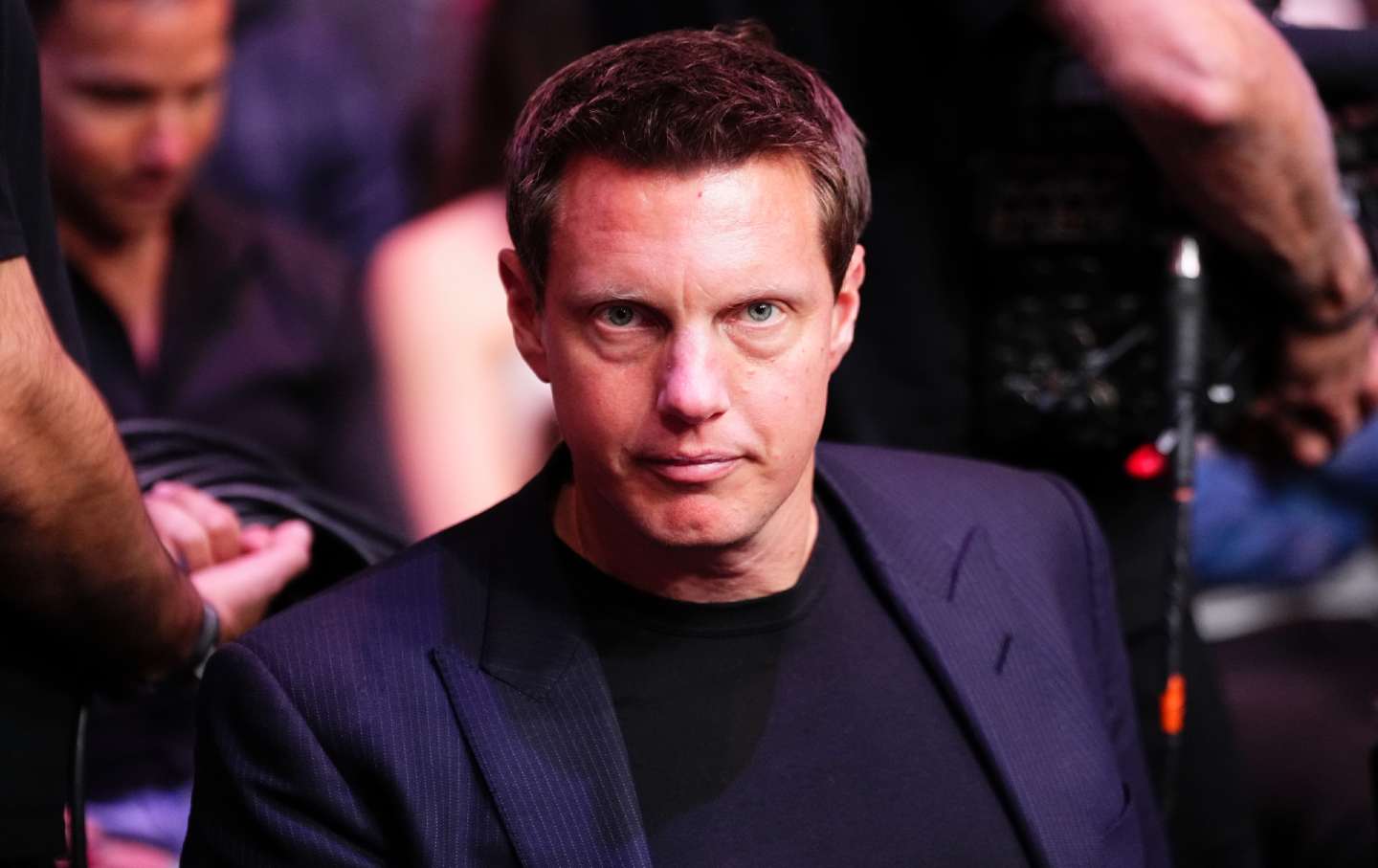
Skydance CEO David Ellison attends a UFC bout in Las Vegas in January.
(Jeff Bottari/Zuffa LLC)Now that the looming Paramount–Warner Bros merger is on hold until a lawsuit from nearly a dozen states to stop it is resolved in in an Oakland, California, courtroom next June, backers of the deal have renewed their efforts to sell it as a journalistic-creative breakthrough as well as an entertainment miracle. Former Fox and CNN anchor Chris Wallace, now an adviser to Redbird Capital, which has a major stake in the deal, wrote an op-ed hymning its genius for The Hollywood Reporter. Ari Emmanuel, brother of Rahm and CEO of the Ultimate Fighting Championship league, which has a $1.1 billion deal with Paramount-Skydance, echoed the same basic case in The Wall Street Journal. But it was the New York Times salvo from Paramount-Skydance’s chief executive, David Ellison, that drew the most attention, as he defended his bid to absorb Warner-Discovery into the maw of Skydance, as well as his checkered first year in journalism at CBS.
First and foremost, Ellison hoped to use his platform at the paper of record to take back the narrative from the hundreds of petition signers, film-industry critics, journalists, and politicians who have decried the bid from Paramount-Skydance to buy out Warner Bros. Discovery for $111 billion as a move to drastically narrow the independence of both filmmaking and news-gathering in the MAGA age. “When California’s attorney general, 11 other state attorneys general and, a day later, the Writers Guild of America sued to stop the deal, I stayed quiet,” Ellison wrote in a disingenuous show of humility. “I quickly learned such restraint has costs. While I was silent, others were happy to write my story for me. No more.”
The ensuing testimony was something well shy of the inspiring story of a scrappy young producer who arrived in Hollywood with nothing but a dream and his father’s Oracle fortune in his pocket. It was a list of talking points that relied more on familiar right-wing claims about the media industry than on a case to deliver even more corporate control and news-making influence into the hands of the Skydance conglomerate. Since a Warner Bros takeover would leave David Ellison, and more alarmingly, his MAGA-devoted father, tech billionaire Larry Ellison, exercising near-unprecedented control over the production of theatrical films, multiple cable networks, and both CBS and CNN, Ellison’s broadside offered little substantive response to the deal’s detractors in multiple industries, unions, and the sprawling global audience their platforms will reach.
Ellison pointedly disregarded such concerns, opting instead to defend his proposed stewardship of CNN in the wake of Bari Weiss’s controversial ideological makeover of his CBS News. “The issue is whether I can be trusted as a steward of Warner’s CNN. There has been speculation about my politics, my loyalties, my intentions.”
And with good reason. During the period of this deal and his buyout of Paramount and its properties, David Ellison was spotted at June’s White House UFC bout sitting next to President Trump. Ellison also attended the State of the Union address as the guest of the now-deceased Senator Lindsey Graham of South Carolina, and convened a dinner in Trump’s honor during the White House Correspondents’ Dinner weekend in April.
Trump has been clear in spelling out what he wants. “It’s imperative that CNN be sold,” he said at a cabinet meeting last December. When he’s not deriding network anchor Jake Tapper as “Fake Tapper,” he calls CNN a “disgrace.” He clearly wants some guarantees that the Ellisons will steer CNN into MAGA-friendly territory, in much the same way that Weiss has made CBS News an obliging outlet for Trumpian agitprop. Trump’s cabinet officials have fallen into line; during a Pentagon briefing this spring, Defense Secretary Pete Hegseth whined about CNN’s coverage of his debacle in Iran, saying, “The sooner David Ellison takes over that network, the better.” (Ellison’s PR flacks immediately shot back, “Editorial independence will absolutely be maintained. It is maintained at CBS; it will be maintained at CNN.”)
At a Simon Wiesenthal Center gala last December, Warner Bros. Discovery CEO David Zaslav accepted an award and recounted an earlier episode of government censorship—unrelated to CBS—in his acceptance speech. He drew a moral from the episode that seemed squarely aimed at David Ellison, who was in the crowd: “When the government controls the news, that is the end of democracy.”
Ellison’s op-ed sought to deflect attention from the prospect of journalistic interference from Trump’s White House and invoke the declining public trust in the media—a trend vastly accelerated by the MAGA movement’s demonization of the “fake news” industry and journalists as “enemies of the people.” The remedy for the media industry’s crisis in public confidence, Ellison advises is to redouble its commitment to impartial news-gathering. “Great news organizations like CNN and CBS News are here to tell it straight down the middle,” he writes. “That requires newsrooms that reflect the whole world, not one side of it. And it requires independence. Our journalists will continue to answer to the facts and to all the people they serve—not to any party or cause.”
There’s just one problem with this line of thinking: There is no “middle” in journalism—particularly when it comes to covering politics. Political parties are not stationary objects that a “straight down the middle” journalist can mathematically triangulate and break down into an easily digestible equation for public consumption. The GOP moves constantly to the pseudo-populist right. Recent primary elections have shown that the base of the Democratic Party is moving to the left. How do you find the middle with two moving targets? Ellison invokes the exhausted ghost of Edward R. Murrow as his supposed avatar of the endangered straight-news sensibility—but Murrow is best known today for his takedown of red-baiting Senator Joseph McCarthy and his stooge, lawyer Roy Cohn. Now Trump, Cohn’s best-known protégé, is keen to exploit his transactional leverage with the Ellisons, who need his approval for the deal to go through, to remake Murrow’s former network in his own image.
As for the entertainment industry, Ellison seeks to disarm his detractors by announcing that the industry they want to preserve is already dead. In assessing the antitrust actions now putting the merger on hold, he says that “the states claim this deal will give one company too much influence over theatrical releases and cable operators…while [the Writers Guild of America] argues that our combined market power will hurt writers. Both suits imagine a Hollywood that no longer exists—an industry ruled by a handful of legacy studios.”
One hundred and 11 billion dollars is a lot of money to pay for something that no longer exists. Currently in theaters, Disney’s Spider-Man: Brand New Day has generated $655 million in 10 days at the summer box office and Universal’s The Odyssey has grossed $461 million in 24 days. Ellison has promised that his proposed merger will put out 30 feature films a year. Like his promise of an unbiased and confidence-building news industry, that claim has met with skepticism, because no studio has done that in 25 years. What’s more, the newly merged Paramount-WB would set out to turbocharge its production arm, as the company would be saddled with a massive debt load.
When Ellison talks about “a Hollywood that no longer exists,” he’s gesturing toward the real quarry of the Warners deal—streaming and Netflix. During a quarterly-report call in March, Ellison made this objective plain to his investors: “We will combine the streaming portfolios of the two companies into one stronger platform over the coming years.” The same analysis held for Skydance’s earlier absorption of Paramount+ and HBO; Ellison sold that deal by observing that “there are more than 200 million [direct-to-consumer] subscribers today, and more than 100 countries and territories worldwide, positioning us to compete effectively with the leading streaming services in today’s marketplace.”
Competing with Netflix was also the prime directive behind the Disney company’s $71 billion takeover of Fox—a stand-alone legacy studio owned by Rupert Murdoch’s Newscorp. “The opportunity to buy Fox first came up later that year,” Disney CEO Robert Iger said at the time of the 2019 buyout. “In fact, just a few months after the board approved us buying the majority share of BAMTech—which was done for one reason, to go into the direct-to-consumer business—Rupert and I sat down and talked about a transaction…. We would not have done that transaction had we not decided to go in this direction, because—if we hadn’t, we would have been looking at that business and through a traditional lens.”
Competing with Netflix and expanding Disney’s market share in streaming proved to be an impossible mission for the recombined Disney-Fox company. Since the merger, Disney has lost billions in streaming and only this year generated a profit with advertising and by raising subscription fees. The merger cost some 7,000 jobs in post-Covid downsizing. Disney and Fox’s combined film and television output shrank. Consumers now pay more for far less. This year, Disney’s ABC network lost the Oscar broadcast to Google as it aggressively expands its own streaming business. In a Disney quarterly call, Wells Fargo analyst Stephen Cahill argued that the company should phase out its streaming platform and return to only making and licensing content.
Seven years later, Paramount-Skydance wants to make the same mistake. Acquiring Warner Bros. means that the parent company will take on billions in debt while it reorganizes (read downsizes) the two giant media companies at the center of the deal. To get the takeover financed, Skydance has recruited three Middle Eastern sovereign wealth funds, while also making itself available to a Trump White House keen to prosecute the president’s many vendettas against CNN.
Studios like Sony have done just fine without entering the streaming business and just producing movies and shows. Despite everything, the unchallenged faith of Hollywood takeover kings like Iger and the Ellisons is to become a Netflix—which in practice means warping and disappearing huge swaths of their own legacy-media world in a business model that’s a proven dead end. Perhaps it’s time to ditch that unsustainable goal and break up Netflix instead.
Certainly, that was the thinking of Paramount-Skydance when it looked like Netflix had won the bidding earlier this year for Warner Bros. and the word “antitrust” entered the chat. Suddenly, the free-market billionaires at Oracle and the Trump administration felt capitalism had gone too far (i.e., they were about to lose). The same issue came up during the 2023 labor strike by the WGA and Screen Actors Guild. Miles Mogulescu, a former business affairs VP for MGM/US and current labor union documentarian, argued in the Los Angeles Times that for Hollywood unions to be able to negotiate with the streaming giants, companies like Netflix, which produce their own content for their platforms, must be forced to separate their production arms from their distribution operations. As a precedent, he cited the Supreme Court’s Paramount Decrees of 1948, which required the studios to spin off their theater chains in order to reduce vertical integration in the industry. It forced the Hollywood studios to finally relinquish the deep reach of their chains that strangled competition at local levels—a move that notably broadened the range of films audiences saw.
Popular
“swipe left below to view more authors”Swipe →In 2025, James Cameron waded into the long-simmering theaters debate between streamers and traditional studios over what metrics production companies should meet to have their films qualify for Oscar consideration. Cameron argued that the playing field should be leveled with a requirement that Netflix (and, one presumes, all streamers its size) release a film in at least 2,000 theaters for at least a month. Currently, the rule (meant for indie filmmakers) is to release a film seven consecutive days in brick-and-mortar theaters in designated cities for it to be eligible for nomination. That would secure the standing of independently produced films in Oscar competition, since those offerings can disappear quickly from movie screens but the Netflix movie sits on your Netflix home screen for months of in-house hype until Oscar night.
In all these areas—be it the specter of an omnivorous giant like Paramount-Skydance, threats to working conditions highlighted by Hollywood trade unions, or making the Oscars less skewed against independents—the same problem continually emerges as the central worry: Netflix is too big. At some point, we have to ask why we’re going to such enormous lengths to adapt an entire industry to one company’s model. If Netflix is too big to fail, that means it’s also too big for its competitors to have a fair shot at success.
There’s still ample time for the Warner merger to be stopped in court or simply collapse under its own rickety leviathan-scale debt load. When the Ellisons bought Paramount, the silver lining was that David Ellison is something the industry hasn’t seen in a half-century: a true producer-owner of a legacy studio. He came into the business as a filmmaker—that’s all he’s ever done, and that’s all he wants to do. It’s been 50 years since the last one, Jack Warner, retired to Palm Springs. Ellison still has the chance to be the owner of a great studio—but he shouldn’t be the CEO of two.
Become a Sustaining Donor This September
Between the reemergence of right-wing red-baiting and Donald Trump’s use of the chilling National Security Presidential Memorandum–7 to criminalize left political organizing, we’re seeing McCarthyism reborn before our eyes.
This assault on democracy cannot be ignored or wished away. Resisting it requires bravery in the face of threats and repression, a steadfast commitment to the truth, and the unwavering belief that we can—and will—overcome this darkness.
We must have an independent media that sets the record straight, unearths corruption and abuses of power, and advances a politics of justice and dignity for all if we’re to win this fight.
That’s why I’m writing to you today. This September, The Nation needs to add 100 monthly donors to sustain our progressive journalism. Your contribution makes the next investigative report, the next truth-speaking column, and the next pathbreaking essay all possible.
I hope you’ll support our work with a recurring donation today. If you donate $10 or more a month, we’ll send you a brand new “Hands Off the Free Press!” sticker to recognise your commitment to our cause. Please, donate today.
Onward,
Katrina vanden Heuvel
Editor and Publisher, The Nation
More from The Nation
The School Behind the Billionaires and the Billionaire Tax The School Behind the Billionaires and the Billionaire Tax
UC Berkeley will inevitably be behind the defeat or victory of Proposition 40.
Dolly Parton Was a Proud Union Sister Dolly Parton Was a Proud Union Sister
Organized labor is celebrating the life and legacy of an artist who championed working women and carried a union card for almost 60 years.
Of Debt and Deficits and the Dollar System Of Debt and Deficits and the Dollar System
By force of preset agendas, conservatives and liberals react to debt headlines like Pavlov’s dogs.

What Happens When 8 Million People Lose Their Student Loan Repayment Plan? What Happens When 8 Million People Lose Their Student Loan Repayment Plan?
As the Biden-era SAVE plan ends, borrowers are facing unaffordable bills, lost payment records, and errors that have falsely put some into default.
The War on the UAW The War on the UAW
The United Auto Workers called for a ceasefire in Gaza. The union’s federal monitor didn’t like it—and now he’s investigating Shawn Fain, just weeks before union elections.

How Public Equity Can Promote a Revived American Democracy How Public Equity Can Promote a Revived American Democracy
Critics are assailing deals to give the government stakes in major companies—but they’re overlooking their civic dividends.

