Trump’s Iran Disaster Is Making All His Cronies Look Like Fools
Two foreign-policy camps are claiming Trump for themselves, while the Middle East fiasco humiliates every single one of them.
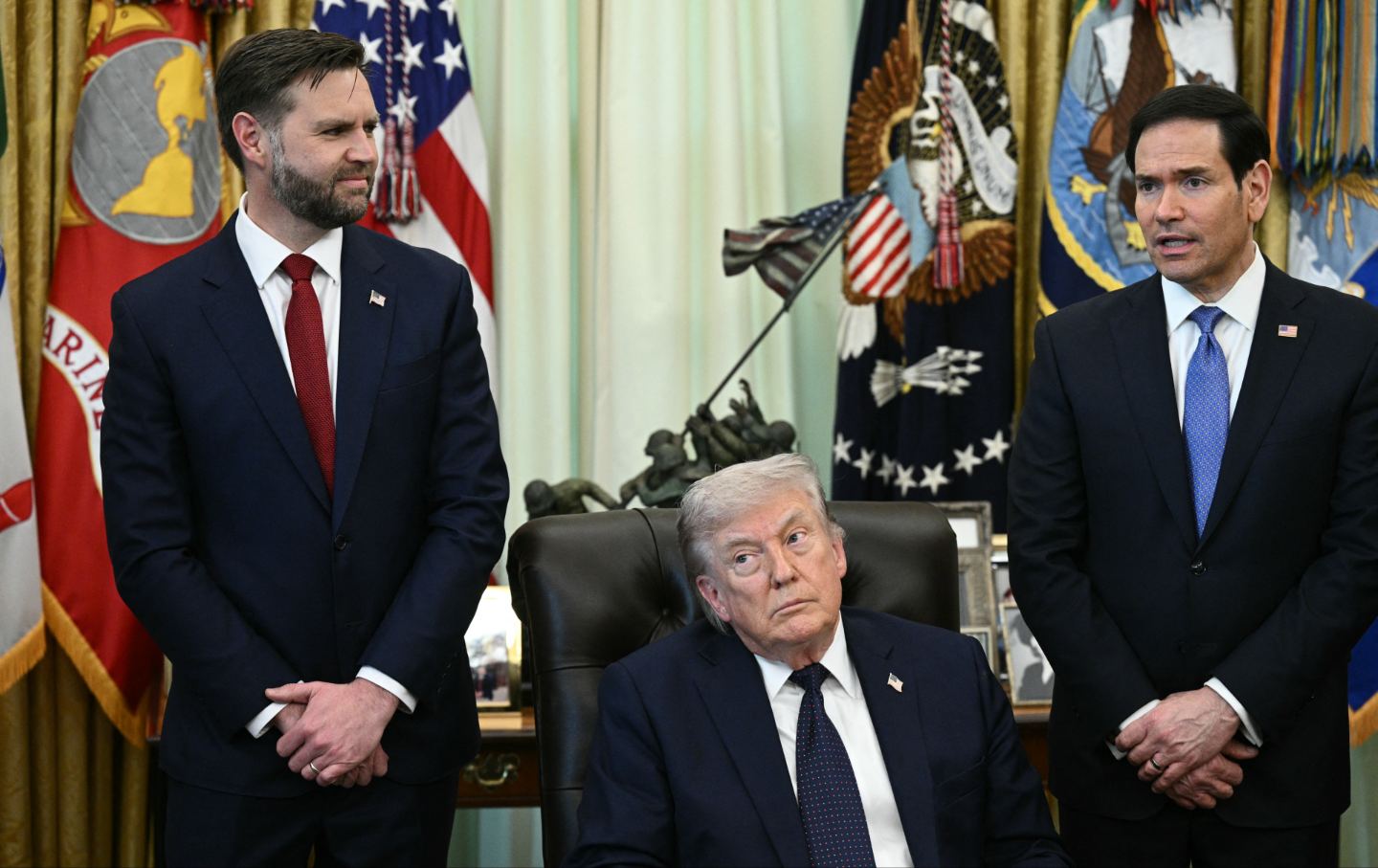
Ever since the 2024 election, two mutually hostile conservative foreign-policy camps have raced to claim Donald Trump’s victory as a mandate for their respective views. There are the “restrainers,” a coalition defined by a skepticism of interventionist wars like George W. Bush’s 2003 invasion of Iraq and by a deep distrust of Israel and its lobby in Washington. And there are the latter-day neocons—the ones who haven’t defected to the Democratic Party, at least—who regard Israel as America’s indispensable ally and remain committed to the military overthrow of its enemies in the Middle East.
Each camp openly disdains the other. The restrainers see the neocons as Israel Firsters and warmongers, while the neocons see the restrainers as antisemites and isolationists. Both camps have power bases within the Trump administration: Vice President JD Vance and Undersecretary of Defense for Policy Elbridge Colby, for instance, are known to be close to influential restrainers like Tucker Carlson and American Conservative executive director Curt Mills, while Secretary of State and national-security adviser Marco Rubio has been influenced by neocons like Elliott Abrams (who served in Trump’s first administration) going back more than a decade. Both camps, if they squinted hard enough, could argue that Trump supports their goals. And both camps keep being made to look foolish by Trump’s actual policies.
When Trump returned to power, the restrainers seemed to be ascendant. A New York Times article the week after Trump defeated Kamala Harris asserted that Rubio and other top picks for Trump’s national-security team, including Pete Hegseth (now defense secretary) and Mike Waltz (now UN ambassador), had shifted from “neoconservatism” in favor of “America First.” The week before he took office, Trump and his special envoy Steve Witkoff got Israel to agree to a ceasefire with Hamas, shaming the Biden administration and Israel’s maximalist supporters, who had backed more than a year of genocide in Gaza. And in February 2025, Trump and Vance insulted and demeaned Ukrainian President Volodymyr Zelensky in front of a press pool in the Oval Office, suggesting a break with the Biden administration’s support for Ukraine against Russian aggression—support that the neocons had generally endorsed alongside liberals. “This just does not sound like a guy who wants to get involved in an insane war with Russia or Iran,” an optimistic Mills tweeted about Trump in March 2025. Writing in The Nation that month, Matt Duss, former foreign-policy adviser to Bernie Sanders, argued that Rubio’s cynical embrace of Trump showed that maybe the two camps weren’t so different.
But the triumph of the restrainers was short-lived. Trump and Zelensky worked things out, and in recent months Ukraine has actually been able to go on the offensive against Russia. By mid-2025, Trump was bombing Iran alongside Israel, and this year he’s deployed US military might with imperial abandon. In January, Trump, with substantial involvement from Hegseth and Rubio, kidnapped Venezuela’s president and installed a puppet government that Rubio now personally controls. Fresh off that apparent success, in February, Trump accepted Benjamin Netanyahu’s invitation to launch a regime-change war against Iran, something Israel and the neocons had unsuccessfully lobbied multiple administrations to do for literally decades. The result has been a disaster for America, the Middle East, and the entire world, as anyone who’s tried to buy gas or groceries this year can tell you. It has also been a series of humiliations for both the restrainers and the neocons, as Trump has managed to disappoint both camps through months of abrupt and ill-conceived reversals.
John Podhoretz, the pugnacious editor of the flagship neocon journal Commentary, exemplifies this whiplash. In June 2025, he was thrilled that his father, longtime Commentary editor and Trump fan Norman Podhoretz, was still alive to see Trump bombing Iran (Norman died six months later), and in July he memorably dismissed critics of MAGA antisemitism by tweeting, “Trump bombed Iran. He can say Shylock 100 times a day forever as far as I’m concerned.” A few days into the 2026 Iran war, when Mills wrote on X that Trump and his administration “actually don’t know what they’re doing. Conned and bullied by Israeli hawks and Capitol Hill neocons,” Podhoretz replied by calling Mills “the Aristotelian fulfillment of the Platonic conception of clownish idiocy.”
And then the worm turned again. In mid-June, Trump suddenly pivoted to a peace agreement with Iran without Israel’s approval—essentially a return to Obama’s Iran deal, which Trump had pulled out of during his first administration, except that his new agreement was more generous to Tehran—causing a total meltdown at Commentary. “I honestly don’t know if this could be worse!” Podhoretz ranted on his staff podcast. “He has choked! He has chickened out!” (“The Iran Deal is a victory for Trump!” was Mills’s response.) Podhoretz needn’t have worried, though: Less than a month later, and at the time of this writing, the peace agreement had collapsed and America and Iran were once again exchanging fire over the Strait of Hormuz.
There’s a lesson here, not only for restrainers and neocons but for anyone who imagines (including elements on the left) that Trump can be an instrumental champion of their preferred policy agenda. As cringe as the “Blue MAGA” wing of the Democrats and the “Never Trump” conservatives of The Bulwark may seem, they at least have the virtue of consistency: For a decade and counting, they’ve accurately identified Trump as the flaky demagogue he’s always been. Everything Trump Touches Dies, the title of the 2018 book by former Republican strategist turned Never Trumper Rick Wilson, has been a pretty reliable mantra, whatever anyone thinks of Wilson or the book itself. Yet with Trump’s every course correction, the right’s foreign-policy minds keep convincing themselves that they’re special and that this time will be different.
Become a Sustaining Donor This September
Between the reemergence of right-wing red-baiting and Donald Trump’s use of the chilling National Security Presidential Memorandum–7 to criminalize left political organizing, we’re seeing McCarthyism reborn before our eyes.
This assault on democracy cannot be ignored or wished away. Resisting it requires bravery in the face of threats and repression, a steadfast commitment to the truth, and the unwavering belief that we can—and will—overcome this darkness.
We must have an independent media that sets the record straight, unearths corruption and abuses of power, and advances a politics of justice and dignity for all if we’re to win this fight.
That’s why I’m writing to you today. This September, The Nation needs to add 100 monthly donors to sustain our progressive journalism. Your contribution makes the next investigative report, the next truth-speaking column, and the next pathbreaking essay all possible.
I hope you’ll support our work with a recurring donation today. If you donate $10 or more a month, we’ll send you a brand new “Hands Off the Free Press!” sticker to recognise your commitment to our cause. Please, donate today.
Onward,
Katrina vanden Heuvel
Editor and Publisher, The Nation