Do Voters Hate Democrats More Than Republicans?
The GOP is staking its chances on the idea that Americans are more dissatisfied with the opposition party than with the one in power.
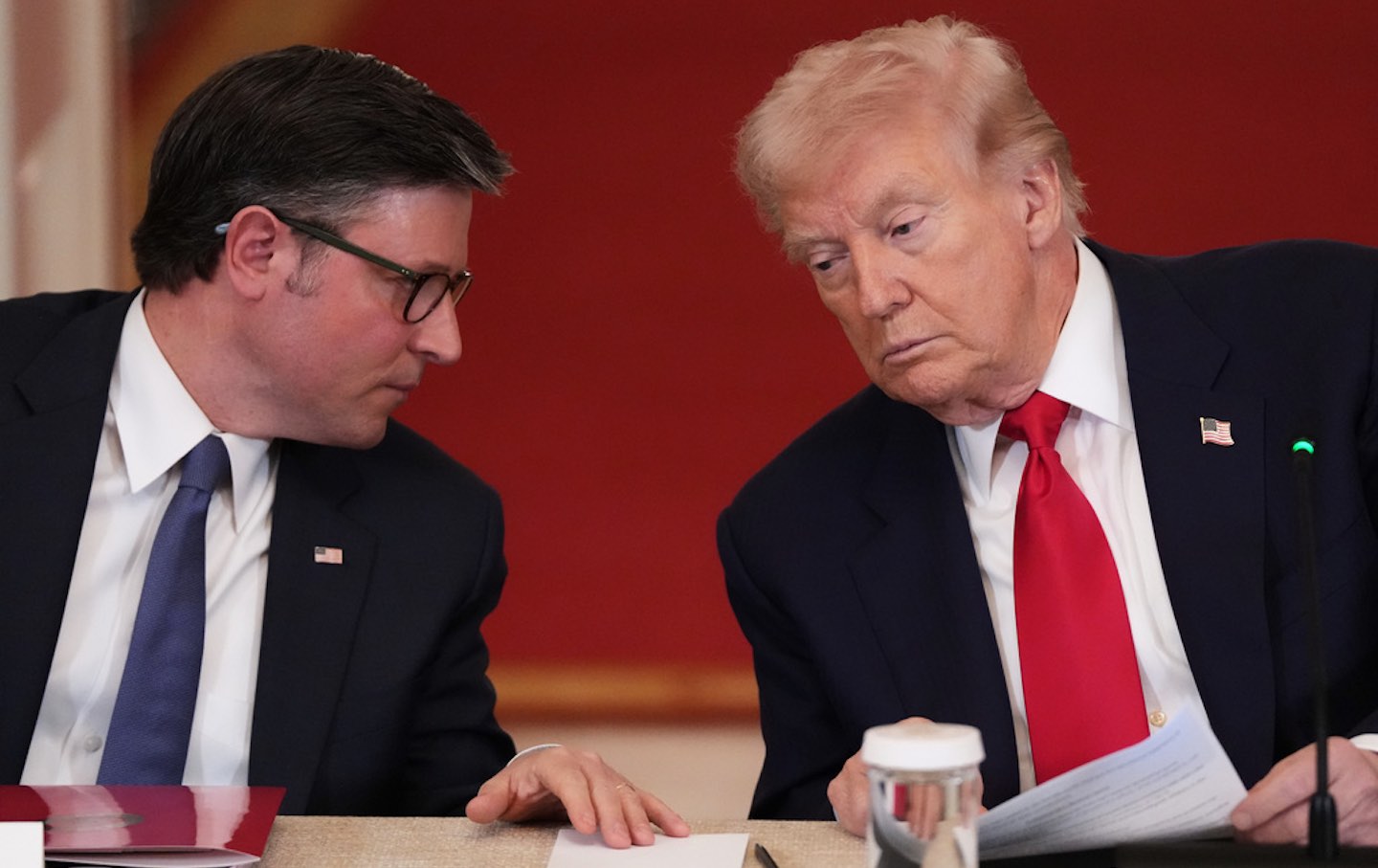
House Speaker Mike Johnson, left, whispers with President Donald Trump in the East Room of the White House.
(Julia Demaree Nikhinson / AP Photo)Saddled with a historically unpopular president, a fraying House majority, an unpopular and directionless war in Iran, an inflationary economic record, and a fracturing governing agenda, Republican strategists have seized the only viable strategy on offer for the 2026 midterms: Dial up the hate. “It’s going to be a hate election,” a consultant close to the Trump White House told Axios. “Voters have to hate the Dems more than they hate us. And we have material to work with.”
You can see why the leaders of the GOP’s campaign brain trust would embrace an all-demonization, all-the-time master narrative in seeking to retain the party’s imperiled majorities on Capitol Hill; it’s pretty much second nature to them. More than a century ago, Henry Adams coined the de facto slogan of the modern Republican Party when he observed that “politics is the organization of hatreds.” That apothegm became the mantra of Kevin Phillips, the architect of the infamous “Southern strategy” to weaponize white racial grievance for the 1968 Nixon campaign, and it’s secured big-ticket victories for GOP candidates ranging from Bush père and fils in 1988 and 2004 to the epochal win for the MAGA right in 2016.
Yet there’s little indication that another MAGA hate-fest will yield similar returns this cycle. For starters, opinion polling doesn’t bear out the claim that voters can be swayed to hate the Democrats more than they do Republicans. The GOP enjoys a trifecta in Washington, after all, so there’s no plausible way to blame Democrats for the current train of miseries afflicting the electorate. That’s a key reason President Donald Trump is highlighting his Ahab-like obsession with the outcome of the 2020 election and his stupendously counter-empirical claims that it was a masterwork of elite Democratic rigging (except, you know, for all the many national, state, and local Republican candidates not named Donald Trump who claimed victories in that cycle).
You couldn’t find a better symbol of the Republicans’ electoral plight than Trump’s petulant refusal to sign a housing relief bill slated to be the sole affordability achievement for GOP incumbents to run on in order to protest Congress’s failure to endorse the SAVE Act, his pet high-paranoid legislation to suppress ballot access in the name of vanquishing Democratic-led election fraud. (House Speaker Mike Johnson, the ever-game MAGA lackey, will pursue a Hail Mary bid to get the beleaguered SAVE bill through by awkwardly suturing it to a must-pass Defense-funding bill ahead of this week’s congressional summer recess, but the measure remains doomed in the Senate.)
The SAVE Act seeks to encode partisan MAGA hatreds into law, but Republicans readily concede that this brand of hate is box-office poison. As Texas GOP Senator John Cornyn—a Trump-loyalist incumbent ritually sacrificed by the president’s endorsement of his clownishly corrupt primary opponent Ken Paxton this spring—told Axios, “I have yet to understand how we win the midterms by talking about what happened in 2020.” In structural terms, Trump’s SAVE Act fixation is akin to the failed (albeit far sounder) Democratic case that the MAGA takeover of the GOP is a mortal threat to American democracy: Both are proceduralist appeals to offstage political machinations that bear a remote-at-best relation to the everyday struggles of voters struggling to get by in an oligarchic political economy. Neither has proven a reliable way to galvanize an increasingly disaffected electorate to endorse either party.
And as for that disaffected electorate: While it’s true that voters aren’t delivering high favorables to either party, they’re far more sour on the GOP. In the 2016 and 2024 cycles, Trump enjoyed double-digit margins among voters in the “double hater” category, managing to exploit his outside-the-Beltway credentials to great partisan advantage. That pitch now appears to be growing stale, however. Polling analyst G. Elliott Morris reports that a June Strength in Numbers/Veritas survey gauging sentiment among double haters revealed a strong pro-Democratic tilt in this pivotal group:
Our poll shows double haters favor Democrats for 2026 by 26 points, 55% to 29%, while everyone else splits about evenly: Democrats lead by 2 among voters who like at least one party. If you do the math on the generic ballot, currently around D+7 in our poll, this means that double haters are responsible for about 80% of the party’s national margin (26 * 0.21 = 5.46 / 7 = 78%).
And if we compare how the double haters feel now to their 2024 vote and partisan identity, the real story of 2026 starts to emerge. The Democratic advantage for the midterms is not built on voters who like the Democratic Party, but on those who call themselves independents and can’t stand either major party.
In other words, Republican efforts to get voters to out-hate the Democrats would seem to be a massive delivery of coal to Newcastle: Non-aligned voters predisposed to hate the Democrats have already done the math in their heads and decided they hate the Republicans more.
And despite the confident appraisal of Axios’s unnamed GOP campaign savant, it doesn’t appear to be the case that aspiring 2026 hate merchants on the right “have material to work with.” The standard Republican pitch to voters in the unmoored center is that Democrats are shifty leftists, not to be trusted with power in Washington. As another unnamed Republican pollster told Axios, “Swing voters have a persistent fear the Democrats will just go too far left. So we can make the case that yeah, we suck. But they’re worse.”
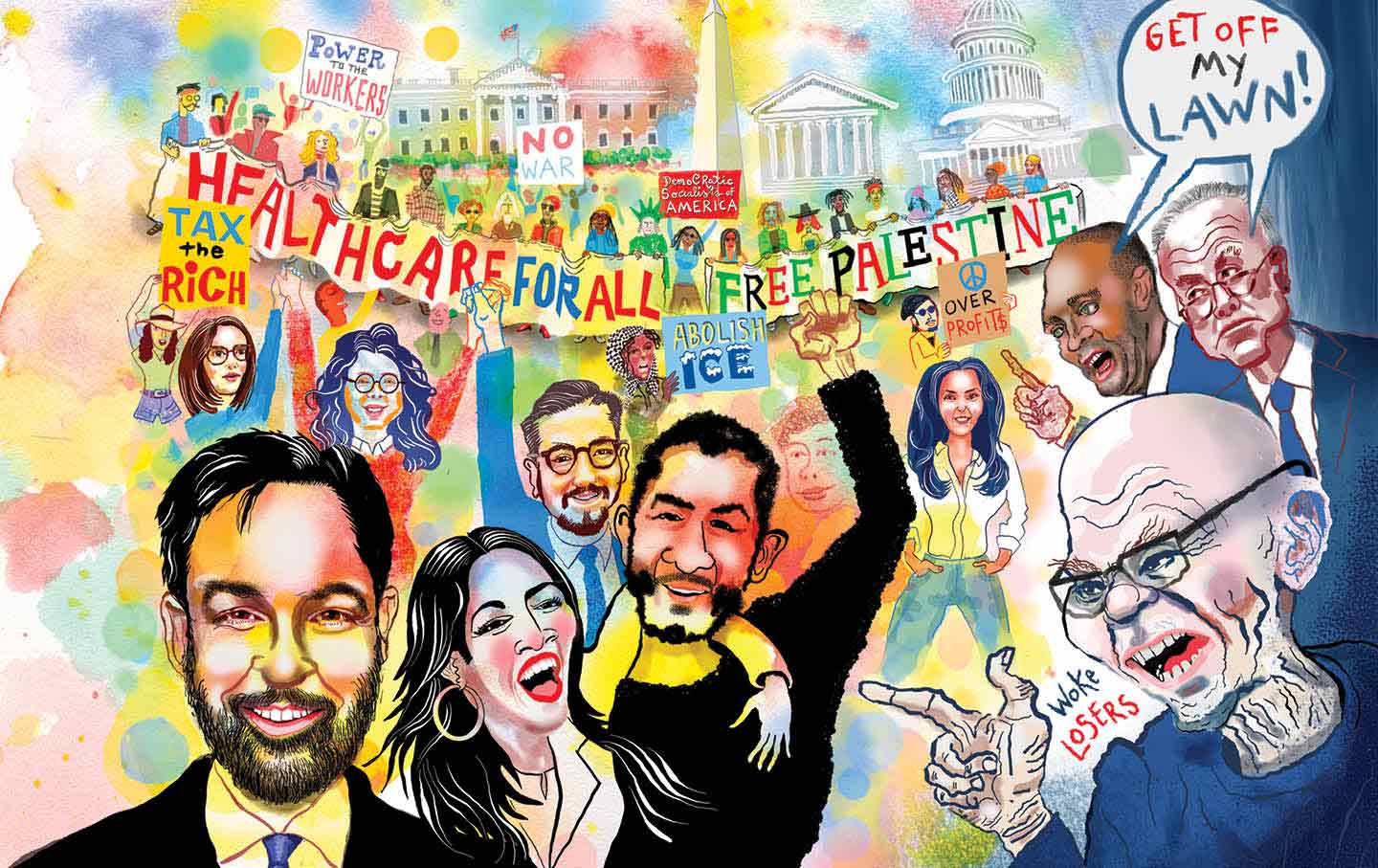
Leaving aside the obvious consideration that “yeah, we suck” isn’t a premise likely to rouse the electorate to your side in a low-turnout midterm cycle, the well-flogged “too far left” refrain just isn’t finding the sort of traction it has in past right-wing campaigns. A CNBC poll released last week found that voters are more likely to support a democratic socialist candidate than one endorsed by Trump; the least popular prospective candidate in the survey was anyone aligned with the MAGA movement. What’s more, the political leaders identified with the resurgence of the left on the Democratic party—Bernie Sanders, Alexandria Ocasio-Cortez, and Zohran Mamdani—are among the most popular figures in American politics.
It’s true, of course, that the attack-messaging complex on the right will do its level best to lie about all this: to depict Trump’s GOP as the true tribune of the righteous Real America, subject to endless calumnies and subversion campaigns on the part of scheming Democratic elites. But when the de facto face of that appeal is 2020-branded election denialism and a grotesquely corrupt warmongering president militantly indifferent to the economic pressures he’s inflicted on working Americans, you can hardly blame a jaded electorate for responding with jeers. If the 2026 midterms are indeed on course to be a “hate election,” don’t look for the Republicans to come out on top.