The Genocide of South Lebanon
Israel is carrying out its Gaza strategy in yet another war.
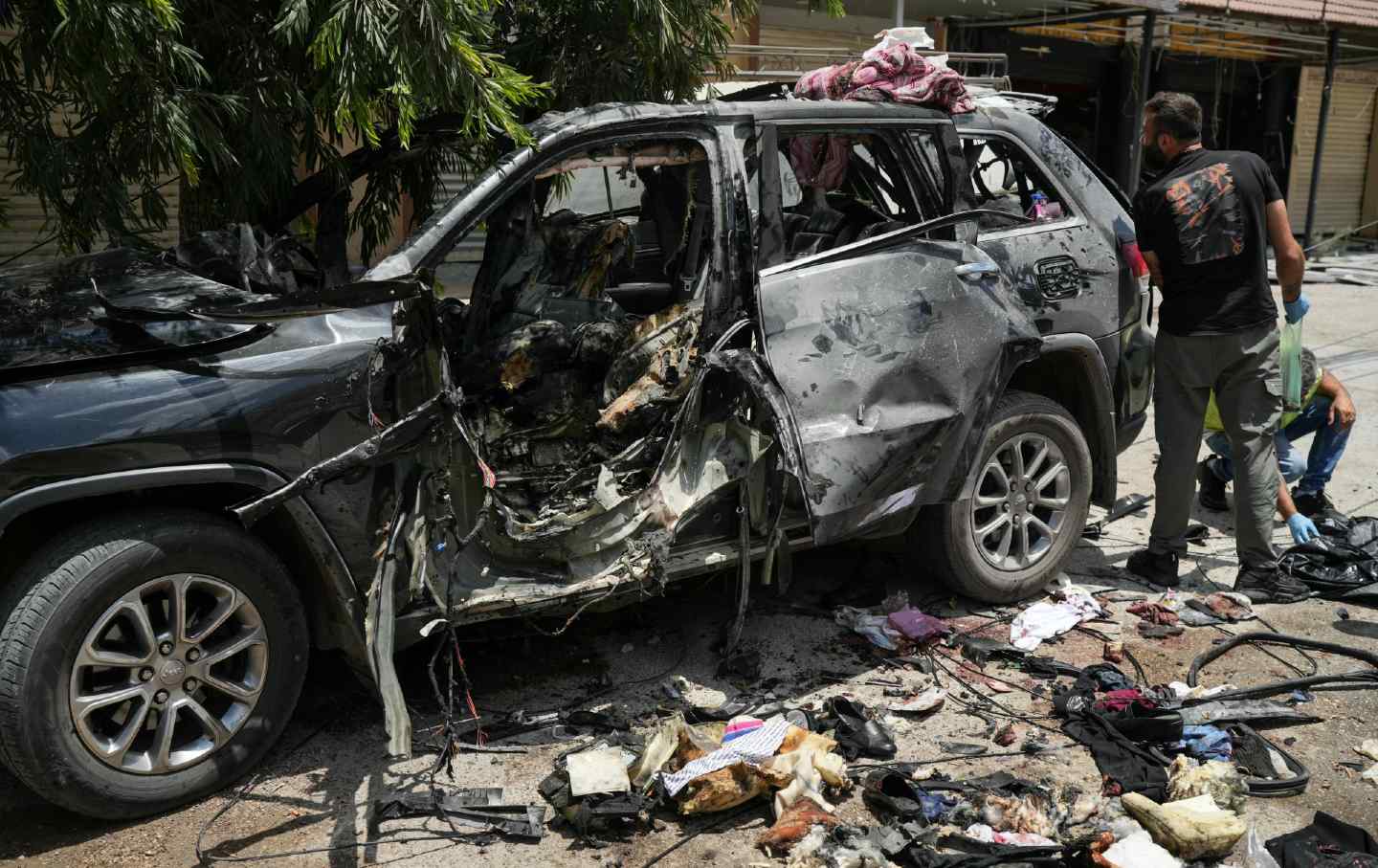
First responders inspect the wreckage of a car reportedly targeted by an Israeli strike in Nabatieh, in the south of Lebanon, on July 6, 2026, which Lebanese state media said killed four people, including three women.
(Abbas Fakih / AFP via Getty Images)On June 9, after an Israeli air strike killed at least eight people in a residential block, the Israeli military ordered the Lebanese city of Tyre to be emptied. Tyre has stood for roughly 4,000 years, long enough to have survived Alexander the Great and the Roman Empire. Now Israel sought to clear it all out—the Old City and the churches and the camps where generations of some Palestinian families have lived since they were exiled from their homeland in 1948.
A few days later, Israel’s finance minister, Bezalel Smotrich, urged that for every rocket fired from Lebanon toward Israel, 10 buildings in Beirut’s Dahiyeh district, where hundreds of thousands of people live, should be leveled. He had previously vowed that Dahiyeh would soon look like Khan Younis in Gaza, and that the villages of the south would be destroyed like Rafah and Beit Hanoun.
Nobody who has witnessed Israel’s annihilation of Gaza should be surprised that it is bringing the same genocidal mission to bear on Lebanon. But just because something is expected does not make it less important—and now that there is talk of peace in the air between Israel and Lebanon, it is vital to examine what Israel has done and what it still intends to do to its neighbor—with, it would seem, the tacit agreement of the Lebanese government.
Since March, more than 4,200 people have been murdered and over 10,000 wounded. Roughly a fifth of the Lebanese population has been displaced. Sixty-four hospitals and clinics have been hit, and more than 100 health workers have been killed. On April 8, Israeli strikes hit more than a hundred targets across Beirut and the south in roughly 10 minutes, killing 357 people, the deadliest day in Lebanon since its civil war.
The Genocide Convention does not require a body count or a particular weapon. Genocide requires intent to destroy a group, in whole or in part, and conditions of life calculated to bring that destruction about. A people do not get killed by the thousands, driven from a fifth of their own country, and have their hospitals, their water, and their farmland destroyed as well, by a state whose ministers announce the plan as they carry it out, for any reason except the one with that name. For Israel’s vision of a “Greater Middle East,” greatness apparently means everything except the people who make the region great: the farmers, doctors, poets, children, villages, orchards, histories, and homes that must first be removed so the empire can admire itself in the cleared land. So the south of Lebanon is owed our witness of its attempted genocide, while there is still something left for it to describe.
Now Israel has signaled that it intends to embed its destruction into the land more permanently—with the complicity of the Lebanese government. On June 26, Lebanon and Israel signed a 14-point framework agreement in Washington that tacitly surrendered the south to the occupation. The deal conditions Israeli withdrawal on the disarmament of the resistance, which is unlikely to ever happen. Article 13 commits Lebanon to cease “all hostile or adverse actions [against Israel] in international political or legal fora,” a clause that wipes clean Israel’s pager attack on civilians in markets and on streets, the demolition of hospitals, the strikes on medics and journalists, and all the other indiscriminate killings. Israel, which carved Gaza to pieces, leaving less than 40 percent of it behind a “yellow line,” has now done the same to Lebanon, seizing a huge swath of territory under the guise of creating a “security buffer.” This is how Israel plans to finish what the airstrikes and white phosphorus started. What began as a cancer in Gaza has become metastatic—the occupation spreading north, the terms of surrender dressed as peace, the same peace offered now to Lebanon, written without them, implemented over them, and called, by the people who wrote it, a beginning.
The way genocide is now reverberating through Lebanon mirrors the pattern against Palestine: Kill the people, murder the journalists, smear them as militants, and let the word “target” do the laundering. That is why the bombardments on neighborhoods in densely populated cities like Beirut are still filed as a strike on a Hezbollah stronghold, because it creates the plausible deniability for the West to believe it is watching a surgeon remove a tumor, when it is really watching an arsonist call the whole house diseased before setting it on fire. And the same Arab newsrooms that risked reporters to cover Gaza now grow visibly more careful once the people under the bombs are Shia.
Anas al-Sharif, one of the last Al Jazeera correspondents in northern Gaza, was killed last August after months of fabricated Israeli claims that he was a Hamas operative. Months later, in Lebanon, a marked press car was struck, and three journalists were killed inside it: Fatima Ftouni, her brother Mohammed, and Ali Shuaib.
None of this is unfamiliar to the south. Its villages were bombed in 1978 and again in 1982, in the invasion that produced Hezbollah, both on the grounds that Palestinians were fighting from Lebanese soil. Every Muharram, the south retells the story of Karbala. Karbala is the story of an army that surrounded a small camp, children included, and for days did nothing but cut them off from the river beside it, until the youngest died of thirst. All the while, those who had promised to fight beside them stayed home. Those who survived the massacre were marched in chains to Damascus, to the court of the man who had ordered their slaughter, where a woman who had lost everyone stood before him and refused to be quiet. The story does not end with anyone winning. It ends with a single word, labbayka, “here I am,” said by people who have nothing to gain and everything to lose, to people who have already lost everything, and meant as an answer that does not wait to be asked twice.
This is why the south is being erased. There is nothing left to offer them that they have not already measured against Gaza and rejected, and no deal that does not somewhere ask them to stop looking at what happens across that line. For two years, the south has been the one place that has refused, at real and rising cost, to look away from Gaza for even a day. Nobody is destroying it by accident.
The Lebanese people sure as hell do not need Israel’s genociders or Washington’s telling them what justice looks like. The Lebanese people who have spent years refusing to treat Gaza’s death as someone else’s, and now asked to die the same death, on the same schedule, for the same reason, know all too well what real justice is, and how it is practiced. While the rest of the world ignores, with the same unhurried care as Gaza, whether the genocide in southern Lebanon is happening, the people, like the Palestinians, will never surrender their dignity—even if their governments have given it up long ago.