“We Are the People”: Reflections on Reclamation Day and Finding Hope in the Darkness
Moments in time like the 250th anniversary, and the counter-celebrations to the president’s Fourth of July spectacles, come and go. But the work of liberation must not end.
I have 250th fatigue. Everywhere you look, there’s some recognition of this milestone anniversary of the nation’s founding. New York City buses and subway cars declare, “Happy 250th.” The Trump administration, diametrically opposing the values of liberty in pursuit of its misinterpretation of “freedom,” celebrates the president along with these foundational principles with cage matches and military jets, and soon-to-come, a world record-breaking fireworks show in Washington, DC. America’s most exorbitant Independence Day.
It’s absurd. But we know that already.
Counter-celebrations provide semblances of solace from these spectacles. Alternative events this year have included National Youth Day, which positioned the next generations as co-authors of the country’s future, and All of U.S. 250, a nationwide mobilization—co-led by the organizations Get Free, Next250 and 50501—and follow-up to the No Kings protests. Pick your poison. Or antidote.
In the lingering joy of Pride Month, Juneteenth, and even Prideteenth celebrations, I approached a long-awaited Reclamation Day, my commemoration of choice. Presented as a new national ritual and Reunion of Hope, the event was held in Brooklyn at 25 Kent Ave, which along with the rest of the city stands on the homelands of the Lenape people. As soon as you entered the space, you were greeted with the mission of the BLIS Collective (standing for Black Liberation, Indigenous Sovereignty) and Reclamation Day: The message of “telling a truer story of the nation’s semiquincentennial” was splayed across the floor-to-ceiling windows. Pamphlets from grassroots organizations and books from activist writers garnished each table. Artworks and installations honoring overlooked histories adorned the walls.
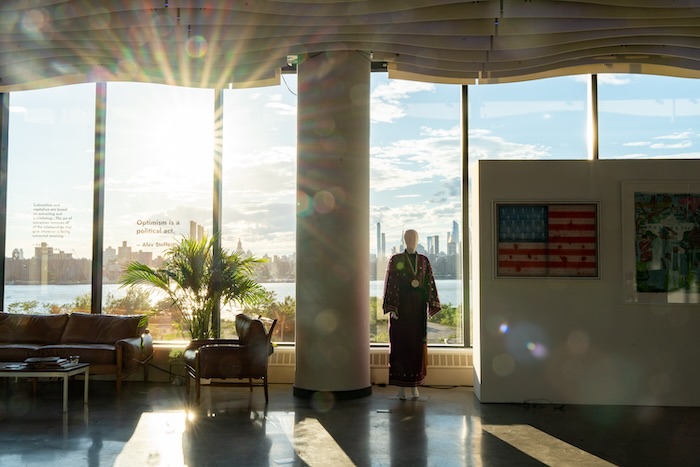
Among explanations of terms like “reparations,” “Land Back,” “Baby Bonds,” and “Guaranteed Income” were questions that struck at the heart of these movements. “Did you know Wall Street was originally a primary market for trading enslaved Black people?” one question asked. “50% of New Yorkers didn’t either.” Another stated that “half of New Yorkers are unaware of local reparations efforts” and asked, “How can you spread the word?”
In their opening remarks, BLIS’s cofounders, Savannah Romero and Trevor Smith, explained that these questions are at the root of the injustices Black and Indigenous communities are experiencing every day. Romero said, “[We] are questioning systems built on extraction, domination, and imperialism, a system that treats land, labor, water, and human life as resources to be extracted.” And Smith added, “Whether you call it settler colonialism, racial capitalism, the globalist ruling class, or corporate capture, we know one thing to be true: the people at the top benefit when the rest of us remain divided. This realization is an opportunity. Solidarity is not generally about agreement. It’s about alignment.”
Those who align on such basic concepts of freedom, democracy, and wealth belonging to the people, and who recognize the sanctity of life on Earth, are on the “liberation side.” It is not, according to Smith, a political party, nor demographic, but a choice: people over profits, sovereignty over domination, care, and compassion over abandonment.
In explaining this choice, Smith turned to—and quite literally turned to—the words of Frederick Douglass’s “What to the Slave is the Fourth of July?”, sung by a high-powered impersonator of the orator, performer Tenaj Smith, bow tie and all.
In his 1852 speech—13 years before the first Juneteenth saw the liberation of the last remaining enslaved people, and before the passing of the Thirteenth Amendment encoded such freedom into law—Douglass retained optimism in the face of terrors unfathomable to most of us today. “I am glad that your nation is so young,” he said. “There is hope in the thought, and hope is much needed, under the dark clouds which lower above the horizon.” But “were the nation older,” Douglass cautioned, “the patriot’s heart might be sadder, and the reformer’s brow heavier.”
As our nation ages, I do still consider it to be young. Its foundations may be set in documents of old, but they are consistently reborn through our interpretations, shifting generation to generation. And America will never grow older than the lands on which it sits, still answering to its elders: the tribes, stewards of the earth, who continue to struggle for sovereignty.
Just as Smith invoked Douglass, Romero called upon the multitalented late Indigenous activist John Trudell’s 1980 “We are Power” speech, recited by actor Benairen Kane. Decades after Trudell stood in the Paha Sapa (Black Hills) of South Dakota in that heated summer, Kane delivered Trudell’s timeless sentiments: “It’s not revolution we’re after; it’s liberation,” he said, rejecting that American ideal of freedom we praise.
We must go beyond the arrogance of human rights. We must go beyond the ignorance of civil rights. We must step into the reality of natural rights because all the natural world has a right to existence. We are only a small part of it. There can be no trade-off. We are the people.
Between Douglass, Trudell, Smith, and Romero, as well as reparations organizers, tribal, and religious leaders, I was starting to feel a bit more human.
Festival-goers throughout the day channeled the Ubuntu philosophy of “I am because we are,” becoming ourselves through each other. Together, we subconsciously bridged the Hope Gap within us all, that disconnect between what we hope versus what we believe to be possible, as we experienced what felt bigger than a simple day party, music festival, and art exhibition.
Popular
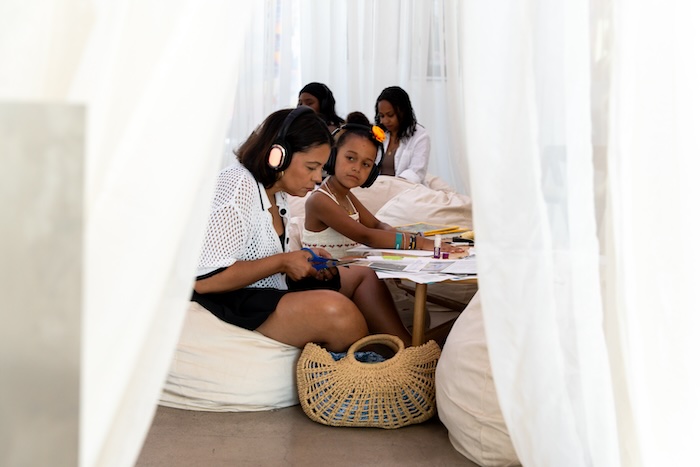
“swipe left below to view more authors”Swipe →One attendee I spoke to, an artist and educator, admitted that the reactions to our current crises exacerbated by the Trump administration feel trite and cliché, but that the messages delivered at the festival actually resonated. A passerby agreed. Another attendee, who helps run an online magazine for organizers, brought her goddaughter along to the celebration. We chuckled at the concept of a resurrected Frederick Douglass, more in awe of its impact than anything else. Her little girl carried a balloon animal home.
Reclamation Day drew a diverse crowd. A group of young Black boys descended upon the space, beckoning one another to try out participation-based pieces—a Dial-an-Ancestor phone booth, a growing wall of receipts that documented what has been taken from us. In what I first thought was an art piece, an Indigenous auntie read a book on a daybed for hours. The spatial designer shared with me that she wasn’t a plant—she just planted herself there.
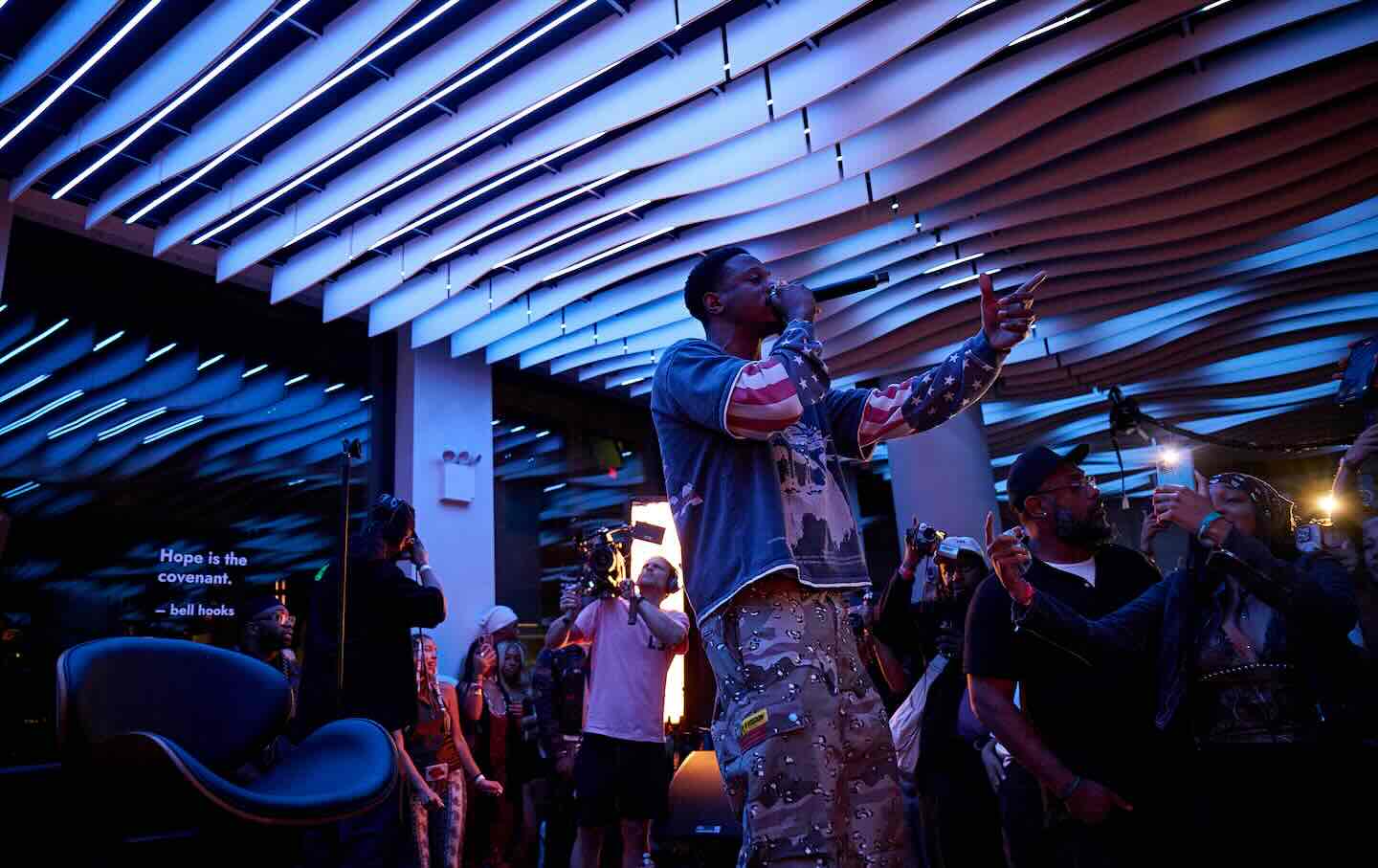
We dined on Southern Black bites for lunch, Indigenous plates for dinner on the rooftop, overlooking a wedding taking place across the way. As dusk overtook us, the night was bookended with performances by Oglala Lakota artist Mato Wayuhi and Joey Bada$$.
If nothing else, it was a beautiful day in Brooklyn.
The thing about anniversaries—about moments in time like Juneteenth, Black History and Pride Month, and even this upcoming farce of the Fourth of July—is that they end and people move on.
My 250th fatigue comes not from a hatred toward the nation or the celebration of its independence, but from the retreading. For 250 years, the nation has claimed the glory of revolution without efforts towards repair. We’ve uplifted liberty—enjoyed only by the most privileged among us—over liberation, the ongoing process of ensuring freedom for us all. In times like these, the work of liberation is often synonymous with speculation—working toward futures unfathomably free, incomprehensibly cohesive, walking on paths of which we can hardly picture the ends, yet establishing the means as we go.
Reclamation Day, with its mission to reclaim, repair, and reimagine, and an emphasis on solidarity through alignment and joy, was much more than a countermeasure. It marked a beginning that the actual fight for liberation desperately needs.