
A Personal TomDispatch Farewell
After 24 years of incisive reporting and commentary on America’s destructive imperial exploits, Tom is passing the torch.
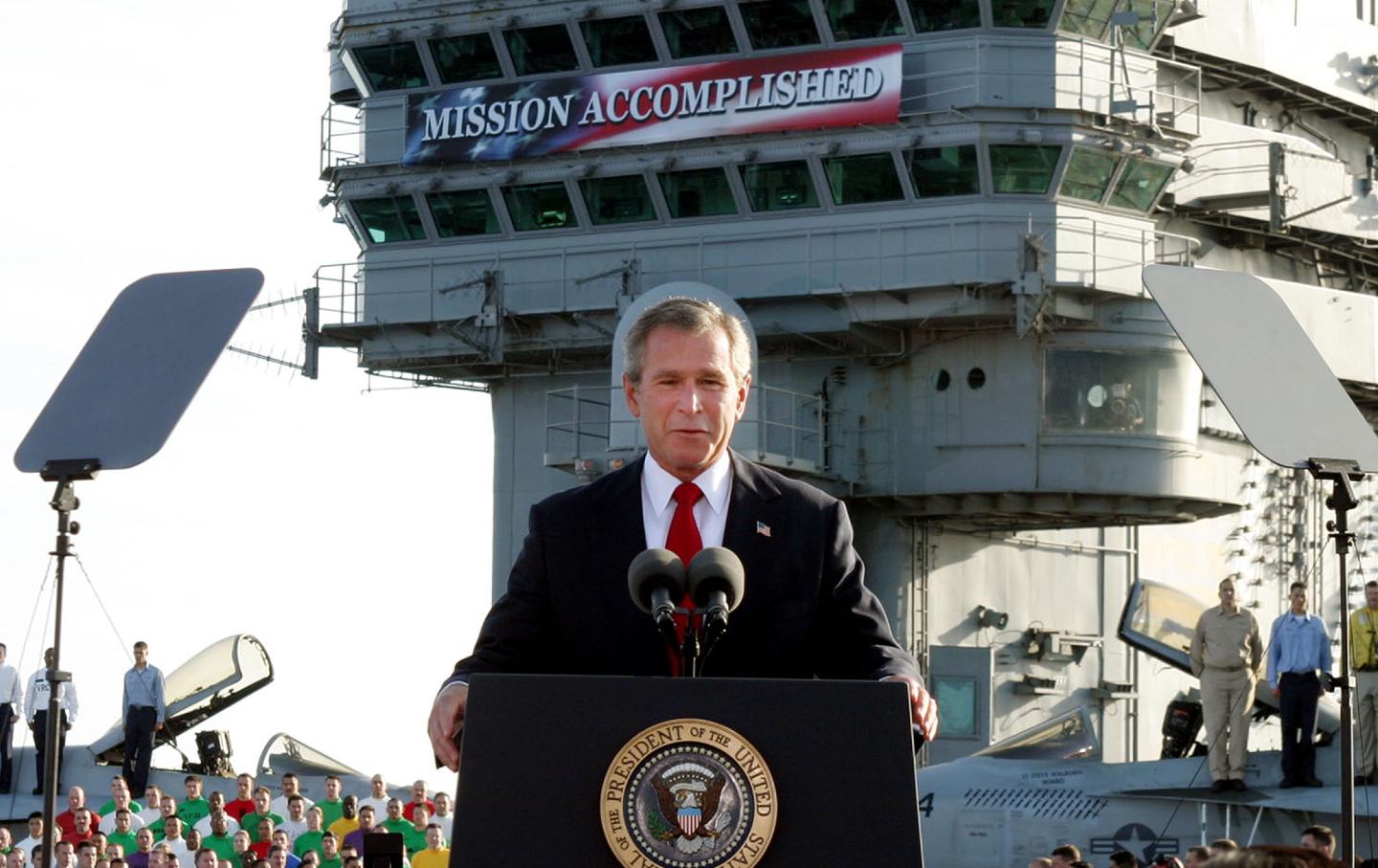
Then-President George W. Bush speaks aboard the aircraft carrier USS Abraham Lincoln off the California coast in 2003.
(J. Scott Applewhite / AP Photo)This article originally appeared at TomDispatch.com.
Yes, I began TomDispatch 24-and-a-half years ago and, today, I’m finally putting up my own last piece, at least as the editor in chief of this site. Very soon, the superlative Nick Turse will be running TomDispatch under the auspices of The Intercept (though I’ll undoubtedly continue to lend a hand). It’s been a long run. I only wish I could say that, so many years later, this world is a better place.… Sigh, no such luck. (Anything but, in fact!)
There are so many people to thank, including all the remarkable authors I’ve published. I couldn’t even begin to list them here, though I’d love to thank each of them from the bottom of my heart. And what a mess their pieces might have been if Christopher Holmes hadn’t shown up online to lend an eternal hand or my old friend Annette Liberson-Drewry hadn’t done the same, both proofing the stories in a fabulous and never-ending manner. And let me not forget Annelise Whitley, who was always there, as (until relatively recently) was Erika Eichelberger!
And I can’t even begin to thank the scads of wonderful writers who kept this site afloat all these many years! I only wish I could still thank Mike Davis, Barbara Ehrenreich, Eduardo Galeano, Todd Gitlin, Chalmers Johnson, David Rosner, Jonathan Schell, and Howard Zinn, who are now gone from this world of ours, not to speak of so many TD authors (far too many to name) who are still deeply alive and kicking on this all-too-strange Trumpian planet and many of whom, I hope, will continue to write for this site under Nick Turse.
I can’t even imagine what my world would have been like if Hamilton Fish hadn’t called me so long ago. He suggested turning the e-mails I had begun sending out to friends in the wake of the 9/11 attacks on my city and Washington, DC, containing articles that struck me at media sites around the world and my own little explanatory introductions, into a website that he (not I) called TomDispatch. And what would I have done if The Nation Institute (which then became Type Media Center) hadn’t supported me all these years? They—and Taya McCormick-Grobow, in particular—were simply fantastic! And how would I have lasted if so many TomDispatchreaders hadn’t so generously contributed money to keep this site alive?
And so, nearly a quarter of a century (and many exclamation points!!) later, I find myself in a world that would have been unimaginable, even in the wake of the 9/11 attacks, when life on this planet became ever stranger. Sadly, then, let me bid farewell not on a planet gloriously or even passingly better, but Trumpianly worse than I ever might have imagined. And let me also offer a small bow of thanks to the many thousands of wonderful readers who have followed this site, sent its pieces around, contributed money to keep it going, and made my life matter. And let me also offer my thanks to all the other sites that reposted TD pieces so wonderfully over the years. Thank you so, so much.
Oh, and if you feel in the mood, I now have my own Substack ready for me, where, after a little time off, I hope to keep writing the odd thing—perhaps the equivalent of my TD introductions—about this ever-stranger planet of ours (as I will also, I hope, continue to do at Nick’s version of TomDispatch from time to time). To subscribe to my new Substack, just click here. And as I used to do so regularly in another life on another planet (or so it now seems to me), I’m soon going to pick up the book manuscript of an old friend (and well-known writer) and begin editing it. And with all of that in mind, here’s my final piece as the guy who created and ran TomDispatch all these years, the last of the hundreds (certainly 300 or more!) I’ve personally written since 2001 at this site.
OK, here’s what this old man remembers nearly a quarter of a century later.
I was living in New York City (as I still am) when, on September 11, 2001, two hijacked planes full of passengers hit the Twin Towers of the World Trade Center, killing almost 3,000 innocent people. Until that moment, of course, such a thing would have been beyond inconceivable, no less watchable on TV, in the United States of America. Had someone written up such a plot with Osama bin Laden and crew in the cast of characters, it would have been treated as the worst kind of unpublishable science fiction.
But, of course, it did indeed happen and, in some strange sense, in its wake (an all-too-appropriate word under the circumstances), our world did indeed seem to flip upside down. That was, of course, after President George W. Bush responded early that October by—God save us!—invading Afghanistan (which, at least to me, was a shock and a half in its own right) and launching his disastrous “Global War on Terror.” Sometime in the weeks that followed, my memory (not exactly trustworthy at almost 82 years of age) is that I saw an article deep inside the print New York Times (which, by the way, I still read daily on actual paper) noting that US soldiers were by then fighting in parts of Afghanistan where the troops of the Soviet Union had struggled endlessly (and lost badly) during that imperial power’s disastrous Afghan war of the previous century, which did indeed help take it down. And that, too, in some grim fashion, stunned me. Talk about mistakes that history had all too clearly signaled should never happen again (and again and again)!
I was at the time (even if barely) online and so I copied that piece into an e-mail and sent it out with a note to a small set of friends. And somehow that began the process that led to TomDispatch.
I soon realized that, thanks to the online world, I could actually read around the globe—the British Guardian, Le Monde diplomatique, etc.—and that out there in the rest of the universe, there were other ways this ever-stranger world of ours was being looked at than the ones that largely dominated attention here in the United States, post-9/11. And so, as I began stumbling across ever more pieces that seemed to offer different perspectives on our increasingly eerie world, I started e-mailing them to a growing list of friends and acquaintances. And after a time—to my complete surprise—people I hardly knew or didn’t know at all e-mailed me that they wanted to be added to my list. And with those send-outs, I began including little introductory explanatory notes or sets of comments (which launched the future TomDispatch form with my eternal little introductions—literally thousands of them over these nearly 25 years—to every piece I posted at TD except my own).
And I remember exactly the moment when I suddenly realized that something out of the ordinary was happening not just in the ever-stranger world out there but to me, too. Susan Sontag, a writer I had long admired but didn’t know from a hole in the wall, suddenly e-mailed me out of the blue and asked to be added to what would become the TomDispatch e-mail list (though it wasn’t yet called that). I was stunned. And soon, I was sending out to—I no longer remember exactly how many—but certainly several hundred people (with more being added every week). And that was the moment when someone I hardly knew (though he, too, was on my mailing list), Hamilton Fish of The Nation Institute, called me out of the blue and asked if I might, in the future, be interested in turning those e-mails of mine into a website that he then did indeed set up for me and that he—not I—called “TomDispatch.”
Initially, at the new site, I simply did what I had been doing in my e-mails. I continued to find interesting pieces published elsewhere about our ever stranger and more disturbing world, wrote little introductions of my own, and then put in their headlines and first paragraphs with a link to the full piece wherever it had first appeared. At some point, however, I started writing longer commentaries of my own on a world that seemed to grow stranger by the week. Then it suddenly occurred to me that I knew a surprising number of writers whose voices, I thought, were distinctly needed in the strange post-9/11 world we were already living through.
After all, among other things, I had been an editor, first at Pantheon Books for 15 years in the previous century and later, in this one, at Metropolitan Books, the publishing house my old friend (and Pantheon coeditor) Sara Bershtel had set up. I had, for instance, published Chalmers Johnson’s remarkable book Blowback: The Costs and Consequences of American Empire at Metropolitan in 2000 to essentially no attention, minimal (and not particularly good) reviews, and few sales. Osama bin Laden’s assault on New York City and Washington, DC, however, turned that book into a nationwide bestseller and put that title word of his into the language in a big-time fashion (and he would indeed write for TomDispatch memorably in the War on Terror years that followed).
The War on Terror Comes Home, a Terrible Science Fiction Novel
And yes, Osama bin Laden’s 9/11 attacks were indeed a nightmare, but this country responded to them almost unimaginably badly by creating a full-scale, seemingly never-ending set of further nightmares in Afghanistan and Iraq (and, of course, over the years from Guantánamo Bay, Cuba, to Somalia in Africa, not to speak of all those global CIA “black sites” meant for the torture of Global War on Terror prisoners). And out of all those nightmares and so much more (none of which I ever would have imagined possible once upon a time) came the presidencies (and who would have believed that there could be two of them!) of Donald (the mad duck) Trump.
From the start, TomDispatch was witnessing and reporting on America’s distinctly imperial fate. I was watching with both horror and fascination as the greatest power (perhaps ever) on planet Earth (once the Soviet Union collapsed in 1991) was somehow going down, down, down, without even a helping hand from an opposing imperial power. After all, early in this century, China had yet truly to rise and now that it has, it’s not acting like a typical imperial power of history. It has (at least as yet) not launched its own version of a Global War on Terror and its leaders seem remarkably intent not on colonizing the rest of Asia in some unexpected fashion, but on making a fortune producing the world’s green energy machinery (including, at the moment, 80 percent of global solar energy panels), even if they’re also still outdoing every other country on this planet—despite Donald Trump’s efforts—in burning fossil fuels and pouring greenhouse gases into the atmosphere).
In some strange fashion, I watched and recorded at TomDispatch just how my country was playing out its grim version of the predictable decline of all imperial powers, historically speaking, in a distinctly up-close-and-personal fashion. And of course, in 2016, this country gave decline a remarkable new meaning on an increasingly strange and disturbed planet by electing Donald J. Trump as president.
As my version of TomDispatch ends (and Nick Turse’s launches), I find myself at my advanced age (with my friends beginning to die around me) in a world I simply could never have imagined. Don’t even get me started on artificial intelligence, which, as Bernie Sanders has pointed out, could someday “replace humans in controlling the planet”! Unreligious as I may be, I’m with the pope on AI—though perhaps even more so. My own feeling is that no genuine intelligence could have been senseless enough to create such an obvious nightmare to come.
And the War on Terror Comes Home Yet Again in the Form of Donald Trump
In a sense, it might even be possible to think of Donald Trump as the possible final chapter in this country’s global war on terror. Think of him, in fact, as the way that war came home, big time! In his own fashion, he could hardly have been more of a terror and, to make matters so much worse, in 2026, a year expected to be the second hottest in recorded history, he seems remarkably intent on making war not just on Iran, or any other random country like Somalia or Nigeria, but on this very planet itself. Even his anti-immigrant agenda is, as the Guardian recently reported, ensuring that ever more fossil fuels go into the atmosphere via the stunning number of planes deporting those immigrants, helping make ever more areas of the planet ever hotter, and—of course!—ensuring that ever more people will end up as—yes!—migrants.
In short, whether it’s climate change, Iran, or you name it, Donald Trump (the second time around) is already giving heat new meaning.
And none of this (not a bit!) would I have believed in November 2001 when all of it began for me. Had you tried to show me such a future then, I would have simply laughed you out of the room and gone about my business.
In a sense, you might say that the war on terror simply never ended, since my country has never stopped bombing other countries around the world, the latest (but undoubtedly not the last), of course, being Iran. And I suspect that, without that “war,” Donald Trump would have been inconceivable.
Popular
“swipe left below to view more authors”Swipe →I’m at an age where my friends are indeed beginning to die and it pains me that, when I go, I’ll be leaving such a mess of an all-American planet to my poor grandchildren. They truly deserve better. And once upon a time (if I even imagined them coming into this world of ours), I might have hoped that someday in the then-distant future I would have signed off TomDispatch by claiming that I was indeed leaving them on at least a modestly better planet than when I began so long ago.
No such luck, of course, and that makes me sad indeed. I mean, we already knew that we were truly on the planet from hell when, on his third try, Donald Trump actually managed to garner 49.8% of the popular vote and win another four unbelievable years as president of the anything but United States.
Yes, anyone (even I) certainly could have hoped for better. In fact, I certainly did—even if such hopes proved unrealistic indeed. Of course, one can (and should) still hope that the next great imperial power, obviously China (if, in fact, there are to be more great powers on this ever less great planet of ours), might indeed prove more reasonable and less Trumpian. At least, that country’s leadership plans to make a fortune off the decarbonization of Planet Earth by producing the equipment, from electric vehicles to solar panels, needed to green this world of ours (even while continuing to pour record amounts of fossil fuels into the atmosphere).
Let’s also not forget that other former great power, Russia, which continues fighting its miserable war in Ukraine into its fifth year, while, of course, pouring ever more greenhouse gases into the atmosphere (as all wars now do), while only recently launching actual nuclear missiles (though with dummy warheads instead of nuclear payloads) against Ukraine. (Just what we need on this planet of ours, of course—the threat of actual nuclear warfare!)
Yes, all in all, we humans are truly a strange (and strangely unnerving) crew and, worse yet, over the decades from atomic warfare to full-scale war on the planet itself, we seem eerily driven to develop the means to be ever more destructive. And with that grimly in mind and only wishing things were better, let me sign off on almost 25 years at TomDispatch. Sigh…
More from The Nation

My Family’s Dark, Hidden History With Institutionalization My Family’s Dark, Hidden History With Institutionalization
My great-great-grandfather was the namesake of an infamous institution for the disabled. From long-neglected records of the property, the lives of forgotten people were uncovered....
Smoke and Mirrors: The Right's Latest Attacks Against Trans People Smoke and Mirrors: The Right's Latest Attacks Against Trans People
The MAGA movement is redoubling its attacks on trans healthcare in an attempt to win votes this November.
Is Blockbuster Video the Answer to Our Digital Privacy Woes? Is Blockbuster Video the Answer to Our Digital Privacy Woes?
The Supreme Court is weighing whether a 1988 video-store law can be used to protect our digital privacy.

How Congress Is Cashing In on the AI Boom How Congress Is Cashing In on the AI Boom
Roughly one in five members of Congress has household investments in the industry.

Obviously, the Knicks Should Not Visit the White House. Why Is This Even a Discussion? Obviously, the Knicks Should Not Visit the White House. Why Is This Even a Discussion?
The Knicks shouldn’t let their legacy include genuflecting to Donald Trump, one of the most hated figures in the very city printed on their jersey. New Yorkers deserve better.
The Real AI Threat Is Already Here The Real AI Threat Is Already Here
Never mind some future apocalypse—AI is being used right now to cause enormous suffering.

