
An Uncertain Future for NYC Student Activism
A controversial bill is proposing that NYPD create a plan for instituting anti-protest buffer zones around many NYC schools.
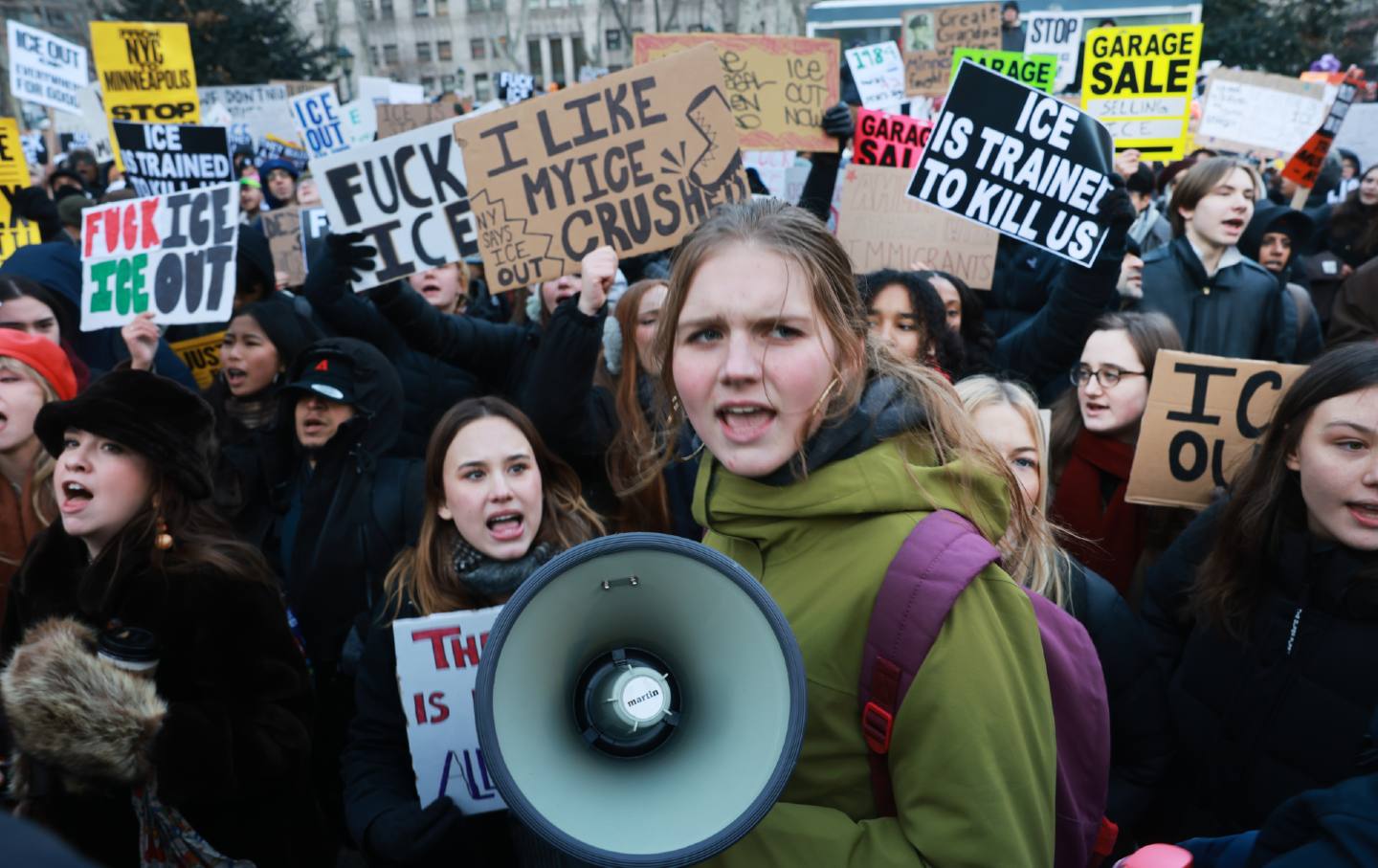
Students attend a rally to protest ICE in lower Manhattan
(Spencer Platt / Getty Images)
On February 3, 1964, hundreds of thousands of New York City children boycotted class and took to the streets to protest the de facto segregation of the city’s school system. Since then, city students have continued to speak out on local and nationwide issues, ranging from the Vietnam War and gentrification to the climate crisis, gun control, standardized tests, and ICE. Today, this kind of free expression lies at the center of a citywide political maelstrom.
On May 20, City Council Speaker Julie Menin announced a revised version of the controversial Intro 175-B bill that would enable the New York City Police Department to establish so-called “buffer zones” around many K-12 schools during protests as a public safety measure. Specifically, the bill calls on the police commissioner to establish a plan to “address and contain the risk of physical obstruction, physical injury, intimidation, and interference, while preserving and protecting the rights to free speech and assembly, and protest.”
The original version, which was vetoed in late April by New York City Mayor Zohran Mamdani, would have included universities, all K-12 schools, all early childhood education centers, and, potentially, museums, libraries, and teaching hospitals in the plan, covering tens of thousands of city blocks. While more limited in scope, the plan under the revised bill could still have significant reach. The new bill covers all elementary, middle, and junior high schools, but only non-public high schools. According to a spokesperson at the City Council, the bill also covers early childhood education centers, except when located in private residences. Together with many city-administered and private nonresidential early childhood education centers, roughly 1,760 public elementary and middle schools, and at least 733 private K-12 schools span the five boroughs, including some located within blocks of common protest sites.
The bill comes in the wake of city college campuses becoming ground zero for protests over genocide in Gaza, heated protests and counterprotests involving a real estate expo hosted by the Park East synagogue that included homes in illegal Israeli settlements, and a significant documented rise in antisemitic attacks and hate crimes. Yet the bill’s implications extend beyond this context, bringing into public focus a core tension: the trade-off between public safety and free speech, and who gets to decide how that trade-off is made.
Bill opponents argue that curtailing protests does not make New Yorkers’ lives safer, while supporters, including Council Speaker Menin and the original bill sponsor, Council member Eric Dinowitz, see the bill as helping ensure that students can attend school without fear and as increasing police transparency. As these debates unfold between powerful political players, the constituency most affected—the city’s students—has its own concerns. For some student activists, the bill has created a sense of deep uncertainty around whether and how their ability to speak out and organize on a range of issues could be affected going forward.
Although in the city, even elementary school students turn out to protests and rallies, the most likely impacted students are high schoolers, who led New York’s earliest youth climate march and school strikes. “The barrier to organizing an effective protest or demonstration of discontent in the first place would be so much larger” if the bill becomes law, said Lucas Phildor, a Queens borough organizer with the youth environmental advocacy organization Treeage. Even if Phildor, a senior at the public Townsend Harris High School, would not find his school directly covered by the plan, the prospect of student activists running into police barriers and feeling under surveillance felt like a high-stakes situation to him. Phildor also imagined this unease would trickle down to younger students. “I can’t imagine at least myself being back in sixth grade, knowing what I would want to do in organizing—the fear that that would instill in me…[around] taking any action.” He also feared that this bill would open the gateway to more buffer zones around public schools.
Alma Adi, a Manhattan borough organizer with Treeage, was afraid the bill’s effects would limit spaces for students to gather without running into buffer zones, especially for citywide protests like May Day. A junior at Hunter College High School, she added that buffer zones would make mobilizing peers more difficult and complicate planning protest routes that would avoid possible security perimeters.
J.P. Perry, a senior staff attorney at the NYCLU, agreed that the bill could have a “chilling effect” on young people. “This measure is really targeted at suppressing campus protest activity,” she said, raising concerns around the uncertainties of what enforcement of the bill would entail in practice. Students could fear possible arrest, disciplinary action, or even consequences in the college admissions process as a result of joining protests that run into a buffer zone, when, she said, “we should be encouraging our students to be standing up to participate in our multifaceted, complex democracy.” The NYCLU previously urged the City Council to sustain Mamdani’s veto of Intro 175-B in a letter signed by over 100 organizations, and has maintained its opposition to anti-speech legislation.
Even if only indirectly, some college student activists fear being impacted by the new bill. For Hagen Feeney, a college senior at Columbia University who is an activist with Sunrise Columbia and a spokesperson for Student Workers of Columbia, and was involved in Gaza solidarity encampments, the bill’s existence functioned almost as a warning for student activists. As is common for a private university, Columbia already regulates protests and demonstrations on its private property, making the surrounding public streets a crucial alternative for student protests. Under the revised bill, the buffer zone plan could cover some of these streets because of their proximity to educational facilities.
Supporters of the bill, however, contend that by outlining the NYPD’s considerations in “determining whether, when, and the extent to which security perimeters” around schools, the bill would provide a core measure of public transparency and allow for “community engagement in NYPD plans to respond to protests.” In testimony submitted to the City Council last February, Michael Gerber, deputy commissioner of legal matters for the NYPD, testified that the NYPD already “exercises its discretion, consistent with the law,” to both facilitate safe entry and exit of schools, and to let protesters exercise First Amendment rights, and that its initial concerns with the bill had been mostly addressed. The NYPD provided this testimony in response to a request for an interview and did not respond to follow-up questions in response to this testimony.
“This increased transparency will help ensure that New York City’s most vulnerable are protected and that students are able to access education without fear of intimidation or harassment,” said Council member Elsie Encarnacion, who is sponsoring the new bill.
Benjamin Feit, a high school freshman at The Ramaz School, a private K-12 school, sees the buffer zone as crucial for preventing the intimidation of students by protesters, especially of Jewish students in the current political moment. Along with peers and parents, he joined the UJA-Federation of New York last March in Albany to lobby for buffer zone legislation at the state level, which recently passed in the New York State Legislature. The UJA-Federation has strongly supported Intro 175-B, calling Mamdani’s veto a “profound failure” to prioritize New Yorkers’ safety.
“There’s no reason why there should be protests [so] close to schools,” said Feit, adding that the same kind of intimidating protest incidents he fears happening outside Jewish schools “could happen outside of a Muslim school or a Catholic school.” Likewise, Feit thinks the bill should apply to public as well as private high schools. “I think all schools should be safe…. there’s no reason why [public] schools shouldn’t be protected if we’re protecting private high schools,” he said.
Many other students, however, fear the bill will have negative safety impacts. Adi said the bill initially seemed logical in a time of deep political polarization. However, she believes that “realistically, the bill won’t be enforced in a way that specifically prioritizes students’ safety and…the harms vastly outweigh any potential benefits.” She notes that many schools already have school safety agents to protect students, while Phildor said he was concerned with the pressing threat to student safety of increased gun violence, not peer protests. Similar to Feit, he finds the exclusion of public high schools in the new bill confounding, given the bill’s ostensible purpose of enhancing student safety, and indicative of a lack of coherence in supporters’ arguments.
Although Intro 175-B does not call for an increase in police presence at schools, the concern that the plan’s implementation and enforcement would inevitably lead to this outcome to support buffer zones raised additional safety concerns for Phildor as a person of color, he said. Adi invoked the school-to-prison pipeline and how students of marginalized and immigrant backgrounds may already be disproportionately targeted by police in schools as a basis for concerns. For Phildor and Ali, the ability for students to protest alongside their peers where they naturally feel most protected—by their schools—also offers crucial support for free expression, since students often find comfort in protesting alongside their peers or, as Adi put it, “as a unit.” For Ami Dube, an Orthodox Jewish student at Hunter College High School, who wrote about Intro 175-B in The Forward, allowing for free speech by students and engaging with “outlooks that make us uncomfortable” is also crucial in his view for “what keeps Jews safe.”
Popular
“swipe left below to view more authors”Swipe →Yet for Feit, the new bill also has straightforward value outside student safety: preventing disruption to school learning and after-school activities by protests. Citing similar concerns around the interruption of student learning, the Catholic Archdiocese of New York and Diocese of Brooklyn and Queens also urged Mamdani’s support for Intro 175-B last April. Feit added that law-abiding protesters could make themselves heard at a safe distance from schools.
Ultimately, whether the new version becomes law or the bill remains a powerful omen, Intro 175-B has put the city’s students on notice. And a question that has plagued the nation since its founding—what actually limits free speech and when are such limits necessary to protect people—will likely continue to permeate city politics and classrooms.
“We’re in a time where we’re seeing like a federal assault on so many of our rights…and so often…where you see the most powerful speech [against this] is from students,” said Perry. For now, how students will shape their activism to continue defending those rights and making their voices heard, while navigating any shifting boundaries of city law, remains to be seen.
Become a Sustaining Donor This September
Between the reemergence of right-wing red-baiting and Donald Trump’s use of the chilling National Security Presidential Memorandum–7 to criminalize left political organizing, we’re seeing McCarthyism reborn before our eyes.
This assault on democracy cannot be ignored or wished away. Resisting it requires bravery in the face of threats and repression, a steadfast commitment to the truth, and the unwavering belief that we can—and will—overcome this darkness.
We must have an independent media that sets the record straight, unearths corruption and abuses of power, and advances a politics of justice and dignity for all if we’re to win this fight.
That’s why I’m writing to you today. This September, The Nation needs to add 100 monthly donors to sustain our progressive journalism. Your contribution makes the next investigative report, the next truth-speaking column, and the next pathbreaking essay all possible.
I hope you’ll support our work with a recurring donation today. If you donate $10 or more a month, we’ll send you a brand new “Hands Off the Free Press!” sticker to recognise your commitment to our cause. Please, donate today.
Onward,
Katrina vanden Heuvel
Editor and Publisher, The Nation
More from The Nation
The Impossible Will Take a Little While: The Power of Persistence The Impossible Will Take a Little While: The Power of Persistence
In troubled times, history offers a lesson: Seemingly impossible change can begin with ordinary people who refuse to give up.
Gloria Steinem’s Many-Splendored Feminist Life Gloria Steinem’s Many-Splendored Feminist Life
The feminist icon lived the struggle for gender equality and always found time to lend support and solidarity to other women leaders, even in her final days.
No, Woke 1 Was Not Crazy No, Woke 1 Was Not Crazy
AOC and others are laughing off 2020 as a wild, isolated moment. None of that is true.
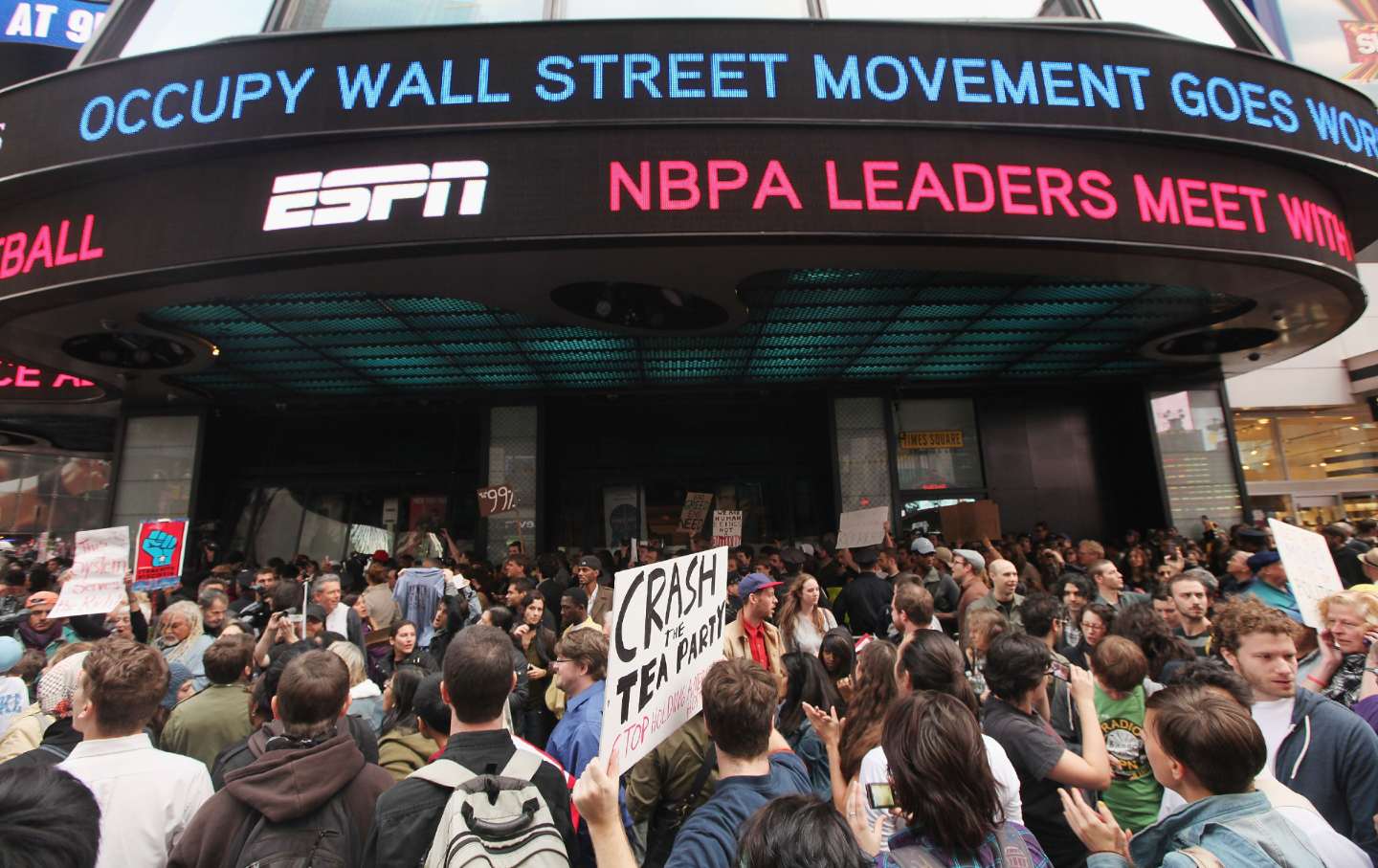
How Occupy Wall Street Still Explains Politics Today How Occupy Wall Street Still Explains Politics Today
It sowed the seeds for a new era of social movements—but its politics of powerlessness should act as a cautionary tale.
Abdul El-Sayed’s Win Is a Landmark. But the Fight Is Far From Over. Abdul El-Sayed’s Win Is a Landmark. But the Fight Is Far From Over.
Even though the Palestine movement is on the march, we can’t afford any complacency.
Mamdani’s Team Redefined Political Video. Now They’re Betting on Short Films. Mamdani’s Team Redefined Political Video. Now They’re Betting on Short Films.
Premiering exclusively in The Nation, a new short film produced by City Hall and narrated by Morgan Spector highlights the efforts of the biggest tenant-led union in New York City...

