
In the Race to Succeed Nadler, Micah Lasher Says Fighting Trump Is Not Enough
The state assemblyman wants to go to Congress to take on MAGA, but says that Democrats need to show Americans that they are “gonna make their lives better. Quickly.”
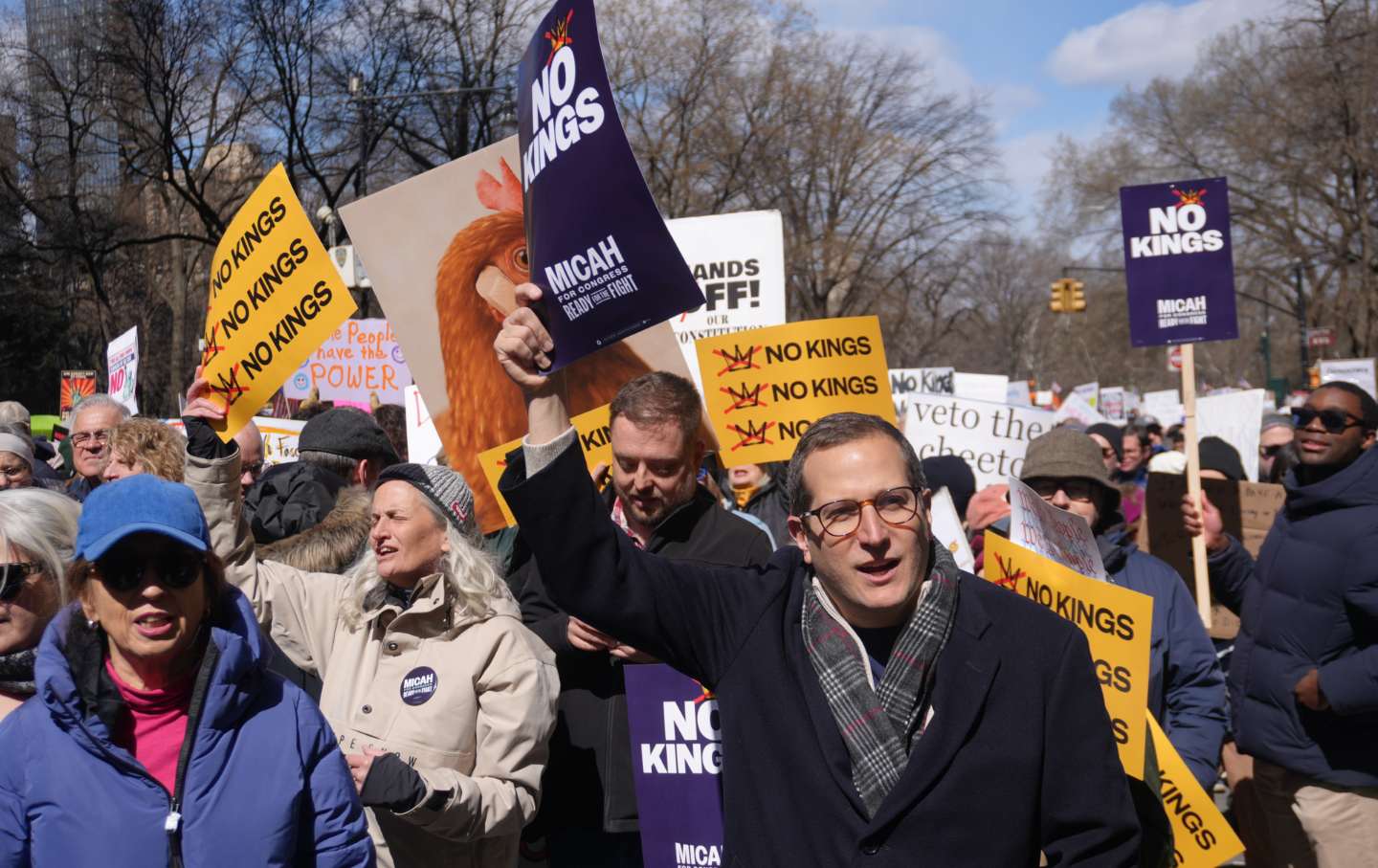
On a recent Thursday night, I walked into a Broadway Democrats meeting in a community room at Cathedral Parkway Towers, late, to hear New York Assemblyman Micah Lasher address a group of about 25 constituents. Lasher, who is running to succeed Representative Jerrold Nadler in the recently redrawn “East Side/West Side” 12th Congressional District, was speaking animatedly about the importance of enforcing the 1936 Robinson-Patman Act, a New Deal law intended to protect small businesses from large industry consolidators.
The choice of topic seemed obscure. “Why is he talking about this to UWS Democrats?” I scribbled to myself. (This is my district, by the way.)
It turned out this was a forum specifically to discuss grocery affordability, with active and smart West Side Democrats, which I’d have known if I’d been on time. Still, I marveled at how on-brand Lasher was that night, as a man who, New York magazine reports, brags, “Our brand is nerd.” He also told writer David Freedlander, “I can’t help but feel like I am going to emerge as a fairly boring character in your story.” He was right.
Daniel Squadron, a former New York state senator who for almost 10 years has run the States Project, a nonprofit dedicated to electing Democratic state legislative leaders, tells me that of all the 7,386 state legislators nationally, “not a single one has been more effective at pushing back on the Trump administration than Micah.” But Squadron is slightly frustrated by the media’s pigeonholing of Lasher as the wonk in the June 23 Democratic primary, rather than the one with the clear policy chops and accomplishments and the scads of local endorsements.
“There’s a shocking number of people who are wildly enthusiastic about the possibility of Micah going to Congress who have known him for a decade or two or three,” he says. “And it’s actually really rare to have a candidate that excites so many people who they’ve known this long, professionally, or personally, for whom he has solved complex personal and political problems.” Voters’ choice in this primary, he says, “should be a no-brainer.” But he adds, “There’s a question [about whether] those qualities matter as much as they used to or should.”
So far, there’s no clear front-runner in the race. Lasher might be getting more attention if he weren’t facing President John F. Kennedy’s under-qualified, over-handsome grandson Jack Schlossberg, 33, a smack-talking YouTuber best known for his rants against his brain-addled, anti-science cousin, Health and Human Services Secretary RFK Jr. (a productive pastime for JKS) as well as shirtless videos where he dances on the beach (where he looks more like a close RFK Jr. relative than he might hope).
Then we’ve got celebrity Republican turned rabid Trump opponent George Conway, ex-husband of Kellyanne, previously best known for his work behind the scenes with Ann Coulter setting the stage for the Clinton impeachment, now hoping to represent a district that has been represented by Nadler, Ted Weiss, Bella Abzug, and former mayor Ed Koch, when he was a liberal. Conway is personally wealthy, and he told New York magazine that if he loses the primary, he’ll “probably go skiing a little bit more.”
NY-12 is an affluent district, but I don’t think that sat well for a lot of constituents. If they saw it.
But while Schlossberg was leading in early polling, and Conway was coming on strong, recent polls have shown both of them losing support. Lasher’s strongest opponent is East Side Assemblyman Alex Bores, who might be emerging as the best-known candidate by virtue of having multiple political action committees on both sides of the artificial intelligence debate pouring money into his race—one side attacking, one side promoting him. (The two are effectively tied in the latest polling.)
Leading the Future, a PAC affiliated with founders of Open AI, has poured millions into attacking Bores, ostensibly because he boasts of sponsoring New York’s AI-regulating RAISE Act (which Lasher cosponsored). A former employee of Peter Thiel’s Palantir, Bores is now getting millions in campaign contributions from PACs and other donors aligned with Anthropic, the AI firm that got credit for insisting that the Pentagon could not use its products for autonomous weapons or mass surveillance (but which is still working on a wide range of defense- and military-related projects). Anthropic and its allies are trying to pitch themselves as the “Good AI” titans, open to sensible regulation. The 12th district race has become a proxy war over whose version of AI regulation—which neither side wants to be particularly muscular—will prevail in Congress.
Meanwhile, crypto-currency billionaire Chris Larsen, who lives in San Francisco, just announced a plan to pour $3.5 million into Bores’s candidacy, ostensibly because of his leadership on AI regulation. But Larsen was one of the biggest backers of pro-crypto attorney John Deaton who tried to unseat Senator Elizabeth Warren in 2024. And over on the other coast, Larsen is a leader in a new PAC called “Grow California,” aimed at curbing the power of progressives and unions and fighting a proposed wealth tax. “Whoever designed that wealth tax in the unions—wow,” Larsen told The New York Times. “They woke up the sleeping giant like I have never seen.”
Bores’s stance on AI won him the endorsement of the Senator Bernie Sanders–affiliated Our Revolution. “Alex Bores isn’t afraid to name or take on the oligarchy,” the group’s executive director, Joseph Geevarghese, said in a statement. He admitted to Politico, “When you ask somebody, ‘What would come to mind when you say leftist progressive,’ it’s probably not Alex Bores.” (Sanders himself has not endorsed in the race.) And when you ask somebody what would come to mind about Our Revolution, it’s probably not backing the same candidate as an anti-union crypto billionaire. But this is a crazy race.
Lasher chafes at the credit Bores gets for his AI stance, at least a little bit. He worked on a draft of the RAISE act with then–state Senator Brad Hoylman-Sigal, and Lasher and Bores have similar platforms when it comes to AI regulation, though Lasher has called for a national moratorium on data center construction, and Bores hasn’t. But Bores’s crypto ties are another matter, Lasher says.
“I think it’s clear that the Open AI attacks have been a very helpful distraction from the crypto industry’s role in this election,” he adds. “And also from the much more complicated story that’s happening within the AI industry.”
While out-of-town tech-bros and crypto leaders are lining up for and against Bores, Lasher has the support of many prominent elected leaders in New York, from retiring Representative Jerry Nadler to former mayor Michael Bloomberg to Governor Kathy Hochul. Local Democratic leaders like Manhattan Borough President Hoylman-Sigal, Comptroller Mark Levine, and Upper West Side state legislators Linda Rosenthal, Erik Bottcher, and Brian Kavanagh are also behind him. Beloved progressive former borough president Ruth Messinger is a staunch supporter. Lasher also has the support of most of the district’s party committee infrastructure, from the venerable Village Independent Dems to Third Act NYC. (The “Silk Stocking” Upper East Side was merged with the more progressive, more Jewish Upper West Side by a redistricting debacle back in 2022.) But to critics, channeled by New York magazine, that makes Lasher the face of the “Establishment.”
Lasher was a precocious political upstart, and his supporters contest who has known him longest. “I’ve known him since he was 16,” Nadler says. But Nadler now feels that the upstart has the maturity, at 44, to take over the seat he’s held for 33 years. “[Retiring] was hard,” Nadler admits. “I still feel ambivalent about it. And if there wasn’t someone that I felt confident in, who would do a good job and continue to do the things that I want to do, like Micah, I wouldn’t have retired.”
Nadler scoffs at the attention some of Lasher’s rivals are getting, particularly Schlossberg.
“He’s totally unqualified. I have nothing in particular against a Kennedy running or not, but the Kennedy running should be someone with some public accomplishments. And he has none. And no private accomplishments, really, you know?” Schlossberg does in fact have a limited professional résumé.
Nadler refutes the notion that Lasher is diminished as the policy wonk in the race.
“I don’t think people think he’s too serious or too wonky. If there’s anything people want in this district, it’s a candidate who’s serious and wonky. We need it.” He goes on: “I’ve watched him, in all his jobs. He worked for me. He worked for Bloomberg. He worked for [former Attorney General Eric] Schneiderman, he did a lot of great work on antitrust, and then he was policy director for the governor. This is a very policy-oriented district, a very intellectual district. People know what he’s done, and they appreciate it.”
I ask Nadler what he’d like to see Lasher do when he gets to Congress. “Well, if we get a trifecta [in 2028], which I think we will, then you pass my bill expanding the Supreme Court to 13. Thirteen is justified, because the Supreme Court historically has had one justice for each circuit, and there are now 13 circuits. And also install 18-year term limits. But you can’t do that right away.” (Lasher tells me this will indeed be a top priority for him.) Nadler says he has confidence that Lasher will continue the job he’s done for the district.
Stephanie Lasher, the candidate’s mother, tells me the relationship between her son and Nadler “certainly goes beyond the professional. I think there’s a great deal of mutual respect, and fondness, and they are so similar in some ways. I mean, ‘integrity’ is a word that, sadly, we are often unable to use in this arena. The two of them have just impeccable integrity.… I mean, if you want to put it in lofty terms, Micah believes in the nobility of public service, and certainly Jerry is a paradigm for that concept.”
Lasher’s mother has zero problem admitting her son is a nerd—and she says it’s a good thing. “It surfaced when he was a kid,” she told me. “When he would get interested in something, he would do a deep dive. When he was in nursery school, he became very interested in Sherlock Holmes. I mean, we had to get him the outfit, the cap.”
Lasher resists identifying one signature issue. He touts his role in the New York legislature passing the first new FAIR Business Practices Act in 45 years, in his first Assembly term, and his successful fight to more than double income eligibility for childcare subsidies. When I ask him what his “first” big issue in the House would be, he refuses to choose just one. “I mean, it’s housing, childcare, and jobs as a general matter,” he tells me, and he has an agenda to help Americans launch themselves into their first job, first home, and parenthood: “I have talked about a program in which the federal government says: We’re gonna guarantee you can get your first job, through a program of paid national service that is organized as a federal jobs guarantee. We are going to make sure you can get your first home or apartment through a significantly expanded program of down payment assistance, and the creation of an equivalent for renters. We should guarantee you can get through your first year of parenting without getting crushed by the costs, and we should have a program of paid family leave at the federal level.”
A guaranteed year of that kind of federal support, Lasher believes—job, home, family support—would be transformative to an upcoming generation of Americans trying to get a toehold on the American dream. (It would also be fantastically expensive, but hey, we have money for wars and cruel, draconian border patrol, and a White House ballroom.)
Lasher lays out even broader priorities on his website, where he touts what he calls his “book,” Project 2026. It’s a vast, inspiring agenda for fighting Trump while he’s still in office and recovering from the Trump era. He lays out how Democrats can “throw sand in Trump’s gears,” even if they don’t take back the Senate. “Democrats can use the power even of the minority to slow or stall what Trump and [House Speaker Mike] Johnson are doing.” Part two is an inventory of oversight and investigation efforts “that they can and should launch as a House majority,” and a third section takes a detailed look “at a whole bunch of statutes that I think the Democrats need to fix, to prevent a reprise of this under some future president.”
He pauses, and smiles. “I think they are good examples of why being a nerd is not an unhelpful attribute in fighting fascism.”
The clash between Lasher’s deliberateness and Schlossberg’s instinct for working a crowd came to the fore at a recent forum at the 92nd St. Y, where New York magazine reported that Schlossberg attacked Lasher for insisting that the Republicans in the Senate would never vote to impeach Trump, so he couldn’t be removed from office before his term ends. “Not with that attitude, at least,” Schlossberg scoffed. According to New York, “the audience cheered.” That’s how the article ended.
Popular
“swipe left below to view more authors”Swipe →But Lasher insists that he favors impeaching Trump in the House. “I have a fairly clear view of it, which I expressed at that forum, but it didn’t quite get captured in the magazine piece. We have to impeach Trump, because there has been no president in the history of the Republic who has committed high crimes and misdemeanors to the extent that we’ve seen in the second Trump presidency. And if we were to not impeach Trump, we would be normalizing that conduct and declaring the impeachment power a dead letter.
“My point to Jack Schossberg and to George Conway is, I think that they misunderstand the Republican Party of 2026 if they are pinning their hopes to 17 Senate Republicans finding their conscience,” Lasher says. While the House can impeach with a simple majority, a two-thirds majority of the Senate must convict. And while he would vote to impeach Trump in the House, he admits he talks to constituents who fear the crusade could preoccupy a new House Democratic majority. “I firmly believe the party needs to show the American people that we have a substantive agenda that’s gonna make their lives better. Quickly.”
Whichever candidate wins this primary will hold the seat for Democrats in November, given the party’s 57-point registration advantage over Republicans in the district. The four leading contenders are all some version of liberal, none of them overtly courting the left wing. Still, Lasher’s supporters argue, with some evidence, that he is the most battle-tested, and his policy chops will make him the district’s most effective representative.
But this is an era when the imprimatur of the Democratic establishment is being challenged. And that’s not a bad thing. Although Lasher has good relations with Mayor Zohran Mamdani, his former fellow Assembly member, Mamdani is not likely to endorse in the race. Lasher has nonetheless signed up Mamdani adviser Morris Katz as a media strategist, a sign that he understands experience, policy chops, and endorsements aren’t a glide path to victory in this era of resistance, not only to Trump, but to stale Democratic leaders.
The day after Veterans Affairs nurse Alex Pretti was murdered by a Customs and Border Patrol officer in Minneapolis, Lasher took an early flight to the city, to see for himself what it was facing. The decision to go was spontaneous and unexpected. “The day that [Pretti] was assassinated, I went with my son, Ben, to a march in Union Square,” he recalled. “It was a very, very cold day. But I didn’t really want to leave. That is the thing we can do. We can be out in the streets, making clear how we feel about what this band of thugs is doing to our country, to Minneapolis. And coming home I thought: Let me go there. Sometimes, what you can do is show up.
“I didn’t have a particularly fleshed-out plan. I’ve worked with legislators in Minnesota on Trump response legislation. So I went, and I spent two days participating in protests there, meeting with legislators. I visited mutual aid organizations. It was to show solidarity with the people there, and it was also to see with my own eyes what it would look like to have a city that really was occupied by ICE.”
I didn’t see much press about it, I told him—I’d only found out about it myself late in my reporting. Why hadn’t he courted more? “It was a good chance to shake up your brand a little,” I suggested.
He chuckled, then got serious. “I was quite conscious at the time of trying to strike a balance between reporting what I was seeing, trying to be constructive, trying to draw attention to the right things without doing it in a way that was cheap, you know?
“I do say ‘my brand is nerd,’” he goes on. “But I think what that obscures is the tenacity and relentlessness that I bring to fights. It’s not flashy. But that is a big part of who I am.”
Editor’s Note: Due to an editing error, this article originally identified Robert F. Kennedy Jr. as Jack Schlossberg’s uncle. In fact, he is his cousin. The text has been corrected.
Become a Sustaining Donor This September
Between the reemergence of right-wing red-baiting and Donald Trump’s use of the chilling National Security Presidential Memorandum–7 to criminalize left political organizing, we’re seeing McCarthyism reborn before our eyes.
This assault on democracy cannot be ignored or wished away. Resisting it requires bravery in the face of threats and repression, a steadfast commitment to the truth, and the unwavering belief that we can—and will—overcome this darkness.
We must have an independent media that sets the record straight, unearths corruption and abuses of power, and advances a politics of justice and dignity for all if we’re to win this fight.
That’s why I’m writing to you today. This September, The Nation needs to add 100 monthly donors to sustain our progressive journalism. Your contribution makes the next investigative report, the next truth-speaking column, and the next pathbreaking essay all possible.
I hope you’ll support our work with a recurring donation today. If you donate $10 or more a month, we’ll send you a brand new “Hands Off the Free Press!” sticker to recognise your commitment to our cause. Please, donate today.
Onward,
Katrina vanden Heuvel
Editor and Publisher, The Nation
More from The Nation

Trump Is Using Your Taxpayer Money to Pay for Illegal Election Propaganda Trump Is Using Your Taxpayer Money to Pay for Illegal Election Propaganda
But as brazen and authoritarian as these ad spots are, they seem likely to backfire.



Clavicular’s Charges Are One Thing. Rape Culture Is Another. Clavicular’s Charges Are One Thing. Rape Culture Is Another.
Braden Peters consistently acts as though the autonomy of women is a maladaptive trait, and dogmatically dismisses any claim to female equality as an outlying aberration.
Kimberly Guilfoyle Is a Master of Mafia Diplomacy Kimberly Guilfoyle Is a Master of Mafia Diplomacy
The US Ambassador to Greece is making suspicious deals for her buddies.
Missing Guardrails for AI Missing Guardrails for AI
Trump ignores the threat of extinction.

