
How Trump’s Deportation Regime Is Reshaping Schools
Across the US, students are missing school, falling behind academically, and carrying the trauma of detention and family separation into school each day.
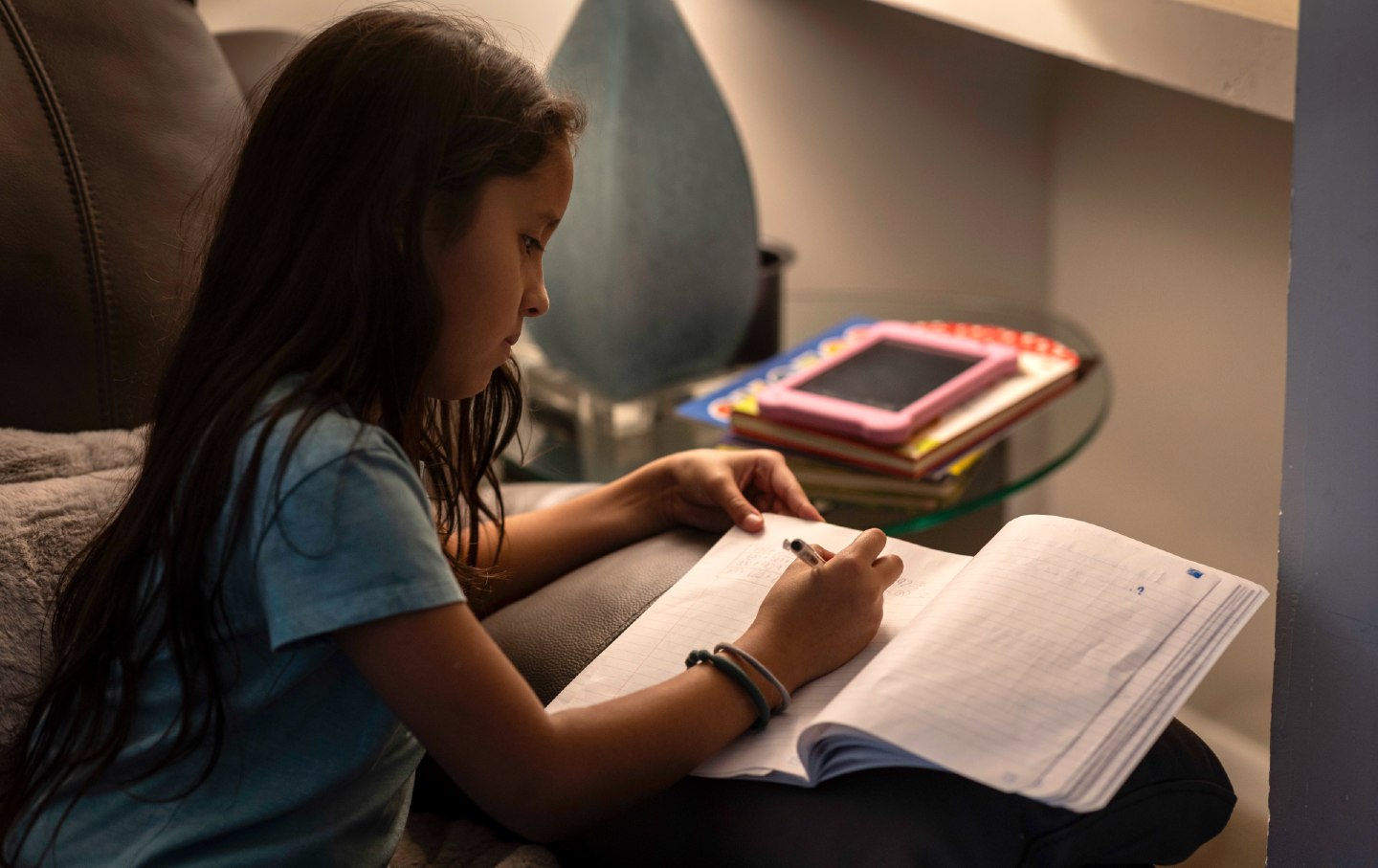
Undocumented third grader Yanela Sanchez practices math at her family’s apartment. Like many of her fellow immigrant students, Yanela stayed home from school the day before due to a nearby Border Patrol operation.
(John Moore / Getty Images)Lina noticed the changes right away when the two sisters returned to school after spending time in a family detention center in San Antonio. “They’re not the same as before they left,” said Lina, a teacher at a mostly Spanish-speaking public school near the southern border in El Paso.
According to Lina, who asked to be identified by her first name only due to privacy concerns, post-detention behavioral changes are not always dramatic. The subtle differences can appear in daily routine, in appetite, in the tempo of a child’s speech. Of the older sister, Lina remarked, “she doesn’t use color as much in her drawings.” Of the other, she observed distress when leftover snacks were thrown away: “She wanted to take extras or whatever was left and she didn’t want me to throw anything away.” Lina is aware that this might seem minor, but not when you are with children every day and know how to gauge when something is very wrong.
Her account comes as family detention has escalated nationwide. Data analyzed by The Marshall Project shows that ICE has detained more than 6,200 children since the start of President Donald Trump’s second term, with the daily number in custody rising to about 10 times the level recorded at the end of the Biden administration.
For school staff, the fallout can take several forms: children returning after detention, students coping with a parent’s deportation, and school communities reshaped by the fear of who might be taken next.
There is a simmering sense of dread at schools coast to coast. Evelyn, an elementary school counselor in Don Ana County, New Mexico, said that when ICE raids intensified, she saw parents afraid to let their children attend classes and worried about what information schools might be forced to hand over to the government.
Indeed, according to a national survey from the Urban Institute, 10 percent of adults from immigrant families have stopped sending their kids to school. In California’s Central Valley, ICE sweeps have coincided with a 22 percent increase in daily student absences, with younger students pulled out at the highest rates. Meanwhile, 63.8 percent of US high school principals reported that “students from immigrant families missed school due to policies or political rhetoric related to immigrants.”
Evelyn, who has seen parents terrified at the prospect of agents descending on campus, recalled one undocumented father telling her, “We are here to make the most of your education, not to get in trouble.” What she heard beneath that utterance was simpler: “we don’t want to be seen.”
The children who are still in school amid this turbulent political environment face myriad stressors. Evelyn has seen undocumented children grow resigned—exhibiting a kind of early withdrawal. They think “I’m not from here, so I’m just giving up. I don’t belong,” she said.
Beyond grappling with fears about their own fates, children must also contend with the deportation of family members. In the first seven months of Trump’s second term, ICE detained parents of more than 11,000 children, all US citizens.
At Evelyn’s school, three siblings were shaken by the deportation of their mother. She witnessed the children respond differently, but the changes were clear. “My sixth grader got in some trouble,” Evelyn said. The middle child became “more reserved, more quiet, more introverted.” The third became more open about her feelings, though Evelyn said she was still processing the situation “in a very difficult way.”
The eldest told Evelyn he wanted to join his mother once she was settled in Juárez, but the younger one believed her mother was simply waiting on documents and would soon return. These misunderstandings, hopes, and partial explanations, Evelyn said, shape how children react at school.
For educators like Lina, “the most important thing is how the students are learning.” With immigration concerns spurring a spike in absenteeism and childhood anxiety, academic performance has, accordingly, suffered. This is especially the case for children who have been in detention centers. “Some miss six months at a time. That’s half a school year,” said Lina. “There’s nothing that teachers can do to make up that gap.”
Joseph, a 10th grade math teacher at a predominantly Hispanic public high school in the Houston area, spotted another academic development: Immigration enforcement has become a dominant way for students to understand politics and government.
“I have kids who can’t tell you what the three branches of government are,” he said. “But, when [immigration-related] stuff happens, they know about it.” Joseph described one student who followed immigration news closely because it saturated both family and work life. “That’s kind of all people talk about,” he said, before adding that, for some students, “the whole government is ICE.”
Popular
“swipe left below to view more authors”Swipe →With educational institutions reeling from President Trump’s unprecedented regime of mass deportation, teachers are left feeling unclear about how to best address their students’ needs. Evelyn said staff at her school began thinking about how to make the environment safer for children and families, even down to whether uniforms from Border Patrol or Customs officials at career-day events might now frighten students. Meanwhile, ICE has been spotted numerous times on K-12 school grounds, so Joseph’s school administrators have held two faculty meetings on protocol should immigration agents come to campus. Students were also briefed.
“The main thing that [the principal] was saying was that it is safer for students to come to school than it is for them not to,” Joseph said. If there were an incident, the principal made it clear that he would call a hold and direct staff not to open the door to the agents.
Other educators have offered support in the form of driving students to class, delivering groceries to their homes, and even offering rent money. But Lina said teachers are often relying on informal communication from parents and other educators rather than clear guidance from school or district administrators. Most teachers have plans, she said, but those plans rarely come from official protocols. “There’s no preparation,” she said, describing a school environment where teachers and staff are left to manage the emotional fallout on their own.
Become a Sustaining Donor This September
Between the reemergence of right-wing red-baiting and Donald Trump’s use of the chilling National Security Presidential Memorandum–7 to criminalize left political organizing, we’re seeing McCarthyism reborn before our eyes.
This assault on democracy cannot be ignored or wished away. Resisting it requires bravery in the face of threats and repression, a steadfast commitment to the truth, and the unwavering belief that we can—and will—overcome this darkness.
We must have an independent media that sets the record straight, unearths corruption and abuses of power, and advances a politics of justice and dignity for all if we’re to win this fight.
That’s why I’m writing to you today. This September, The Nation needs to add 100 monthly donors to sustain our progressive journalism. Your contribution makes the next investigative report, the next truth-speaking column, and the next pathbreaking essay all possible.
I hope you’ll support our work with a recurring donation today. If you donate $10 or more a month, we’ll send you a brand new “Hands Off the Free Press!” sticker to recognise your commitment to our cause. Please, donate today.
Onward,
Katrina vanden Heuvel
Editor and Publisher, The Nation
More from The Nation

Trump Has Made it Legal to Destroy Endangered Species’ Habitats Trump Has Made it Legal to Destroy Endangered Species’ Habitats
By redefining the meaning of “harm” in the Endangered Species Act, the administration is giving big corporations a gift they have long demanded.
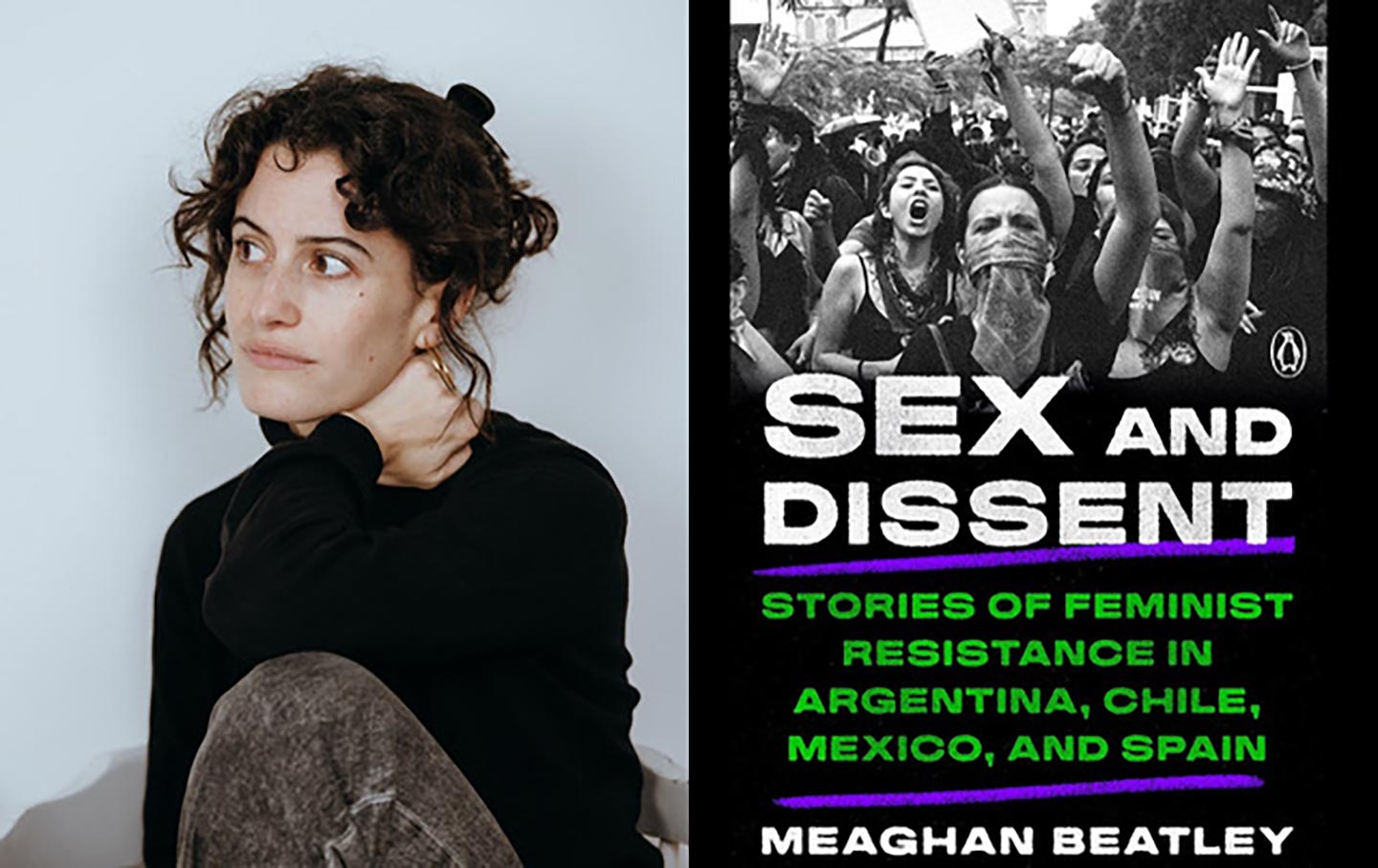
Journalist Meaghan Beatley on Latin America’s Feminist Resistance Journalist Meaghan Beatley on Latin America’s Feminist Resistance
A conversation with the author of Sex and Dissent about what American feminists can learn from the Green Wave movement.
As Cornell’s Rape Case Draws National Attention, Students Want Accountability As Cornell’s Rape Case Draws National Attention, Students Want Accountability
A new lawsuit alleging that a former student was drugged and gang-raped by Chi Phi fraternity members is sparking outrage in the Cornell community.

Irish Goalkeeper Gavin Bazunu’s Refusal to Play Against Israel Puts Him on the Right Side of History Irish Goalkeeper Gavin Bazunu’s Refusal to Play Against Israel Puts Him on the Right Side of History
Bazunu’s decision raises the perennial question: Why is a country that is currently committing a genocide allowed to compete in the first place?
The Promises and Compromises of the University of California The Promises and Compromises of the University of California
I grew up in a neighborhood manufactured by the University of California, Irvine. It felt like a utopia for academics—until the university forsook its mission of serving the publi...

