The Pastor With a Fascist Agenda
Early on, The Nation evinced a prescient skepticism toward Father Coughlin’s populism. Turns out we were right to do so.
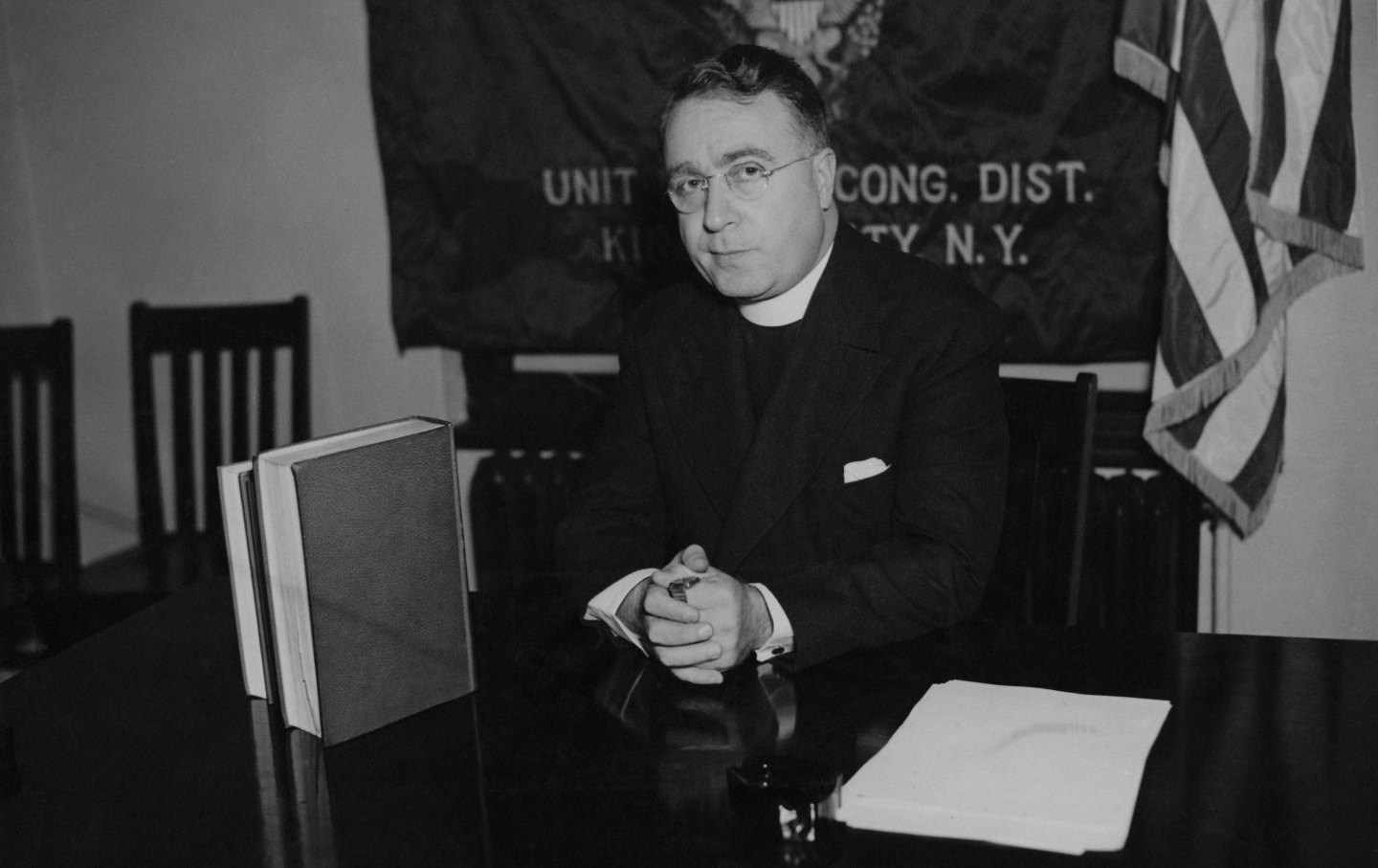
Roman Catholic priest and broadcaster Charles Coughlin (1891 – 1979), circa 1935.
(PFG / Getty Images)
Chris Lehmann writes this month about Tucker Carlson. He quotes an acquaintance calling the podcaster “the Father Coughlin of the twenty-first century”—a peddler of ugly bigotries dressed up as the pseudo-populist vindication of the forgotten man.”
The Nation started sounding the alarm about Coughlin soon after he burst onto the national scene in the early 1930s, denouncing bankers and corporations for preying on ordinary people. An Ontario-born Catholic priest in suburban Detroit, Coughlin began broadcasting his Sunday sermons over the radio and found a massive audience. He initially claimed to support the New Deal, but soon turned against it as insufficiently opposed to high finance.
Early on, The Nation evinced a prescient skepticism toward Coughlin’s populism. In 1934, Raymond Gram Swing published a two-part profile, warning that the pastor’s program, though vague, bore a clear resemblance to fascism. Swing’s portrait calls to mind none other than Carlson: “In type he is an actor, with an advanced sense of stage management. He plays several roles…. Few visitors get to know the real Father Coughlin, perhaps because there is no real Father Coughlin. The reality may be just this succession of parts.”
Columnist Heywood Broun observed in 1936 that Coughlin “has a certain contempt for his own fuzzy followers and sees them as so much fascist fodder…. he is solely a fascist faker using whatever means come to his hand to lend dignity and cover to his effort to achieve literal dictatorship in the United States.”
And then, in 1939, the journalist James Wechsler published “The Coughlin Terror,” which showed how the Coughlin-aligned “Christian Front” organization was behind a sharp rise in anti-Semitic street violence in New York. In response, Coughlin repeatedly attacked “the Bolshevik Nation.” The editors responded: “Well, we are used to verbal rocks from both right and left, but our readers know, even if Coughlin does not, that for nearly seventy-five years The Nation has been not a Bolshevik but a liberal magazine which has fought hard for the civil liberties of all groups without distinction of race or creed.”
American entry into World War II eroded support for Coughlin’s pro-fascist message. In 1942, his Catholic superiors ordered him to give up broadcasting. He continued ministering to his Michigan church until the late 1960s and died in 1979.
In 1965, The Nation reviewed a book about Coughlin. The reviewer, Harvey Bresler, asked whether “some new Coughlin-like mass movement” might rise in the future: “In the eventuality of a prolonged economic collapse like that of the 1930s, almost anything could happen. But that is not likely, today we have too many built-in precautionary mechanisms…. Furthermore, American society is not as polarized as it was thirty years ago.”
Well, today it seems about as polarized as in the 1930s, and those built-in precautionary mechanisms don’t appear to be quite as sturdy as they used to be. Only time will tell how far our own “fascist faker” chooses to take his hateful grift, and what it will take to stop him.
Become a Sustaining Donor This September
Between the reemergence of right-wing red-baiting and Donald Trump’s use of the chilling National Security Presidential Memorandum–7 to criminalize left political organizing, we’re seeing McCarthyism reborn before our eyes.
This assault on democracy cannot be ignored or wished away. Resisting it requires bravery in the face of threats and repression, a steadfast commitment to the truth, and the unwavering belief that we can—and will—overcome this darkness.
We must have an independent media that sets the record straight, unearths corruption and abuses of power, and advances a politics of justice and dignity for all if we’re to win this fight.
That’s why I’m writing to you today. This September, The Nation needs to add 100 monthly donors to sustain our progressive journalism. Your contribution makes the next investigative report, the next truth-speaking column, and the next pathbreaking essay all possible.
I hope you’ll support our work with a recurring donation today. If you donate $10 or more a month, we’ll send you a brand new “Hands Off the Free Press!” sticker to recognise your commitment to our cause. Please, donate today.
Onward,
Katrina vanden Heuvel
Editor and Publisher, The Nation