
Jamie Raskin Just Told John Roberts: “The Emperor Has No Clothes”
In this week’s Elie v. US, The Nation’s justice correspondent hails Raskin’s bold call-out. Plus, a counterintuitive take on the SAVE Act and a controversial video-game lawsuit.
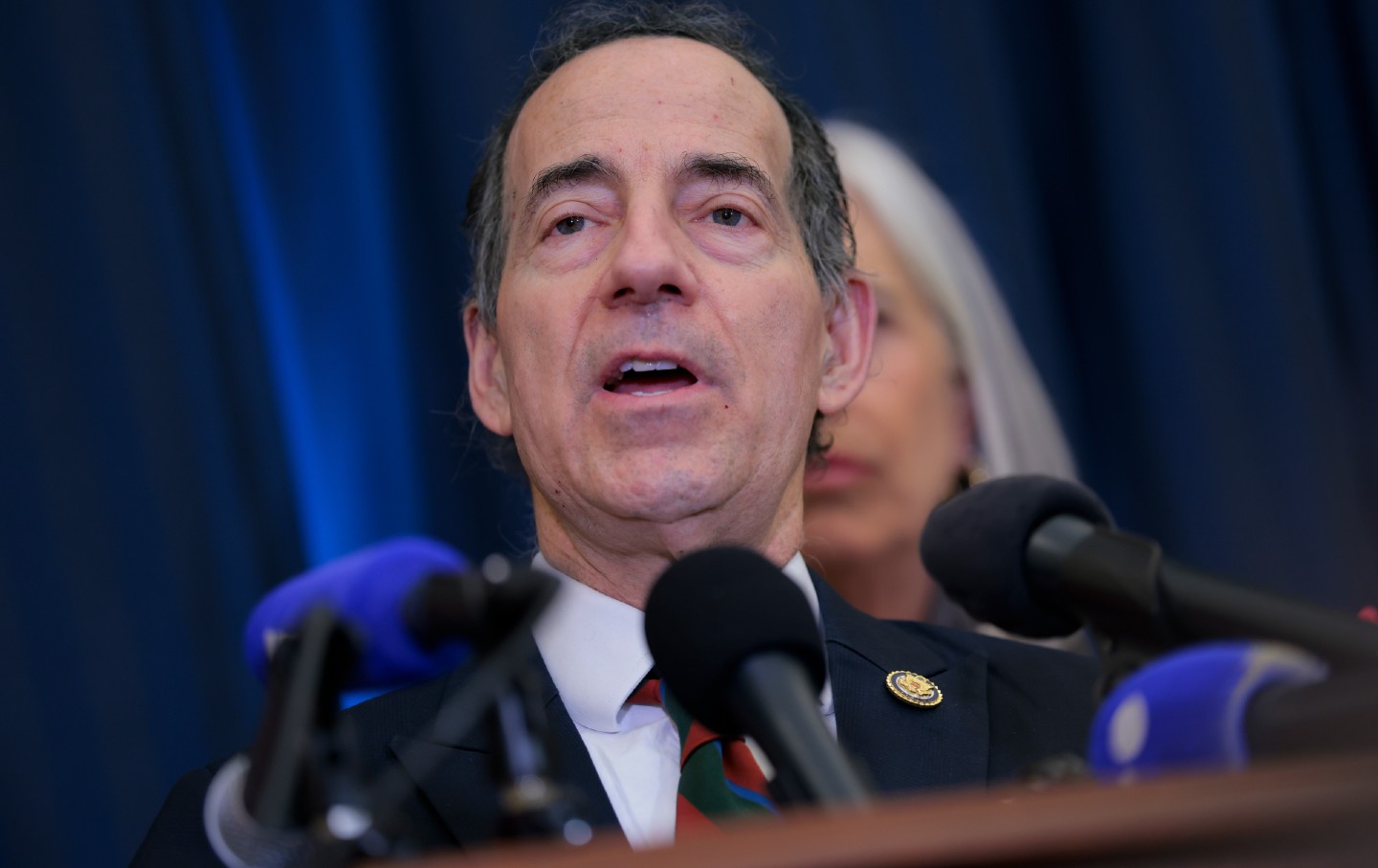
Representative Jamie Raskin (D-MD)
(Heather Diehl / Getty Images)
The Judicial Conference of the United States held one of its semiannual meetings this week. The conference, which is overseen by Chief Justice John Roberts, consists of a 26-member panel of judges who make suggestions on judicial policy. Often, lawmakers and experts are invited to speak to the judges about the pressing issues of the day. Most of the time, the gathering is entirely pointless: It’s a closed door meeting that isn’t even newsworthy enough for reporters to try to get a scoop on what was said inside.
This week’s meeting was a bit different. Representative Jamie Raskin, ranking member of the House Judiciary Committee, lit into the justices, specifically Roberts. And we know this because Raskin made his remarks public. The meeting was focused on the increased threats to the safety of judges, something that, not surprisingly, judges always want to talk about. Raskin acknowledged the threats, and pledged to do everything he could to ensure the safety of the judiciary. But then he broadened his focus to address why judges are seeing more threats of violence. He said:
Those threatening judges, with menacing voicemails, physical violence, doxxing, or by calling for them to be impeached for ruling a particular way, all share an illegitimate ambition: they seek to change the outcome of cases through fear and coercion.
But the rising tide of threats against federal judges reflects a basic and spreading misunderstanding of what judges and Justices do. You are not legislators who are expressing your policy preferences or the policy preferences of your constituents. Nor are you Executive branch officials who are implementing a public policy decision.… We must combat the misconception that judges are political actors as opposed to elucidators of the meaning of the law. This means the Judiciary itself must make sure that the rule of law operates in a way which makes it clear to everyone what law is.
That is a very nice and respectable way of saying that the Supreme Court has gotten out of its lane. Raskin was calling out the justices for acting like legislators or executives and imposing their policy preferences on the rest of us. That is what’s leading to the “misconception that judges are political actors.”
Raskin went on to call out the court’s use of the shadow docket:
The shadow docket’s flight from reason is an affront to the historic role of the judiciary because its fleeting, conclusory statements are typically the final word on the case. Preliminary injunctions, stays and their grant or denial effectively resolve the matter, since by the time a final judgment issues in the lower courts, the controversy will have been resolved in practice by the unexplained and inscrutable shadow docket decision.
Look, no reasonable person wants judges to get death threats. But Raskin just told Roberts that the way to stop this from happening is not by simply gifting the court with enough congressional funding for the justices to have their own private security forces. The way to truly decrease the pressure on the Supreme Court is for the justices to act like they’re members of a court of law, instead of the rulers of America.
I don’t imagine John Roberts will listen or care. But at least someone told him to his face.
The Bad and the Ugly
- In other news about the Supreme Court’s shadow docket, alleged attempted rapist Brett Kavanaugh and Justice Ketanji Brown Jackson got into it during a rare joint appearance at a Washington, DC, lawyers’ event. Kavanaugh argued that the court is turning to the shadow docket more frequently simply because presidents are using executive orders more often—thanks to “gridlock in Congress.” Jackson pushed back, pointing out, correctly, that the reason is that while in the past the court used the shadow docket to maintain the status quo, now the Republicans on the court are using it to enact new policies.
- In decisions that will soon be overturned via the shadow docket, a Portland judge restricted the use of tear gas at an ICE facility located near residential homes.
- A federal judge said that the Pentagon’s press policy, which labels reporters “national security threats” merely for disclosing unclassified information without prior authorization from the Department of War Crimes, violates the First Amendment.
- In his dissent from the tariff decision a few weeks back, Kavanaugh worried about the complicated nightmare of making restitution to all the plaintiffs charged illegal taxes under the Trump regime. It seems Brett just isn’t used to thinking through complicated problems. Looks like we could have a system in place to make repayments within 45 days, no nightmares required.
- I’m not going to pretend to understand the intricacies of Georgia’s 14th Congressional District, the place that inflicted Marjorie Taylor Green on us. I’ll just tell you that the runoff in the special election to replace Green will feature Democrat Shawn Harris against the Trump-backed MAGA plant Clay Fuller. While Trump’s endorsement did indeed seem to help Fuller, Harris did better in the primary than expected. Experts tell me that my plan to sell the Georgia 14th to the Dominican Republic in exchange for Vladimir Guerrero Jr. and a player to be named later is unworkable.
Inspired Takes
Popular
“swipe left below to view more authors”Swipe →- I really liked this piece in The Nation from Maha Hilal about the Trump administration’s performative legality. It does a good job of explaining that while the administration does not act like it is constrained by the law in any way, it often goes out of its way to manipulate and weaponize the law in an attempt to give its actions a veneer of legitimacy.
- The Nation’s Jeet Heer has been all over the illegal war against Iran and its disastrous effects on global stability and the global economy.
Worst Argument of the Week
As usual, this week’s Worst Argument Award goes to Donald Trump. But, this time, I’m happy he’s making it, and I hope he takes it to its logical conclusion. Let me explain.
Trump has a real bee in his hairpiece over the SAVE America Act—the massive voter-suppression law Trump wants passed in order to rig the midterms for the Republican Party. The act would require people to show proof of citizenship to register to vote, and photo ID to cast a ballot. Trump also wants Congress to pass laws banning mail-in voting for everybody except veterans and disabled people.
The bill passed the House but is stalled in the Senate, where it faces a Democrat-led filibuster. Trump wants the Republicans in the Senate to break the filibuster and push the bill through. He has vowed not to sign anything until the SAVE Act is brought to his desk.
It’s a terrible strategy. Senate majority leader John Thune wants to do Trump’s bidding but he doesn’t have the votes in the Senate to kill the filibuster. As Thune put it, “that’s just a function of math.” If Trump sticks to his plan and petulantly refuses to do any further business with his party, which controls Congress, in the months leading up to the congressional midterm elections, it would be an amazing self-own.
I am here for this. It would be great if Trump’s Congress is unable to do any more damage until November (provided, of course, that the Democrats hold together and filibuster the SAVE Act). Alternatively, if the Republicans want to get rid of the filibuster now, so be it. While I believe that the SAVE Act is the most direct legislative threat to the integrity of our elections in decades, the filibuster remains the most long-term threat to the effectiveness of a Democratic government, should Democrats ever be allowed to hold power again.
One option floated by Republicans is to reinstitute a “talking filibuster,” and I love that option as well. A talking filibuster means that no other Senate business can be conducted while a bill is being blocked because the opposing party is literally holding the floor, preventing all other business. Thune says he doesn’t have the votes to do this either, which is a shame. There are 60 executive positions and 40 judicial vacancies awaiting confirmation, and all of those would be stalled during a talking filibuster. I would literally go down to DC and hold a bucket for Democrats to pee into if a talking filibuster would stop the Trump judicial confirmation machine for eight months.
Unfortunately, Trump talks shit all of the time and then doesn’t follow through. Thune has already declared the SAVE Act will be brought to the floor, and he knows that the Republicans will lose that floor battle. The Democrats will filibuster the bill, and that will be that. Trump can stomp around all he wants, but eventually somebody will remind him that Congress still needs to do things and he can’t engage in his own private shutdown for eight months because he’s having a tantrum.
Trump will not shut down the whole country because he wants legislation that will help Republicans rig the election, but, man, I wish he would try.
What I Wrote
I don’t feel like people are paying enough attention to the lawsuit filed by Anthropic, makers of the Claude AI model, against the Department of Defense. Essentially, Secretary of War Crimes Pete Hegseth wants autonomous killing robots now, but Anthropic won’t give them to him, so the Trump administration decided to burn the First Amendment and punish Anthropic for its political views. But it’s not like Anthropic is one of the “good guys.” This fight is really a battle between two entities eager to usher in a dystopian future. I explain it all here.
In News Unrelated to the Current Chaos
New York Attorney General Letitia James is taking a righteous swing against one of the most malign forces in the video-gaming industry: loot boxes.
Loot boxes are an item you can earn while playing certain types of online multiplayer video games; when opened, they generate a random reward. That reward is usually a “skin,” which is a cosmetic item that changes the appearance of your character or gun or gear.
Some games like, say, Fortnite, allow players to buy these cosmetic skins directly from the in-game shop: If you want your character to look like Darth Vader, you can just go buy the Darth Vader skin. But games that work on the loot-box system don’t let you buy the skin outright. Instead, you buy the box (or, usually, you buy the “key” that lets you open the box you won while playing the game) and that box has a chance to have the skin you’re looking for. But the box also has a chance to generate something that you’re not looking for, or something you already have, or something you generally don’t want. Obviously, the chances are higher that the box will spit out a low-value item than a desirable one.
If this all sounds like gambling to you, it absolutely should. A loot box is a slot machine. I’m not saying it’s like a slot machine, I’m saying it’s an actual slot machine in all but name. When you open loot boxes they literally have spinning wheels or a moving line showing you all your possible outcomes, and you watch while it slows and eventually lands on the thing you get, which is exactly the visualization of a slot machine. Players literally talk about buying keys as buying more “pulls” on the thing to get what they want.
And what they want is to make real money. These skins are not valueless cosmetics enjoyed by hardcore fans; in some games, entire economies, usually run by third-party businesspeople tacitly supported by the game makers, have popped up to buy and trade skins. In one game, Counter-Strike 2: Global Offensive (CS:GO), made by the Valve corporation, there’s even a stocks-like speculative market based on the predicted future value of these skins. One CS:GO weapon skin sold for $400,000 a few years ago and is estimated to be worth $1.5 million today. If you pull one of these rare skins, you’ve hit the jackpot. And, of course, every time you sell one of these skins to another player through Valve’s immensely popular storefront, Steam, Valve takes a cut.
Late last month, Tish James sued Valve for supporting this illegal gambling ring through its games, which include CS:GO, Team Fortress 2, and Dota 2. The complaint alleges that Valve is operating slot machines without a license, because opening loot boxes is not a “skill-based” activity but a straight-up game of chance.
This is not the first time somebody has gone after Valve over its loot boxes. Loot boxes are banned altogether in Belgium and the Netherlands, and heavily regulated in China and Japan. But the United States has kind of been the Wild West of loot boxes, with no regulator or politician except (and I hate to say this man’s name in a positive context) Senator Josh Hawley really trying to do anything to stop them.
You might think gamers would generally appreciate James’s effort to rid the industry of this predator practice, but that is not the case. There are a few reasons for that. The first and most obvious one is that gamers are fanboys and the large CS:GO community is worried about know-nothing regulators interfering with their game. On top of that, Valve is an extremely popular company among gamers, myself included. Valve is generally one of the good guys in gaming (loot boxes excepted).
The second problem is that, while the lawsuit focuses on the illegal gambling inherent in the loot-box system, James’s press release about the lawsuit is just full of the same tired bullshit old people always say about video gaming. “[I]t is important to note that Valve’s promotion of games that glorify violence and guns helps fuel the dangerous epidemic of gun violence, particularly among young gamers who can become numbed to grave violence before their brains are fully developed.” No… it is not important to note that Valve “helps fuel the dangerous epidemic of gun violence,” because Valve does not do that. THE PEOPLE SELLING THE REAL GODDAMN GUNS do that, not the video game selling paint jobs for fake guns. My kingdom for a regulator more interested in helping gamers than insulting them.
But the astute gamer will recognize the third big problem with James’s lawsuit: What will Valve do if the state wins? Valve is estimated to earn over a billion dollars from loot boxes in CS:GO alone. It’s not just going to give that revenue stream up.
The most likely answer is that Valve (if it loses after years of litigation) will just… apply for a gambling license. But to get one, it will have to implement an age-verification system, one that greatly restricts access to its games, not just for people under 18 but for people under the age of 21, because that’s what most gambling laws require. Folks, I don’t have to tell you that a lot of 18-to-21-year-olds play video games (to say nothing of the 17-and-under crowd). Moreover, age verification often creates unnecessary and annoying hurdles for people well over 21 (like me), who don’t want to pull out a driver’s license or plop down a credit card every time they want to play a game. And don’t even get me started on the new “AI age-verification” technology I’ve seen, where you have to let the AI take a picture of your face (that it will totally delete, it super double promises) so it can guess your age.
Most gamers hate loot boxes and would like to see them banned. But from the perspective of those same gamers, this is a lawsuit that could fundamentally change and restrict the access to video games—all because some idiots are gambling thousands of dollars on loot boxes no one is actually forcing them to buy.
All I can say is: Watch this space. Because while James absolutely has the law on her side, Valve is a billion-dollar corporation, and it’s going to fight this with everything it has. And many of the victims of Valve’s predatory practices will be defending Valve because the alternative seems worse.
Now if you’ll excuse me, I have to go not play any of these games and instead play one that allows me to buy a new skin directly from its source, as God intended.
***
If you enjoyed this installment of Elie v. U.S., click here to receive the newsletter in your inbox each Friday.
Become a Sustaining Donor This September
Between the reemergence of right-wing red-baiting and Donald Trump’s use of the chilling National Security Presidential Memorandum–7 to criminalize left political organizing, we’re seeing McCarthyism reborn before our eyes.
This assault on democracy cannot be ignored or wished away. Resisting it requires bravery in the face of threats and repression, a steadfast commitment to the truth, and the unwavering belief that we can—and will—overcome this darkness.
We must have an independent media that sets the record straight, unearths corruption and abuses of power, and advances a politics of justice and dignity for all if we’re to win this fight.
That’s why I’m writing to you today. This September, The Nation needs to add 100 monthly donors to sustain our progressive journalism. Your contribution makes the next investigative report, the next truth-speaking column, and the next pathbreaking essay all possible.
I hope you’ll support our work with a recurring donation today. If you donate $10 or more a month, we’ll send you a brand new “Hands Off the Free Press!” sticker to recognise your commitment to our cause. Please, donate today.
Onward,
Katrina vanden Heuvel
Editor and Publisher, The Nation
More from The Nation

The US Had a Choice After 9/11. It Chose Wrong. The US Had a Choice After 9/11. It Chose Wrong.
In this week’s Elie v. U.S., our justice correspondent reflects on September 11. Plus: the stupidity of the "Trump Dividend" and the threat of AI.


Trump Wants Voters to Pretend He’s on the Ballot Trump Wants Voters to Pretend He’s on the Ballot
But Republican midterm candidates are hoping everyone forgets he exists.

Remembrance: 25 Years Since the September 11 Attacks Remembrance: 25 Years Since the September 11 Attacks
On September 11, 2001, coordinated terrorist attacks carried out by the extremist group al-Qaeda killed 2,977 people and injured more than 6,000 others in the United States.

How The Nation Covered 9/11 How "The Nation" Covered 9/11
Our phone lines were down. People were weeping. But we got an issue out the door with morality, justice, and nuance.

James Talarico’s Leap of Faith James Talarico’s Leap of Faith
The Democratic Senate candidate in Texas is reviving a long-neglected tradition of left-leaning American religiosity.

