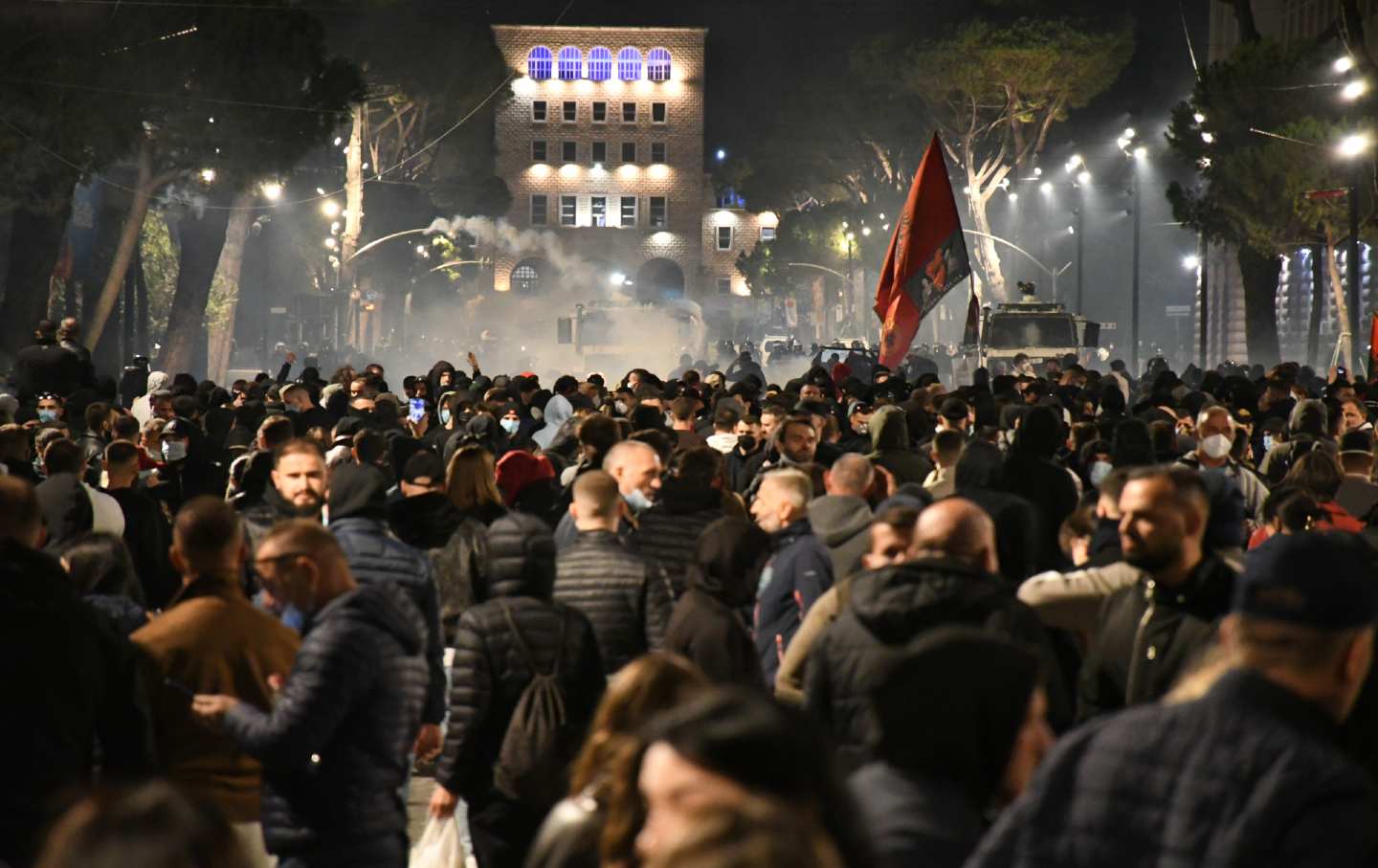
Trump and His Soulless Cronies Have Managed to Suck the Joy Out of the World Cup
Not even soccer is immune from Trump’s reverse Midas touch.
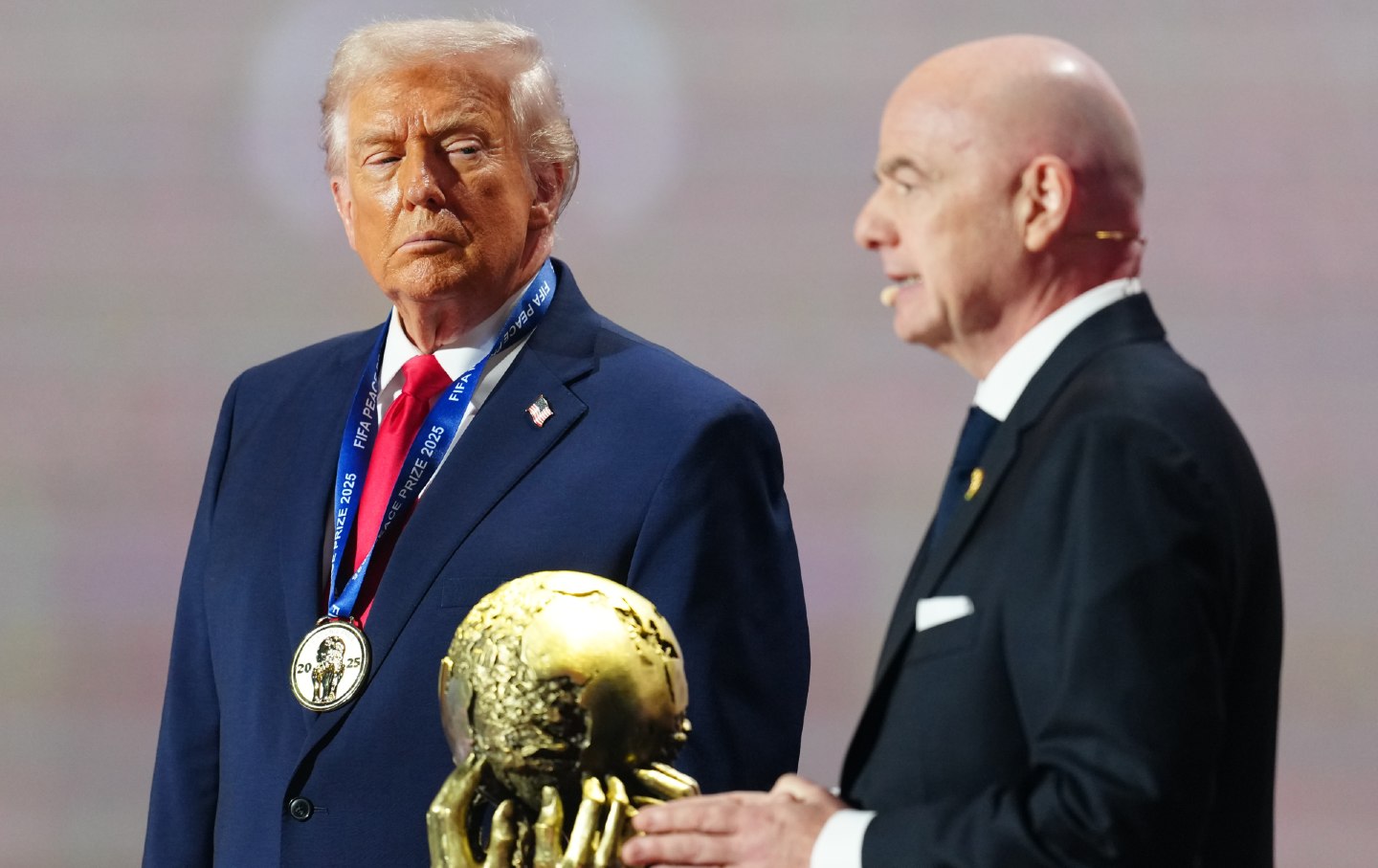
US President Donald Trump receives the FIFA Peace Prize from Gianni Infantino, president of FIFA, during the FIFA World Cup 2026 Official Draw at John F. Kennedy Center for the Performing Arts on December 5, 2025, in Washington, DC.
(Jia Haocheng / Getty Images)I have been a critic of the World Cup for over two decades. Reading books like Andrew Jennings’s Foul!: The Secret World of Fifa: Bribes, Vote Rigging and Ticket Scandals and my own investigative journalism on the ground in South Africa in 2010 and Brazil in 2014 convinced me that soccer’s governing body, FIFA, is not only an utterly corrupt and immoral entity but a supporter of dictators and bulwark against democracy. (Since those days, under the leadership of Gianni Infantino, it has devolved even further into a corroded husk led by authoritarian-worshiping gnomes.)
The three main outcomes for countries hosting the World Cup, as I saw time and again, was debt, displacement, and the militarization of public space. The main differences—whether we were talking about Durban or Rio—were the languages used to dissemble and explain the ensuing corruption scandals. And yet, despite all of this, there was also a fourth component: joy. The people of these countries were generous and enthusiastic hosts. Bars turned into fiestas. Fiestas turned into bacchanalias. And bacchanalias became hyper-focused watch parties, as everyone snapped from revelry to riveted attention on the most popular sport on Earth.
We are now 100 days out until the United States—along with Canada and Mexico—hosts the World Cup. In the US, we are certainly getting the financial chaos, the fears of displacement (which the unhoused people of past host cities can attest to), and the hyper-militarization. Plus, this World Cup could end up being an ICE feeding frenzy on attendees both foreign and domestic. But beyond these issues, it is also the first World Cup in my memory devoid of eager anticipation and joy.
The 2026 World Cup has, so far, been cloaked in a grim haze. First, with the United States and Israel launching a war against the people of Iran, the “FIFA peace prize” that Trump’s pathetic quisling Infantino bestowed on our decrepit president last year has moved from a pathetic suck-up to a horrific irony.
Iran’s soccer team was set to play in two group-stage games in Los Angeles and Seattle for this year’s cup. Now they will almost certainly forfeit their matches. “What is certain is that after this attack, we cannot be expected to look forward to the World Cup with hope,” said Iran’s top soccer official, Mehdi Taj, after the bombings began last weekend. If Iran’s team were forced to withdraw from the tournament, it would become the first in 75 years to do so, willingly or otherwise.
Trump, for his part, scoffed at the thought of Iran’s missing the World Cup. “I really don’t care,” Trump told Politico. “I think Iran is a badly defeated country. They’re running on fumes.”
Then there is ICE. The administration’s murdering shock troops are official parts of the security apparatus for the Cup, raising safety fears for fans. Countries are issuing travel advisories about coming to the United States for the events. International tourism has been hampered, now that enjoying the global game comes with a risk of ending up indefinitely detained in an airport hangar jail or being accidentally placed in a secret prison in El Salvador, which undercuts a key economic argument for hosting the World Cup in the first place. Nevertheless, the administration has refused to rule out that ICE operations will be in full effect. This World Cup could end up being an ICE feeding frenzy on attendees both foreign and domestic.
And of course there are the games scheduled for Mexico, which is currently facing down another surge of drug-related violence following the military assassination of a cartel boss in Jalisco. Guadalajara, Jalisco’s capital, is set to host four matches. Top-flight soccer matches have already been canceled because of the recent spasms of violence. ESPN has veered from its “no-politics rule,” asking if matches are being suspended, “could FIFA World Cup games follow?” While President Claudia Sheinbaum is insisting there is no risk for fans coming to the tournament, people are inevitably going to be cautious—that’s not something she or anyone can guarantee.
But it’s not just the war on Iran or the cartel wars that are disfiguring this year’s World Cup. Usually, host cities hold World Cup “fan fests.” These are ways for people who cannot afford tickets to watch the games on big outdoor screens, hang out with thousands of other soccer lovers, and experience the general vibe. This year, all the US fan fests, which were to be held in six cities, have been slimmed down or outright canceled. Cities aren’t getting the federal funds needed to put them on, which the GOP is blaming on holdups of Homeland Security money. Most notoriously, the New York/New Jersey “fan fests” broke with tradition and sold tickets to what was supposed to be and has always been a free event—only to cancel it outright.
When I think of the “fan fests” in Rio, which were just as fun—sometimes more fun—than the matches themselves, the ticketed-then-canceled New York/New Jersey event looks like an apt symbol for how joyless this country has become under the authoritarian eye of the current regime and how pitiable this World Cup will likely be. Only these people could squeeze every bit of fun out of the Cup.
Still, it’s fitting for a country being ruled by chaos and fear. Not even soccer is immune from Trump’s reverse Midas touch. FIFA is just reaping what it has sown.