
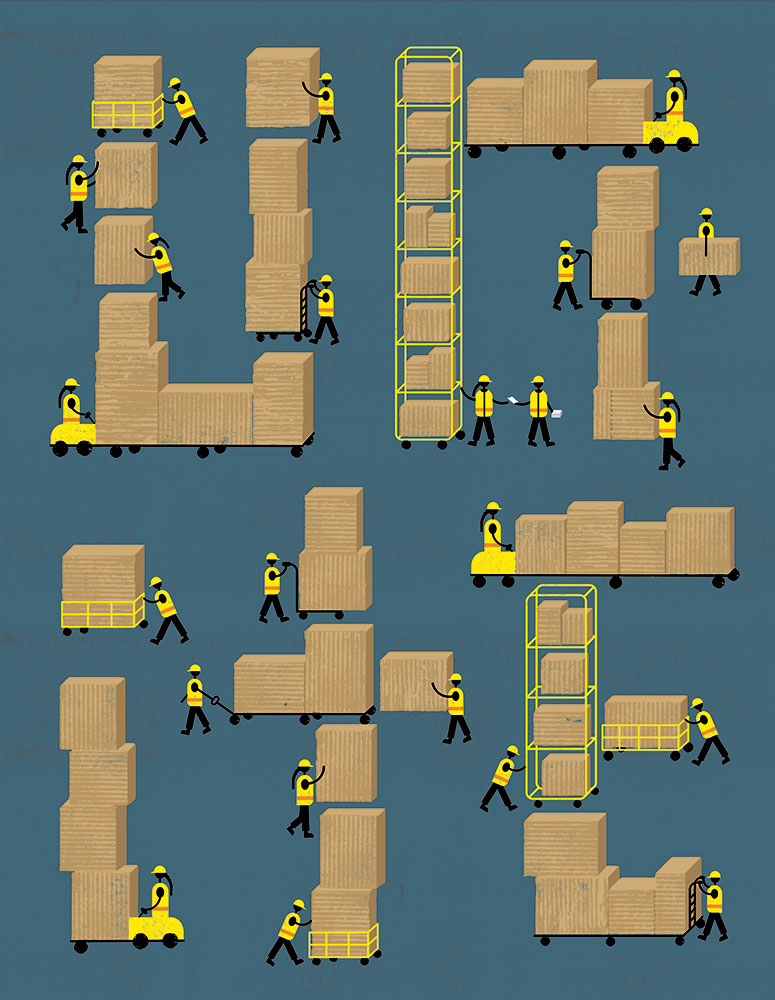
When you apply for a job as an “associate” at an Amazon warehouse, you don’t have to attach a résumé or supply references. All you have to provide is your name and your Social Security number, and the automated hiring system conducts a basic background check within minutes. If you clear that, congratulations—you got the job! Next you’re invited to a “hiring appointment” at a nondescript office building, where you shuffle into a line with dozens of other new hires, surrounded by banners in Amazon’s signature blue emblazoned with the company’s “Leadership Principles”: “Bias for Action,” “Learn and Be Curious,” “Customer Obsession.” You are photographed, drug-tested, and told, verbally, what your start date and schedule will be.
At no point are you asked, “Why do you want to work here?” When I went through these steps in the fall of 2022, my answer would have been “I want to build a union at Amazon.” I was a “salt,” a worker who gets a job in order to organize their workplace. Salting is a long-standing tactic of labor activists who seek to spark organizing from the shop floor. The origins of the term are debated—some say it connotes pouring salt in the wounds of capitalism to aggravate its contradictions. It could also derive from “salting a mine” to extract its valuable minerals (in this case, the collective potential of workers).
I first learned about it the week before my college graduation, over coffee with a classmate who had worked at an Amazon warehouse while taking time off from school during the pandemic. Now she and other organizers with the Democratic Socialists of America (DSA) were trying to recruit motivated individuals to get jobs in nonunion workplaces they saw as vital sites for building working-class power. I didn’t know what I wanted to do when I got out of school, but I couldn’t think of anything more worthwhile than to help build a union at one of the biggest and most powerful employers in the United States.
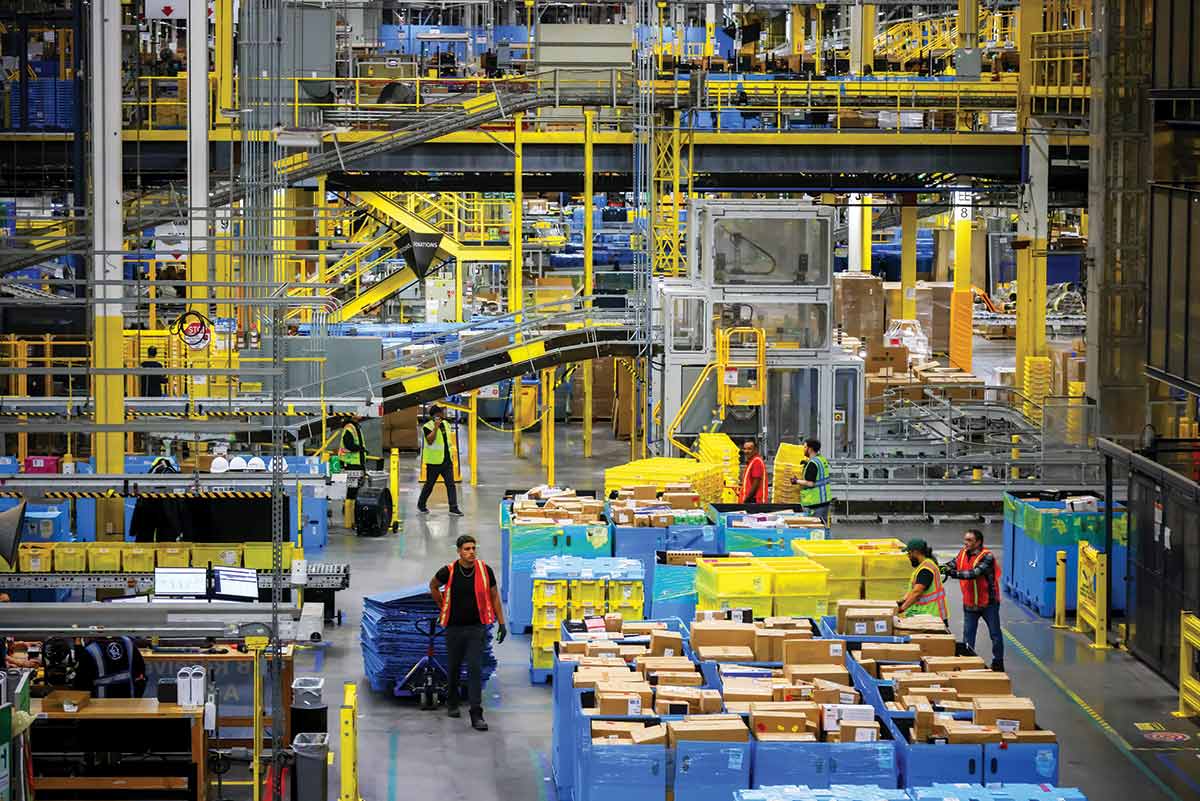
My first shift at Amazon that fall was 1:05 am to 11:50 am, the overnight so-called megacycle that makes one-day shipping possible. I worked at a delivery station, a smaller warehouse that employs around 150 associates (more during the peak periods before Prime Day and Christmas), where we scanned, pushed, and sorted packages according to the individual routes that drivers would take the next morning. In the early months of my time there, my “organizing” involved building relationships with my coworkers through bleary-eyed conversations over the mechanical churn of the conveyor belts or during our 5:15 am lunch breaks. We talked about TV shows, dating, our families. My coworkers ranged in age from their late teens to their 60s, and there was a pretty even gender split. Some were immigrants; most were Black or Latino. They had ended up at Amazon for a number of different reasons. The night shift allowed people to take care of their kids or go to school during the day (sacrificing sleep, of course). The gig-ified way of picking up shifts and transferring between facilities via the employee app gave people flexibility—one of my coworkers liked that he could work at different sites around the country while living out of his van (like a less idealized version of Nomadland).
What we all shared were the hours working alongside one another night after night. We bonded over our frustrations with the workflow, or the company’s clumsy attempts to boost employee morale, like the “Thanksgiving dinner” served at the end of the 12-hour shift (we ate boxed mashed potatoes and wobbly slices of canned cranberry, and the turkey carcass sat in the break-room fridge for weeks afterward). And then there were the manifold—and often absurd—safety hazards. I’ll never forget the soggy package that came rolling menacingly down my lane soaked in canned chili, the streaky red-brown bean mixture clinging to the metal cylinders of the conveyor belt and dripping onto the floor below.
This was my first experience as a labor organizer, though I had spent the fall of 2020 working on Democratic campaigns in Iowa (we lost nearly every race). Unlike electoral work, organizing my coworkers felt satisfying for how direct it was—I wasn’t trying to persuade people to believe in a candidate, but in our own collective power. Between shifts, I would meet with a small cohort of other DSA members who were organizing their own workplaces to discuss how to identify potential leaders among our coworkers and support them through their fears about organizing. We read Secrets of a Successful Organizer, a manual produced by the publisher of the left-wing magazine Labor Notes, and role-played conversations to assess how our coworkers might feel about a petition or a walkout.
I didn’t broach those conversations for months; instead, I focused on learning the mechanics of the job and getting to know my coworkers. Still, knowing I was there to organize changed my approach to work. I pushed myself to be more outgoing than I would normally be, which made work a genuinely social space with people I was excited to see each day. In our DSA cohort, we discussed what it meant to be a good worker, not from the perspective of producing value for the company but in solidarity with our fellow workers. At the warehouse, I tried to keep up a solid pace of work so as not to make things more difficult for the people in front of or behind me on the conveyor belt. Before we had even begun to discuss taking action, I thought about the impact that building solidarity could have on me and my coworkers: not just winning better conditions but transforming the workplace itself.
Of course, I’d have to start with a much simpler task—inviting my coworkers to grab lunch or a coffee or come to a barbecue, where I would push through my fear and ask, “What do you think we could do to make this workplace better?”

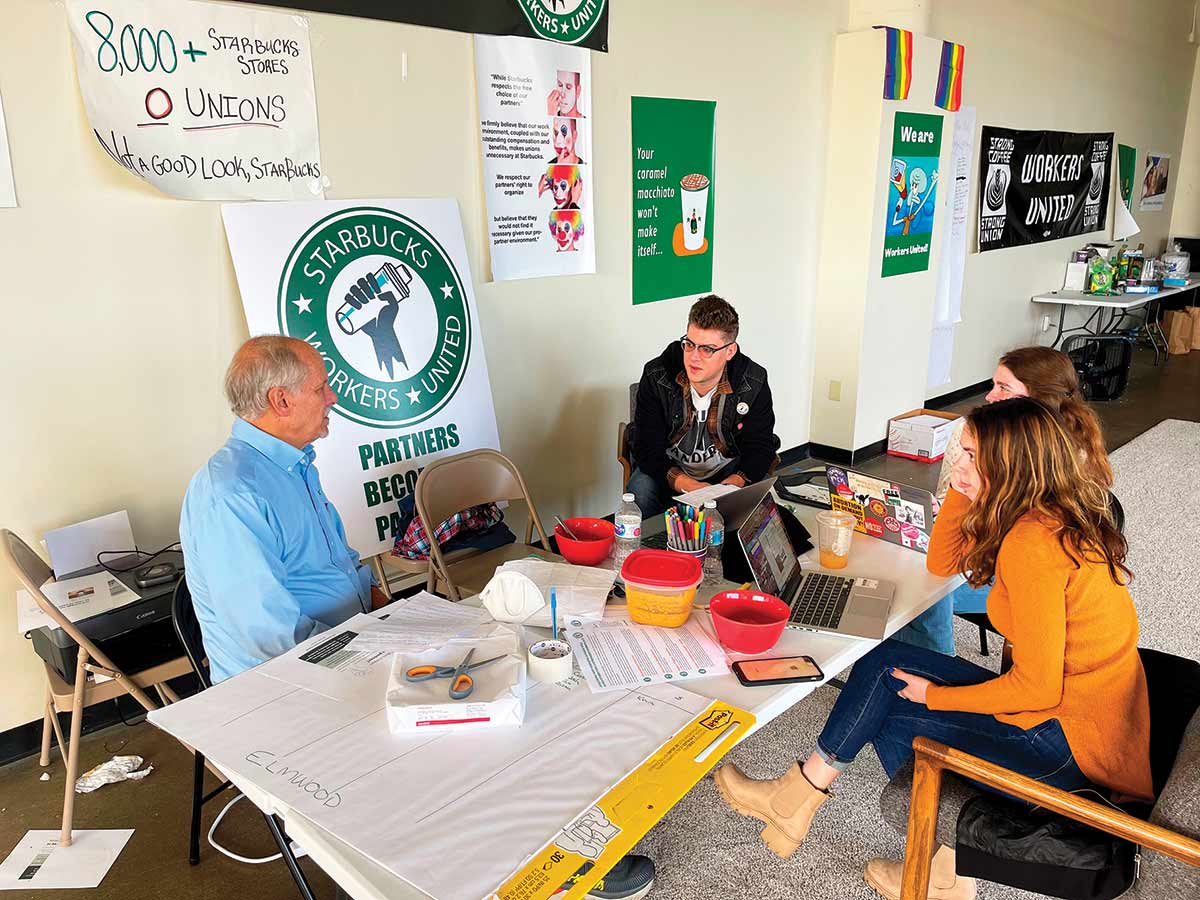
My decision to salt came amid the broader resurgence of a practice long deployed by labor activists in unorganized workplaces, from the upsurge of unionization that produced the Congress of Industrial Organizations (CIO) in the 1930s to the Vietnam-era wave of wildcat strikes. In the past few years, young socialists, disillusioned college graduates, and activated rank-and-file workers have become a sort of reserve army ready to get jobs and organize alongside the millions of nonunion American workers employed in logistics, services, auto manufacturing, and beyond. Salts played a key, but often unseen, role in the successful union drive at Amazon’s JFK8 warehouse in Staten Island and in the spate of organizing victories at Starbucks.
Rand Wilson, a longtime labor organizer who has been evangelizing about salting for years, said he’s seen a renewed interest in the practice after a less active period in the 1990s and early 2000s. “People didn’t see the labor movement as a viable response to corporate greed and inequality,” he told me. But now, young people coming of age in the era defined by Bernie Sanders’s—and, more recently, Zohran Mamdani’s—class politics see their workplaces as a crucial frontier in the fight for a better future. The resurgence in salting comes at a time when a historically low proportion of US workers are represented by unions—just 11.2 percent in 2025. The economic and political headwinds that threaten worker power, from automation to corporate consolidation to gig work, also make organizing for fair wages and safe conditions more critical than ever. “Employers are getting really good at keeping people very atomized—tons of people who don’t know any of their coworkers,” Wilson said. “It’s that special bond with your coworkers that is so critical to having a union.”
Activists dedicated to reinvigorating the labor movement believe the stakes are too high to rely on salts finding their way into the movement like I did—through word of mouth—and filtering into ad hoc organizing projects. In recent years, unions, leftist groups, and workers’ assemblies have begun to build more formal pipelines to recruit, train, and place salts in strategic workplaces. The Inside Organizer School (IOS), based in upstate New York, produced the salts who sparked the unionization movement at Starbucks. And in the past couple of years, projects like DSA’s Workers Organizing Workers (WOW) and the Rank and File Program at the Southern Workers Assembly (SWA) were formed to recruit salts from their respective networks of socialists and unionists.
Recruiting and supporting salts has always required a delicate balance between secrecy (to avoid tipping off employers) and accessibility (to find the activists willing to commit their working lives to organizing). “The reason why salting projects haven’t until recently taken the form of WOW or Inside Organizer School is that there was an assumption that you had to keep things really hush-hush, because you didn’t want companies to know you were salting them,” said Eric Blanc, a professor of labor studies at Rutgers University who serves on the WOW organizing committee. “There’s been a shift in thinking, because the reality is the companies that are facing organizing drives are already generally on watch.” Groups like WOW, the SWA, and the IOS can play an important role as clearinghouses to connect activists to existing organizing projects that may not yet be public.
Salts can provide kindling for a unionization fight, but their goal is to make themselves replaceable by developing their coworkers’ organizing abilities. “Your job is to build relationships with people who are in the workplace and help them realize the leadership qualities and the courage to take on the fight that they already have,” said Jaz Brisack, a former Starbucks salt who now leads the IOS. Advocates see salting as necessary to counter the boss’s propaganda, which insists that workers can’t and shouldn’t ask for more. “Without a union, workers have zero say, zero voice, zero control,” Brisack said. “And we’re conditioned to just accept that that’s the way it is. Salting can help people question what we’ve been conditioned to believe.”
While they may not have always used the term salting, radical workers (socialists, in particular) who got jobs in order to organize their workplaces have long driven the US labor movement into new sectors of the economy. Organizers from the Industrial Workers of the World (IWW) embedded themselves in factories and sweatshops for years, culminating in the 1934 general strike of Teamsters, autoworkers, and others. “There was still a huge number of radical workers in those workplaces, some of whom just happened to be working there, but a lot of them more or less consciously got jobs in particularly strategic places,” Blanc said. “It was not purely spontaneous and leaderless in the way that people assume it was.” One notable early salt was Powers Hapgood (yes, that was his real name), a wealthy Harvard graduate who went on to organize coalfields with the United Mine Workers. In the 1970s, Rand Wilson asked the legendary union leader Tony Mazzocchi how he could get involved in the labor movement. “Get a fuckin’ job,” Mazzocchi answered. And so Wilson did, at a precious-metals refinery in what he called a “disgusting hell hole in Waterville, Connecticut,” that was a strategic target for the Oil, Chemical, and Atomic Workers union. Wilson was part of a generation of militant union organizers at auto plants, ports, coal mines, and more. “Salting is what changed me,” he recalled. “That transformed my life—my experience building the union, uniting workers, teasing out class consciousness from my coworkers, and trying to be a spark.”
The DSA is now working to extend the lineage of socialists building the labor movement in the United States. In 2023, it launched WOW to recruit members and anyone else interested in getting a job to organize in strategic industries. Before WOW formalized the community of DSA salts that I joined in 2022, “it just felt like so many people were slipping through the cracks,” said Shayna Elliot, a co-chair of the DSA’s National Labor Commission. “We wanted to make it a one-stop for people who might want to join the labor movement in this way.” Up to 400 people have gone through WOW’s series of Zoom workshops (nearly 200 attended the most recent session in September alone). “Our biggest source of salts…is young people who are feeling disillusioned about professional-class jobs that are so much less reliable than they once were,” Elliot said. She estimated that the program has placed dozens of salts in strategic jobs. “Anybody can do it,” Wilson told me. “You just have to have the fire in the belly.”
Noah learned about salting as a volunteer for Bernie Sanders’s 2020 campaign on his college campus. (The names of some of the salts in this article have been changed to protect their identities and organizing projects.) After Sanders dropped out of the race, organizers from the campaign encouraged Noah and other students to get jobs at an Amazon warehouse and start salting that summer. “Bernie was trying to fight for the working class, but the working class didn’t have a movement strong enough to win,” Noah said about his decision. “So we needed to build that working-class movement if we wanted someone like Bernie to succeed in the future.”
Noah spent four years at Amazon, starting in the warehouse and later becoming a driver when the inverted sleeping schedule required by his overnight shift became too taxing. He found delivering packages to be less monotonous than working on the conveyor belt. “I would often go out to this little park on the water and take my break there,” he said. “Which was a lot different from the little picnic table in the parking lot at the warehouse where I would sit and look at the moon.” Finding work he actually enjoyed was critical to keeping Noah in the movement for the long haul. “If you’re going to be effective as a salt, or as a rank-and-file organizer in general, it takes a long-term commitment,” he said. “And you can’t commit to a job long-term if you hate every time you have to wake up and go to the job.”
Salts sometimes feel anxiety about how much to disclose to coworkers about their reasons for getting the job. Noah wouldn’t advertise that he came to Amazon to organize, but he found that coworkers who became leaders in their campaign were receptive when he revealed the tactic. “It’s not that crazy of a concept to someone who’s thinking on a serious level strategically about ‘How do we do this?’” he said. And once salts have been working somewhere for a while, the divide between them and other worker organizers becomes less important. “Especially because we weren’t paid [for our organizing efforts],” Noah told me. “We’re literally just people who did this on our own—I wasn’t sent there by anyone.”
David-Desyrée Sherwood got a job at Amazon’s JFK8 warehouse two months after the workers there—including at least six salts—won their union drive, the first ever at the company in the United States. When he became involved with the union, Sherwood didn’t see a major distinction between himself as a worker organizer and the salts who got a job in order to organize. “We’re all working-class people,” he said. “Whether or not you come in with the intention to organize, we’re in this together.”
When Noah and the other drivers at his warehouse unionized with the Teamsters and marched on their bosses to demand recognition, it was “the most satisfying day of my life,” he recalled. “[The managers] ran—they literally ran. They scattered.” Their warehouse was one of nine Amazon sites to go on strike over the holiday season in 2024, and it was during the organizing for the strike that Noah realized that their campaign had become a truly collective effort. “So many people stepped up to even make that happen,” he said. “As a salt, you’re always putting in a ton of effort, but then when you start to see other rank-and-file workers step up and match you, it gives you so much more energy.” Workers showed up early every day on icy winter mornings to talk to their coworkers outside the warehouse, and they helped run the picket line and manage the egress of vans. “At this point, it’s bigger than me,” Noah said. “If I was to leave, I would be leaving behind a bunch of people that I recruited.”
Italked to Luke when he had just gotten off a 10-hour shift at an electric-vehicle-manufacturing plant in the South. When he and his fellow workers are required to stay for one or two hours of overtime, he asks them, “Do you think that’s fair?” As a salt, Luke sees his role as “blowing on those embers of solidarity,” he said.
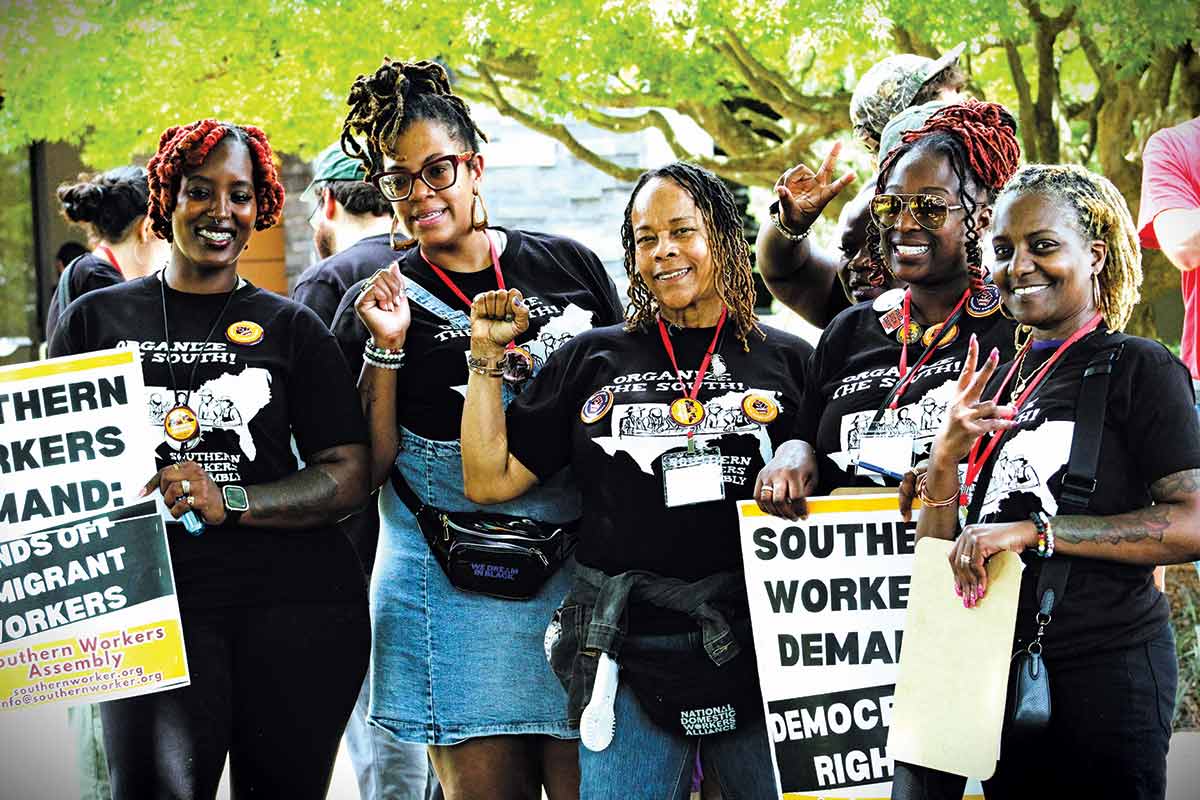
Luke had no labor-organizing experience before he learned from fellow leftists about the Southern Workers Assembly’s network of worker leaders committed to building strong rank-and-file-led unions in the region. With new EV plants cropping up rapidly across the South, SWA workers want to make sure they’re getting their share of the profits. “We were hearing from a lot of workers and other people that were around [the SWA’s local chapters], and there was a lot of interest in salting and trying to do that in an organized way,” said Ben Carroll, the organizing coordinator for the SWA. In early 2024, the group started its Rank and File Program to recruit and train people like Luke who wanted to get jobs and organize. Over the past two years, around 80 people have attended the SWA’s weekend-long training sessions, finding them through local workers’ assemblies, friends and family who are union members, and even online ads.
The SWA’s training weekends begin with a history of how heavy manufacturing has shaped economic development and worker power in the region. Since the 1980s, foreign-owned auto companies have built their US plants primarily in the South, where they can exploit right-to-work laws, low wages, and low union density. Autoworkers in Southern states are paid less than their counterparts in other regions, with vehicle-parts workers in Texas making a cost-of-living-adjusted median wage of $38,349, compared with $51,681 in Michigan. The Biden administration’s incentives for the EV industry and American manufacturing have brought $79 billion in investments and more than 75,000 jobs to the so-called Battery Belt in states like Tennessee, North Carolina, South Carolina, and Georgia. The massive capital investment required to build an auto plant theoretically makes companies reluctant to shut down a facility in the face of a successful unionization drive, giving workers leverage. After years of corrupt, conservative leadership in the United Auto Workers, union president Shawn Fain has announced bold new organizing projects, especially in the South. In 2024, the UAW committed $40 million to organize auto and battery plants like the recently unionized Volkswagen hub in Chattanooga, Tennessee, where workers won a 20 percent wage increase in their first tentative agreement.
Many salts haven’t worked in manufacturing before, but in SWA trainings, they learn how to craft their résumés and prep for interviews, just as they might for any other job. Have you ever been in a high-stress situation? You can talk about that. Do you play any instruments? Highlight your manual dexterity. In an ironic twist, foreign-owned auto manufacturers have traditionally preferred applicants without manufacturing experience in order to keep the UAW out. Carroll doesn’t think the auto companies are aware of potential salts, but even if they are, it’s illegal for an employer to refuse to hire an applicant because they want to unionize.
Alex had been interested in the idea of salting for a while when he attended one of the SWA’s recruitment weekends, but he was nervous to go into a workplace on his own. He had been involved in other forms of left activism, but he’d begun to feel that turning people out for protests wasn’t a direct enough way to address the issues facing working people. “Being involved in the SWA seemed like a way to focus on that baseline point of struggle that everyone’s going to engage with every day”—their workplace—“whether they want to or not.” Alex now works in a section of an EV plant that opened just a couple of months before he was hired, and there are still glitches in the workflow. Robots play a beep-boop version of Eddy Grant’s “Electric Avenue” as they roll around the warehouse delivering parts, but they break down a lot, which gives Alex time to talk to his coworkers.
There’s a debate among SWA organizers about whether to use the term salting at all because it implies a short-term project. This cohort of organizers sees itself more in the tradition of the early radicals in the steel and auto industries who embedded in factories for years. Alex plans to stick around long enough to build a fighting union that helps transform conditions in the whole industry. “How can we [make] this a job that I can actually hold on to for several decades and retire from?” he said. “This could be my life. This could be a good future for me and my coworkers if we fight for it and win it.”
Perhaps the most well-known salt is Jaz Brisack, who helped kick off the historic wave of unionization at Starbucks from their store in Buffalo, New York. “The way that we were able to build a really large organizing committee across many stores before the company knew what was going on probably would have been impossible without salts,” Brisack said. Though there were only 10 salts working at stores in the Buffalo area, Howard Schultz, then the CEO of Starbucks, tried to paint the entire campaign as an astroturfed effort by outside agitators. But after the initial wave of stores organized, the campaign rapidly expanded across the country, with people getting jobs to organize independent of the original salting effort. “The lines are really blurry between ‘Are they a salt, or are they a pro-union worker?’” Brisack said. “And I think they should be blurry.”
Today, Brisack co-leads the Inside Organizer School with another former Starbucks salt, Casey Moore. The IOS uses the term inside organizer rather than salt because it wants its workshops to serve both people getting jobs with the goal of organizing and people already at a given workplace. As Brisack explained it, “Inside organizing basically means you’re organizing your own workplace instead of organizing from the outside,” as generally happens in campaigns led by union staffers. Brisack and Moore were both trained in early iterations of the IOS in upstate New York supported by organizers from the Amalgamated Transit Union, Workers United, and the hospitality union Unite Here, which has a long history of deploying salts in its organizing. The IOS’s three-day in-person training retreats have now expanded nationwide and cover a range of organizing topics in depth, from how to inoculate coworkers against management retaliation to facilitating organizing-committee meetings. The IOS estimates that since its founding in 2018, more than 1,000 people have gone through the program. “Me and all the other Starbucks salts were trained in this model and practiced this model,” Moore said. “So it can work. We just need to be doing it more and committing more resources.”
Leo was salting before he’d ever heard the term. He’s tried to organize at nearly every job he’s had, from a now-shuttered Brooklyn ice cream factory to an also-shuttered Manhattan café chain. Last year, he helped to unionize his Starbucks location in Soho, but it too was shut down in the wave of store closures in late 2025. “I have a djinn haunting me,” he joked.
The ice cream factory was “the worst job I ever had,” Leo told me. The managers were aggressive and the freezers lacked proper safety mats, so workers would often slip. He reached his breaking point one night when an ice cream machine malfunctioned, spewing sugary sludge while the managers were off the floor in some eternal meeting. “I was like, ‘I’ll walk out right now,’” he recalled telling his coworkers. “‘I’ll do it if you do it.’” He couldn’t persuade them to walk off the job that night, but he started thinking about what collective action might look like. Before he could get serious about organizing, though, he was fired for attendance issues.
At the café, Leo tried to launch a petition after management enabled tipping and reduced hourly wages, telling workers they were now technically tipped employees. He took shifts at different locations to meet as many coworkers as possible, keeping track of people’s attitudes toward organizing on his phone. He noted how many workers were on each shift, and how many would need to walk off to shut down a store for the day. But then Covid hit and everyone was laid off. Still, he was hooked from that first swing at organizing. “It wasn’t that hard,” he realized. “I like to talk to my coworkers.”
When Leo got the job at Starbucks a few years later, he hit the ground running. In the years since Brisack and Moore organized their stores, Starbucks Workers United hasn’t actively recruited salts. But the phenomenon of the autonomous, independent salt has continued, with workers like Leo and another barista at his store, Maya, taking it upon themselves to get jobs and organize. Maya had been involved in college with YDSA, the youth section of the Democratic Socialists of America, and was looking for a way to get shop-floor organizing experience before starting nursing school.
Maya and Leo planned bowling nights and escape rooms and even asked a coworker to sign a union card at a casino. In June 2024, they won their union election 18–1. When management refused to address the persistent flooding that coated the store’s basement in raw sewage, the newly unionized workers walked out on five different occasions. The company shut down Leo and Maya’s store a little over a year later, but it was the union that pushed Starbucks to follow New York City’s Fair Workweek Law, giving workers the opportunity to get their jobs back at other locations and winning a $38 million settlement.
Leo didn’t return to Starbucks, but he’s already trying to organize at his new job. He still feels conflicted over whether he considers himself a salt, and he bristles at the notion of young college graduates seeing it as a short-term stint. “Other people are going to work at Amazon until their body breaks,” he said. Leo believes in the tactic “100 percent”; he just wants people to take the commitment seriously. “At some point, the people that we have in these left-wing organizations, they need to merge with the great majority of people who live in America, and the only way to do that is actually by being there,” he said. “You have to be in that warehouse all the time. That’s your life, the same way it’s the life of millions of people.”
Lately, the bleakness of our political moment can’t help but seep into the day-to-day at Luke’s EV plant. Workers were outraged when federal immigration agents raided Hyundai’s EV plant near Savannah, Georgia, in September 2025 and detained nearly 500 people. Some have family members who lost their food stamps during the government shutdown a month later. A phrase that Luke often repeats could apply to the broader political landscape as much as to the plant’s workplace dynamics: “This is a dictatorship, not a democracy.” Coworkers have started saying it back to him.
When I left Amazon after a year, worn down by the overnight shift, I hoped that the sense of solidarity we had built through meetings outside of work would stay with my coworkers. “I’ve seen this fight transform people who were previously apolitical or didn’t care about unions. I’ve seen them become very dedicated and passionate political activists,” Noah said.
A sentiment that was expressed to me over and over again by the salts I spoke with was that organizing their workplaces was their best shot at building a better world. It was, they sensed, the only real lever they had to do so. “I’ve given up—I’ve given up multiple times, and I’ve tried to find other work. And I just always end up recommitting,” Noah told me. “Because I didn’t just want any job. I wanted a job where I could make a difference. And I never found something better than this.”
Become a Sustaining Donor This September
Between the reemergence of right-wing red-baiting and Donald Trump’s use of the chilling National Security Presidential Memorandum–7 to criminalize left political organizing, we’re seeing McCarthyism reborn before our eyes.
This assault on democracy cannot be ignored or wished away. Resisting it requires bravery in the face of threats and repression, a steadfast commitment to the truth, and the unwavering belief that we can—and will—overcome this darkness.
We must have an independent media that sets the record straight, unearths corruption and abuses of power, and advances a politics of justice and dignity for all if we’re to win this fight.
That’s why I’m writing to you today. This September, The Nation needs to add 100 monthly donors to sustain our progressive journalism. Your contribution makes the next investigative report, the next truth-speaking column, and the next pathbreaking essay all possible.
I hope you’ll support our work with a recurring donation today. If you donate $10 or more a month, we’ll send you a brand new “Hands Off the Free Press!” sticker to recognise your commitment to our cause. Please, donate today.
Onward,
Katrina vanden Heuvel
Editor and Publisher, The Nation
More from The Nation

How Trump’s Crackdown on Speech Has Damaged the Student Press How Trump’s Crackdown on Speech Has Damaged the Student Press
I serve as editor in chief and president of The Stanford Daily. Our newsroom has keenly felt the effects of Trump’s campus crackdown, which is why we sued the federal government.

Nationalize Spotify Nationalize Spotify
Music streaming platforms have way too much control over musicians and music lovers. It’s time to rein them in.

What’s the Matter With Effective Altruism? What’s the Matter With Effective Altruism?
President Trump has decried the techbro creed for indulging in AI doomerism, but its excesses are far worse than that.

As Morale Sags, More Military Service Members Are Having a Crisis of Conscience As Morale Sags, More Military Service Members Are Having a Crisis of Conscience
According to multiple GI rights organizations, service members are inquiring in unprecedented numbers about seeking conscientious objector status.
What Remains of Riis? What Remains of Riis?
A new members’ club has revived Riis Park’s long-vacant bathhouse, reopening old questions about whom the People’s Beach is really for.

When Texas Sex Ed Falls Short, Gen Z Women Turn to Social Media When Texas Sex Ed Falls Short, Gen Z Women Turn to Social Media
A 2025 study found that 70 percent of adolescents sought reproductive health information through social media platforms.

