
Trading Places
The fictitious capital of HBO’s Industry
The Fictitious Capital of HBO’s Industry
In the show’s fourth season, everyone has a story to sell and very few are true.
Courtesy of HBO.
(Simon Ridgway)
In the fourth season of Industry, everyone has a story to sell: a neutered fund or loveless marriage, shamed husbands, a life aimless after retirement, a payment-processing firm hampered by its ties to porn and sex work. These labels seem to indicate mistaken priorities or misplaced trust. But they are just narratives to be refined or redefined. Everything is up for grabs if you tell the right story. The right story can justify anything: Lies, fraud, financial malfeasance, corporate espionage, and distraction are all just different ways of telling your story. If your story is good enough, the truth will eventually catch up—or at least that’s what Industry’s characters believe.
Old narratives, like the older seasons of this show, are just fodder for the new. Industry, which remains in the hands of its creators, Mickey Down and Konrad Kay, was once about young, ambitious university graduates out of their depth in a bustling bank at the center of London’s financial markets. These days, Industry is about seasoned and cynical operators. Gone are the frenetic trading floors; now our heroes operate in lavish hotels and palatial dining rooms. The buzz of ringing phones, shouted prices, and moving trend lines on tick charts has given way to one-on-one conflict. The show’s main characters are no longer neophytes; they can move markets with a well-placed word.
If the early seasons of Industry were about those who get chewed up on the ground floor by the voracious beast that is international finance, this season concerns the maximalist mythmaking of market movers. Full of visually striking settings—town houses with intricate wallpapers and plush armchairs, magnificent country estates—the show depicts a set of people desperate to write themselves into the leading roles they think they deserve. Even Nathan Micay’s pulsing electronic score is now overshadowed by an incredible volume of needle drops. Industry is no longer HBO’s neglected stepchild.
In a clear indication that this season will expand the show’s palate, the first episode begins with two characters we’ve never seen before. A journalist and a corporate assistant are circling each other in a nightclub. The journalist is investigating a rising fintech company called Tender that’s seeking to become a full-fledged bank—even a “bank-killer,” in the words of its CFO. The corporate assistant, although seemingly exploited, is central to Tender’s nefarious methods for bending people to its will. In this story about the carrot and the stick, the assistant is a stick dressed in orange.
At the center of Tender is another newcomer to the series, Whitney Halberstram (played by Max Minghella), the hollow core around whom much of this season orbits. Ethnically ambiguous, of allegedly ignoble origins, and with an unplaceable American accent, Whitney seems unflappable and always operates from a position of power. Relentless in his attempts to manipulate, first through flattery, then through advice or legal counsel, and finally through blackmail, he plays Industry’s characters much like he does the financial markets. He knows what to promise, how to distract, and the right lie to tell about his upbringing; he crafts narratives intended to mold the world to his aims. When his business partner cautions him against his ambitions for Tender, saying, “That’s not our story,” Whitney writes him out of the story altogether.
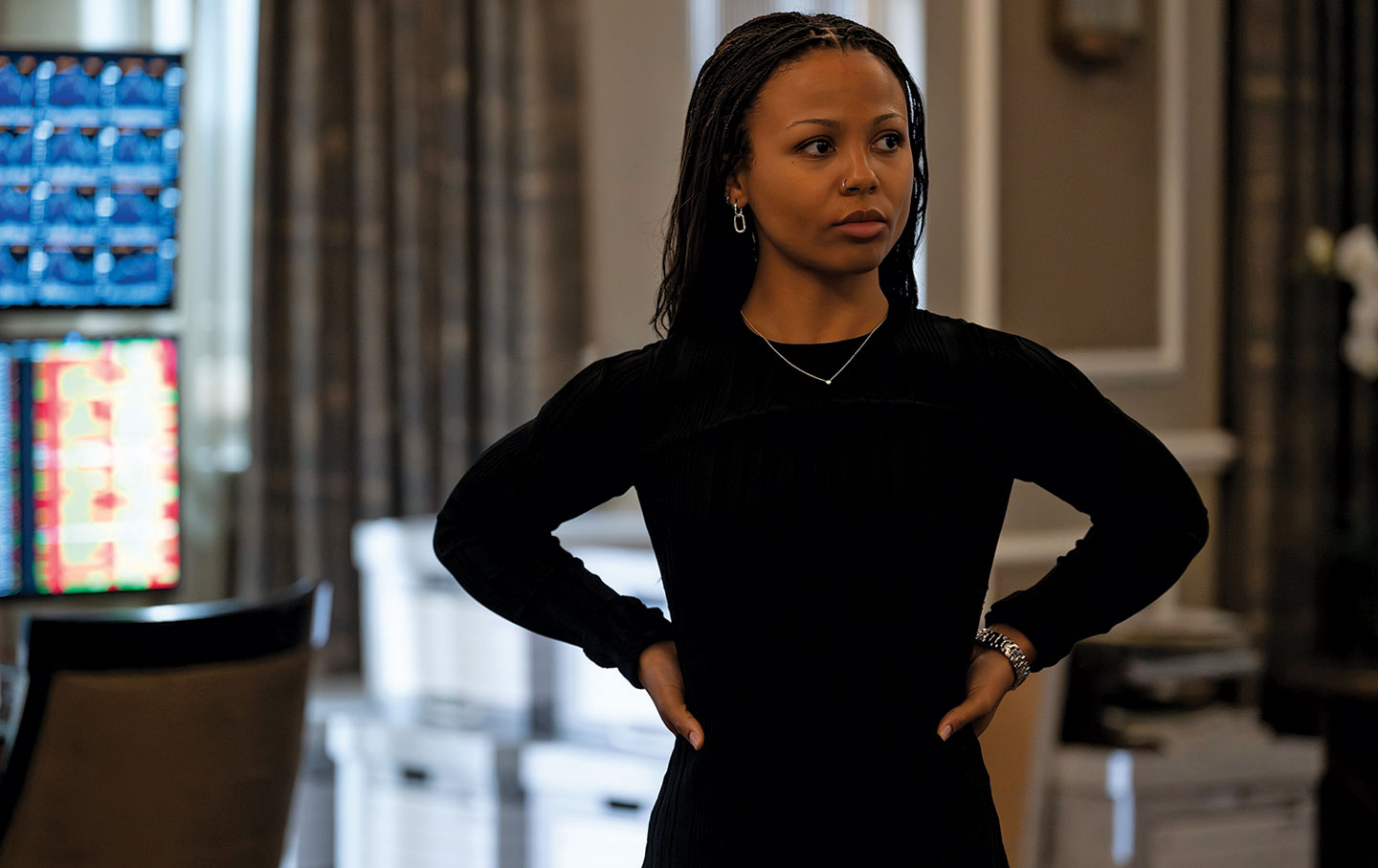
Yet even as these CEOs and CFOs wrestle with each other, the emotional heart of the series lies in two women who started as grads at the investment bank of Pierpoint & Co. in Industry’s first season: Harper (Myha’la), an American college dropout who reinvents herself in London through sheer gumption, even if her drive and unscrupulousness get her in trouble as often as they rake in millions; and Yasmin (Marisa Abela), a child of privilege who can speak more than half a dozen languages and relies on her family’s wealth and connections—at least until her father’s transgressions destroy her own stability. Harper and Yasmin are the real rivals in the show, the mythological figures pushing and pulling each other down: They are sometimes confidants, sometimes frenemies, but ultimately each sees the other as the only person in the world who understands her.
To wage their mortal struggle, Harper teams up with her old mentor, Eric (Ken Leung), and starts a new fund that pursues only short-selling strategies, meaning that she is invested in undermining a particular stock’s story, and the company she sets her sights on is Whitney’s. Because Harper sees herself in Whitney, she recognizes Tender for the fraud it is—and by taking such an extreme and unpopular opinion, becomes the righteous underdog, justifying any means to expose the company (and make boatloads of money in the process). Yasmin, meanwhile, has pursued a strategic marriage with the depressed aristocrat Henry Muck (Kit Harington). She manipulates the narrative around Henry to push him back on the path to success—albeit only on her terms—and gets him appointed as Tender’s CEO. A sad princeling desperate for redemption, Henry proves to be the perfect puppet for Yasmin’s schemes—until he starts to believe that he doesn’t really need her.
It is telling that both Yasmin and Harper trace their craving for success to their love-starved childhoods. Yasmin wants to be necessary in a world in which everything is bought, sold, or traded; Harper seeks to prove herself at any cost. Their ambition won’t ever heal the wound that love was supposed to fill. (Sex is everywhere in this show, but like money, it has little to do with love. Even the saddest men in Industry are desperate to buy a new story, one in which a girl happily calls them “Daddy.”) While Yasmin and Harper don’t exactly want each other’s love, their entanglements with Tender eventually bring them together. Their stories finally intersect when their interests do.
When you can no longer rely on the stability of the past, you have to write a new future. But it is easier to unmake an old story than it is to wrangle a new one into shape.
Harper and her team are harsh critics, pointing out the plot holes in Tender’s and in Henry’s and Whitney’s narratives. Yet as the narratives that the characters continuously parrot fall apart, the show itself follows Tender’s arc, expanding to cover up a hollow center. The story is a mystery with a sleight of hand at its source. But Industry makes this hollowness the point. And the way Harper, Yasmin, and Henry react to the unraveling story and Whitney’s efforts to overwrite their suspicions is what propels the latter half of the season.
If not properly supported, though, a plot that revolves around an empty center can cave in on itself. Whitney remains inscrutable, a collection of obfuscations and fabulations. Perhaps we should see him as the profit motive personified, but he is so central to this season’s events that his unknowability becomes a hindrance. Conspiracies are introduced that amount to nothing; everything hinges on grand speeches, characters whisper and scream, and the landscape is rearranged around a new starting point. Though all of this may pay dividends in future seasons, the show’s cynicism can be so encompassing that it feels like a safety net.
Industry is about a world in which companies aren’t valued for their current earnings but rather for their promise, their ability to disrupt the old way of doing things and the profits they might make… someday. And a good business plan is a compelling story. Industry’s own story structure, then, may have its own delayed profits. Its showrunners Down and Kay have turned the series into a reinvention scheme, which means what you see is not always what you will get next season. But it still feels like a bet worth taking.
Support independent journalism that does not fall in line
Even before February 28, the reasons for Donald Trump’s imploding approval rating were abundantly clear: untrammeled corruption and personal enrichment to the tune of billions of dollars during an affordability crisis, a foreign policy guided only by his own derelict sense of morality, and the deployment of a murderous campaign of occupation, detention, and deportation on American streets.
Now an undeclared, unauthorized, unpopular, and unconstitutional war of aggression against Iran has spread like wildfire through the region and into Europe. A new “forever war”—with an ever-increasing likelihood of American troops on the ground—may very well be upon us.
As we’ve seen over and over, this administration uses lies, misdirection, and attempts to flood the zone to justify its abuses of power at home and abroad. Just as Trump, Marco Rubio, and Pete Hegseth offer erratic and contradictory rationales for the attacks on Iran, the administration is also spreading the lie that the upcoming midterm elections are under threat from noncitizens on voter rolls. When these lies go unchecked, they become the basis for further authoritarian encroachment and war.
In these dark times, independent journalism is uniquely able to uncover the falsehoods that threaten our republic—and civilians around the world—and shine a bright light on the truth.
The Nation’s experienced team of writers, editors, and fact-checkers understands the scale of what we’re up against and the urgency with which we have to act. That’s why we’re publishing critical reporting and analysis of the war on Iran, ICE violence at home, new forms of voter suppression emerging in the courts, and much more.
But this journalism is possible only with your support.
This March, The Nation needs to raise $50,000 to ensure that we have the resources for reporting and analysis that sets the record straight and empowers people of conscience to organize. Will you donate today?
More from The Nation
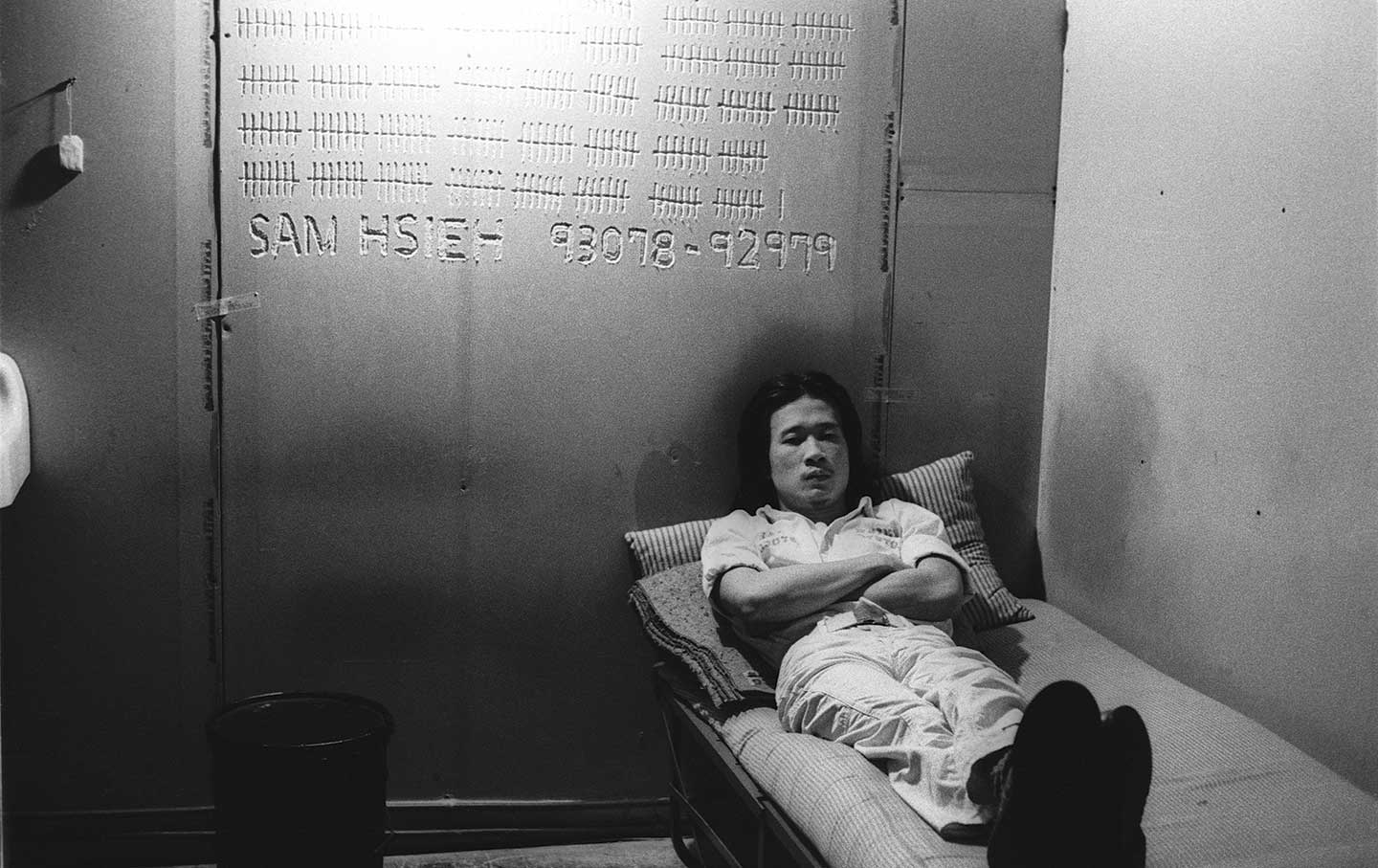
Tehching Hsieh—an “Artist Without Art” Tehching Hsieh—an “Artist Without Art”
In his performances, he questioned whether or not an artwork needed to supply a specific meaning in order to generate a feeling.
George Packer’s Liberal Imagination George Packer’s Liberal Imagination
What happens when liberalism’s crisis is made into a fable?
The Greatest Love Is Grieving The Greatest Love Is Grieving
I spent years as a labor organizer. Marguerite Duras’s war novel taught me that the strongest fighters are always the women hurting the most.

