Speaking Out on the Insanity of Nuclear Weapons
At a time when nuclear dangers are not just rising, but multiplying, we need all hands on deck in sounding the alarm and advocating for abolition of nuclear weapons.
Near the end of his life, Robert McNamara wrote an essay for Foreign Policy, titled “Apocalypse Soon.” In it, the controversial former US Secretary of Defense and president of the World Bank argued that we “must move promptly toward elimination—or near elimination—of nuclear weapons.”
McNamara is known for his moderating role during the Cuban missile crisis, which might have saved us from the end of the world. In “Apocalypse Soon,” he writes about this experience and how it shaped his own views on nuclear weapons. But hardly is McNamara alone in examining his role in national security in his final years and concluding that he needed to speak out about nuclear weapons.
Others with long-time service at the highest levels of government have sounded the alarm. In 2007, former Republican secretaries of state Henry Kissinger and George Schultz, former Democratic secretary of defense William Perry, and former Democratic senator from Georgia Sam Nunn wrote an op-ed in The Wall Street Journal, titled “A World Free of Nuclear Weapons.”
Today, of the “four horsemen of the apocalypse,” Bill Perry and Sam Nunn are still alive. Nunn was involved in cofounding and leading the Nuclear Threat Initiative, while Perry, at nearly 100 years old, has his own William J. Perry Project, dedicated to “working to end the nuclear threat.” In 2014, in an interview with three Columbia University students, Perry shared that he was afraid we were already in a new nuclear arms race. More than 10 years later and with the seeming expiration of New START, the last remaining arms control treaty between the United States and Russia, we may be in an entirely new phase of this new race.
What is desperately needed is people currently in office coming to the same inescapable conclusion that these statemen had reached, while they can do something about it. It is quite shocking that of 100 senators, only Ed Markey has publicly urged the Trump administration to accept the offer of the Russian President Vladimir Putin to extend New START for another year. Markey, a veteran of nuclear policy, has championed many arms control causes during his time in Congress. But even Markey has yet to firmly stand behind nuclear abolition, by, for instance, endorsing the Treaty on the Prohibition of Nuclear Weapons. He shouldn’t wait until he too is out of office and nearing the end of his life. Many in Congress look up to him when it comes to nuclear issues, and his actions have the potential to be transformative.
The last three presidents have spoken about nuclear weapons in sobering terms. President Obama gave a speech in Prague, in which he stated, “So today, I state clearly and with conviction America’s commitment to seek the peace and security of a world without nuclear weapons.” That declaration helped him win the Nobel Peace Prize.
Although Obama wisely negotiated New START, he also went along with the plans to modernize the US nuclear arsenal at the unimaginable price tag now approaching $2 trillion. President Trump has spoken about the need to “denuclearize,” making the argument that nuclear weapons cost too much and that they could destroy the world over and over again. And yet he has gone on to violate international law on repeated occasions and has so far refused to extend New START, potentially setting the arms race ablaze. In 2021, we had otherwise hawkish Joe Biden to rescue us from the Treaty’s expiration, but it remains unclear whether we can be saved this time. Without an extension of New START or a replacement agreement, we would likely witness a dramatic and terrifyingly dangerous growth in the nuclear arsenals of Russia and the US, the two nuclear superpowers that possess some 87 percent of the world’s approximately 12,500 nuclear warheads.
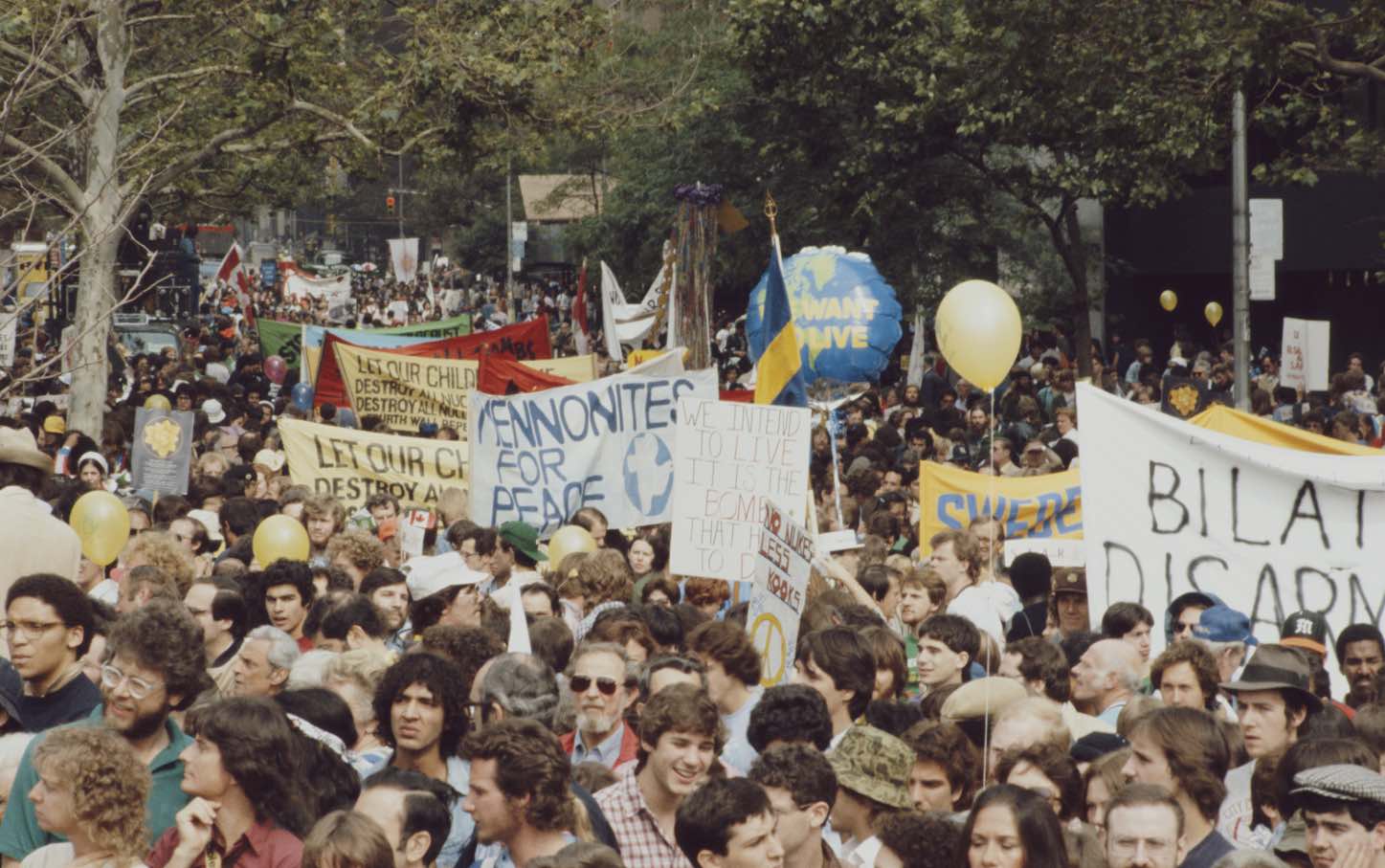
And it’s not just former or current officials who need to talk about this problem. Those with large platforms could play a huge role. Imagine if Michele Obama talked less about fashion and more about peace, if Taylor Swift devoted a tiny fraction of her time to ensuring that her millions of fans won’t all die in a nuclear war, and if professional athletes embraced this as a political cause, the way they had embraced political causes in decades past. In 1982, celebrities were right there with a million ordinary Americans gathering in Central Park, calling out the insanity of nuclear weapons. Senator Ed Markey was there, too. And young Mikhail Gorbachev watched from a distance. The US public opinion had a profound impact on the late Soviet leader.
One group bears a special responsibility in sounding the nuclear alarm, and that is the scientists themselves. Although the scientists who originally brought nuclear weapons into the world are long gone, many of them did their share of trying to eliminate their own creation, including Joseph Rotblatt, who was the architect of the Russell-Einstein Manifesto and a winner of the Nobel Peace Prize, alongside the Pugwash Conferences on Science and World Affairs, an organization he founded. Carl Sagan devoted a good part of his last two decades speaking for peace and disarmament, and explaining the impact that nuclear war would have on the entire planet through nuclear winter. We still have some celebrity scientists, like Neil de Grasse Tyson. They need to get involved, too!
A week ago, the Bulletin of the Atomic Scientists, an organization started by the likes of Einstein and Oppenheimer, unveiled its Doomsday Clock, according to which, it is 85 seconds to midnight, the closest we have ever been to human destruction of the planet. We need all hands on deck. Let’s not leave this task only to those thinking about the world as they prepare to make their exit.