
Nurses Dig In Against New York’s Hospital Giants
As nearly 15,000 nurses’ strike, New York’s biggest hospital systems are trying to roll back hard-won staffing rules and health benefits—even as executive pay soars.
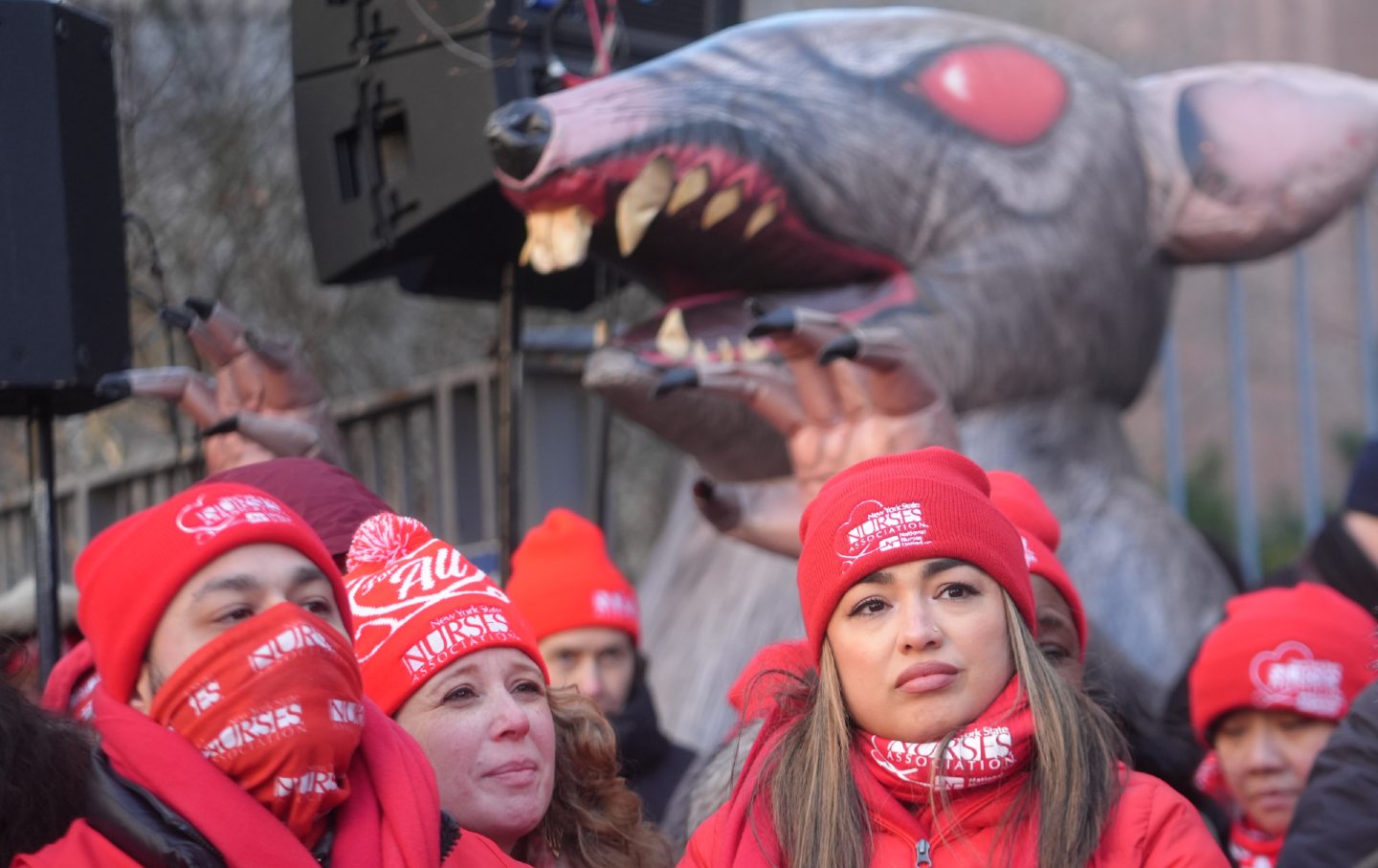
Striking nurses listen to New York City Mayor Zohran Mamdani and Vermont Senator Bernie Sanders on the picket line at Mount Sinai West on January 20, 2026, in New York City.
(Selcuk Acar / Anadolu via Getty Images)Nearly 15,000 nurses are in their second week of the largest nurses’ strike in New York City history, demanding that three of the city’s biggest hospitals preserve healthcare benefits, safe staffing ratios, and workplace safety protections.
Nurses represented by the New York State Nurses Association (NYSNA), a union representing more than 42,000 nurses statewide, walked out in protest on January 12 after delivering notices to the hospitals under the Mount Sinai, Montefiore Medical Center, and NewYork-Presbyterian/Columbia University Irving Medical Center systems.
The nurses in NYSNA who work at these hospitals have been without a contract since December 31, after their demands were not met during negotiations that began in September 2025. The nurses say hospitals have stonewalled bargaining on key issues like healthcare benefits and safer staffing ratios.
Even on Thursday, after 11 days of the strike, the two sides remained far apart in talks. The strike comes as President Donald Trump’s “Big Beautiful Bill” threatens major cuts to Medicaid and federal healthcare funding to New York.
Divya Viswanathan, a 27-year-old registered nurse who works in the infant cardiac ICU of NewYork-Presbyterian’s Morgan Stanley Children’s Hospital, outlined the nurses’ demands. “We are asking for fair pay, safe staffing ratios, safety from workplace violence and coverage from our insurance,” Viswanathan said. “We’ve been negotiating for months before going to strike.”
Emma Cano, 27, who also works at NewYork-Presbyterian Hospital in the pediatric medical surgical floor, said they are showing up at the picket line asking for safe staffing ratios, mandating specific ratios of registered nurses to patients such as have been written into laws in states like California. Cano handles up to four patients (including transplant patients) during her shift on her floor, but says it should ideally be three or fewer. She said, “It takes a really big emotional toll to be able to show up for that patient when you have three, four other patients who also really need you.”
Nurses at the two other hospitals—Mount Sinai and Montefiore—went on strike for three days in 2023 and negotiated a contract with enforceable staffing ratios. The contract allowed independent arbitrators to award financial penalties when hospitals violate the staffing ratios. In nine separate rulings in 2024, arbitrators found that Mount Sinai violated those ratios and awarded nurses approximately $4.7 million in financial penalties, NYSNA said.
“Hospitals want to roll back the staffing enforcement mechanisms we won in our strike three years ago,” an NYSNA official said. “They also do not want to hire more nurses or improve staffing standards in units that are chronically understaffed.”
Healthcare benefits are another central issue in the negotiations, nurses say. In all three hospitals, nurses currently have their health insurance premiums covered, but hospitals now want nurses to start covering the costs themselves. Cano said, “We would need to pay for it out of pocket as hospitals are proposing not to pay for it anymore.”
NYSNA officials said approximately 44,000 people—nurses and their families at the three hospitals enrolled in the union’s health benefit plan—could be affected by healthcare cuts.
The Nation asked all three hospitals to respond to questions about staffing proposals and healthcare benefits. A spokesperson for NewYork-Presbyterian said it has “proposed maintaining our nurses’ current employer-funded benefits.” The hospital also said the union’s overall contract demands are unrealistic given “drastic federal cuts to Medicaid and ACA marketplaces.” Mount Sinai said in a statement that there have been no discussions about cutting or discontinuing health care benefits and accused the union of “mischaracterizing” negotiations.
NYSNA officials disputed both hospitals’ claims, stating that NewYork-Presbyterian and Mount Sinai are threatening to discontinue or drastically cut nurses’ health benefits and have rejected the union’s proposals to continue current coverage.
A Montefiore spokesperson said healthcare is “not on the negotiating table.” In a December memo, the hospital’s chief nurse executive told nurses “your existing healthcare coverage will stay exactly as it is.” Montefiore provides free health insurance with no premiums or deductibles.
However, the hospital has restricted striking nurses’ access to its pharmacy, preventing them from picking up prescription medications since the strike started. NYSNA filed an unfair labor practice charge over the issue.
Popular
“swipe left below to view more authors”Swipe →Nurses are also demanding better workplace safety protections. They want behavioral response teams that include psychiatric nurses and social workers to de-escalate violent situations. Mount Sinai had an active shooter incident in November, and NewYork-Presbyterian Brooklyn Methodist Hospital experienced a violent incident shortly before the strike began.
A statement from NYSNA said that hospital executives have increased their own compensation significantly while threatening nurses’ benefits. CEO total compensation at the three hospitals rose more than 54 percent from 2020 to 2023, based on 990 tax filings. In 2024 alone, NewYork-Presbyterian CEO Steve Corwin received $26.3 million in total compensation while Montefiore CEO Dr. Philip Ozuah received around $16.3 million in compensation.
NYSNA officials also estimate that, based on an average nurse workload, Mount Sinai is spending at least $10 million a week to pay the 1,400 travel nurses they reportedly hired before the strike began. According to Bloomberg News, the hospitals have collectively spent over $100 million on temporary travel nurses to maintain operations during the strike, paying some replacement workers more than $9,000 per week.
New York Mayor Zohran Mamdani, who visited the picket line on Tuesday, criticized the disparity. “These executives are not having difficulty making ends meet,” Mamdani said. “But too many nurses can’t make ends meet.”
Nurses also received support from other unions at the picket line, including firefighters, the Central Labor Council, 1199 SEIU (which represents healthcare workers), PSC-CUNY (which represents City University of New York faculty and staff), and the New York Taxi Workers Alliance. On Tuesday, taxi drivers drove by the picket line honking their cars in support of the striking nurses.
Gustavo Ajche, a leader with Los Deliveristas Unidos, a delivery workers group, said he sees the nurses’ fight as connected to his own. “We see them as fellow workers asking for fair wages,” Ajche said. “It is the nurses who do the work in hospitals, and we see it no different to the painstaking work delivery workers do for little wages. We wholeheartedly support the nurses strike,” he said.
NYSNA president Nancy Hagans said the strike’s impact extends beyond New York. “Nurses throughout the country are facing many of the same issues that striking New York City nurses are fighting back against—chronic understaffing that puts our patients at risk, rising workplace violence, and greedy employers who are willing to cut corners on nurse and patient safety,” Hagans said. “When nurses unite and fight, we win.”
Become a Sustaining Donor This September
Between the reemergence of right-wing red-baiting and Donald Trump’s use of the chilling National Security Presidential Memorandum–7 to criminalize left political organizing, we’re seeing McCarthyism reborn before our eyes.
This assault on democracy cannot be ignored or wished away. Resisting it requires bravery in the face of threats and repression, a steadfast commitment to the truth, and the unwavering belief that we can—and will—overcome this darkness.
We must have an independent media that sets the record straight, unearths corruption and abuses of power, and advances a politics of justice and dignity for all if we’re to win this fight.
That’s why I’m writing to you today. This September, The Nation needs to add 100 monthly donors to sustain our progressive journalism. Your contribution makes the next investigative report, the next truth-speaking column, and the next pathbreaking essay all possible.
I hope you’ll support our work with a recurring donation today. If you donate $10 or more a month, we’ll send you a brand new “Hands Off the Free Press!” sticker to recognise your commitment to our cause. Please, donate today.
Onward,
Katrina vanden Heuvel
Editor and Publisher, The Nation
More from The Nation

The UAW Wave Has Hit Our Shores The UAW Wave Has Hit Our Shores
The union’s endorsements of insurgent candidates led to big wins this summer. It’s all part of a strategy to remake American politics for the working class.
The Making of the Millennial Working Class The Making of the Millennial Working Class
A new book follows a rising generation of labor organizers as they attempt to unionize their workplaces.
Dolly Parton Was a Proud Union Sister Dolly Parton Was a Proud Union Sister
Organized labor is celebrating the life and legacy of an artist who championed working women and carried a union card for almost 60 years.
Adjuncting Until the End of Time Adjuncting Until the End of Time
Universities now have more adjuncts than tenured and tenure-track professors combined. The conditions are unsustainable—for professors and students alike.

The Dignifying Solution to America’s Care Crisis The Dignifying Solution to America’s Care Crisis
Employee ownership turns care work jobs into good jobs—and leads to better patient outcomes.

Mamdani’s Team Redefined Political Video. Now They’re Betting on Short Films. Mamdani’s Team Redefined Political Video. Now They’re Betting on Short Films.
Premiering exclusively in The Nation, a new short film produced by City Hall and narrated by Morgan Spector highlights the efforts of the biggest tenant-led union in New York City...

