December 11, 2025

The UK’s Climate National Emergency Briefing Should Be a Wake-Up Call to Everyone

The briefing was a rare coordinated effort to make sure the media reflects the science: Humanity’s planetary house is on fire, but we have the tools to put that fire out.
Mark Hertsgaard

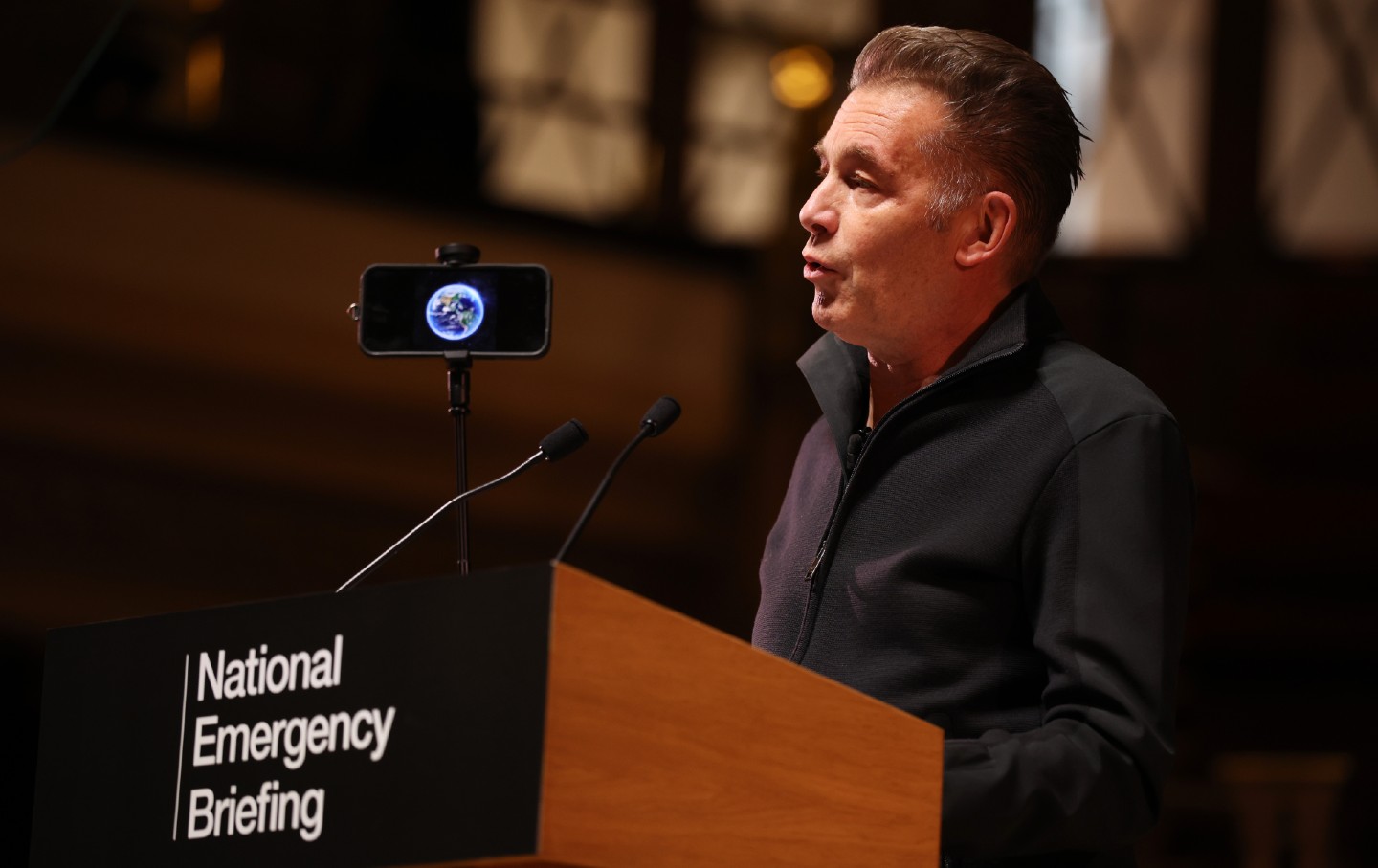
Chris Packham addresses the audience at a National Emergency Briefing on the climate and nature crisis, at Central Hall Westminster on November 27, 2025, in London, England.


(Dan Kitwood / Getty Images)

“You must listen to the science.” Chris Packham, the veteran presenter of BBC nature shows, was imploring an audience at London’s Westminster, a stone’s throw from the Houses of Parliament, to face facts. An invitation-only crowd of about a thousand people, including more than 100 members of Parliament, news executives, celebrities, and civil society leaders sat before him, joined by a live-streaming audience. Held November 27, the gathering was billed as a National Emergency Briefing.

“You must listen to the science,” Packham repeated. “Because if you don’t, then things go wrong, and lives are lost.” Quoting from a recent investigation of the UK government’s handling of the Covid pandemic, Packham noted that an additional 23,000 people died during a single week because scientific advice was ignored as social distancing orders were lifted prematurely. “Tragically,” he continued, the threat posed by climate change is “far, far greater…. It’s not thousands, it’s not hundreds of thousands, or millions of lives that are at risk. It’s billions of lives that are at risk.”

“Billions” was no TV star’s rhetorical flourish, a panel of top scientists then explained. A series of 10-minute presentations summarizing the latest research on how rising global temperatures affect food production, public health, economic well-being, and military security offered a fresh take on what thousands of scientists have long warned. Humanity “is hurtling toward climate chaos,” in the words of “The 2025 State of the Climate Report,” “an unfolding emergency…where only bold, coordinated action can prevent catastrophic outcomes.”

Irreversible tipping points, such as the shutdown of the massive ocean current known as the Atlantic Meridional Overturning Circulation (AMOC), absolutely must be avoided, said Tim Lenton of the University of Exeter. An AMOC shutdown would spread Arctic Ocean ice far southward, give London temperatures of -20 degrees Celsius (-4 degrees Fahrenheit) for a full three months of the year, and cut in half the world’s growing regions for wheat and maize, Lenton said, sparking “a global food security crisis.”

Packham also called out his news industry colleagues. The BBC presenter said the public was not “getting access to…the reality of what is happening to our one and only home.” Disinformation spread by the fossil fuel industry and its allies is partly to blame, he said. But beyond that, he added, much of the media “is either far from independent, outwardly biased, or simply failing in its duty to explain to everyone the gravity of our predicament.”

The briefing concluded with the release of a public letter demanding that government and media leaders do better. Addressed to Prime Minister Keir Starmer and the heads of five of Britain’s national broadcasters and their independent regulatory body, the letter was read aloud by Olivia Williams, an actor in the television series The Crown. Declaring that the people of Britain “are not safe,” the letter urged “the Government and all public service broadcasters to hold an urgent televised national emergency briefing for the public, and to run a comprehensive public engagement campaign so that everyone understands the profound risks this crisis poses to themselves and their families.”

Although this particular national emergency briefing was focused on Great Britain, it’s a wake-up call that needs to be heard in countries—and newsrooms—around the world. Despite an abundance of strong individual stories and a scattering of news outlets providing high-profile coverage of the climate emergency, the media as a whole is still not reflecting what science is saying: Humanity’s planetary house is on fire, but we have the tools to put that fire out. “Now is the time,” the letter concluded, “to put trust in the public,” which, if properly informed, can take “the action needed.”
Support independent journalism that does not fall in line

Even before February 28, the reasons for Donald Trump’s imploding approval rating were abundantly clear: untrammeled corruption and personal enrichment to the tune of billions of dollars during an affordability crisis, a foreign policy guided only by his own derelict sense of morality, and the deployment of a murderous campaign of occupation, detention, and deportation on American streets. 

Now an undeclared, unauthorized, unpopular, and unconstitutional war of aggression against Iran has spread like wildfire through the region and into Europe. A new “forever war”—with an ever-increasing likelihood of American troops on the ground—may very well be upon us.  

As we’ve seen over and over, this administration uses lies, misdirection, and attempts to flood the zone to justify its abuses of power at home and abroad. Just as Trump, Marco Rubio, and Pete Hegseth offer erratic and contradictory rationales for the attacks on Iran, the administration is also spreading the lie that the upcoming midterm elections are under threat from noncitizens on voter rolls. When these lies go unchecked, they become the basis for further authoritarian encroachment and war. 

In these dark times, independent journalism is uniquely able to uncover the falsehoods that threaten our republic—and civilians around the world—and shine a bright light on the truth. 

The Nation’s experienced team of writers, editors, and fact-checkers understands the scale of what we’re up against and the urgency with which we have to act. That’s why we’re publishing critical reporting and analysis of the war on Iran, ICE violence at home, new forms of voter suppression emerging in the courts, and much more. 

But this journalism is possible only with your support.

This March, The Nation needs to raise $50,000 to ensure that we have the resources for reporting and analysis that sets the record straight and empowers people of conscience to organize. Will you donate today?

Mark Hertsgaard

Mark Hertsgaard is the environment correspondent of The Nation and the executive director of the global media collaboration Covering Climate Now. His new book is Big Red’s Mercy:  The Shooting of Deborah Cotton and A Story of Race in America.

More from The Nation

Trump and his Environmental Protection Agency have made it easier for polluters to profit off our families, our public health, and our planet, writes Representative Lee.

Rep. Summer Lee: The Fight for Environmental Justice Is Far From Over Rep. Summer Lee: The Fight for Environmental Justice Is Far From Over

The Trump administration’s destructive environmental policies will cost us all. But we must not give up.

Summer Lee

Fire breaks out at the Shahran oil depot after US and Israeli attacks in Tehran, Iran, on March 8, 2026.

A World on Fire Needs More Climate Reporting—Not Less A World on Fire Needs More Climate Reporting—Not Less

War is a climate story, but billionaire media owners don’t want to tell it.

Kyle Pope

Natural Man

Natural Man Natural Man

Russ Feingold is on a new mission: preserving nature to save the planet.

Feature / John Nichols

Men watch from a hillside as a plume of smoke rises after an explosion on March 2, 2026, in Tehran, Iran.

The Iran War Is Also a Climate War The Iran War Is Also a Climate War

Climate change is not a peripheral part of what we’re seeing in Iran—it’s structurally embedded in modern warfare.

Mark Hertsgaard and Giles Trendle

US President Donald Trump speaks during a State of the Union address in the House Chamber of the US Capitol in Washington, DC.

The Planet-Sized Hole in Trump’s State of the Union Address The Planet-Sized Hole in Trump’s State of the Union Address

Although climate change received no attention during the president’s speech, Americans must continue to find new ways of making progress against the ongoing environmental crisis.

StudentNation / Ilana Cohen

Donald Trump looks over Japanese Prime Minister Sanae Takaichi as she speaks to US Navy personnel aboard the USS George Washington aircraft carrier at Yokosuka naval base on October 28, 2025.

Japan’s New Climate Bomb—in the US Japan’s New Climate Bomb—in the US

Bloomberg Green reveals the climate costs of the US-Japan trade deal.

Mark Hertsgaard