
The Epstein Survivors Are Demanding Accountability Now
The passage of the Epstein Files Transparency Act is a big step—but its champions are keeping the pressure on.
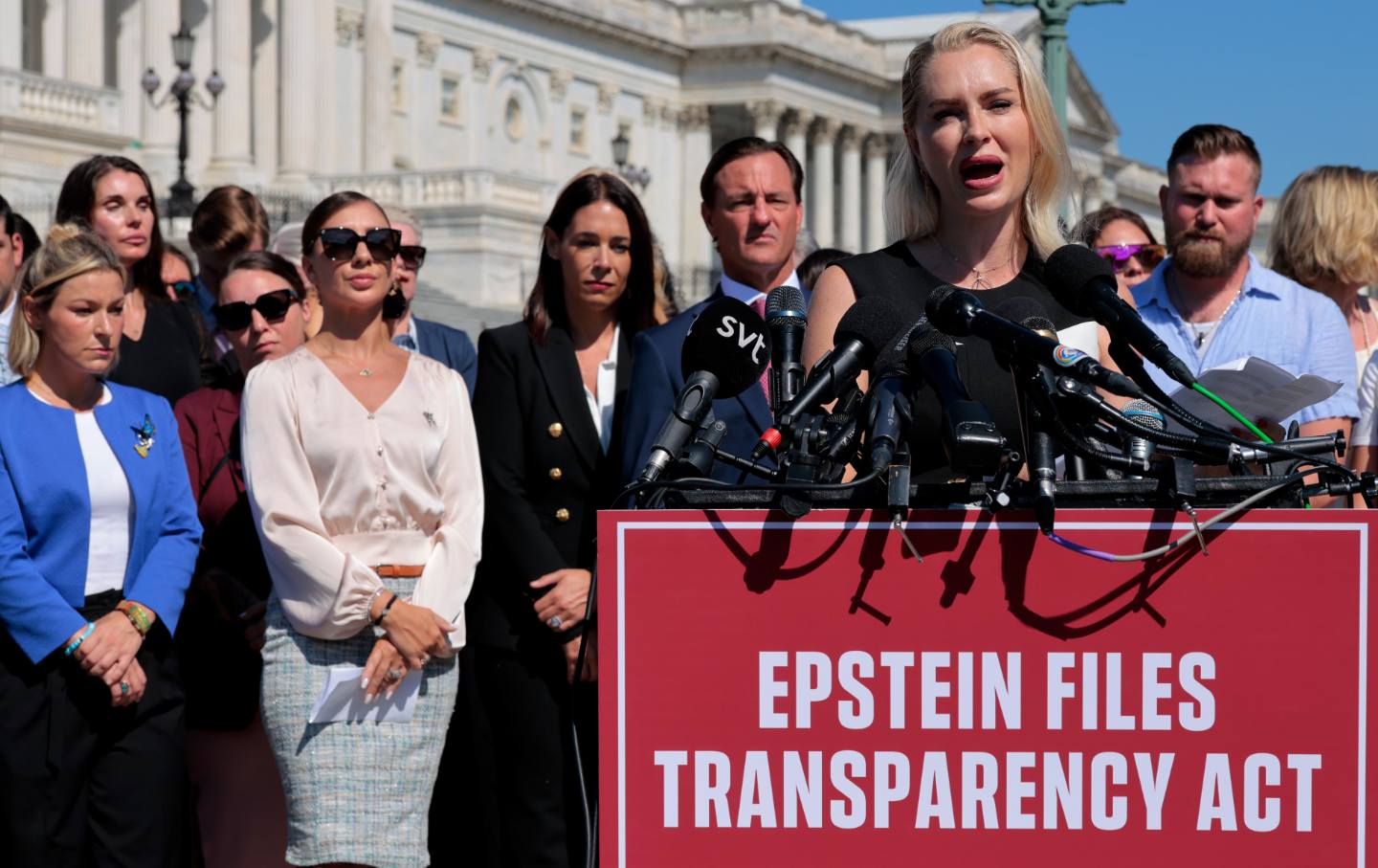
“The survivors won!” announced representative Ro Khanna (D-CA) after he and Thomas Massie (R-KY)—with a late assist from Marjorie Taylor Greene (R-GA)—secured a remarkable 427–1 vote in the House of Representatives for their Epstein Files Transparency Act. The November 18 vote was immediately followed by unanimous approval in the Senate, in a rare assertion of authority by an otherwise dismal 119th Congress. Yet instead of taking a victory lap, Khanna and Massie kept talking about what had been accomplished by the courageous survivors of the child-sex-trafficking abuses perpetrated by the late financier Jeffrey Epstein, his accomplice Ghislaine Maxwell, and their elite associates.
It is not often that members of Congress steer attention to others. But Khanna and Massie did just that. Long before the unlikely legislative partners made their bold decision to take on both Donald Trump—who had long sought to downplay his ties to Epstein—and the disinclination of both major parties to launch a political fight that was likely to reveal bipartisan wrongdoing, survivors were demanding the release of Justice Department and FBI documents and investigative materials regarding Epstein and those with alleged ties to the deceased sex offender.
These congressional votes were correctly understood as rebukes to Trump and House Speaker Mike Johnson (R-LA), who for months had used every tool in his legislative toolkit to prevent the House from considering the transparency act. Trump finally buckled, as did a grumbling Johnson, after it became clear that Khanna and Massie were not letting up—and after Democrats released a tranche of e-mails that suggested Trump had closer ties to Epstein than was previously known. The votes showed that, in Khanna’s words, “We do not have to be supplicants to Donald Trump…. [Congress] is a coequal branch of government.” By “taking on the Epstein class who have been shielded for too long,” the California Democrat argued, Congress had taken “a step toward changing our rotten system.” But that step was only possible, Khanna reminds us, because the survivors had the courage to reveal the extent of the rot and the vital importance of addressing it.
The Epstein Files Transparency Act mandated the full release of the files by December 19. But survivors are still speaking up, knowing the fight is far from over, as a group of them explained in a powerful letter, titled “What We’re Bracing For,” that we produce below.
Thanks to the bravery of survivors, advocates, and champions in Congress, we have won an important victory: the passage of legislation to release the Epstein files. But our fight is far from over. As the release of these files approaches, we want the public to understand what survivors are bracing for—and why your support is needed now more than ever.
1. Attempts to Blame Victims Instead of Perpetrators
For decades, Epstein escaped accountability by portraying his victims as “bad girls” or unreliable witnesses. We know this tactic will be used again to protect his enablers. Some of us were neglected or vulnerable children. Some were manipulated into recruiting others our own age. These were deliberate strategies used by Epstein, Maxwell, and all sex traffickers. These tactics reflect on the predators—not on us. We refuse to be blamed for the abuse committed against us.
2. Incomplete or Selective Disclosures
Aside from redacting victims’ names, we are demanding full transparency. Survivors and the public deserve access to all Epstein-related files—not selective releases designed to shield the powerful. We call on our allies in Congress and beyond to keep fighting for complete disclosure.
3. Escalating Threats to Our Safety
Many survivors have already received death threats and other forms of intimidation. We expect these threats to intensify once the files are released. We are asking every federal and state law-enforcement agency with jurisdiction to investigate these threats and protect the survivors who have come forward.
4. Efforts to Divide and Discredit Us
We are already hearing attempts to pit survivors against each other—especially through the false claim that anyone who was over 18 “wasn’t really a victim.” We reject this outright. Some of us were 18, 20, or 22 when we were exploited. Some were vulnerable due to childhood trauma or poverty. Some were assaulted using intimidation, manipulation, or force. Age does not undo vulnerability, nor does turning 18 make someone “fair game” for a pair of wealthy, calculated predators.
Epstein and Maxwell targeted girls and young women using a range of tactics, but the outcome was the same: devastation that many of us still carry today. As adult women now, we stand united—and we refuse to let anyone divide or diminish us.
Popular
“swipe left below to view more authors”Swipe →Signed by: Maria Farmer, Annie Farmer, Courtney Wild, Anouska de Georgiou, Rachel Benavidez, Jess Michaels, Marijke Chartouni, Danielle Bensky, Liz Stein, Marina Lacerda, Ashley Rubright, Sharlene Rochard, Teresa J. Helm, Lara Blume Mcgee, Sky and Amanda Roberts, Haley Robson, Jena-Lisa Jones, Wendy Pesante, and 10 Jane Does
More from The Nation

What’s It Like Inside a Data Center? What’s It Like Inside a Data Center?
Northern Virginia is laden with structures that house data for Fortune 500 companies. I went inside just one of those monstrosities that bothers its neighbors.

What Trump and Tucker Carlson Have in Common What Trump and Tucker Carlson Have in Common
Carlson has broken with Trump largely over the war in Iran. But on Ukraine and immigration, the two speak very much the same language.

The Jewish Case Against AI The Jewish Case Against AI
Haredi rabbis and the secular left agree: This technology is a threat to the entire social fabric.
The Fight for Educational Equality Is Also a Fight for a Just Supreme Court The Fight for Educational Equality Is Also a Fight for a Just Supreme Court
The court has severely weakened our ability to make an education system that fulfills the promise of Brown.
The Fall of “Scientific American” The Fall of “Scientific American”
When the beloved science publication got too political, its corporate owners stepped in. Now its future is uncertain.

The Bookstore Revolution in Taiwan’s Conservative Heartlands The Bookstore Revolution in Taiwan’s Conservative Heartlands
After Taiwan legalized same-sex marriage, gender-themed bookstores are working to build the social acceptance that the law alone couldn’t deliver.

